
3 Dems vying for Monroe County clerk nomination make contrasting cases at LWV forum
At a League of Women Voters forum Monday night, the three Democratic Party candidates for Monroe County clerk—Tanner Branham, Tree Martin Lucas and Joe Davis—provided contrasts in experience and approach.
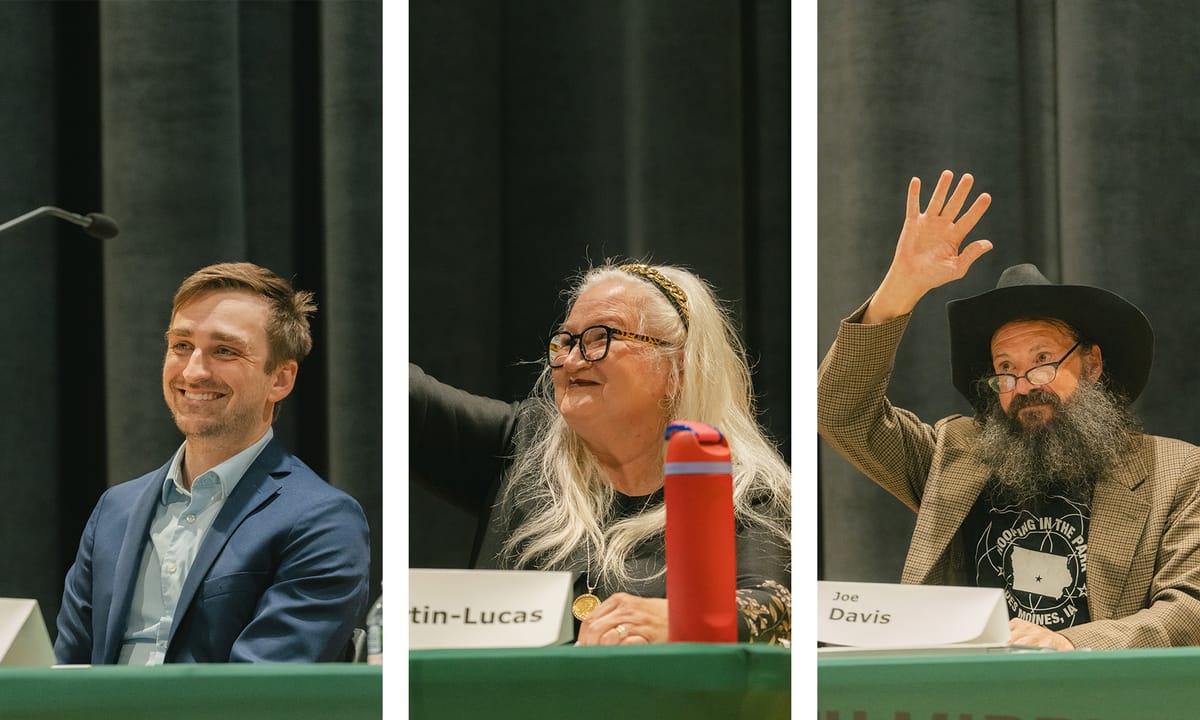
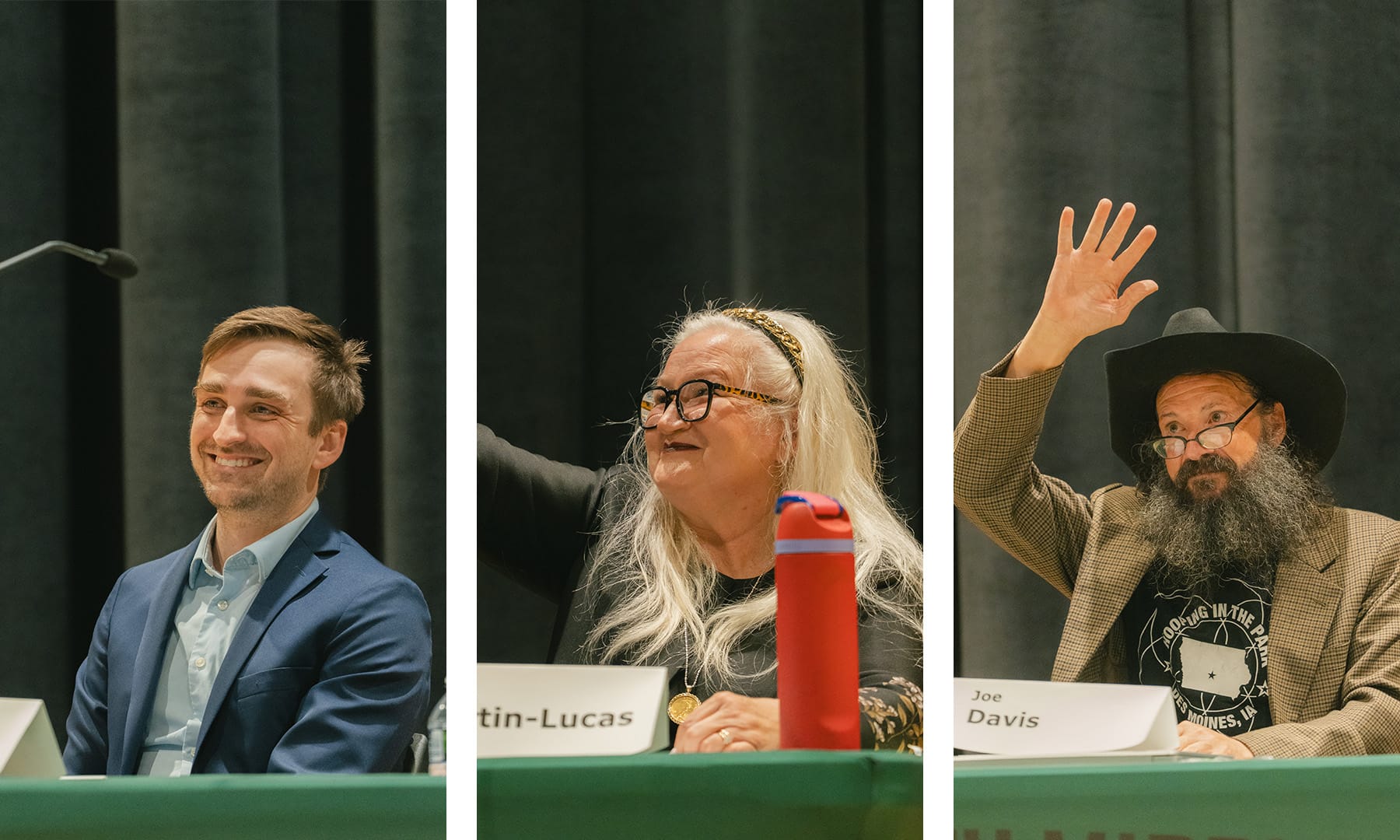
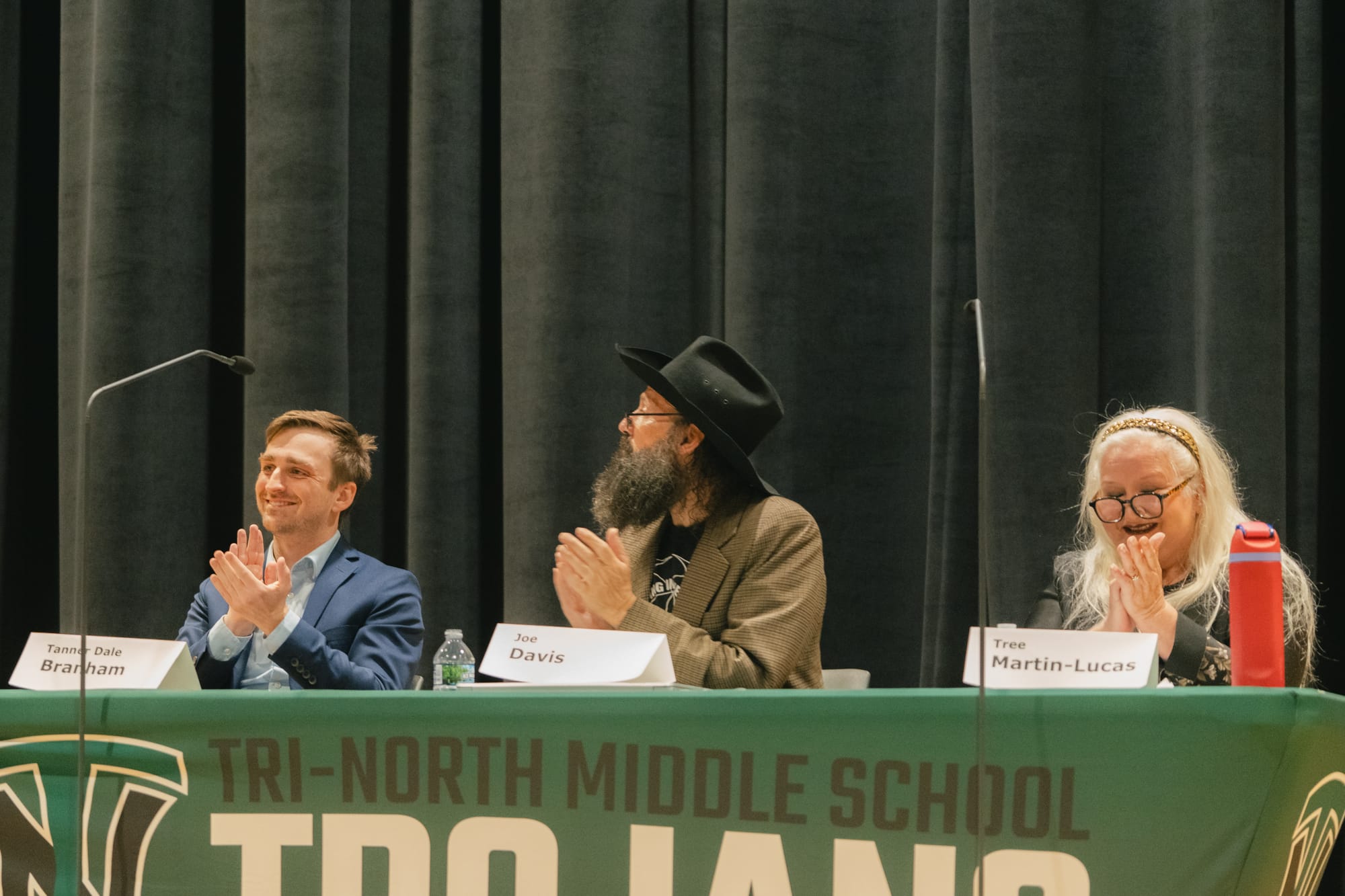
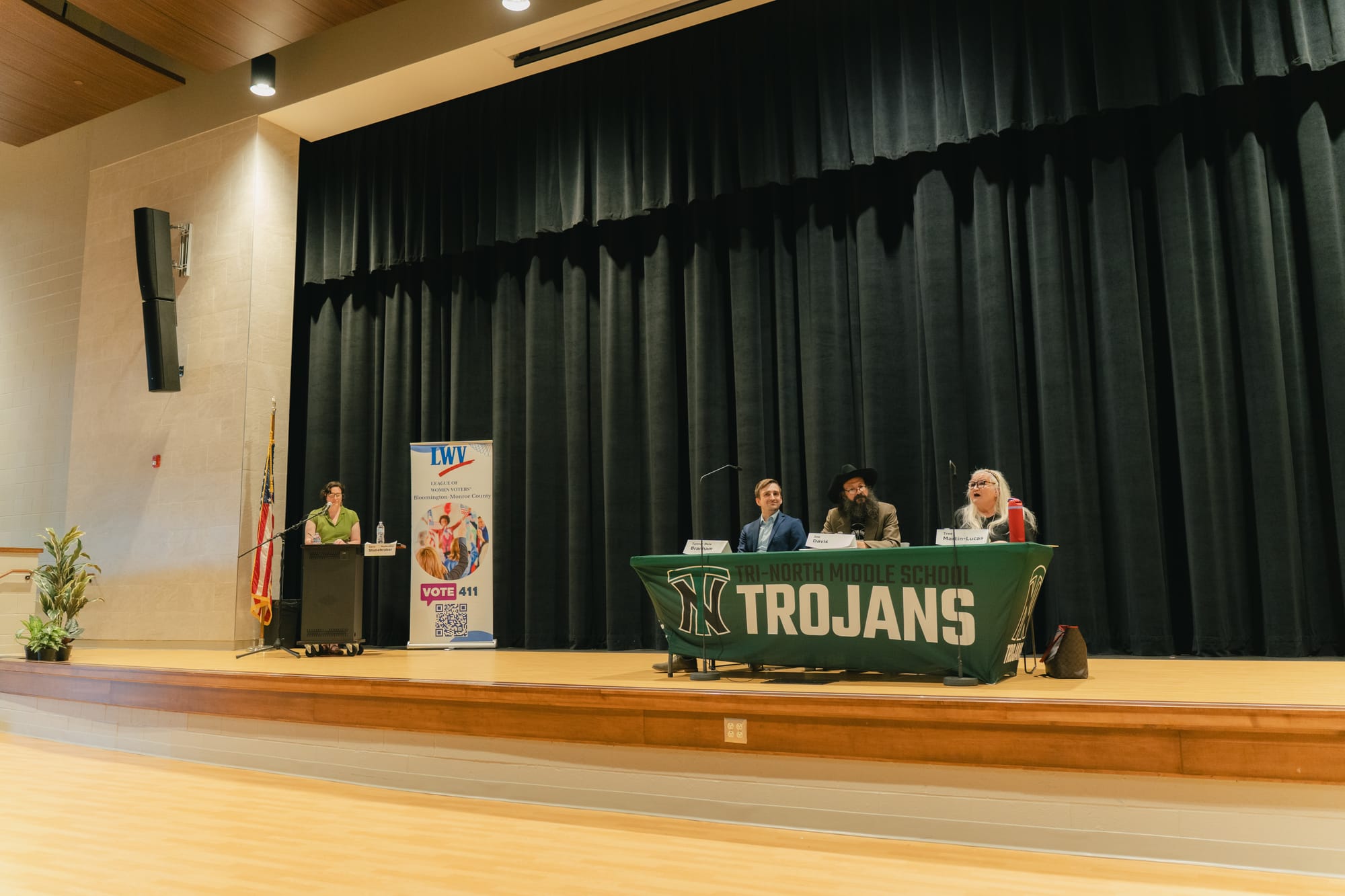
On Monday night (March 30), three candidates for the Democratic Party’s nomination for county clerk fielded questions at a forum held by the League of Women Voters of Bloomington and Monroe County. Appearing on stage at Tri-North Middle School were Tanner Branham, Joe Davis, and Tree Martin Lucas.
According to the LWV, the sole Republican candidate for county clerk, Julie Hays, was also invited.
Primary Election Day is May 5. Early voting starts on April 7. The last day to register to vote is April 6.
The contrast in candidates was evident in their job experience, and the recurring themes they stressed across many answers. But the clearest difference came over whether the law should be changed so that early voting ballots can be scanned before Election Day.
Davis said early voting ballots should not be scanned until Election Day, while Branham and Martin Lucas said it should be lawful for such ballots to be scanned earlier, to reduce time it takes to produce the results on Election Day.
Job experience
Branham was recently appointed to the position of chief deputy clerk by incumbent clerk Nicole Browne to replace Laura Wert. Browne is term limited and can’t run this year.
Branham’s first day on the job was Monday. So he was able to say during his closing statement at the forum: “I am currently the chief deputy clerk in the office, so I am currently doing the job, so that I’ll be able to ensure it will be a smooth transition, if I am to be your next clerk.”
He was previously an executive assistant with Indiana University, and before that worked at the university as a tech professional in web services support. His earliest jobs included a couple of years interning and working in the prosecutor’s office and the public defender’s office in Lawrence County, and as a substitute teacher, as a manager of Inklings Bookstore.
Tree Martin Lucas countered with several years of experience working in the sheriff’s office, and eight years of service in the clerk’s office, including some of that time as chief deputy. She said, “I’m not asking you to take a chance on me—I’ve done this work. I’ve served as both election supervisor and chief deputy, and at times I’ve done both jobs simultaneously. I know this office inside and out.”
Davis also laid claim to experience with the clerk’s office—not inside it, but as a resident to who has relied on the services of the clerk. He has represented himself in several court cases he has filed against the city of Bloomington, to appeal citations he has received over the condition of his property. He has also sought protective orders.
Davis described growing up managing farm operations, then spending his “longest career” as a builder and designer in construction, where he managed crews and brought on new crews seasonally.
Counting early voting ballots
The question from the moderator was: Under current law, ballots cast during the early voting period cannot be scanned until Election Day. Do you think earlier scanning should be allowed? And what concerns or benefits might this introduce?
Davis is opposed to any change to the state law, arguing that security and secrecy outweigh speed. About the idea of scanning ballots cast during the early voting period ahead of Election Day, Davis said: “No way, no how. Scan them on Election Day.” He warned that scanning before Election Day “puts the anonymous secret ballot component at risk,” and linked that to broader concerns about data breaches: “Just think how often we get information that our data has been compromised. We must protect this at all costs.”
Martin Lucas took the opposite view, saying earlier scanning should be allowed and can be done without jeopardizing anonymity. “I do believe we should scan early. There is no way to connect the ballot to the voter. They walk up to the scanner and they put it in, boom, it’s gone. There’s 100 other ballots there. I don’t know which one is yours.”
Martin Lucas stressed the distinction between scanning and tabulating, saying that scanning the ballots doesn’t tabulate them. She described how it’s possible to find a ballot cast by someone who dies after voting during the early election period, and extract it, all without compromising the secrecy of the votes cast by the person. The reason such ballots have to be pulled out is because of Indiana’s “dead voter law” which says that a person must be alive on Election Day for their vote to count. Martin Lucas summarized the law like this: “You have to live in the state of Indiana to vote, and if you’re dead, you’re not living.”
Tanner Branham supported the idea of scanning ballots cast during the early voting period before Election Day, but also said, “It is an issue that I want to do more research on.” The obvious benefit, he said, is that the results of the election are known faster. ”
Recurring themes: Branham as Democrat, technologist
A common thread through several of Branham’s responses were his Democratic Party ties and his work in connection to the party, as well as his experience with technology.
He wrapped up his opening statement by saying, “I’ve been a dedicated Democrat my entire life, and I’m very excited to ensure that we have the best elections possible …”
Later, when the moderator asked if it was the clerk’s role to increase voter registration and turnout and how he would do that, Branham pointed to his current partisan role: “I am currently the chair of the Monroe County Young Democrats,” he said, stating he has been “tabling at every possible event we can to get young people engaged with politics and registered to vote.”
As clerk, Branham said “I hope to do a lot more voter outreach, especially using modern tools, modern technology … Social media, obviously, that’s where people are, and that’s how you have to reach them these days, if you want to get people involved.”
Responding to a question about ethics and transparency, Branham made technology a part of the answer: “I want the office to be as transparent as possible. I want our data to be accessible online, easy for people to find whenever they need it.”
Responding to a question about management experience, Branham pointed to his experience managing volunteers on campaigns. Branham worked on Monroe County sheriff Ruben Marté’s campaign as well as Monroe County commissioner Jody Madeira’s campaign.
Responding to a question about why they felt a need to run, Branham said, “I’ve been a dedicated member of our Democratic Party,” but said he’d been a “a little back and forth” about running for office himself. When he asked around with party sources about who might be planning to run to replace the term-limited incumbent, Nicole Browne, said, “there was just nobody else who really seemed like they’re going to step up.”
In his closing statement, Branham said, “I’m running for clerk because I am a qualified individual. I’ve been a passionate supporter of our Democratic party.” He added, “I have a lot of experience working with technology, and technology is more important now than ever, and that’s the kind of experience that we need in the clerk’s office.”
Recurring themes: Martin Lucas focusing on people
The big theme of Martin Lucas’s campaign emerged in her opening remarks, when she said “The clerk’s office isn’t political, it’s personal. Let me say that again, the clerk’s office is not political, it’s personal. It’s about people.” She added, “Every person who walks through those doors deserves respect, kindness and professionalism.”
When the moderator asked how candidates would allocate their time and effort across the many functions listed on the clerk’s webpage, Martin highlighted the people who need the services of the office: “My goal is to communicate with my people, but also listen to the people that come into the office. They’re not in familiar territory. We are. The main goal I have is to listen, and I will truly listen.”
Martin Lucas said supervising a large number of people comes naturally to her. When she served as chief deputy clerk, she supervised about 40 people in the office, and when she served as election supervisor, during the election season that number would rise to 250 to 300. A key point from Martin Lucas was that “people are not disposable.”
It was a reminder that when Martin Lucas resigned from the job as chief deputy clerk in 2023, she cited as the reason differences with county clerk Nicole Browne over how to treat employees. In early 2023, departing election supervisor Karen Wheeler told The B Square that her departure was voluntary, but only in the sense that she had resigned the position. Wheeler added that she’d been given a choice by Browne—either resign or be “let go.”
In the 2022 general election, more than 6,000 votes were not included in the initial tally, which made some races a lot closer than they would have been, and in a couple of township races, flipped results.
At Monday’s forum, Martin Lucas said everyone has bad days, and if underperformance becomes a habit that needs to be addressed, the answer is “corrective training,” not firing. She underscored that when someone walks out the door, “there goes knowledge, institutional knowledge. You can’t replace institutional knowledge.”
Responding to a question about how candidates would support women, LGBTQ+ people, and marginalized genders in Monroe County, Martin Lucas made it personal: “If you need someone to stand with you, I will. If you want to get married, I do those marriages.”
Recurring themes: Davis helping disempowered people
Responding to questions from the moderator, Davis often took the perspective of people like himself, in the legal actions he has initiated, who don’t have anyone to advocate for them.
Davis put it like this: “The question becomes, who will bring you—the pro se individual, the individual who’s not an attorney—the ability to find your power, to take your action, to get it filed.” Davis’s answer: “I am the one who is going to bring that to you.”
Describing his supervisory experience, Davis said, “People have their own strength and confidence in their abilities, and one fosters independence and gives them some leeway such that they can be the captain to make decisions appropriate to them.”
In response to a moderator’s question about whether it’s the clerk’s role to increase voter registration and turnout, Davis framed the issue less as a numbers problem and more as a question of personal empowerment. He said that democracy “requires the maximum accessibility to every voter,” and argued that accessibility “can unlock that individual and turn them from a victim who thinks that they have no control over their life to the point where they are powerful, and maybe it starts with only one vote.”
That one vote could become a “launch pad for them to do other things,” Davis said. He added, “If we become a community of powerful people, then we can change our community for the better, much more easily, because especially when this happens, partisan politics all fall away—because … it’s your neighbor, your friend and your family member that is important.”
In response to a question about how he’d support women, LGBTQ+ people, and marginalized genders, Davis focused on self-help, calling for more legal help kiosks around Bloomington—not just at the public library and the justice center, but also in places like the courthouse and city hall—so that “people can help themselves” when they have access to tools and information.
Links to LWV Vote411

Comments ()