
3 MCCSC board incumbents to run unopposed in 2026
Three MCCSC board seats are up for election in 2026, and all three incumbents—Erin Wyatt, Ashley Pirani and Aja Jester—are running unopposed. District 7 briefly had a challenger, but Cole Pospisil withdrew after Hatch Act concerns tied to Indiana’s new school board party-label law.
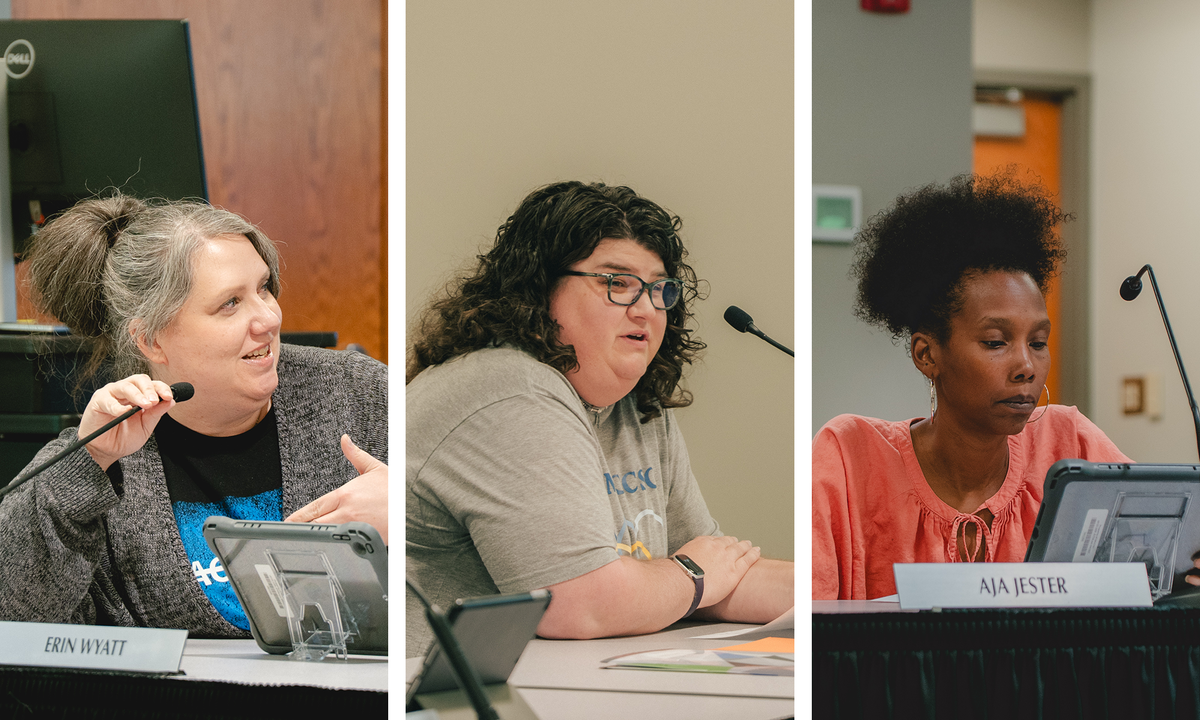
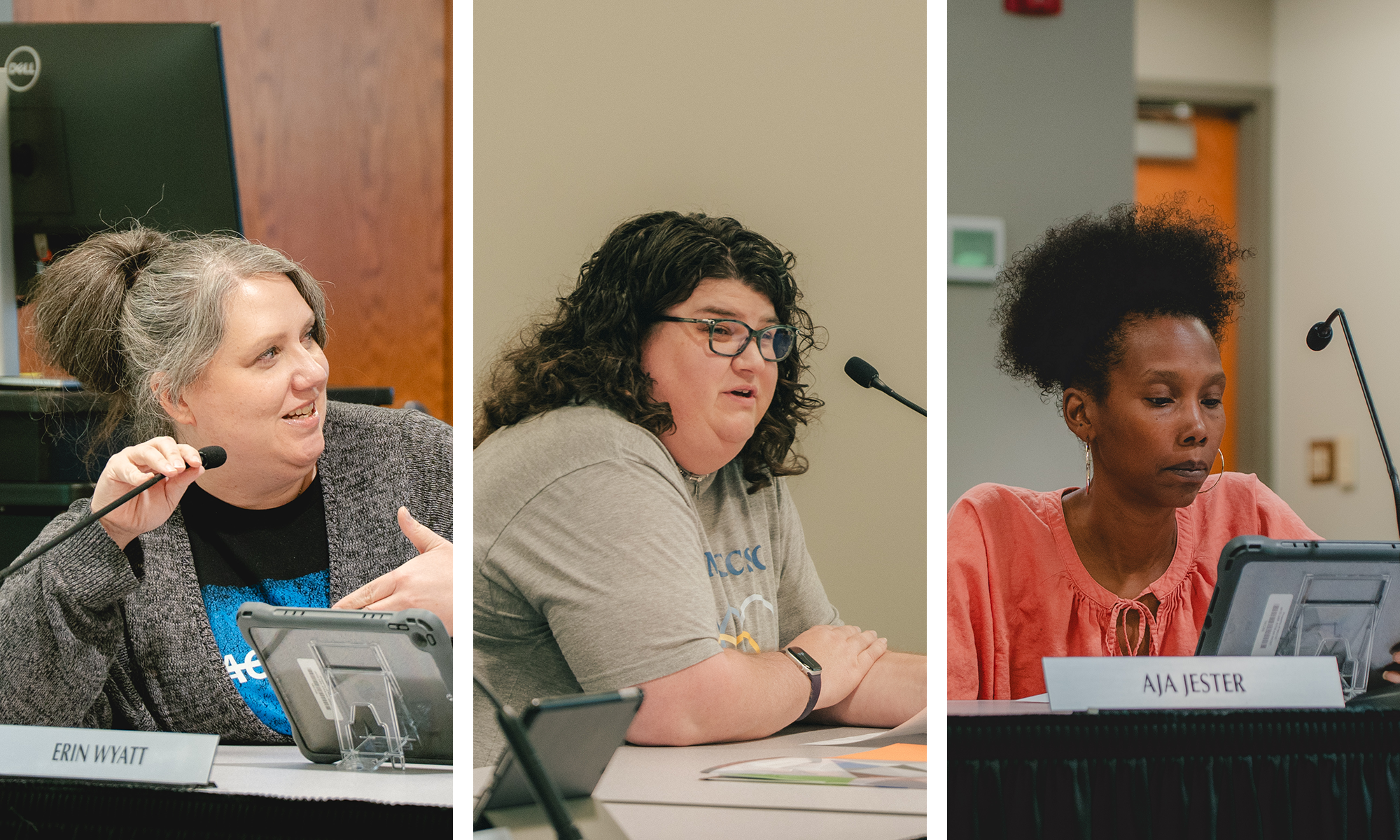
This year, three of the seven Monroe County Community School Corporation (MCCSC) board seats are up for reelection. The incumbents are all running unopposed.
That’s even after District 7 looked briefly like it would have a contested race. But the declared candidate, who would have contested the seat with incumbent Aja Jester, withdrew in connection with the Hatch Act. The federal law prohibits federal employees from participating in partisan political contests, which Indiana school board races now can be, because of a new state law enacted in 2025.
Besides the one for District 7, MCCSC board seats for District 1 and District 3 are up for election this year. In addition to Jester, the board members with four-year terms ending this year are Erin Wyatt in District 1 and Ashley Pirani in District 3.
The other four seats are not up for election this year. Elected in November 2024 and serving through 2028 are April Hennessey in District 2, Tiana Iruoje in District 4, Erin Cooperman in District 5, and Ross Grimes in District 6.
The deadline for declaring candidacy was June 18. The deadline for a candidate withdrawing is July 15.
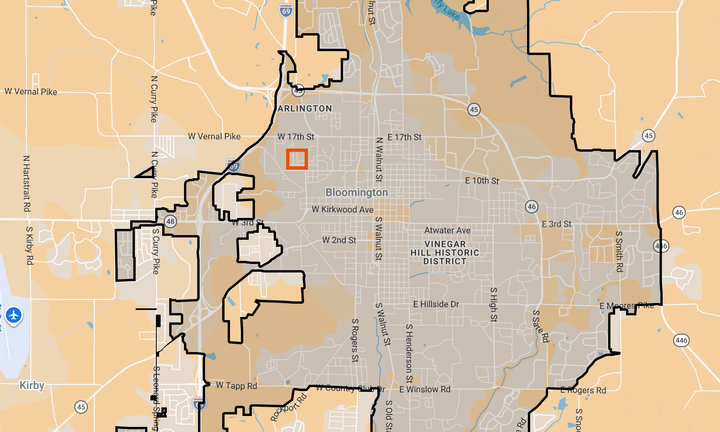
MCCSC board residential districts: map | text descriptions.
The three incumbent candidates are running without a stated party affiliation.
District 1: Erin Wyatt
Currently representing District 1 and seeking reelection on the school board is Erin Wyatt. She has served on the board since 2023. With about 51% of the vote, she won a three-way race in 2022 that included Tabetha Crouch and Byron Turner.
Responding to emailed questions from The B Square, Wyatt said that her time so far on the board has been “educational.” She wrote, “The first half or so of my first terms really was about fully understanding the roles and responsibilities of being a board member. I’d also consider my time to be fairly dynamic. We’ve seen several big changes in a relatively short amount of time.”
Wyatt said she’s seeking reelection because of challenges MCCSC—and other school districts in Indiana—are facing, including changes to public school funding and patterns of enrollment decline. She continued, “MCCSC is very important to me, and [I] hope that my continued presence on the board will limit disruption. I feel the board is currently made up of folks who are very dedicated to ensuring that MCCSC will continue to be successful and thrive even in the face of all the challenges we are anticipating, and I don’t want that to change.”
Wyatt said her goals for the board’s future are the same as the corporation’s: “achieve fiscal balance, facilitate academic success and excellence, and ensure the health, safety, and well-being of the students and employees.”
District 3: Ashley Pirani
Before publication, The B Square was not able to reach Ashley Pirani, who currently represents District 3. Pirani has served on the board since 2023. With about 46% of the vote, she won a three-way race that included Jon Hays and Daniel O’Neill. She currently serves as board secretary.
District 7: Aja Jester
Aja Jester was appointed to fill a vacancy for District 7 when previous board member Brandon Shurr resigned in March of 2025. Jester was sworn in at the April 22, 2025 school board meeting.
Responding to emailed B Square questions, Jester said her time on the board the past 14 months has been “a period of learning and growth.”
She wrote, “When the seat I now hold became available, school board was not on my radar. It was the encouragement of my community that ultimately made me decide to even put my name out there.” She said the trust and support of those community members have empowered her. “It is for those people that I have spent this time and effort learning and growing,” she said, “in order to be an effective representation of those you don’t often see in these positions.”
“My goal in this role is to support the administration in efforts to accomplish the MCCSC mission statement for every student,” Jester wrote. The district’s mission is: “Empowering students to maximize their educational success to become productive, responsible global citizens.”
“The decisions that we make as a board are critical in making sure that our policies and financials allow for this to be possible,” Jester said. “Core to who I am are the beliefs that every perspective has value and that compromise is possible.” She said her goal is to “show up ready to listen and work toward solutions that benefit the entire community.”
District 7: Almost contested
One other candidate filing was made for the District 7 seat, by Cole Pospisil. He declared himself an Independent in his paperwork. However, he withdrew his candidacy on Thursday (June 25). In an email to The B Square, he said his withdrawal was “due to new guidance on the interaction between SEA 287 and the Hatch Act.”
The Hatch Act of 1939, titled “An Act to Prevent Pernicious Political Activities,” is a U.S. law that restricts political activity that employees in the federal executive can engage in. Section nine of the law bars federal employees from running in partisan elections. It states: “No officer or employee in the executive branch of the Federal Government, or any agency or department thereof, shall take any active part in political management or in political campaigns.”
Pospisil is an employee at Naval Surface Warfare Center (NSWC) Crane Division, which is a U.S. Naval base.
In Indiana’s 2025 legislative session, governor Mike Braun signed Senate Enrolled Act 287 into law, which gives school board candidates the option to state a political party affiliation, run as an independent candidate, or not to identify with a political party.
Before SEA 287 was passed, school board elections in Indiana were strictly non-partisan—no candidates were identified by political party. That meant the Hatch Act was not a barrier to federal employees participating in Indiana school board races.
After SEA 287 was passed, it became an open question whether the optional nature of a party label in a race made a school board race “political” in the sense of the Hatch Act.
According to a guidance document from the Indiana School Boards Association about the law, The U.S. Office of Special Counsel has advised that “a federal employee could file a petition of nomination, declaring no party affiliation, for that particular seat and have his or her name appear on the ballot if no other candidate files a petition or all candidates who file a petition for the same seat have also declared no party affiliation.”
If Pospisil had declared no political party affiliation, he may have been in compliance with the Hatch Act. However, he wrote to The B Square: “The problem is that a non-partisan race can become partisan with regards to the Hatch Act if a candidate is endorsed by a party or national group either explicitly or implicitly.”
Pospisil continued, “So the fact that Aja and I did not declare with a party means that me filing was not a violation, but should there be any coordination then I would have to withdraw to not be in violation.” However, he said any “coordination” or implied endorsements of a candidate by a political party could make the nonpartisan race effectively partisan. “[T]he line for coordination is not clearly delineated,” he said.
“In summary,” Pospisil wrote, “there is a pathway where a campaign can be run that does not violate the Hatch Act, but it requires every candidate to act in a very specific way (including those with no incentive to act that way), and that felt too precarious for me.”

Comments ()