
After lockout, Monroe County women’s commission meets on ‘Women in Government Plaza’
A properly noticed meeting of the Monroe County women’s commission was nearly thwarted when members found the courthouse locked and were denied their usual room—over a calendar error. They met outside instead. County officials have pledged that it won’t happen again.
On March 19 at 5:30 p.m., members of the Monroe County women’s commission arrived for a legally advertised public meeting at the historic county courthouse and found the building locked.
After being let inside, they were told they could not use their regular meeting space, which is the Nat U. Hill room, because their meeting was not on the county’s digital calendar. The Nat U. Hill room is the same place where the county commissioners and the county council meet.
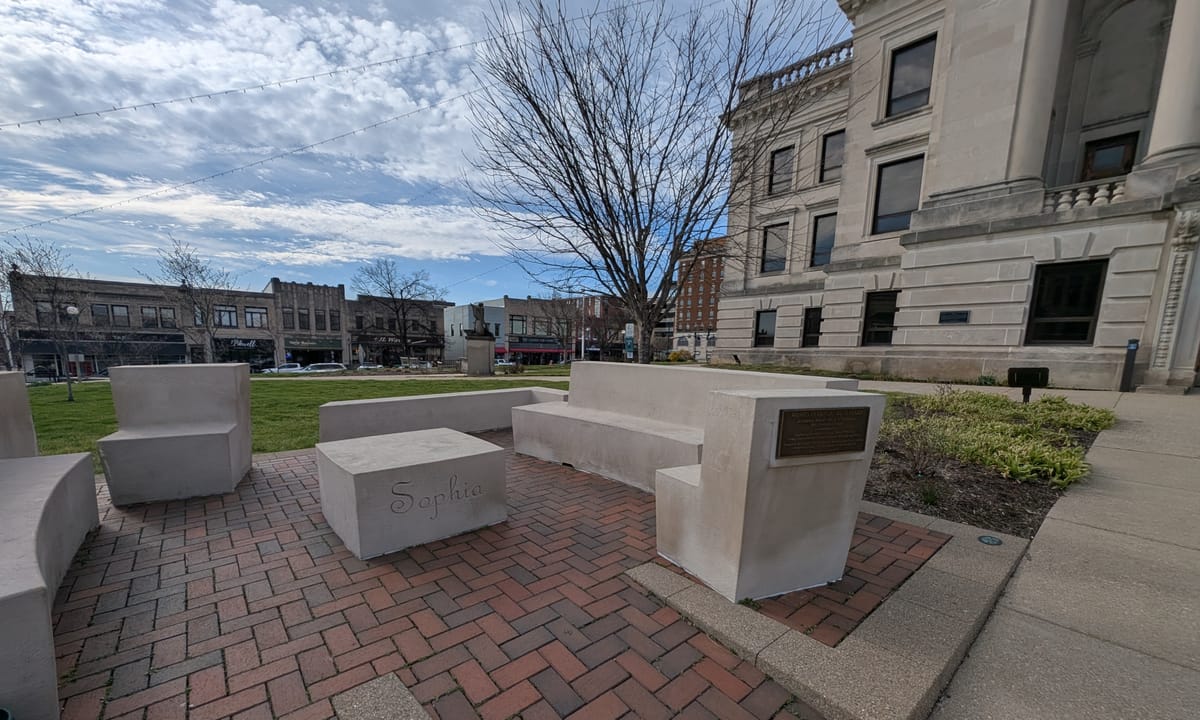
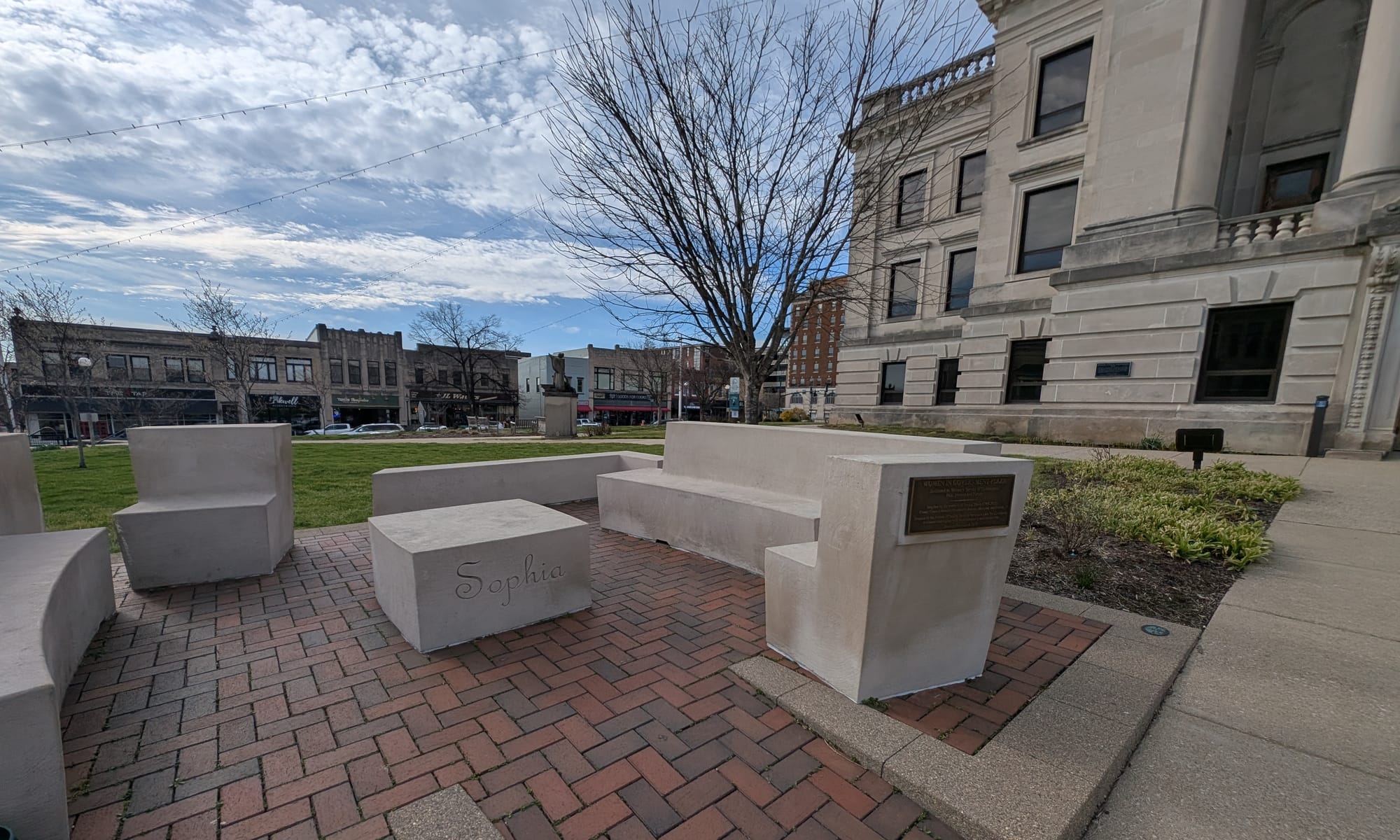
The group managed to hold its regular monthly meeting anyway—in a location that framed the incident with some irony. They met outdoors on the small plaza south of the courthouse, where limestone benches were installed in 2015 in part to commemorate the late county councilor, Sophia Travis.
The literal name of the plaza is more general: “Women in Government Plaza.” The plaza is dedicated to “women’s service in government, past, present, and future.”
Monroe County officials say they will review internal procedures and have given assurances that such a locked-door situation won’t happen again.
The lockout incident got some airtime at Tuesday night’s (March 24) meeting of the county council.
From the public mic, women’s commission president Susan Hingle briefed councilors on what happened. The meeting had been properly noticed under Indiana’s Open Door Law, but when members of the commission arrived, the building was locked; after they were let in, they were told they could not remain in their regular meeting room because the meeting was not on the county’s internal calendar. With a quorum present and the meeting properly noticed, the commission chose to meet outside on the benches of the “Women in Government Plaza.”
Hingle told the council the episode highlighted “the fragility of the systems that support boards and commissions.” She stressed the commission had followed the law and still could not rely on basic access to a public meeting space
Women’s commissioner Maria Douglas followed Hingle by linking the lockout to a longer pattern where the commission has been “largely underutilized,” even as commissioners attend meetings, participate in justice reform work, and develop tools like a gender‑equity rubric meant to help evaluate the impact of county policies on women and marginalized genders. The gender-equity guidelines were presented to the Monroe County commissioner by women’s commissioner Julie Hardesty on March 12.
Both Douglas and Hingle asked county officials to tighten internal processes so a properly noticed public meeting cannot be displaced by a calendaring error, and to more clearly affirm that logistical support—room access, calendaring, coordination—is a core obligation, not an optional courtesy.
County attorney Molly Turner‑King told councilors that the county’s technical services department had acknowledged the incident as an oversight.
Turner-King said confusion arose partly because most boards and commissions adopt an annual meeting schedule that staff then load into the county calendar; the women’s commission had not yet adopted such a schedule for the year. Turner‑King framed that as context, not a criticism of the commission.
Council president Jennifer Crossley pressed the question of whether anyone had explicitly apologized. Turner‑King said she believed county commissioner Jody Madeira had contacted the commission that night but did not have full details. Madeira is the county commissioner ex officio member of the women’s commission.
Addressing the members of the women’s commission at Tuesday’s meeting, Crossley said:
And we want you all, because we have council appointments as well, want to make sure that we have an understanding that we don’t want you all to feel like this is something that is completely intentional. And being a liaison to the boards and commission or the women’s commission before, and seeing some of the past history. We don’t want to make you all feel that way at all, and I hope you all hear the sincerity and our voices that you know we will work to rectify the situation.
Commissioner Jody Madeira then weighed in remotely via a Microsoft Teams connection, to give an assurance that what unfolded last week would not happen again:
And just to confirm yes, it was very, very unfortunate—it will definitely not happen again. We don’t want any commission to feel disparaged. We don’t want anyone to show up and feel that their time was wasted. And it was very unfortunate. I could not attend that meeting, since I was on the road. And for the meeting, it was absolutely properly noticed, and we will absolutely get to the bottom of what happened and make sure that that does not happen again.
During the period for county councilor comments towards the end of the county council meeting, councilor David Henry used the incident to raise broader concerns about how Monroe County treats its boards and commissions. He said, “It sends the message that this work is optional or incidental, rather than an essential part of county governance.” Henry pointed to problems with other bodies, noting the Emergency Management Advisory Council (EMAC) had twice failed to reach a quorum and had not held a formal meeting since October last year.
Henry also said he’d reviewed the profile of county board and commission appointees, which he said showed that boards and commissions are “mostly white, mostly over the age of 65, mostly men, and mostly people that own houses … [worth] half a million dollars or more.” In that context, Henry said, it is especially troubling if a more diverse body like the women’s commission feels sidelined.
The Monroe County women’s commission typically meets on the third Thursday of the month.
Comments ()