Amplify Bloomington launched as ‘civic platform’ for innovation, with Fernandez at the helm
Amplify Bloomington debuted as a 'civic platform' uniting The Mill, the Trades District, Indiana University, city government, and major employers under one strategy. Led by former mayor John Fernandez, the effort aims to coordinate startups, talent, space and capital.
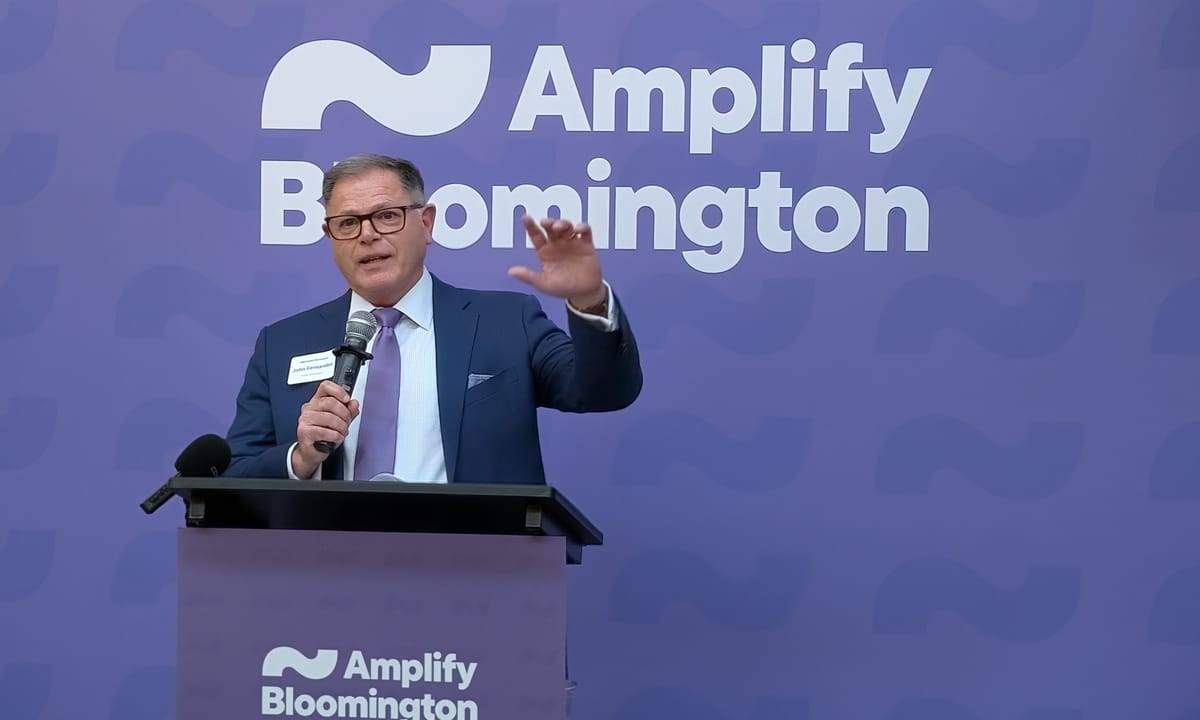
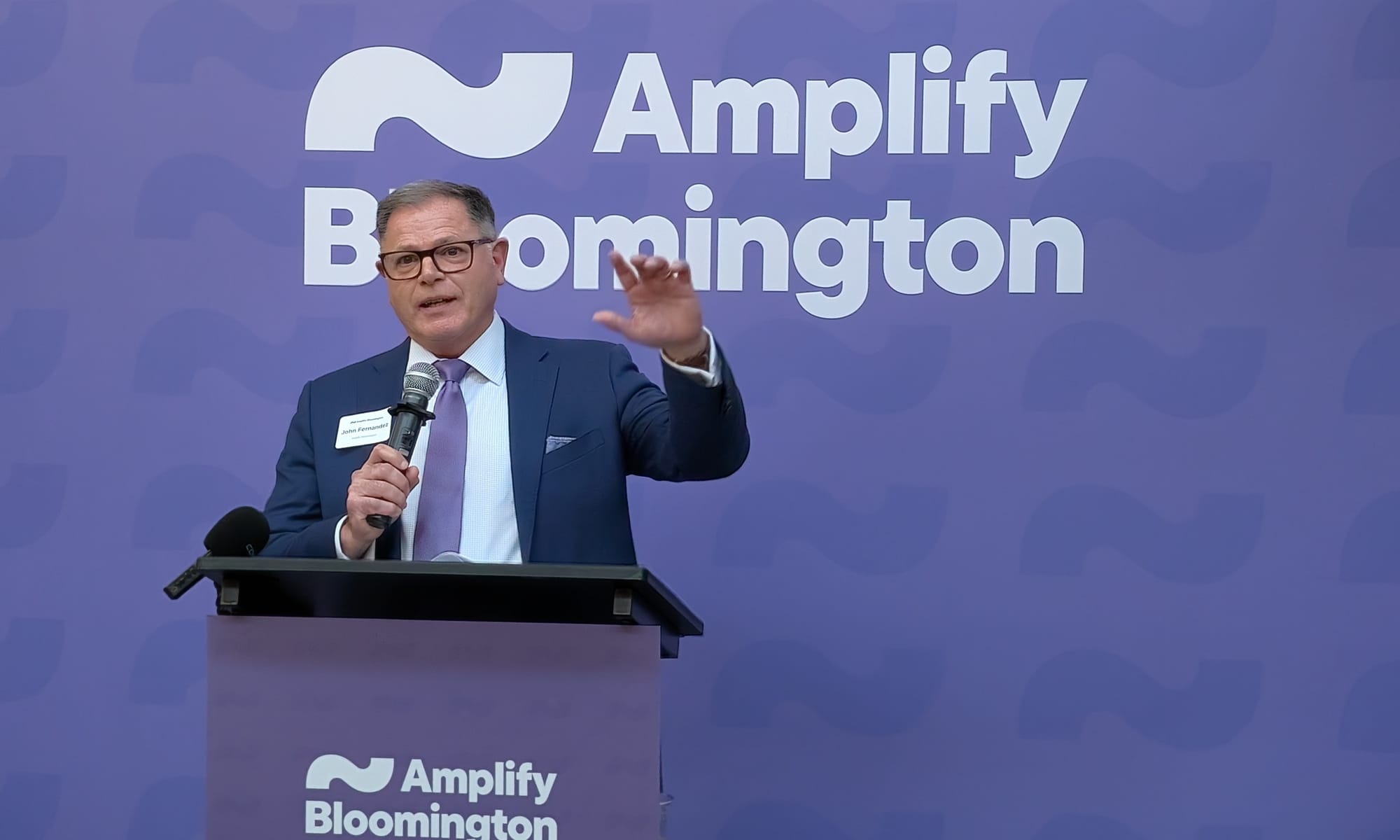
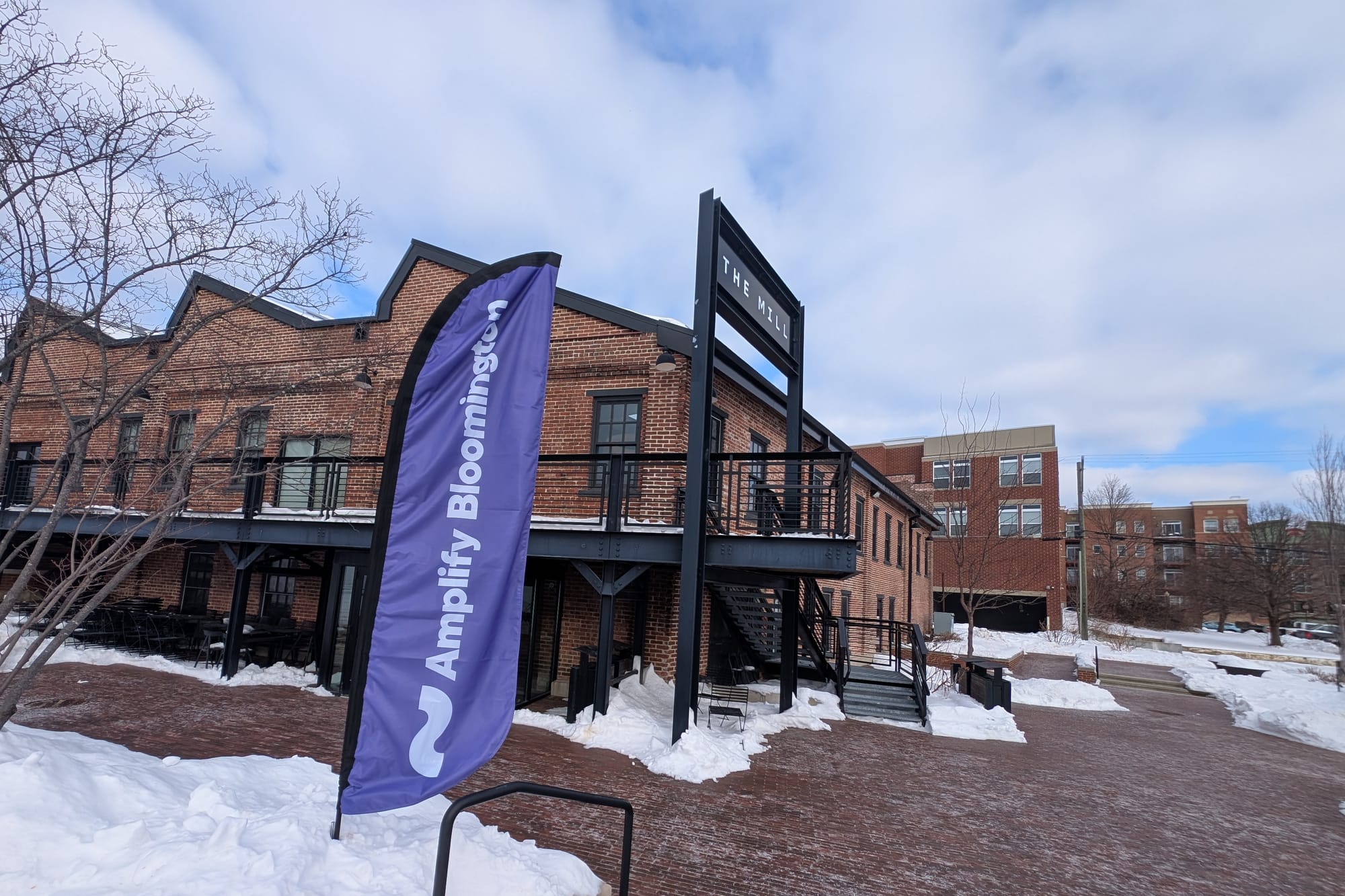
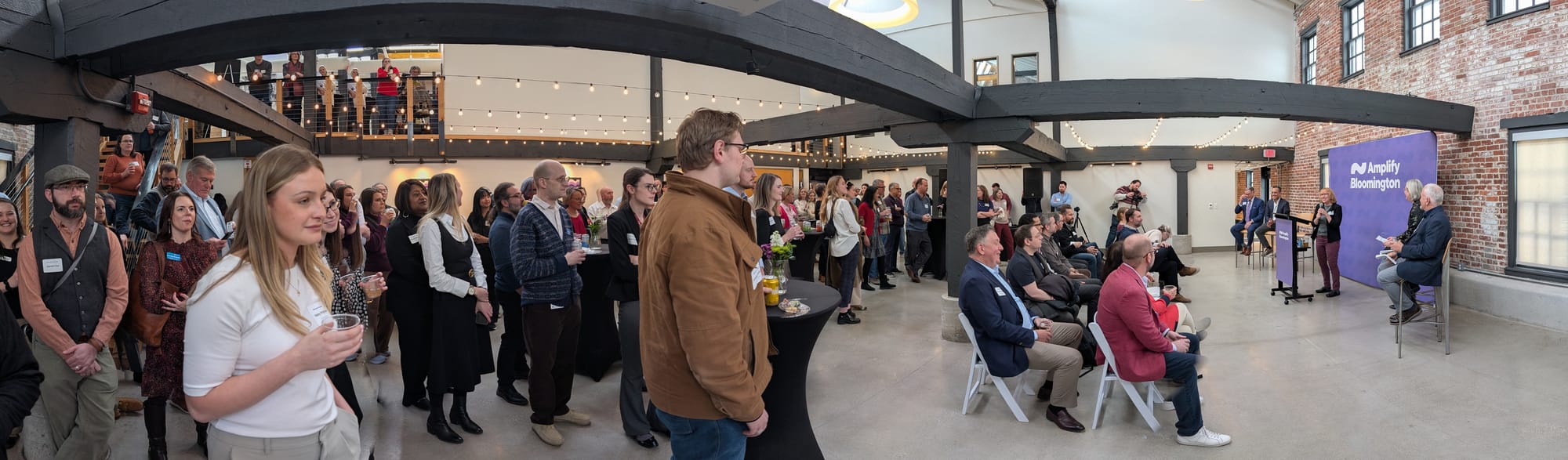
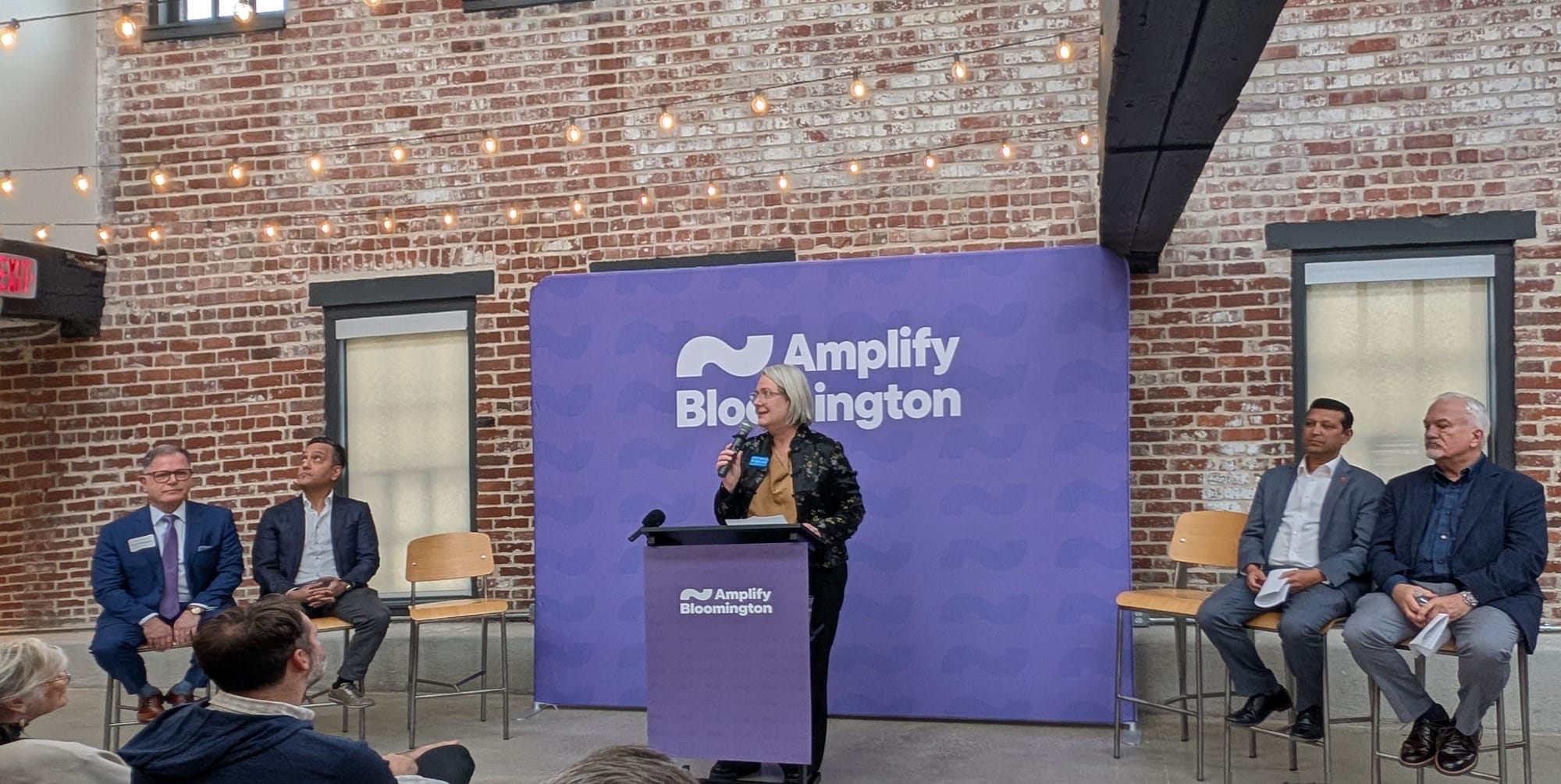
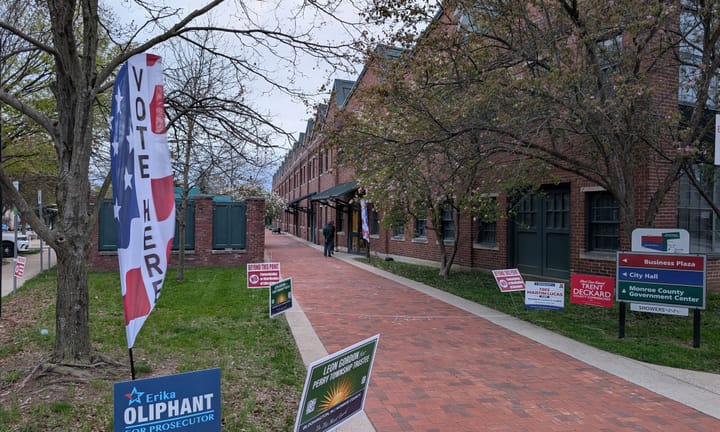
Left: CEO of Amplify Bloomington, John Fernandez addresses the crowd inside The Mill for the launch of the new 'civic platform.' Right: The outside of the The Mill in the Trades District with "Amplify Bloomington" banners. (Dave Askins, Feb. 4, 2026)
What began seven years ago as The Mill, a co‑working hub in a refurbished historic factory building, has now been formally re‑cast as the centerpiece of a broader “civic platform” that pulls together Bloomington’s major “innovation assets” under one umbrella.
That platform is Amplify Bloomington, led by former Bloomington mayor John Fernandez, who says the move is about “scaling” what already works and aligning institutions around a shared economic and community agenda.
The launch event for Amplify Bloomington was held on late Wednesday afternoon (Feb. 4) at the old Showers Brothers dimension mill furniture factory building, in the meeting event space on the south end of the building. That is the space planned to be renovated into additional work area, using part of a $16-million grant from Lilly Foundation that was announced in August 2024.
The institutions and the innovation assets to be aligned through Amplify Bloomington include: the members of The Mill co-working space, who will automatically become members of Amplify Bloomington; the companies who are tenants at The Forge, the 3-story 22,000-square-foot technology center that opened across Madison street from The Mill in late 2024; the Trades District generally, which is a 12-acre portion of a larger area that forms Bloomington’s certified technology park; Indiana University; research engine and talent pipeline; the city of Bloomington; major employers like Cook Medical; Regional Opportunity Initiatives (ROI) Indiana; the Bloomington Economic Development Corporation (BEDC); and the Greater Bloomington Chamber of Commerce.
Fernandez said Amplify Bloomington will operate across three main areas: innovation support; strategic business attraction; and cultural activation.
“The Mill, the building, is still the Mill,” Fernandez said in an interview with The B Square after the launch event. The building on Madison Street will still be known as The Mill—the metal letters on the top of the building aren’t coming down. But the corporate and strategic identity behind it has changed, Fernandez said.
The roots of the idea could be traced to a $400,000 contract that was awarded to The Mill by Bloomington’s redevelopment commission (RDC) in 2023 to “advance the City’s objectives for the Tech Center, Trades District and Bloomington’s innovation ecosystem…”
In corporate terms, on Dec. 19, 2025 the paperwork was filed to make Amplify Bloomington the assumed business name of The Dimension Mill, Inc. which was incorporated as a nonprofit in 2017.
Bloomington, Fernandez told the group at the launch party, is at “an inflection point.” He recalled his time running the federal Economic Development Administration and later advising cities worldwide at the world’s largest law firm. “I worked with cities that are three times as big as Bloomington that would give anything for what we have,” he said. “I worked with cities half the size of Bloomington that were outperforming Bloomington.” The difference, he said, is not the size of the resource base, but the shared mindset and willingness to refuse “self‑imposed limitations.”
“We’re competing for people—people who could build careers anywhere but choose here, because Bloomington offers something rare: the ability to be ambitious without sacrificing connection,” Fernandez said. “We’re trying to create a platform where institutions coordinate instead of compete. We have a moment—and this moment won’t last forever. Momentum is fragile. Windows of opportunity close.”
For most people, Fernandez said, the practical on‑ramp to the new platform will look something like joining The Mill did—joining Amplify Bloomington as a co-working space doesn’t mean renting a desk, but rather joining a community. The community that people are joining is just much bigger. Visitors to the website will be able to start with a simple need—“I need space”—and be routed to desks, offices, or other options in The Mill, The Forge, or elsewhere in the Trades District, Fernandez said.
Asked about fears that Amplify Bloomington could be seen as an effort to compete with the Bloomington Economic Development Corporation, Fernandez rejected that idea. BEDC, he said, plays a critical role in business retention, expansion, and attraction—the traditional economic development work that “goes hand in glove” with an innovation‑forward, entrepreneur‑centric strategy. Large employers connected to BEDC, he added, need stronger ties into the startup and innovation world, and Amplify Bloomington is intended to provide those bridges.
Also delivering remarks at the launch event ahead of Fernandez were: Bloomington deputy mayor Gretchen Knapp, on behalf of mayor Kerry Thomson and the city of Bloomington; Rahul Shrivastav, Indiana University provost; Dan Peterson, vice president of industry and government affairs for Cook Medical Group; Chelsea Sanders, CEO and founder of Blue Line Media (remarks read in absentia by Michelle Cole, partner at Paragraph); and Ravi Bhatt, CEO and founder of Folia.
At its core, Fernandez described Amplify Bloomington as an effort to “sell a belief” that the community can match its ambitions to its assets. “We have to believe that we can do this and then act on it,” he said from the stage. “Welcome to Amplify Bloomington. Let’s build something worth staying for!”
Photos: Amplify Bloomington Launch (Feb. 4, 2026)
Comments ()