
Analysis: New House map would reduce compactness, reshape Indiana’s political geometry in GOP’s favor
HB 1032, set for hearing Tuesday, would redraw Indiana’s congressional map mid-decade under pressure from President Trump. The proposal drops compactness scores by half and permits precinct-splitting for 2026. Starting the bill in the House will force Senate Republicans to take a make-or-break vote.
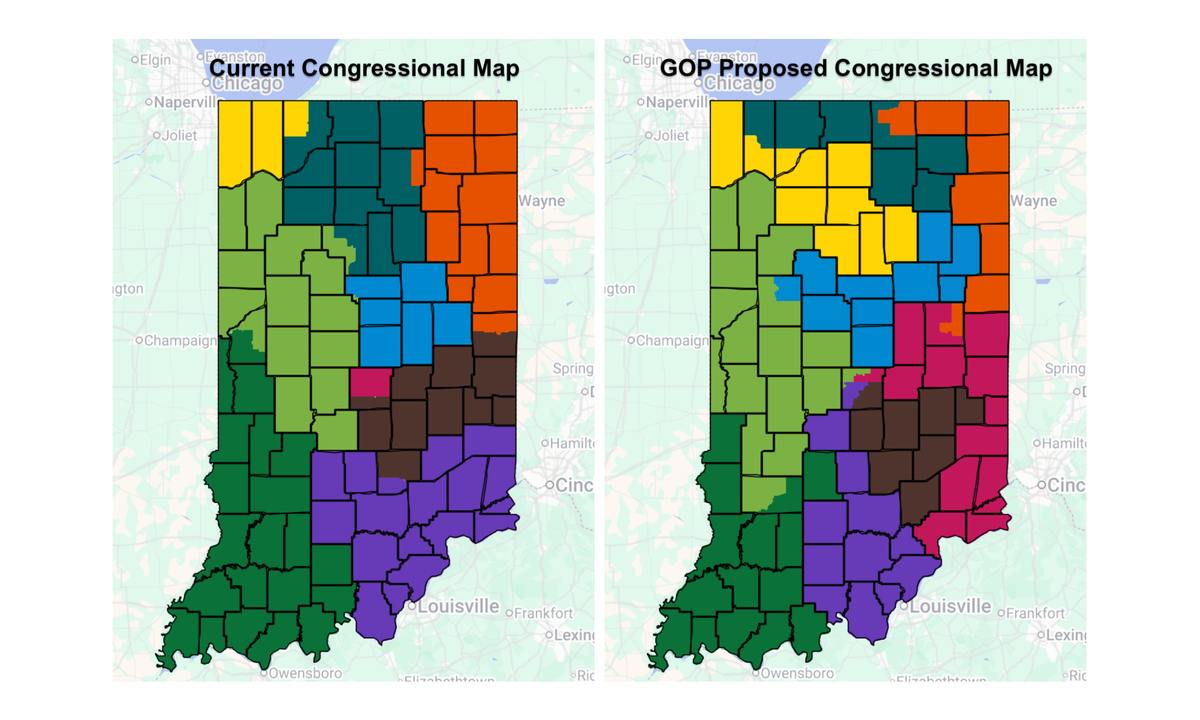
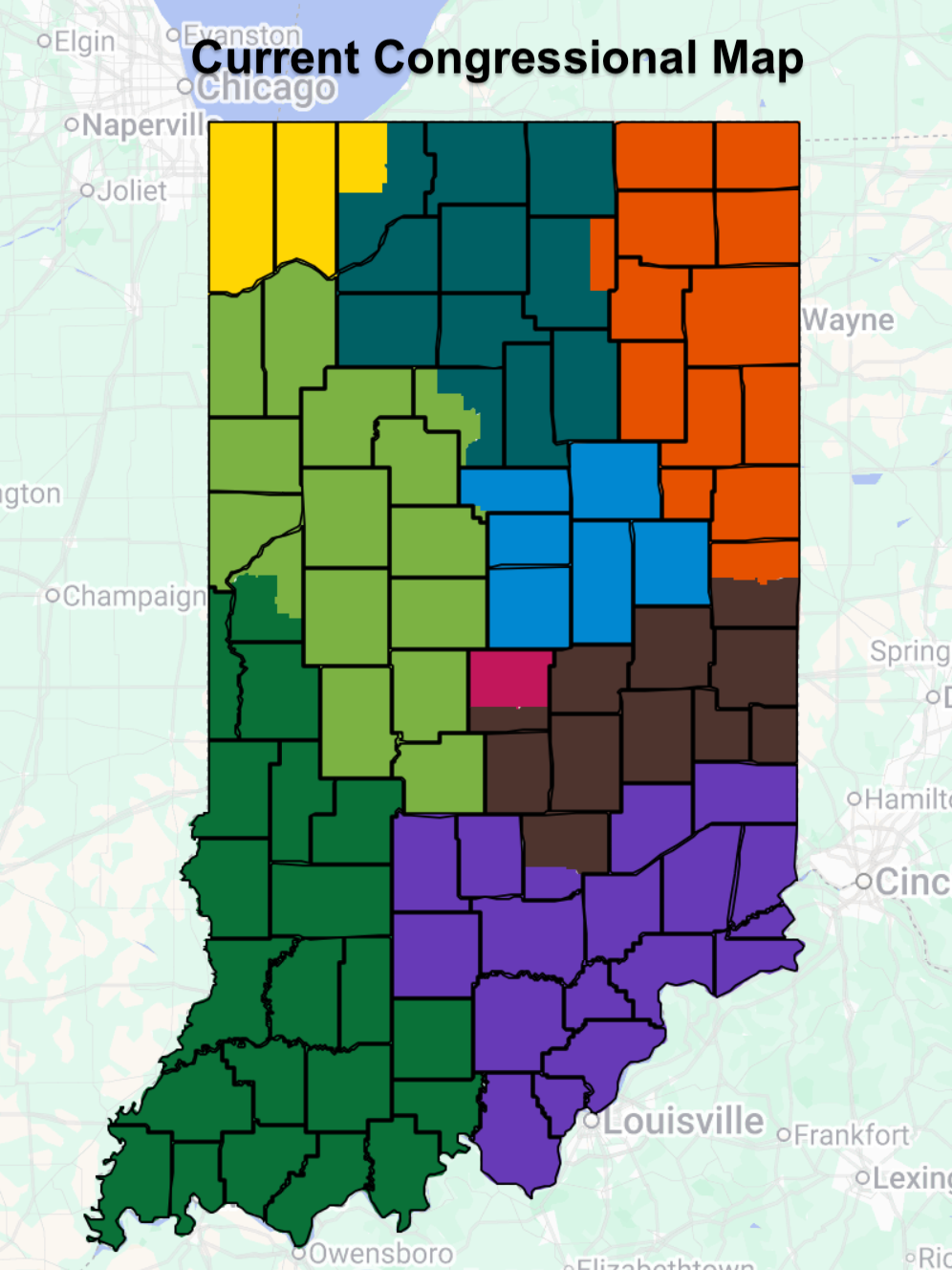
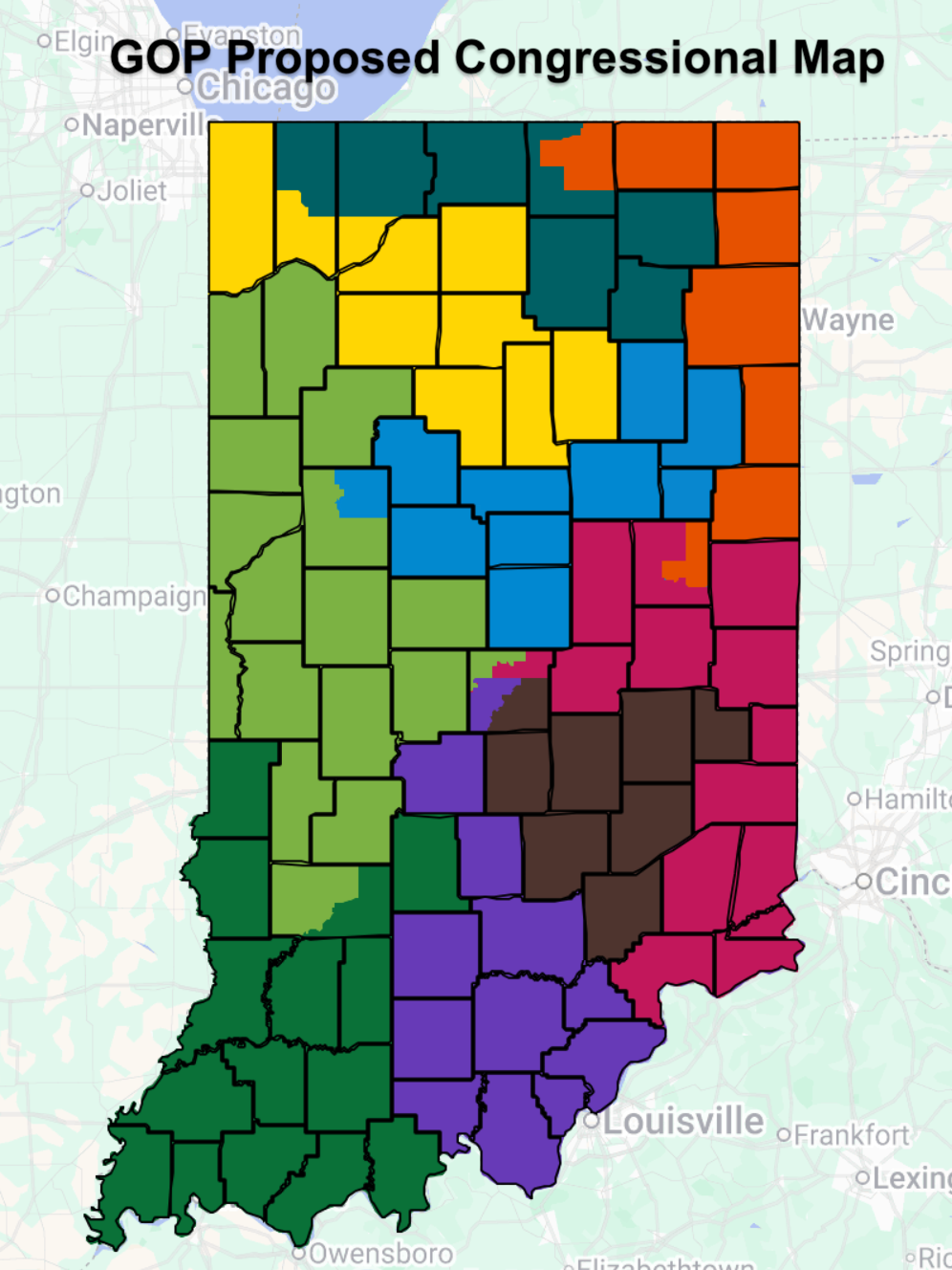
Maps by The B Square with geographic information from public sources and the Indiana Republican Party. [link to dynamic map]
Scheduled for hearing in front of the House Elections and Apportionment committee on Tuesday morning (Dec. 2) at 9 a.m. is HB 1032, which would set new boundaries for Indiana’s congressional districts.
The proposed new boundaries would create likely 2026 election victories for Republicans for all nine districts.
The General Assembly and the Indiana governor Mike Braun have been under pressure from U.S. President Donald Trump to redistrict mid-decade, instead of waiting until the regular decennial census. The idea is for the Republicans in the Hoosier state, who have a supermajority in both the state House and state Senate, to use redistricting to increase their control from seven of nine congressional seats to nine of nine seats. The idea is to help the GOP preserve its majority in the U.S. House.
In the proposed bill, the congressional districts are defined not by lines on a map, but rather by the union of areas for a list of counties, townships, precincts, as well as census blocks. That means partial precincts can make up part of a congressional district. That means the resulting boundaries for the proposed new congressional districts can cut across precincts, which is not otherwise allowed under state law. .
But the wording of the bill explicitly allows for the possibility a congressional district boundary slicing through a precinct boundary: “Notwithstanding [existing state law on the topic], for purposes of the 2026 primary and general election, a precinct may cross the boundary of a district of the House of Representatives of the Congress of the United States.” It appears that the work of drawing new precinct boundaries on the county level would be left until after the 2026 election cycle.
Monroe County is wholly contained in the proposed new District 8, so there would be no extra logistical complications for Monroe County election staff due to any crossed precinct boundaries
The existing congressional districts for Indiana are considered among the best of any state in the country. Princeton University’s Redistricting Report Card gives Indiana an average grade of A for the districts that were enacted in 2021, including an A for the compactness of its districts.
A district’s “compactness” is one way to judge the geometry of district boundaries. Compactness is a concept that can be defined in different ways. A compact district is considered the goal—it’s the opposite of the “squiggly” character of many districts that are cited as examples of gerrymandering. But the idea behind the concept is to calculate how non-squiggly a shape is, instead of relying on gut feel.
One formula commonly used is called the Polsby–Popper score, which compares a district’s area to the area of a circle with the same perimeter, producing a number between 0 (for a line) and 1 (for a circle). The more squiggly a district is, the closer it could come to a Polsby-Popper score of 0.
Indiana’s current congressional districts have compactness scores between 0.21 to 0.71 for an average of about 0.48. In a map with new boundaries, which was circulated around social media earlier in the fall, the range was between 0.16 to 0.48 for an average of about 0.35—clearly less compact than the current districts.
The map actually proposed by House Republicans on Monday has districts that range in compactness from 0.17 to 0.39 for an average of 0.26. That’s about half the average compactness score of the current districts.
The fact that the bill is originating in the House instead of the Senate is counter to the prediction of some observers, who thought that it would likely originate in the Senate—because that chamber is where Republican support for the measure is most uncertain. If it could not even get passed out of the Senate, that would end the effort on the spot. That approach would have been efficient.
But by having the House take up the issue first, and getting it passed out of the House, that would put Republican senators in a position where they’d be squarely in the spotlight, needing to take a make-or-break vote one way or another. A vote against redistricting by an individual senator, even if they were on the prevailing side, could mean they’d face internal party repercussions when it comes to a 2026 primary election campaign.
After the 9 a.m. committee meeting on Tuesday, a session of the full House is set for 3 p.m. the same day.


Comments ()