
As convention center rises, Bloomington council bristles at potential host hotel land donation
As construction begins on Bloomington’s convention center expansion, there is still no deal for a host hotel. At a joint work session, councilmembers criticized the mayor’s administration as the RDC considers donating city-owned land to help bridge a long-known funding gap.
Even as structural steel for the Bloomington Convention center expansion goes up south of 3rd Street between College Avenue and Walnut Street, there’s no deal yet for a developer to build a host hotel.
With construction of the expansion expected to be completed sometime around the start of 2027, the opening of a host hotel would, even if a deal were reached now, come no earlier than the start of 2029, at least two years after the convention center expansion is complete.
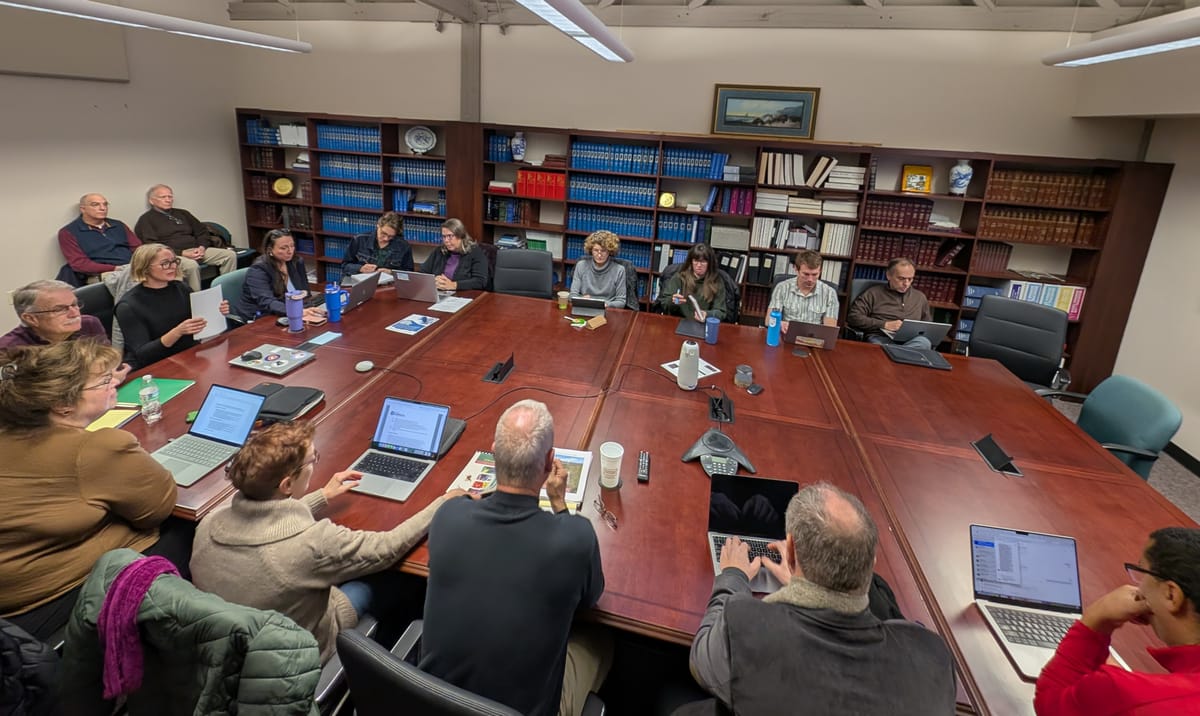
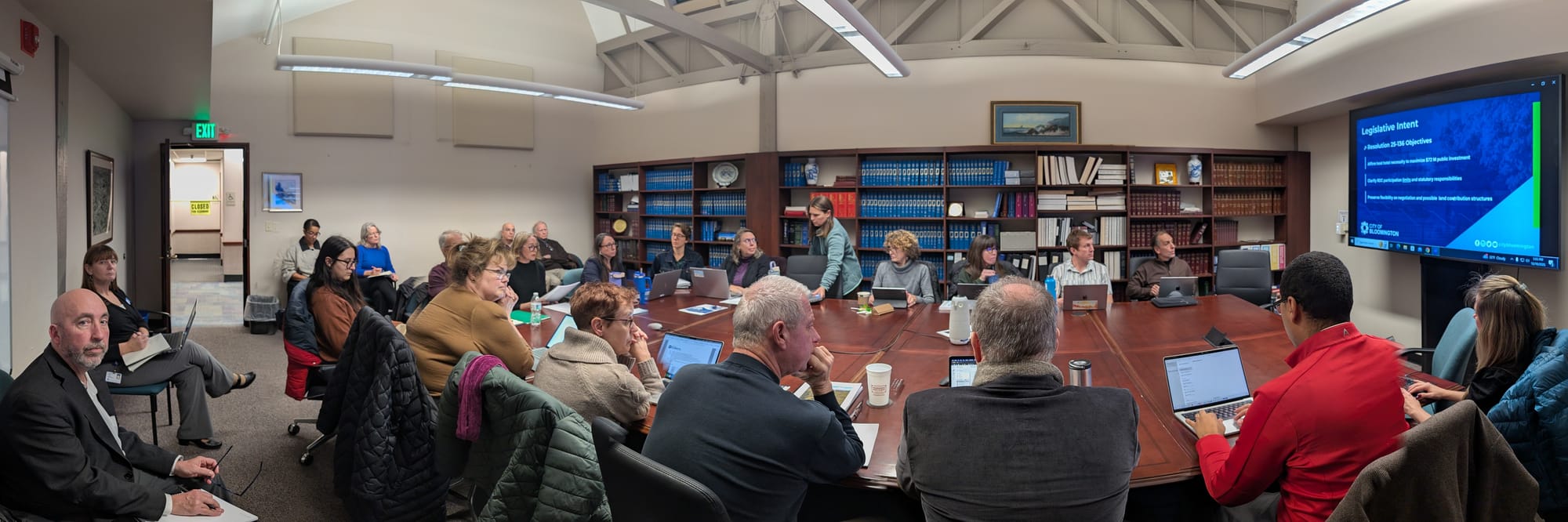
That was the basic backdrop of a work session this past Wednesday (Dec. 10), attended by members of the Bloomington city council and the Bloomington redevelopment commission (RDC).
Provoking interest among councilmembers is a resolution that the RDC is mulling, which would indicate a willingness to donate RDC-owned real estate—the former Bunger & Robertson property—to the hotel project. By the time of Wednesday’s work session, the RDC had already deliberated on the resolution at its meeting the previous week, but decided to put off a vote.
The RDC’s resolution comes after a year and a half ago, eight of nine councilmembers signed a letter to the RDC, indicating that they wanted to see the roughly $7-million total purchase price for the property recouped. The only councilmember who did not sign the letter was Courtney Daily.
Wednesday’s meeting was a mix of grievances aired by councilmembers against Bloomington mayor Kerry Thomson’s administration, and practical considerations that are connected to the real estate in the general context of economic development.
On Monday (Dec. 15), Bloomington’s RDC will again be taking up the question of a resolution about a potential land donation to the hotel, after putting off a vote at its meeting two weeks ago.
The RDC’s regular Monday meeting comes after a special meeting of the city council that has been called for Monday (Dec. 15) at 4 p.m. by Bloomington mayor Kerry Thomson, on the topic of the Hopewell South project, which is being developed on real estate at and around the site of the former IU Health hospital site, which is also owned by Bloomington’s RDC.
Audio recording
The audio recording of the Dec. 10, 2025 joint work session of the Bloomington city council and the RDC is big enough that it cannot currently be embedded in this website. However, here’s a link: Dec. 10, 2025 joint work session.
Very recent history
There’s still no deal with a hotel developer in connection with the convention center expansion, even though the Monroe County capital improvement board (CIB) selected Dora Hospitality as its preferred hotelier more than a year ago, in October 2024. A potential deal has foundered on the gap between amount of capital Dora can access for the required investment and the amount needed to build the project.
In the lead-up to CIB’s selection of Dora as the preferred hotelier, after hearing public presentations from three hoteliers who submitted proposals to the RFP released by the CIB, Jim Whitlatch, who is the CIB’s legal counsel, briefed the CIB in mid-September. Whitlatch identified for CIB members a key factor common across all three respondents to the RFP: All three hoteilers indicated some kind of public subsidy would be needed to make the project financially feasible.
Less-recent history: Funding gaps generally for host hotels
A 2019 study done by Hunden Strategic Partners (HSP) for a steering committee, which was working on the convention center expansion project, indicated that a significant public subsidy would be needed to support a host hotel. From the report, which analyzed a potential 300-bed host hotel (emphasis added):
As shown in this report, the average public subsidy for a headquarters hotel over the past 25 years is approximately 33 percent. Other communities have publicly-funded their headquarters hotel 100% via public bonds. The city/county should be prepared for this conversation. Any smaller hotel will handicap the ability of the convention center to block needed rooms for events.
The Hunden report estimates a 300-bed host hotel would cost $76.5 million—the estimates were done in mid-2019. (The RFP issued by Monroe County’s CIB last year called for a minimum of 200 guest rooms.) Hunden estimated that the net operating revenue for such a hotel would be able to support developer equity of $14 million and an additional $36 million in private debt. This would leave a funding gap of $26.5 million for the development of the host hotel, “which will need to be subsidized like most other [host] hotels,” according to the Hunden report.
Why host hotels have profitability challenges
At this past Tuesday’s (Dec. 9) meeting of the convention and visitor’s commission (CVC), Visit Bloomington executive director Mike McAfee briefed the group on the definition of a host hotel: “You will never hear me call it anything but the ‘host hotel’—that is the purpose of its existence, is to host groups coming into this convention center.” He added, “Their whole reason for existence needs to be their partnership with this convention center and giving us room blocks and group rates and all that type of stuff.”
The need to incorporate booking of big room blocks and reduced group rates into their business model means that convention center host hotels can’t tap into a significant potential revenue stream available to other local hotels—premium pricing that can stem from high-demand events, like Indiana University football games.
In the staff memo that was prepared for this past Wednesday’s joint work session of the RDC and the city council, the challenges faced for the profitability of convention center host hotels are described like this:
Host hotels operate with thinner margins, because they must guarantee blocks and reduced conference rates years in advance, unlike other local hotels that rely on peaks driven by IU activities. For this reason, nearly all U.S. Convention Center host hotels involve public participation, such as land value contributions, TIF assistance, or tax incentives.
Efforts to bridge gap: Reducing costs
The approach taken by local officials, including the CIB and now the city of Bloomington’s RDC, is not to identify new funding sources for the private developer, but rather to reduce costs.
The CIB has proposed a reduced scope for the host hotel, in order to reduce costs, like eliminating a skywalk across 3rd Street connecting the hotel to the existing convention center—an element that Dora included in some preliminary concept drawings. A rooftop bar and underground parking are also not essential, according to the CIB. By eliminating those elements, the project could potentially save $15 million, CIB president John Whikehart said at the CIB’s regular November meeting.
It is an effort to help bridge the funding gap, by reducing cost, that has now prompted Bloomington’s RDC to now consider the idea of making available, at no cost to the hotel project, the College Square property it owns at 4th Street and College Avenue. The parcel is commonly called the former Bunger & Robertson property. The College Square property is the focus of the negotiations, because that’s the real estate that Dora Hospitality has targeted as its preferred location to develop a host hotel.
The property was acquired by the RDC starting in 2019, in two separate transactions with two separate owners, for a combined total of just under $7 million. Initiated by then-mayor John Hamilton, the idea behind the transaction was to generate momentum towards selection of the site as the location of the convention center expansion. The CIB wound up choosing county government owned property to the east, because the county government was willing to make the land available at no cost—in contrast to roughly $7-million price tag on the former Bunger & Robertson real estate.
In 2019, two parts of the block forming the southwest corner of 4th Street and College Avenue had two separate owners. The bigger parcel, which includes the office building, was owned by RBOWA, LLC, with connections to the Bunger & Robertson law firm, before it was purchased that year by Bloomington’s redevelopment commission (RDC) for $4.995 million.
Four years later, in 2023, Bloomington’s RDC purchased the other part of the block, a portion of the parking lot, from Thomas Sicks and Nancy Held, for $1.9 million.
Based on the figures released a year and a half ago by the city of Bloomington, responding to a request from the B Square, Bloomington’s RDC paid $255,000 less than the average of two appraisals for the bigger parcel, and $565,000 more than the average of two appraisals for the smaller parcel.
Bloomington mayor Kerry Thomson and the city council previously shared the same policy position—that the TIF (tax increment finance) revenue that was used to purchase the real estate should be recouped. In May of 2024 the city council sent a letter signed by eight of nine councilmembers saying that they wanted to see the roughly $7-million total purchase price for the property recouped.
But at that time, no decision had been made by the CIB about the location of the convention center expansion. The first thought was that it would be the CIB seeking to use the College Square parcel, at 4th Street and College Avenue—for the convention center expansion. The possibility that it might be a hotelier is included only parenthetically. From the letter:
Any land owned by the RDC that may be considered for an expanded convention center site must be purchased by the CIB (or other entity, for example, a hotelier) for, at minimum, the price the RDC paid to acquire the property.
If the land were donated—either to the CIB or to a hotelier—that would count as an expenditure outside of food and beverage tax revenue.
Food and beverage tax as the sole source of funding
The city council’s letter makes clear that the only money it wants to see going towards the convention center expansion project is food and beverage tax revenue: “It is our view that the City of Bloomington should limit its expenditures on the convention center expansion project to the food and beverage tax revenues previously identified for that purpose.”
While council’s statement technically could be parsed to be consistent with donating the land to the hotel project, not the convention center building expansion itself, it was evident at this past Wednesday’s work session that such a parsing was not what councilmembers had in mind.
Councilmembers were considering the “convention center expansion” to mean the expansion of the convention space including the development of the host hotel, given that the host hotel has been considered to be integral to the success of the project. It’s also the way CIB members have described the project.
Even if the host hotel is integral to the project, the CIB’s responsibility, as defined in the interlocal agreement under which it operates, doesn’t include financing the construction of the hotel. In that interlocal agreement, the CIB’s responsibility with respect to the hotel is spelled out like this: “The CIB shall be responsible for selecting and overseeing partnerships with any hotelier partners.”
At Wednesday’s work session, councilmember Matt Flaherty indicated that he believes the CIB should have planned for the use of the food and beverage tax revenue alone, and no other resource, in its approach to financing the convention center expansion, which includes the host hotel.
Flaherty put it like this: “[The CIB] apparently did not account for the need to plan resources for a subsidy for a hotel, if that’s what they believed—since 2018 the people involved with this project—would be needed.” Flaherty added: “So it feels a lot like a bait and switch or some kind of shell game here, when we’re at the beginning now of a long pattern that could unfold, of [the project as a whole] coming for more public resources.”
Flaherty wanted to know why the CIB did not plan to accomplish the financing for the convention center and the host hotel from the constrained set of funds of food and beverage tax and innkeeper’s tax (for operations).
“Why was that not taken into account when we decided to bond and spend all the money… on the convention center alone, and not a hotel?” Flaherty asked, “Can anyone answer that? Please?”
Responding to Flaherty, CIB president John Whikehart drew a line between the CIB’s responsibility for the convention center expansion and the hotel: “The charge was the expansion of the convention center. The bond was for the expansion of the convention center. The food and beverage tax was for the expansion of the convention center.”
Whikehart continued, “There was never any charge to us that we also had to pay for the development and creation and construction of a hotel.” He added, “We have never been charged, nor have we ever implied that we were also constructing a hotel.”
Wednesday’s work session: Airing of grievances
Early on in Wednesday’s work session, some councilmembers took the occasion to deliver sharp criticism of Bloomington mayor Kerry Thomson’s administration, because the administration, through the RDC’s pending resolution, was effectively rejecting the city council’s explicitly expressed position on the topic.
Neither the mayor nor deputy mayor Gretchen Knapp attended Wednesday’s work session. Absorbing the criticism were were director of economic and sustainable development Jane Kupersmith, and RDC executive director Anna Killion-Hanson.
Questioned by councilmember Dave Rollo, about the change in the administration’s position on recouping the purchase price of the College Square property, Killion-Hanson said, “I think honestly, over time, as information becomes available, positions change. So our opinion, my opinion of the situation, has evolved, as I think everyone’s has.” She added that as more information became available, about the need for a public subsidy, that information was not shared with the council in as timely a way as it should have been.
Rollo said he’d received no notification about the possibility of the RDC’s resolution on the effective donation of the real estate—he’d read about it in the local press.
Flaherty was more pointed, saying he wanted to “express disappointment and some dismay at the process of how this unfolded.” While he appreciated the convening of the work session that day, Flaherty said, “It’s quite disconcerting as a member of city’s fiscal body who … very clearly took an expressed fiscal position before appropriating funds for the food and beverage tax, then we see a proposal come that is directly counter to that.” Flaherty added, “No one from the RDC or staff bothered to tell us about it.”
Flaherty asked if it was an intentional omission: “I’m curious, actually, if it was even discussed. … Did somebody make a decision not to tell the council?” Killion-Hanson told Flaherty it was not a conscious decision not to tell the council.
Kerry Thomson took office as mayor at the start of 2024, with Killion-Hanson taking over as HAND director and RDC executive director at that time.
Killion-Hanson described how the council’s letter on the topic had factored into the administration’s work. “The letter was received in May of 2024—early in the administration, I would say. And it was not until October that a hotelier was selected. The letter is specific to convention center [not host hotel] language.” She added, “It was just lost, to be perfectly honest with you. It was just completely missed. It was a mistake. We are very sorry for it.”
The transition between administrations could also help account for the failure to recognize more recently that a significant public subsidy, in the tens of millions of dollars, would be required for a host hotel. The information about the required subsidy was clearly included in the 2019 Hunden study.
At Wednesday’s work session, Killion-Hanson told councilmembers she had not read the Hunden report until recently. Flaherty responded to that revelation by saying, “That’s unfortunate. And that’s why I’m saying it feels like a $7 million mistake. At minimum.”
On Wednesday, Sydney Zulich said that the communication failure about the pending RDC resolution was just another example in a long list of occasions when the city council was informed about an important issue only after-the-fact by a news release or an account in the local press.
As specific examples, Zulich cited some news about the College-Walnut corridor study, as well as the news that city controller Jessica McClellan was leaving, to be replaced by Geoff McKim early next year. About the failure to communicate, Zulich said, “This is a very consistent pattern, and I would like to see more public effort to actually collaborate with council members—instead of just kind of informing us and expecting us to go along with it.”
Hopi Stosberg was critical of the timing of the joint RDC and city council work session, because the final half hour of the joint work session overlapped with the start of a previously scheduled work session of the city council about budget priorities. Stosberg described herself as “personally frustrated” about the scheduling, saying “it feels like another moment where council’s, business and council as a body, is just not really considered very highly in terms of that.”
Land donation: Ceiling not floor
Towards the end of Wednesday’s joint work session, RDC president Deborah Myerson acknowledged Flaherty’s concern that the pending resolution about making the real estate available at nominal or no cost would just be the first of many elements of public subsidy. She put it like this: “I can see from the councilmembers perspective, it looks like a floor.” But she added, “The RDCs role in having this resolution is an attempt to make it a ceiling.”
She said that with its resolution, the RDC had publicly wanted to put a ceiling, that is a limit, on what could be provided to a hotel developer, because in the negotiations “there was a lot more that was being asked of the RDC that was not appropriate or reasonable.”
Councilmember Isak Asare said that he had come into the work session a fairly strong view of the resolution, based on the way it had been originally framed, which he characterized as “we’ll just give you something.” But during that day’s conversation, Asare said, he had come to believe that the framing of the question should be: “What is it that we want to achieve with economic development through having a [host] hotel and how much we’re willing to pay for those benefits that will come from it?”
Asare added, “I think that future conversations have to be about that. It’s really just about the input, output part of this.”
At its Monday (Dec. 15) meeting, Bloomington’s RDC will again be taking up the question of a resolution about a potential land donation to the hotel will start at 5 p.m.
The RDC’s regular Monday meeting comes after a special meeting of the city council that has been called for Monday (Dec. 15) at 4 p.m. by Bloomington mayor Kerry Thomson, on the topic of the Hopewell South project, which is being developed on real estate at and around the site of the former IU Health hospital site, which is also owned by Bloomington’s RDC.
Even if the RDC’s resolution passes, it looks like the CIB will likely get a report of no done deal by the time of its Dec. 17 meeting, which was the deadline it set to hear back from Dora Hospitality and the Bloomington RDC.

Comments ()