
Bloomington approves new special events policy amid disputed attendance figures, denied records requests
Bloomington’s board of public works adopted a new policy limiting large festivals in the public right of way to three downtown areas, citing public safety concerns. Fourth Street Festival organizers objected but received a one-year exception for the event’s 50th anniversary.
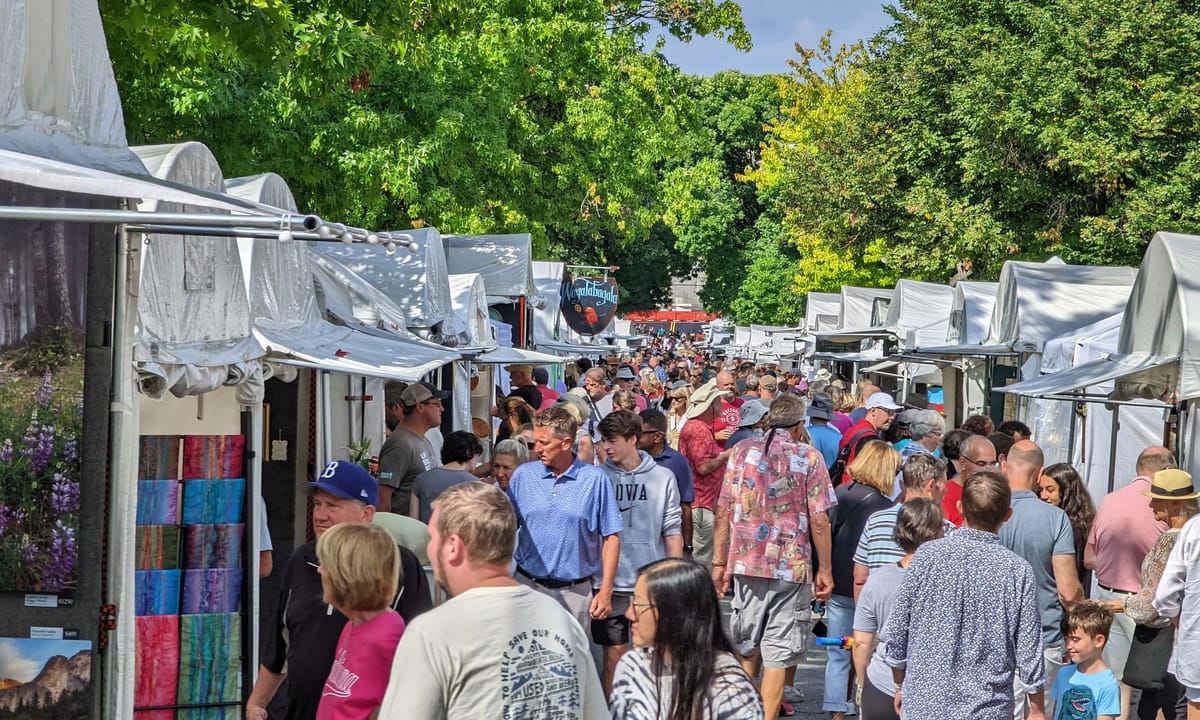
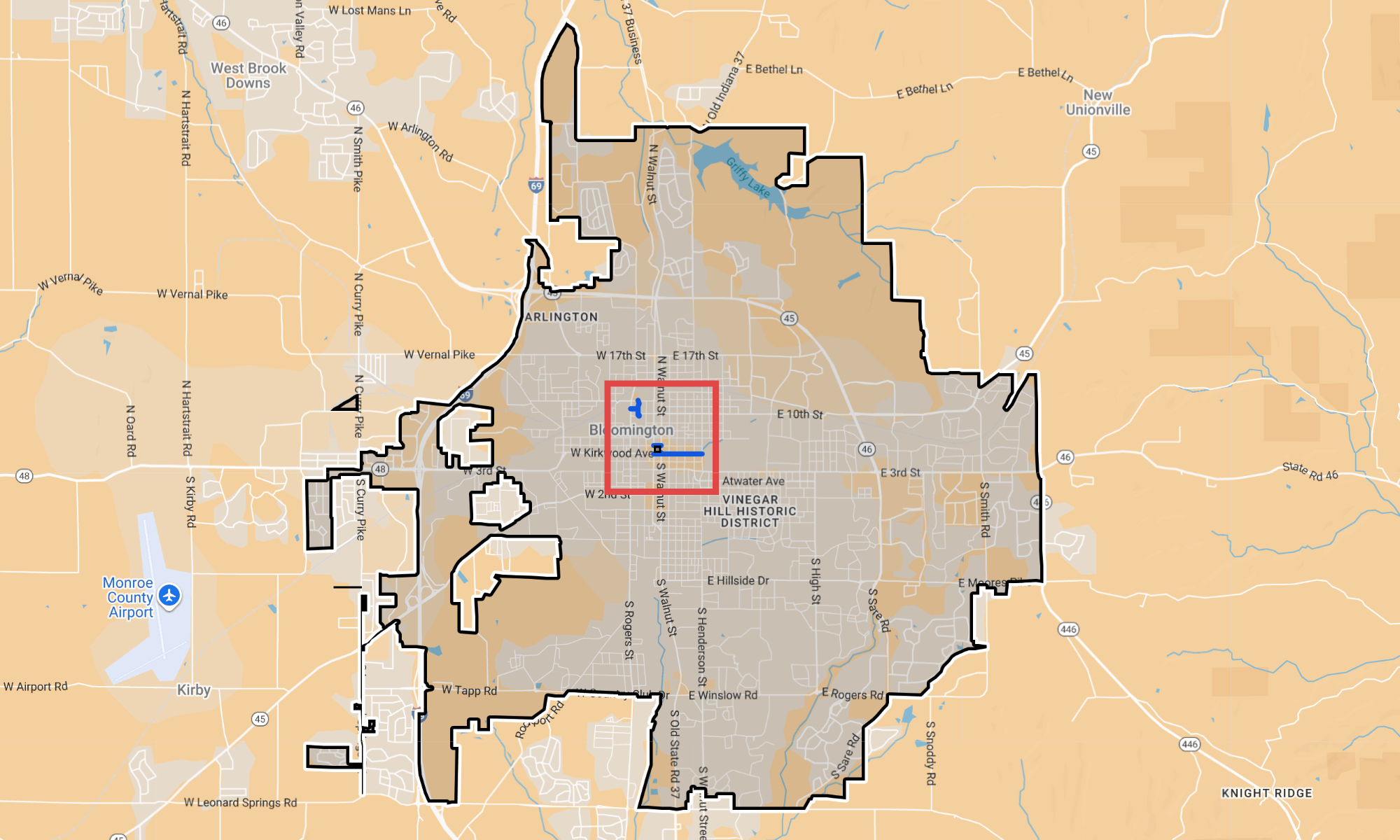
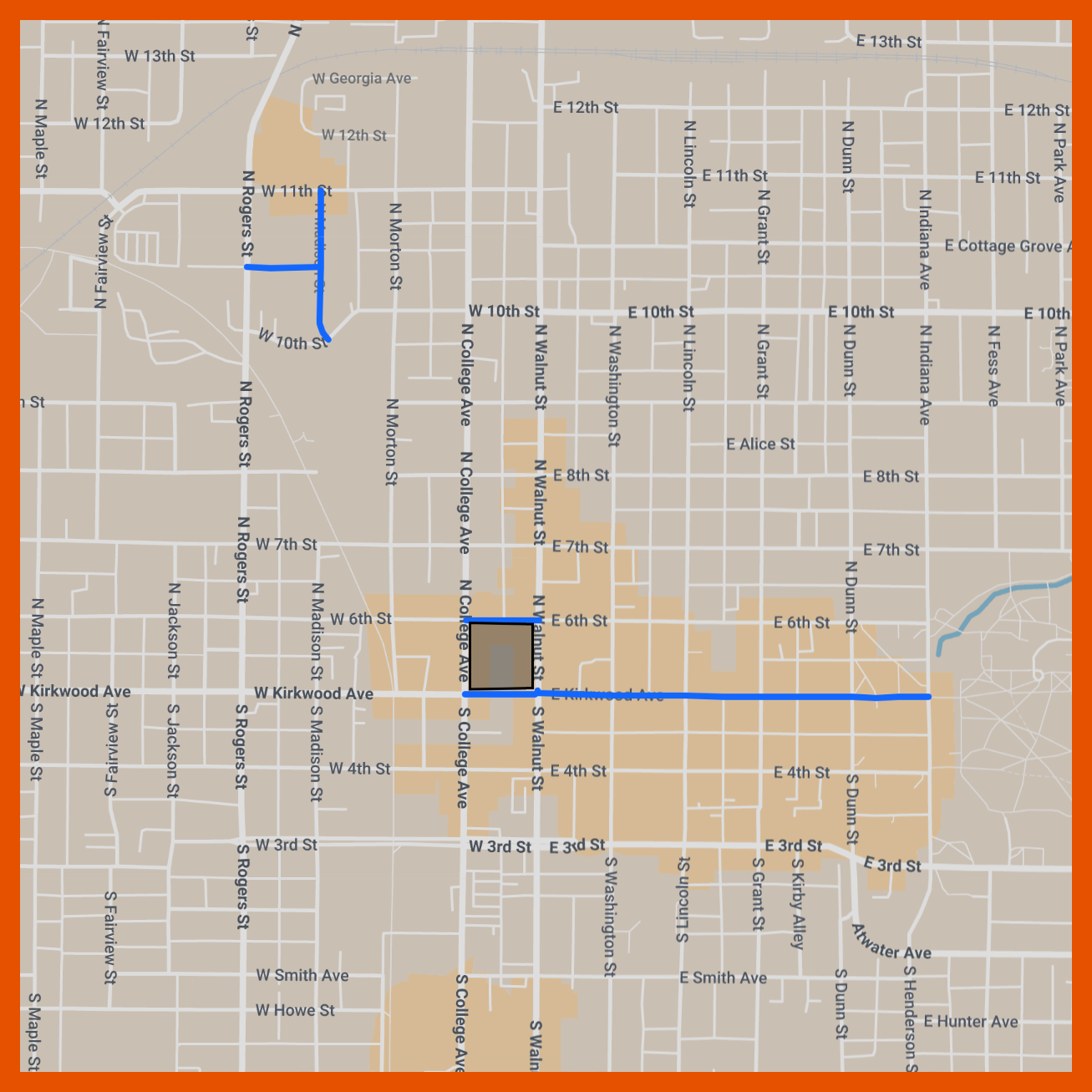
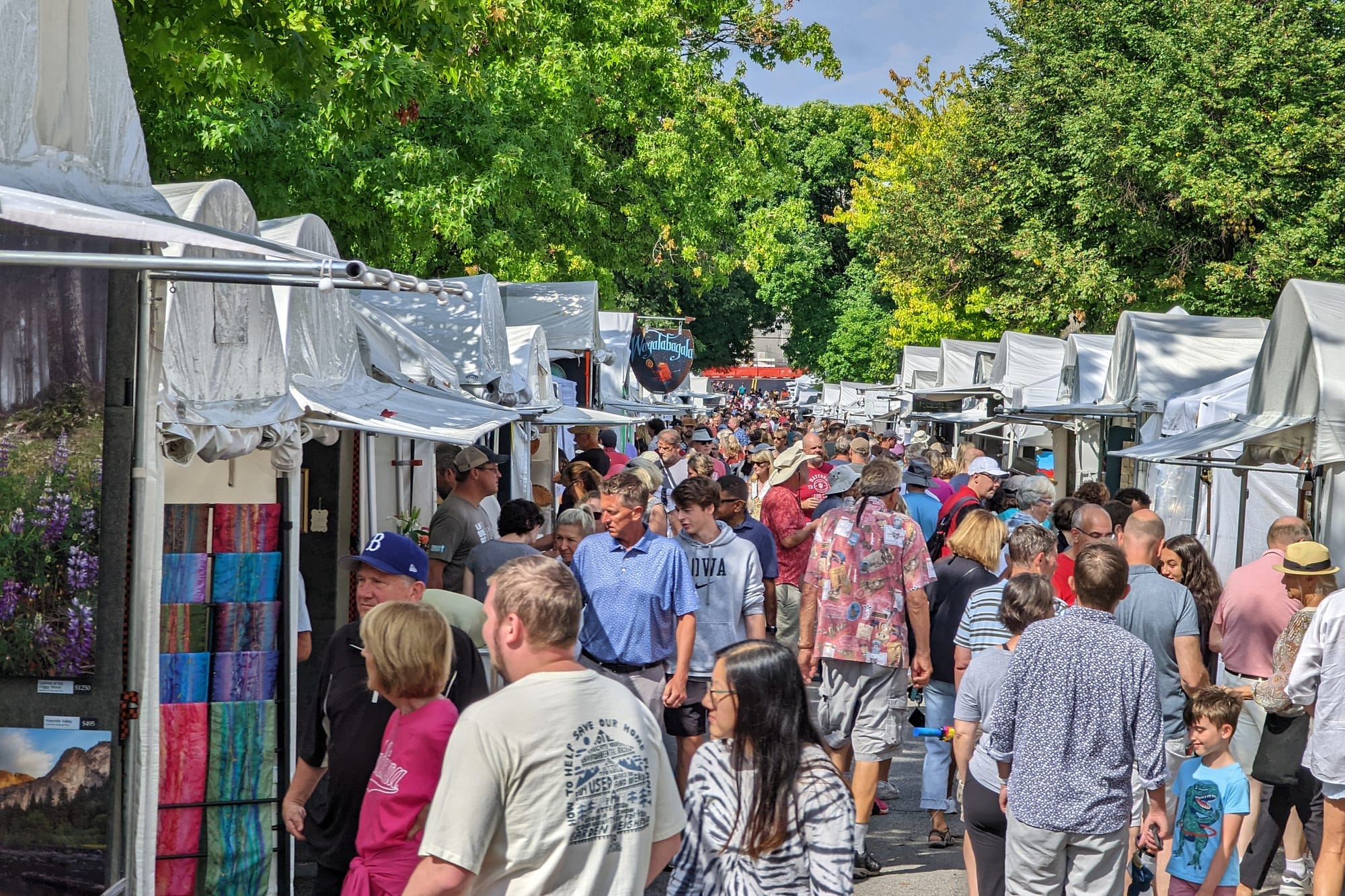
Left: Closeup view of the three locations where special events must now take place, if they are expected to draw over 1,000 people. Map by The B Square with information from the city of Bloomington. [link to dynamic map] Right: B Square file photo of the Fourth Street Festival in 2022.
Bloomington’s board of public works voted Tuesday evening (Jan. 13) to adopt a new policy governing special events that use the public right of way.
The policy restricts special events to just three areas where large downtown festivals can be staged, a restriction that city staff say is needed for public safety. The policy creates three designated “festival footprints” for events anticipating 1,000 or more attendees:
- Kirkwood Avenue from Walnut Street to Indiana Avenue
- Courthouse Square (Kirkwood on the south, 6th Street on the north)
- The Trades District near city hall on Madison Street and Maker’s Way
Public works director Adam Wason framed the policy as driven “A-number-one” by public safety. “We have to put together festival footprints and public events in the public right of way with footprints that have public safety at the forefront,” Wason told the board.
Wason pointed to the permanent bollards installed along Kirkwood Avenue at street intersections and alleys from Indiana Avenue to Walnut Street as investments that allow “more contained and manageable closures.”
The new policy does not apply to events in city parks.
Part of the discussion at Tuesday’s board of public works meeting featured disputed claims about attendance at the Fourth Street festival. The city uses a vendor Placer.ai to measure attendance, but past B Square requests for reports from Placer.ai have been denied by the city of Bloomington.
Objections from Fourth Street Festival
One of the policy’s most immediate impacts is on the long‑running Fourth Street Festival of the Arts & Crafts, which currently closes 4th Street between Grant Street and Indiana Avenue for its Labor Day weekend show. The adopted policy requires festivals of its scale to move into one of the three designated footprints.
However, the resolution adopted by the board carves out a one‑year exception through 2026 for the festival’s half-century anniversary. Wason said, “The event will celebrate its 50th anniversary this year on 4th Street, and we want to help accommodate their use of 4th Street for this 50th anniversary, and in subsequent years would be moved to Kirkwood Avenue.”
On Tuesday night, Fourth Street Festival organizers and artists filled city council chambers, where the board meets, to argue for a permanent exception, not just one year.
Festival board member Pamela Davidson read a 15‑point list in support of granting a permanent exception for the Fourth Street Art Festival, starting with the festival’s name and 50‑year association with the street: “How do we market 4th Street on 5th Street?” she asked, warning that the proposed required move would “destroy decades of carefully cultivated and costly marketing outreach and name recognition.” [Kirkwood Avenue corresponds to 5th Street, if the city’s numbered street system were strictly followed.]
Fiber artist and former festival president Martina Celerin spoke against the mainstreaming of the event: “Uniformity in Bloomington is not a virtue most times, especially [when it comes to] performances and the arts.” She continued, “Keeping this festival true to its roots and not mainstreaming is a huge plus with this community, and we like ‘quirky’ and ‘unique’ here. That’s one of the joys of Bloomington is not being a mall-type organization.”
Several artists warned a move could cause top exhibitors to stop participating in the festival, threatening the festival’s viability.
Board of public works president Kyla Cox Deckard said that the Fourth Street Festival is important to Bloomington’s identity, but added that the policy is important because it puts public safety “at the forefront.” Board member Elizabeth Karon put it like this: “I feel like it would be irresponsible to allow a festival to continue to happen in a place that we know is not safe.” Karon referred to the “porous” nature of 4th Street and the large number of vehicle entry points.
The board approved the policy unanimously, adding a requirement that it come back for review in October 2026, after another season of implementation and further discussions with event organizers, including Fourth Street Festival.
Wason, addressing festival supporters directly near the end of the meeting, said “We want your event to last for another 50 years, and we’re going to help you do that,” he said. “Our intent is not to try to damage your festival.” He added, “When I say it’s done with public safety in mind, that is our police department, that is our fire department, that’s the Department of Homeland Security for large‑scale events.”
Attendance data, records requests
During public comment, one speaker cited internal crowd counts suggesting tens of thousands of attendees. Special projects and operations manager Cassie Werne countered with figures drawn from the city’s data vendor for crowd counts, Placer.ai: “The attendance for Fourth Street Festival for last year, for Saturday, was 1,700 and for Sunday was 1,600,” Werne said.
Werne added, “This is based on an attendance data platform, which is called Placer.ai, which uses cell phone data to determine how many people are in a space during a date and time frame.”
Werne acknowledged limitations to placer.ai—people without cell phones are not counted—but said that placer.ai data is what the city uses to measure attendance for right-of-way special events.
In the past, when The B Square has requested copies of reports that city staff have created using Placer.ai those requests have been denied, based on the claim that such reports do not exist.
One B Square request [25-227] started down a path to compliance, with an assistant attorney appearing to acknowledge the existence of some responsive records. But the city’s corporation counsel, Margie Rice intervened and wrote that no responsive records existed, based on the claim that “The data pulled from Placer Labs Inc. data platform represents live data, and is not saved as a record by the departments viewing the data.”
That’s despite the fact that the city’s contractual documents for Placer.ai highlight the easy export capabilities to different formats from the Placer.ai platform as a specific reason for selecting Placer.ai over other vendors.
Another B Square records request for Placer.ai reports [25-443] was denied by corporation counsel Rice just 12 minutes after it was submitted, also based on the claim that no responsive records existed.
When she responded to a B Square question about how staff in her department use Placer.ai, economic and sustainable development director Jane Kupersmith appears to have contradicted Rice’s claims about the non-existence of reports: “When talking with ESD staff, we run a report with certain filters and export a map or graph or numbers. We use this when looking at event attendance or particular issues that arise.”
In denying the second request, which also covered communications between staff about the information in Placer.ai reports, corporation counsel Rice claimed that any communication mentioning data from Placer.ai would be subject to an exemption under I.C. 5-14-3-4(b)(6).
Although Rice did not provide the wording of that section of state law, it’s the exception that many local government units try to use as a kind of catch-all for denying records requests.
(6) Records that are intra-agency or interagency advisory or deliberative material, including material developed by a private contractor under a contract with a public agency, that are expressions of opinion or are of a speculative nature, and that are communicated for the purpose of decision making.
It’s not clear how the mention of data from Placer.ai in a communication would automatically satisfy the criteria in the exemption.
The B Square has now made a request for the Placer.ai reports on which Werne relied for her statements about attendance at the Fourth Festival last year, as well as any email correspondence on the topic of the Placer.ai data for the festival that year.
Comments ()