
Bloomington city council adopts resolution on Flock license-plate reader cameras as ‘first step’
The Bloomington city council voted 9–0 Wednesday to adopt a resolution addressing the city’s use of Flock automated license-plate reader cameras, after more than 30 speakers spoke from the public mic. The resolution asks the mayor for a public briefing and detailed information about the program.
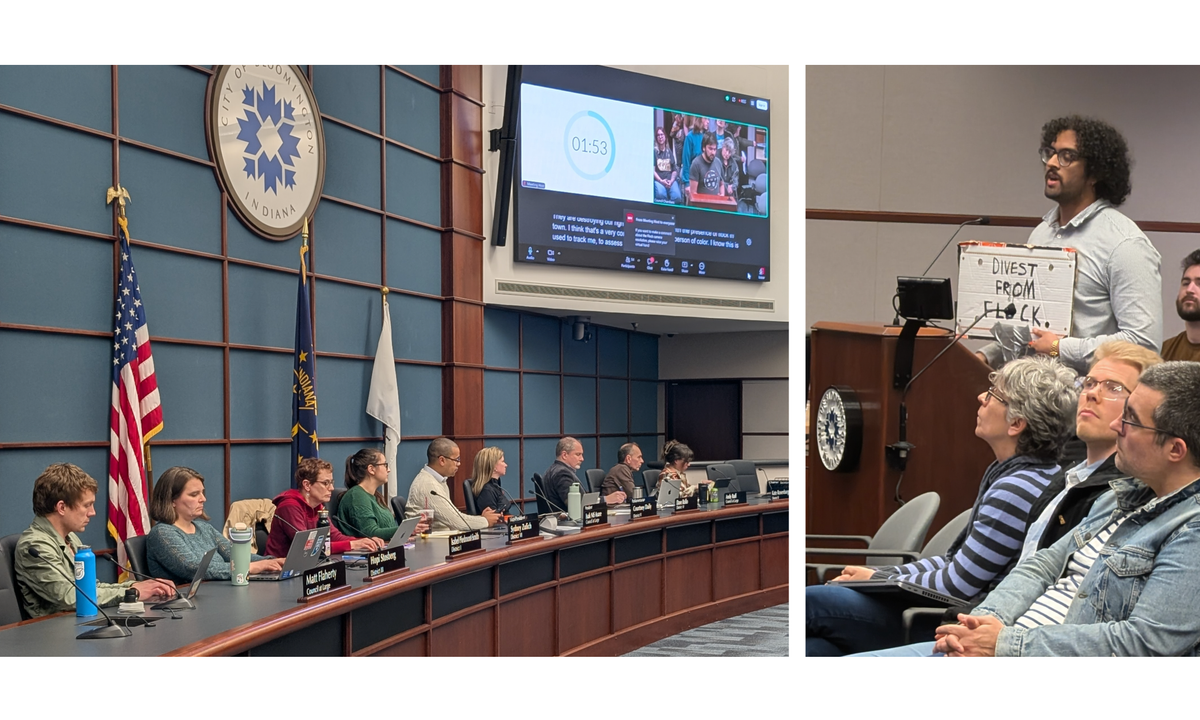
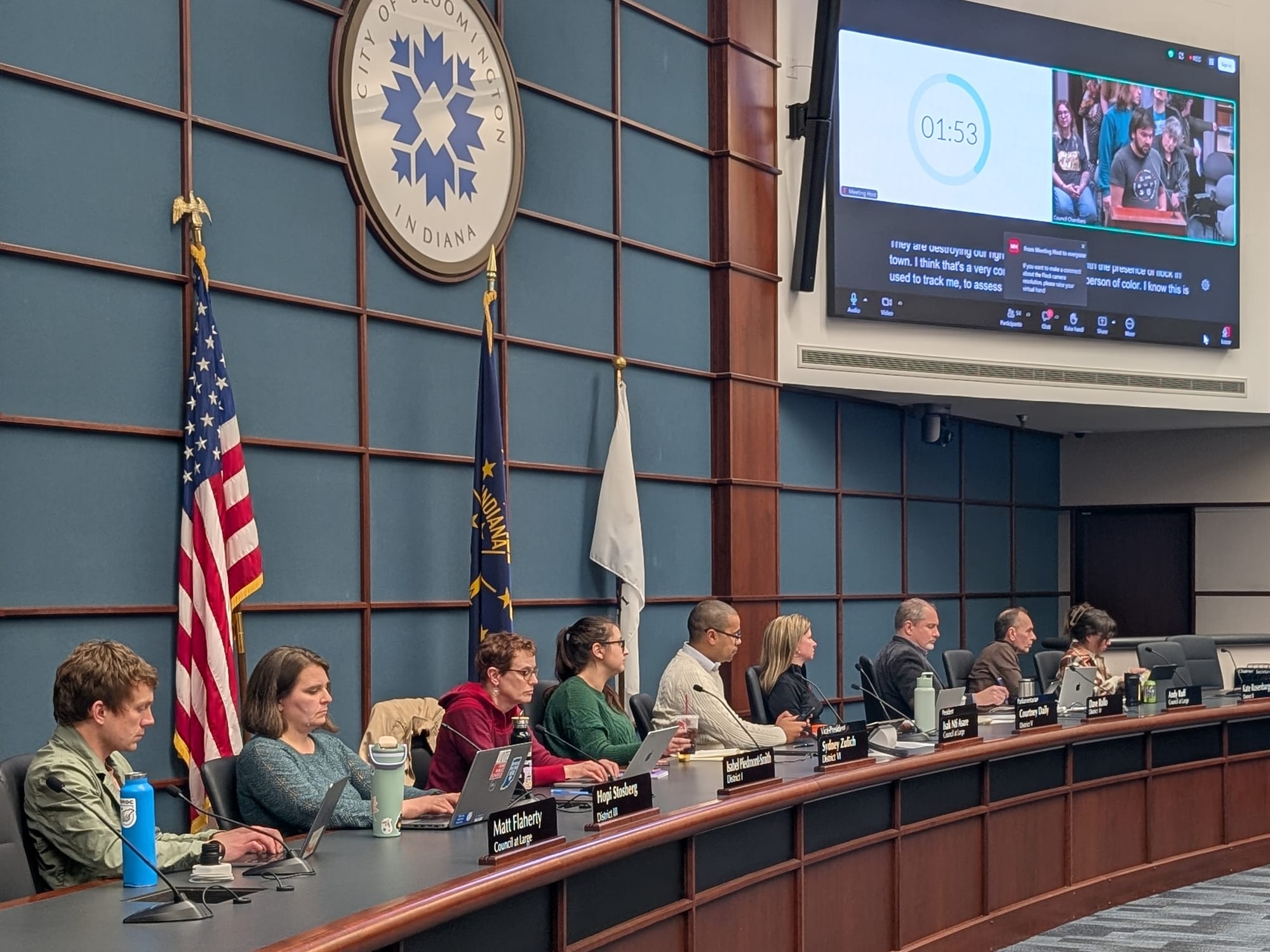
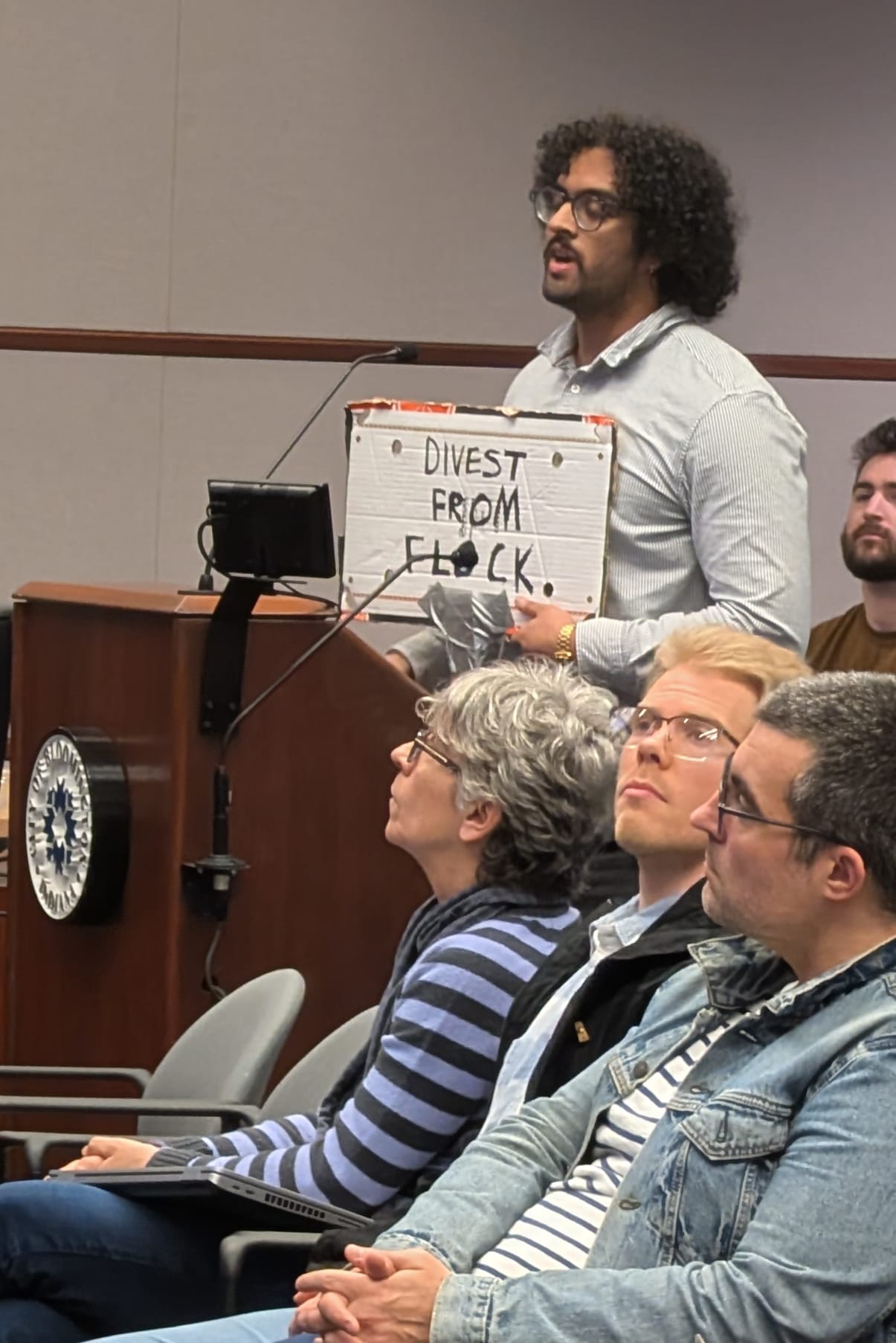
Left: Bloomington’s city council listens to comment from the public mic on a resolution about automatic license-plate reader techology. Right: From the public mic, a speaker holds a hand-lettered cardboard sign that reads "Divest from Flock" as he delivers comments in support of the resolution.
On Wednesday night (March 4), Bloomington’s city council adopted a resolution addressing the city’s use of automated license-plate reader (ALPR) cameras operated by the Flock Safety company.
The resolution, written by council president Isak Asare, won unanimous approval from the nine councilmembers, after more than 30 people spoke during the public comment period. Both the first level of the city council chambers and the balcony were packed for the meeting.
The action comes after months of public controversy over the cameras, which automatically photograph passing vehicles and record license plates and other identifying features such as color and bumper stickers. The images are stored in a searchable database used by law enforcement agencies investigating crimes, including from other jurisdictions besides Bloomington..
Objections to Flock cameras from the public mic on Wednesday echoed some of the concerns in the preamble of the resolution, which included: civil-liberties worries about location tracking of residents who are not suspected of wrongdoing; the risk that surveillance systems expand in scope over time; limited city control over a vendor-managed platform operated by a private company; the need for strict limits on how the technology is used and how long data are retained; the possibility of data sharing beyond the city’s intent; and the broader concern that large-scale data collection itself creates risks of misuse, breaches, or normalization of surveillance.
Speakers also complained about the city of Bloomington’s record of thwarting attempts by residents to get information about about the city’s relationship with Flock Safety. The city has responded to records requests for contracts in part with needlessly redacted documents.
The resolution calls on the mayor and the chief of police to provide a public briefing to the city council about Bloomington’s ALPR program, including contractual agreements, and current operational use of ALPR cameras.
The resolution also calls on the administration to provide written information, before the public briefing, that includes “plain language” describing the devices currently in operation and their general placement. The information requested in the council’s resolution includes: contract terms: total program costs to date; data retention periods; current access controls and training requirements; current rules about searches, auditing, reporting, and data sharing.
During Wednesday’s meeting, the council unanimously adopted an amendment to the resolution, adding a six-week deadline for the administration to provide the requested information to the council.
The information request in the resolution has a solid grounding in state law, which says the mayor “shall ... provide any information regarding city affairs that the legislative body requests.”
A big protest—against ICE (US Customs and Immigration Enforcement) and the use of Flock cameras—took place on the steps of city hall on Jan. 30. It wound its way down Kirkwood Avenue and back.
Around that time Bloomington mayor Kerry Thomson said that canceling the contract with Flock was “an option,” without committing to ending the arrangement. The mayor was set to meet with representatives of Flock on Feb. 16. The mayor’s office has not released any statements following that meeting.
The resolution calls on the mayor to “impose an immediate pause on any expansion of the ALPR program” and talks about the council’s “intent to develop and consider an ordinance to establish durable rules governing the acquisition and use of ALPR technology in Bloomington.”
Speakers from the public mic described the resolution as a good “first step.” Councilmembers echoed the sentiment that the resolution should not be the council’s final action. Councilmember Kate Rosenbarger put it like this: “I think a resolution is a great first step, and it’s clear that this is what the community wants, and we should just push it forward to make it more real.”
The council could not itself cancel the contract with Flock—because that is a mayoral power, that is, within the authority of the executive branch. But the council could conceivably kill such a contract, at least eventually, by starving it of funding. The city council is the city’s fiscal body.
As councilmember Dave Rollo put it on Wednesday, “I think that the case has been made tonight that we don’t need this. We don’t need Flock cameras, and we should think of defunding it. And so that’s what I look to as the next step.”
A news release from the Bloomington mayor’s office in April 2024 touted the addition of Flock Safety cameras as able to assist in locating suspect vehicles and vehicles associated with missing persons, Silver Alerts, and Amber Alerts.
Later, in October of 2024 the InRoads web page for the city indicated road closures for the period a period of road closures to install Flock cameras at four locations: Kirkwood & Dunn; Kirkwood & Grant Kirkwood & Walnut; and 7th & Walnut.
Wednesday’s action by the council was not a surprise. Asare had posted a statement to his Facebook account on Jan. 30 indication that some kind of action by the council could be expected. In that statement, he wrote:
My preference is to eliminate our relationship with this technology entirely. The strongest protection for civil liberties is not better settings or better assurances—it is restraint. You cannot misuse data that does not exist.
On Feb. 12, councilmember Isabel Piedmont-Smith sent an open letter to Bloomington mayor Kerry Thomson, that said, “I do not think it is wise for the City of Bloomington to trust [Flock Safety] to adhere to any limitations or restrictions we may require in any signed contracts.”
Criticism: Thomson’s absence
Bloomington mayor Kerry Thomson had been presented in the council chambers at the start of the council’s Wednesday meeting, to support the consideration of the Hopewell South PUD rezone—it was moved along for a final vote at the council’s next regular meeting on March 25.
But Thomson did not stay for the consideration of the resolution on Flock cameras, which meant she was subjected to criticism from the public mic over her departure. The B Square counted nine of 31 speakers who criticized the mayor for not staying in the room. Leading off was Susan Brackey who said, “Where is the mayor? I wish she had stayed for this. I hope you’re around. This is important.” One speaker put it like this: “The contract belongs in the shredder, and Mayor Thompson belongs in this room.”
Another speaker said that for Thomson not to be there in the room set a precedent for “cowardice.”
Yet another speaker quipped, “And so I know why the mayor had to leave—it’s because she is back at home twirling her mustache and tying up James Bond over a shark tank, because that’s the kind of people that use this technology.”
The comment reflected the general mood in council chambers, which was serious, but not without some lighthearted moments.
Ryan, who describe himself as a researcher at Indiana University, said, “I think that in the context of this federal administration, we can draw our own conclusions from Flock: If it walks like a duck, if it quacks like a duck, if it’s literally called Flock, maybe it’s a fascist duck!”
Ryan also alluded to the Hopewell South PUD when she said: “I think that [Bloomington mayor Kerry Thomson] wants a legacy to leave which is admirable.” He added: “And maybe her legacy could be: The mayor that said no to bringing fascism into Bloomington.”
Comments ()