
Bloomington council approves $778K CDBG plan amid long-term federal decline
Bloomington’s city council approved a plan to distribute an estimated $778,293 in 2026 Community Development Block Grant funds, dividing money among administration, social services, and physical improvements. Staff and councilmembers warned that long-term federal cuts are squeezing local needs.
At its Wednesday meeting, Bloomington’s city council approved a resolution outlining how the city will distribute an estimated $778,293 in 2026 Community Development Block Grant (CDBG) funds from the U.S. Department of Housing and Urban Development. It’s an annual exercise.
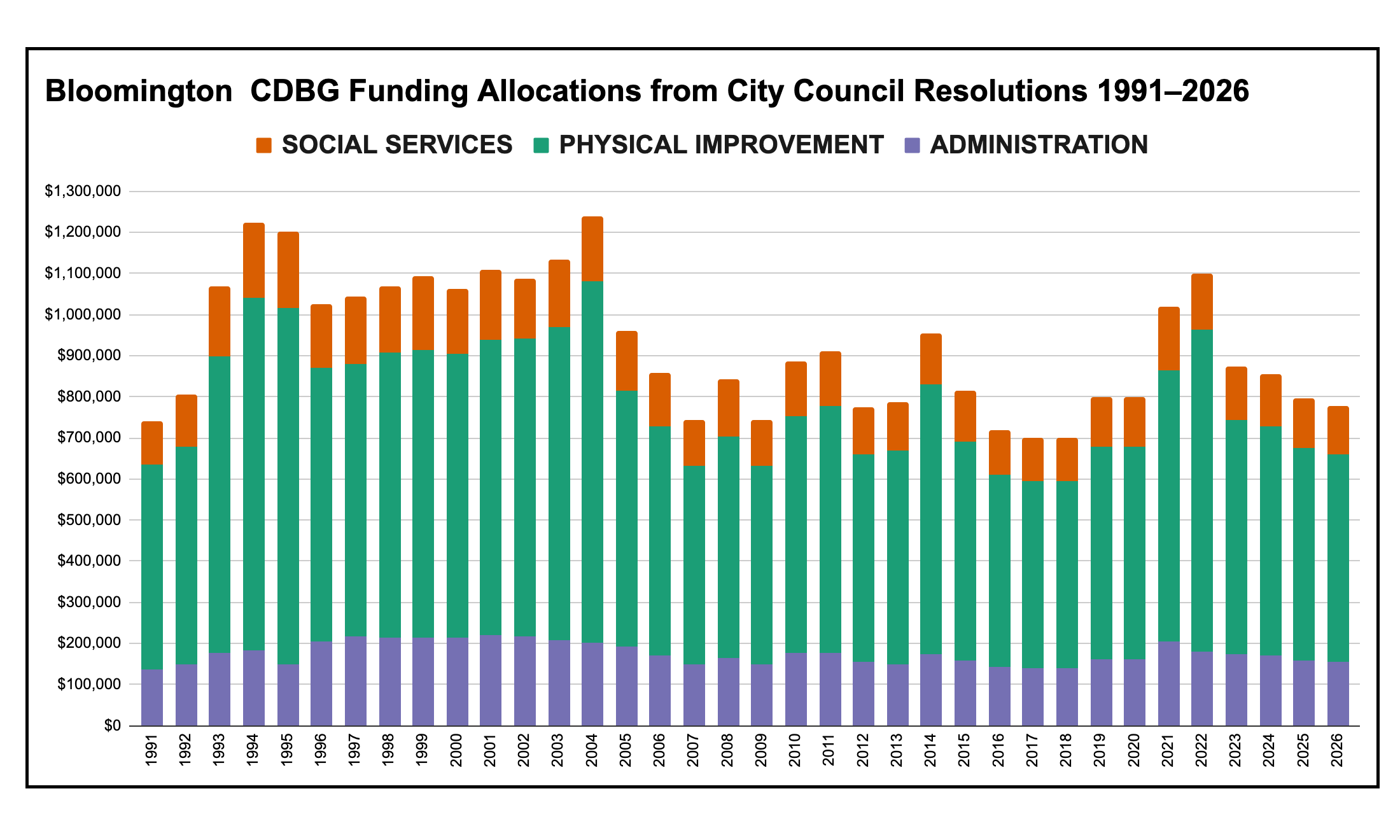
Under federal rules, the money is divided into three categories: 20% for administration ($155,658.60), 15% for social services ($116,743.95), and 65% for physical improvements ($505,890.45). During council deliberations, Matt Flaherty drew out the fact that the 20% for administration is a cap, and that the money could, in principle, be used for physical improvements.
The allocation came in the context of diminishing funding availability in the federal program. From 1991 to 2025 Bloomington’s estimated amount was consistently better than $1 million. After that, it has mostly been under $1 million—the exception was in two post-panemic years of 2021 and 2022. In the four years after that, there’s been a clear downward trend to this year’s amount.
Presenting the item to the council was Housing and Neighborhood Development (HAND) Director Anna Killion-Hanson. She framed CDBG as a highly regulated but locally powerful tool: “The Community Development Block Grant is a federal grant…to develop viable communities by helping to expand housing and economic development opportunities, principally for persons of low to moderate income.”
HAND program manager Matt Swinney summarized recommended allocations for bricks-and-mortar projects, including Boys & Girls Club gym improvements and security access ($127,580, requested $169,000); LifeDesigns group-home flooring at 1701 E. Winslow Rd. ($19,420); Middle Way House’s new fire panel at 338 S. Washington St. ($11,334); New Hope for Families’ family shelter basement build-out ($53,000, requested $60,000); Reverend Butler playground and courtyard improvements ($150,000, requested $400,000); and My Sister’s Closet major renovations at 1204 W. 2nd St. ($144,556.45, requested $190,000).
Social services funding, administered as program grants, focuses heavily on food, child care, and shelters. Another HAND program manager, Cody Toothman, listed six allocations for social services: Community Kitchen’s Free Meals Program ($25,000); Beacon/Friends Place emergency shelter ($20,000); Hoosier Hills Food Bank food distribution ($20,000); Boys & Girls Club Ferguson Crestmont after-school programs ($18,000); New Hope for Families child care and early education ($18,000); and Middle Way House’s New Wings emergency shelter.
The allocations included contingencies for the allocations, in case the amount of federal funding is lower than the $778,293 that has been estimated.
Councilmember Dave Rollo used the CDBG discussion to highlight long-term erosion of the program: He said when he started his service on the council, there was a total of $8 billion that was distributed nationwide. Rollo started on the council in 2003 Today, it’s 3.3 billion, Rollo said.
Put the decline in starker terms was a 2023 report prepared by Greg Miller and Todd Richardson, with the Office of Policy Development and Research at HUD:
In 1978 dollars, the real allocation per capita in 1978 was $15.70, and in 2021, the real allocation per capita was $2.50. In fiscal year 2021, CDBG allocated $3.475 billion, which would have been $21.3 billion if the allocation had remained constant for inflation and population trends. The CDBG program has significantly less purchasing power to service significantly more people. All told, CDBG is a scarce resource that needs to be well-targeted to the communities that need it the most, and among those communities needing it the most, each should get their fair share of the funds.
Rollo urged residents across the political spectrum to press federal representatives, saying these are “our tax dollars that we send to Washington, and we’re getting fewer and fewer back for low income earners’ basic needs in the community.”
Killion-Hanson said that if reductions continue, the city will have to “work smarter and not harder” and coordinate priority setting more closely with allocations from the Jack Hopkins social services fund—to stretch limited dollars. “We have two to three times the funding requests than funding, so it is incredibly challenging, and our social service agencies really rely heavily on this funding every year.”
Council president Isak Asare said, the council should improve information-sharing between the Jack Hopkins program and CDBG, even though they run on different timelines, because better coordination could help both. Asare also suggested interested councilmembers might consider writing a resolution to be forwarded to the local congressional delegation expressing support for CDBG funding, describing the positive impact it has had on Bloomington.
Comments ()