
Bloomington council OKs 2.7% elected-official raises, leaves bigger pay issue for election year
Bloomington’s city council voted 6–3 to approve 2.7% raises for the mayor, clerk and councilmembers in 2027, matching other city employees. Two alternatives failed, leaving unresolved a two-year effort to overhaul pay for city elected officials ahead of the 2027 municipal election.
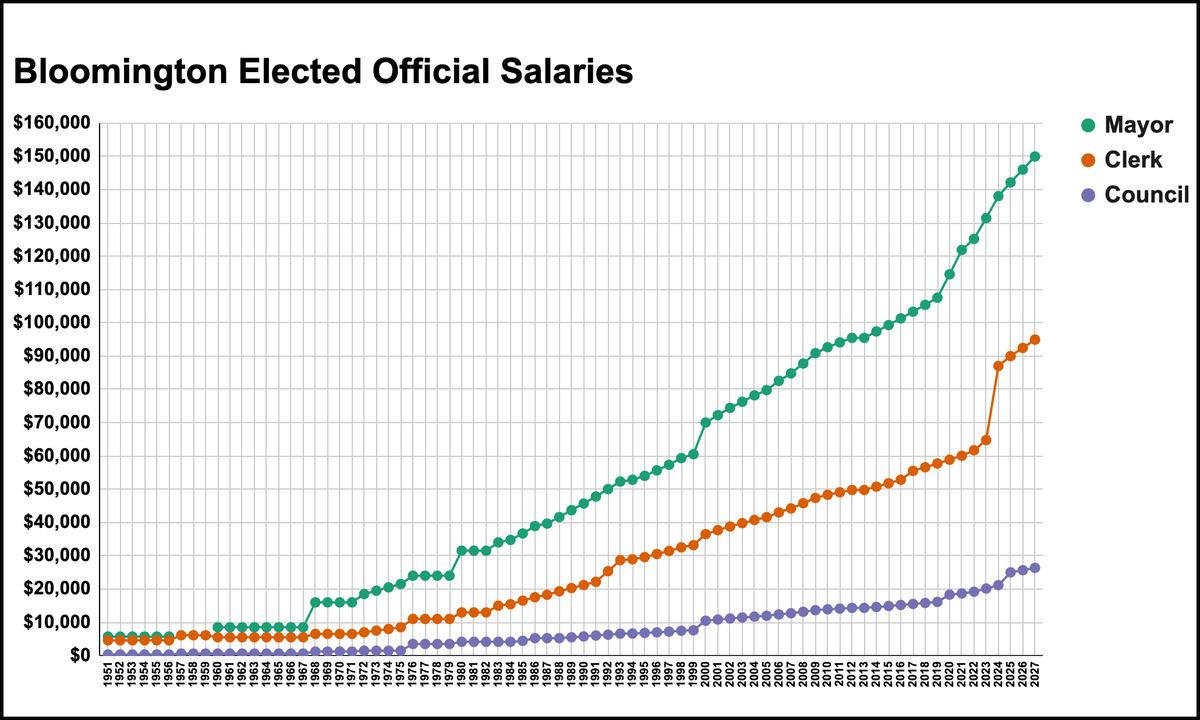
Bloomington’s city council voted 6–3 Wednesday (Nov. 18) to give the mayor, city clerk and nine councilmembers a 2.7% salary increase for 2027. It’s the same cost-of-living allowance (COLA) other city employees will receive.
Voting against the salary ordinance were Kate Rosenbarger, Matt Flaherty and Hopi Stosberg. The decision came after failed votes on two different options. It also left unresolved a two-year effort to develop a more systematic way to pay city elected officials.
The vote comes with a municipal election approaching in 2027, when voters will choose the people who will hold those offices starting in January 2028. That raises a question beyond the size of next year’s increases: If better compensation is supposed to encourage a wider range of candidates to run, could the council establish 2028 salaries before candidates decide whether to enter the race in early 2027?
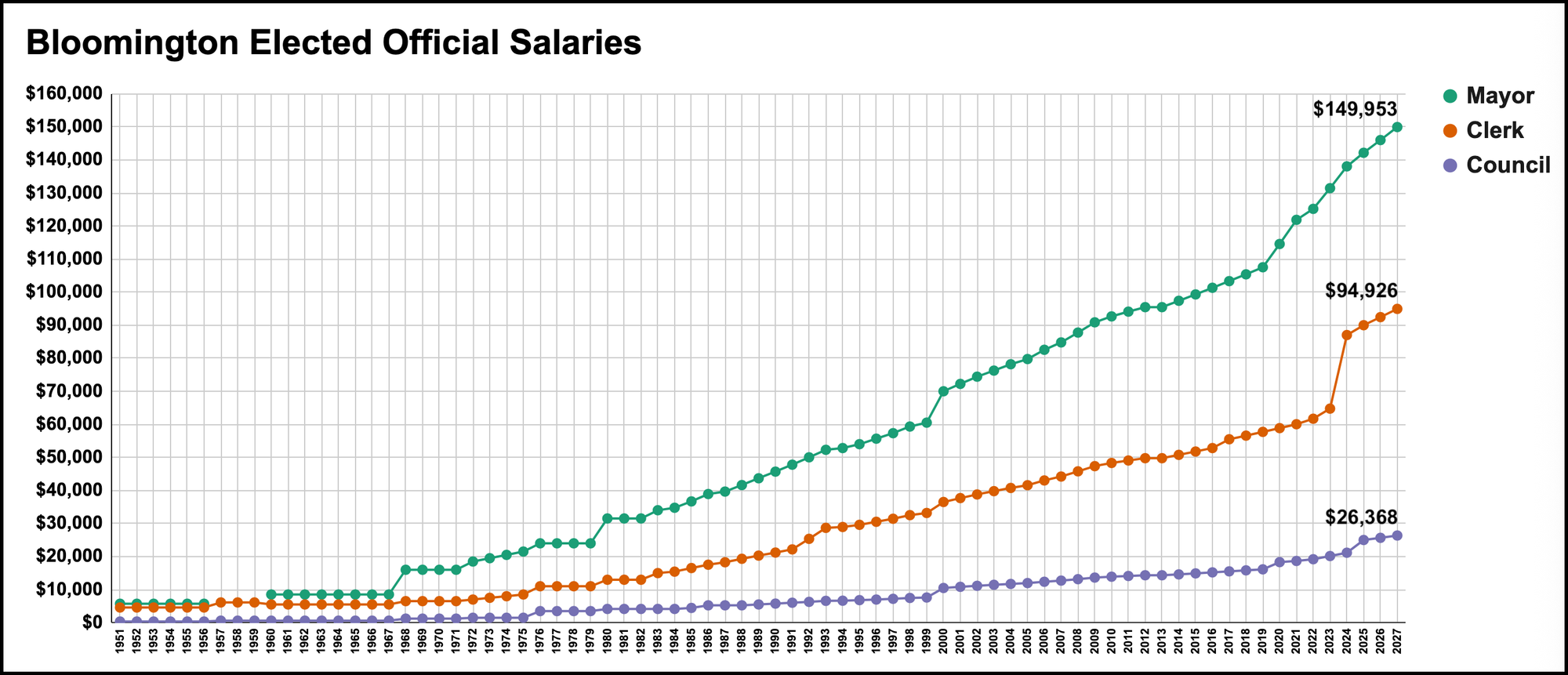
Under the ordinance approved on Wednesday night , the mayor’s annual salary will rise from $146,011 to $149,953; the clerk's from $92,430 to $94,926; and each councilmember's from $25,675 to $26,368. The council president also receives $1,500 beyond the base council salary, and the vice president $800.
Two alternatives rejected
The council's special fiscal committee had recommended the 2.7% increase by a 2–1 vote, with Hopi Stosberg dissenting and Matt Flaherty absent. The other two committee members are: Isabel Piedmont-Smith and Dave Rollo. The committee recommended following the general city employee COLA increase, rather than changing the underlying compensation structure.
Stosberg put forward two amendments on Wednesday.
The first would have given every elected official the same $1,152 increase instead of the same percentage increase. Her rationale was that giving raises based on percentage produce larger dollar-amount increases for people already earning more. A uniform percentage increase preserves the ratios between salaries, but increases the gaps measured in dollars.
Under the flat-dollar amount approach, in 2027 the mayor would have received $147,163, the clerk $93,582, and each councilmember $26,827. Applied to each of the 11 elected city officials, the flat-dollar approach would have cost virtually the same as the 2.7% proposal.
The first amendment failed 4–5. Joining Stosberg in support were Dave Rollo, Andy Ruff and Kate Rosenbarger.
Stosberg’s second amendment would have frozen the three salaries at their 2026 amounts. Stosberg argued against continuing automatic increases without first establishing defensible starting salaries. That approach failed 2–7, supported only by Stosberg and Ruff.
City clerk Nicole Bolden objected to the freezing of salaries, saying that withholding a cost-of-living increase amounts to a reduction in purchasing power, especially for an office that is a full-time job. Bloomington mayor Kerry Thomson weighed in from a remote connection. She likewise urged the council to follow the compensation approach used for other city employees until it devises a better system.
Rollo, who favored the flat-dollar amendment, nonetheless voted for the ordinance. He said the wider problem of salary disparities should be addressed across city government.
Rosenbarger voted against the final ordinance, saying the council had again missed an opportunity to pay enough to make serving feasible for more people. Flaherty and Stosberg also voted no.
How Bloomington got here
In 2024, a council committee, working from a compensation framework developed with consulting firm Crowe, recommended increasing council pay from $21,153 to $45,423, the clerk’s from $87,000 to $129,780, and the mayor’s from $138,031 to $151,410. The proposal prompted public backlash and resistance from Thomson.
The council instead settled on 2025 salaries of $25,000 for members, $90,000 for the clerk and $142,171 for the mayor. Council pay still rose more than 18%, but the effort to increase compensation of councilmembers significantly did not survive.
Salaries for the mayor, clerk and councilmembers also increased by 2.7% from 2025 to 2026. The new 2027 ordinance repeats that approach. The special fiscal committee’s October memorandum says members have agreed on guiding principles, including making public service financially feasible across socioeconomic groups. But the fiscal committee has not yet agreed on how to calculate the salaries. Another study was proposed for 2028.
Could 2028 pay be set before election deadlines?
A B Square comparison of 2023 elections in Indiana’s 19 largest cities found little connection between council salaries and the number of contested races But that does not answer the question of whether higher salaries would actually encourage people to run who currently would not consider it.
Indiana Code state law gives the council responsibility for setting annual compensation of city officials by ordinance. It prohibits changing compensation during the year for which it is fixed, and prohibits setting it below the previous year’s amount.
The statutory text does not explicitly require the council to wait until late 2027 before enacting an ordinance for 2028. On its face, adoption now or in early 2027 appears to be possible.
An ordinance for 2028 enacted in early 2027 would not necessarily be set in stone. The council could potentially amend 2028 figures during 2027, before the affected year begins, subject to the statutory salary floor. And any increase would still have to be supported by the eventual 2028 budget.
The timing matters because of the municipal election calendar. Filing for major-party candidates begins Jan. 6, 2027, and ends at noon Feb. 5. The municipal primary is May 4 with the election falling on Nov. 2. A 2028 salary ordinance passed before February would give prospective candidates a concrete number they could relay on when they are deciding whether to run, instead of asking them to trust that the next salary debate will come out differently.
Isabel Piedmont-Smith urged her council colleagues on Wednesday to tackle the issue in 2027, noting that some current councilmembers will not return.

Comments ()