
Bloomington council OKs $6.87M bond issue by narrow 5–2 vote
Bloomington’s city council approved $6.87 million in bonds for a fire truck and street improvements on a 5–2 vote. Andy Ruff opposed some street designs, while Matt Flaherty cited broken spending commitments. Dave Rollo cast a conflicted yes vote, providing the minimum needed for passage.

Around $6.87 million in general obligation bonds were approved by Bloomington’s city council at its regular Wednesday (Nov. 4) meeting. The money will pay for replacement of an aging aerial fire truck and street safety improvements.
But the 5–2 vote gave Bloomington mayor Thomson’s administration just the minimum five votes needed for passage by the nine-member council. Kate Rosenbarger and Sydney Zulich were absent.
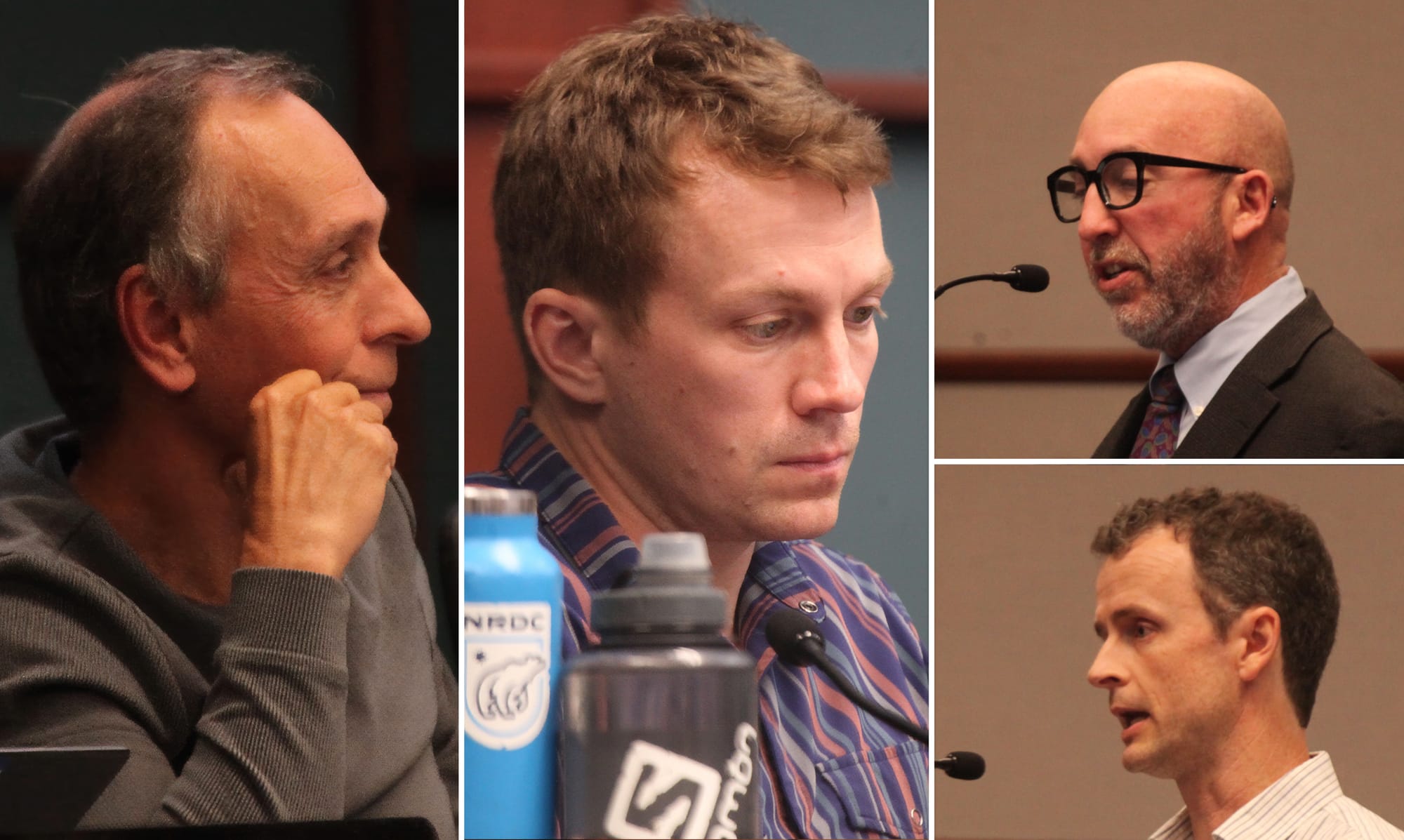
Voting in favor were Hopi Stosberg, Isabel Piedmont-Smith, Isak Asare, Courtney Daily, and Dave Rollo. Matt Flaherty and Andy Ruff voted against the ordinance, but for very different reasons.
Ruff questioned whether some of the city’s street safety improvements will actually make streets safer. Flaherty defended those improvements, but said the administration has failed to honor commitments made in connection with earlier bond appropriations.
Rollo, who ultimately supplied one of the five affirmative votes, said he was deeply conflicted about the proposal.
The bonds will provide $2.5 million to replace Bloomington’s only aerial platform fire truck, which has experienced increasingly lengthy periods out of service. Another $4.23 million is allocated to transportation improvements, including $1.7 million for 10th Street, $1.5 million for 3rd Street, and smaller amounts for sidewalks, bikeways, crosswalks and street lighting.
The debt is expected to be repaid through additional property taxes over slightly more than six years. The authorization sets a maximum interest rate of 5.5%.
The bond issue is also intended to launch a regular three-year borrowing cycle for capital improvements. That’s a strategy that city controller Geoff McKim has described as increasingly important under Indiana’s property tax restrictions.
Two different objections
Ruff proposed an amendment that would have cut the borrowing authorization in half, preserving the full $2.5 million for the fire truck while limiting the transportation spending to selected improvements, such as sidewalk reconstruction, pavement work and lighting.
To explain his objection, Ruff showed videos he had recorded while cycling through recently installed traffic-calming features west of Rogers Street along Kirkwood Avenue. He contended that curb extensions, sometimes called bumpouts, force bicyclists into narrower spaces shared with motorists and can make navigating streets more dangerous.
“I cannot vote for more of that,” Ruff said. He acknowledged that the projects are intended to improve safety but questioned whether they are achieving that goal. From the public mic, Iris Bull opposed Ruff’s amendment, noting that the videos showed a section of the street where work was not complete. Some of the pavement markings will be changing, Bull said. Bull noted that the city’s transportation commission provides a forum for evaluating design decisions.
Flaherty took the opposite position on the street improvements. He defended curb extensions and other traffic-calming measures as established, evidence-based strategies for reducing crashes, serious injuries and fatalities. He said that street design, in addition to traffic enforcement, is essential to improving safety.
Flaherty voted against Ruff’s amendment, which failed 1–6, with Ruff casting the only vote in favor.
But Flaherty subsequently voted against the complete bond ordinance on grounds of accountability. He cited at least two previous commitments that he believes the administration has failed to honor. One was restrictions on the use of bond money for the Showers West project, which was started under John Hamilton’s administration. The other was an agreement to prioritize safety improvements on Indiana Avenue.
Flaherty said the Indiana Avenue project had been delayed after opposition from a small number of Indiana University stakeholders, despite an earlier understanding between the Bloomington mayor Kerry Thomson’s administration and the council that it would be a priority.
City engineer Andrew Cibor told the council that further consideration of Indiana Avenue improvements is now expected to occur as part of a broader downtown transportation study planned for next year.
Flaherty said his objection was not to the merits of the projects proposed for the new bonds, but to what happens after the council authorizes spending. “I just don’t really find it acceptable that once we appropriate the money, council’s out of the picture and sort of whatever happens from there,” Flaherty said.
Flaherty said he would be reluctant to approve additional appropriations from the administration without stronger accountability. Referring to earlier commitments, and the old fool-me-once adage, he said: “I won’t be fooled a third time.”
City staff defend borrowing, transportation work
City controller Geoff McKim told the council that general obligation bonds have become the city’s principal practical means of financing major capital investments because other property tax revenues are constrained. “We just simply don’t have the other sources of revenue,” he said.
McKim also cautioned that cutting the bond amount in half, as Ruff had wanted to do, would not proportionately reduce the costs of issuing the debt. It could also disrupt the administration’s proposed cycle of issuing roughly six-year bonds every three years.
Cibor said some of the transportation funding is needed to take advantage of federal funding already secured for crosswalk improvements. Without the bond money, the city might be unable to use those federal dollars.
Cibor also disputed the premise that the city’s traffic-calming work creates new hazards for cyclists. He said the designs maintain bicycle lanes where they exist and preserve travel lanes that cyclists are permitted to use.
Responding to a question from Rollo about whether street improvements have produced measurable benefits, Cibor said crashes on 7th Street have declined compared with conditions before the street’s redesign, particularly since all-way stop signs were restored. He said the city collects before-and-after information on projects and makes crash data available online.
Comments from the public mic reflected the division. While Iris Bull was opposed to Ruff’s amendment, Eric Ost supported it and called for stronger council review of street designs. Paul Rousseau said that better enforcement of traffic laws should play a larger role in addressing conflicts between motorists and cyclists.
Wednesday’s commentary from the council dais and the public mic on safe street design likely foreshadowed some of the talking points that will be heard on both sides at the 5:30 p.m. Nov. 16 public hearing on the College-and-Walnut corridor study to be held by the city’s transportation commission.
Rollo’s conflicted vote
Rollo expressed concerns about the street projects and the city’s spending priorities, particularly as the city draws on reserves. He said the transportation engineering work could potentially be postponed, but the fire truck was necessary.
Rollo also characterized the need for expensive aerial firefighting equipment as a cost associated with allowing taller buildings to be constructed, with that cost ultimately falling on taxpayers generally. “I’m very conflicted about this,” Rollo said shortly before the final vote. “I’m not sure how I’ll vote.” But when the clerk called his name, Rollo voted yes.
Stosberg seemed to share some of Flaherty’s accountability concerns but said she did not want to jeopardize needed investments. She singled out the needed improvements to the horrendous intersection of Covenanter Drive and Auto Mall Road, near the eastside Kroger, and additional street lighting as particularly worthwhile.
The financial adviser’s presentation projected a property tax rate for the new bonds of $0.0249 per $100 of net assessed value, equivalent to $24.90 annually per $100,000 of assessed value before property tax caps are applied. Justin Chang of Reedy Financial Group said the additional tax burden would fall primarily on properties that are not already at their constitutional tax caps.
The ordinance authorizes borrowing up to $6,868,000 and appropriates up to $7 million, an amount that also allows for earnings on bond proceeds before they are spent.
The five yes votes were enough to authorize the borrowing, but the narrow margin underscored unresolved disagreements on fundamental issues about how Bloomington designs its streets, oversees capital expenditures, and finances infrastructure improvements.


Comments ()