
Bloomington council OKs residential TIF for Summit, now back to RDC for final step
Bloomington’s council created the 140-acre Summit District EDA and named Shasta Meadows as its first residential TIF district. The plan aims to fund major infrastructure, but sparked discussion about growth and a shift toward public financing of development.
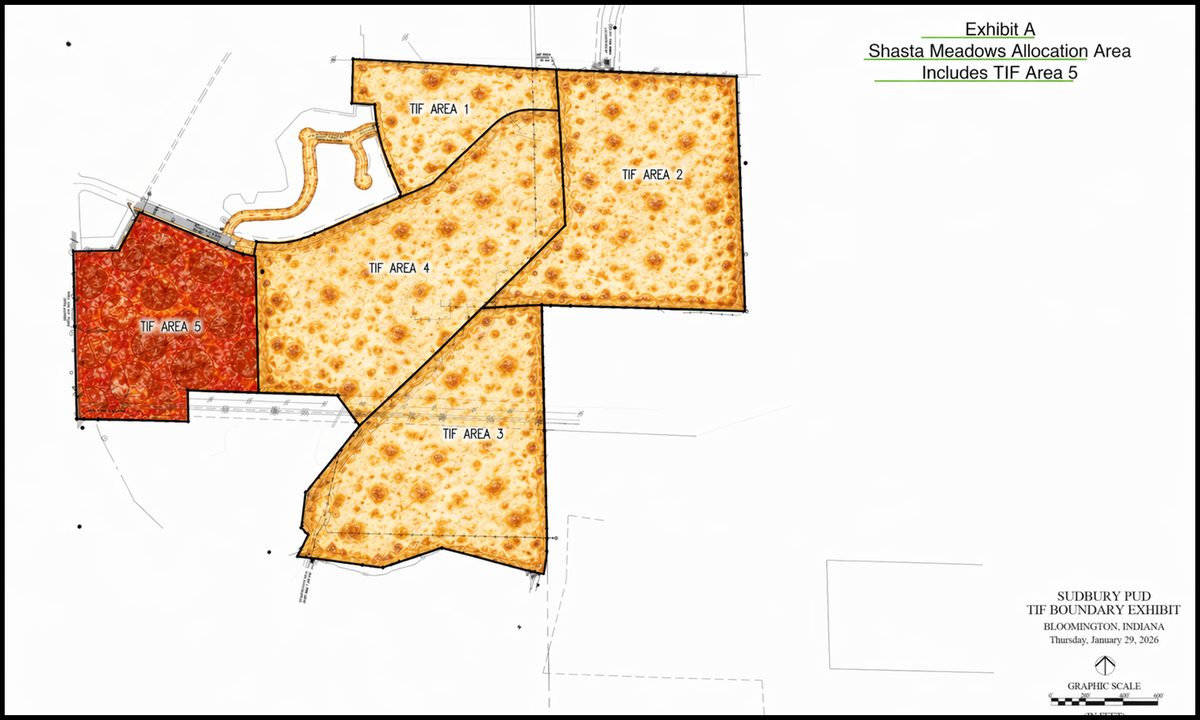
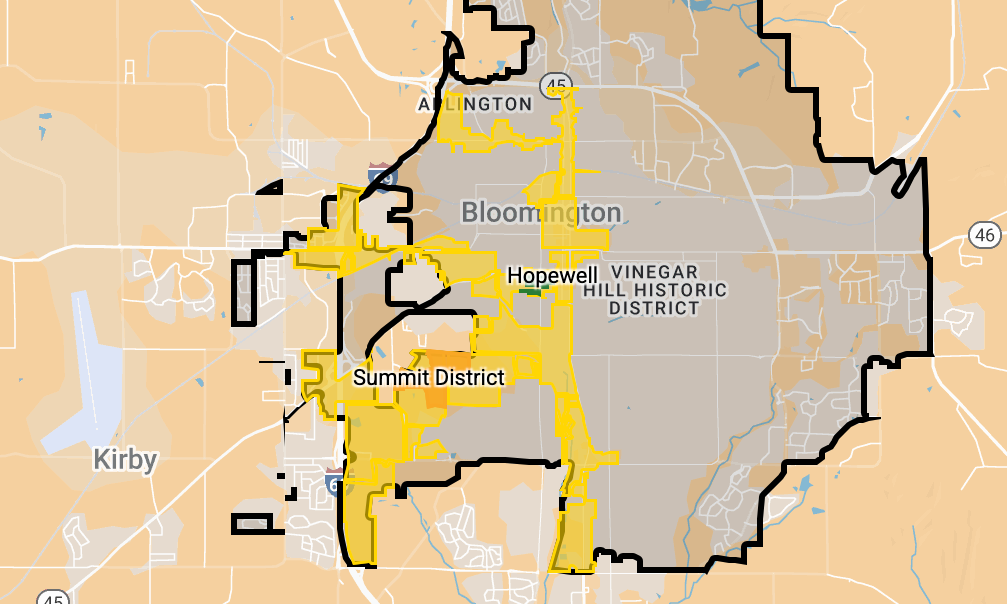
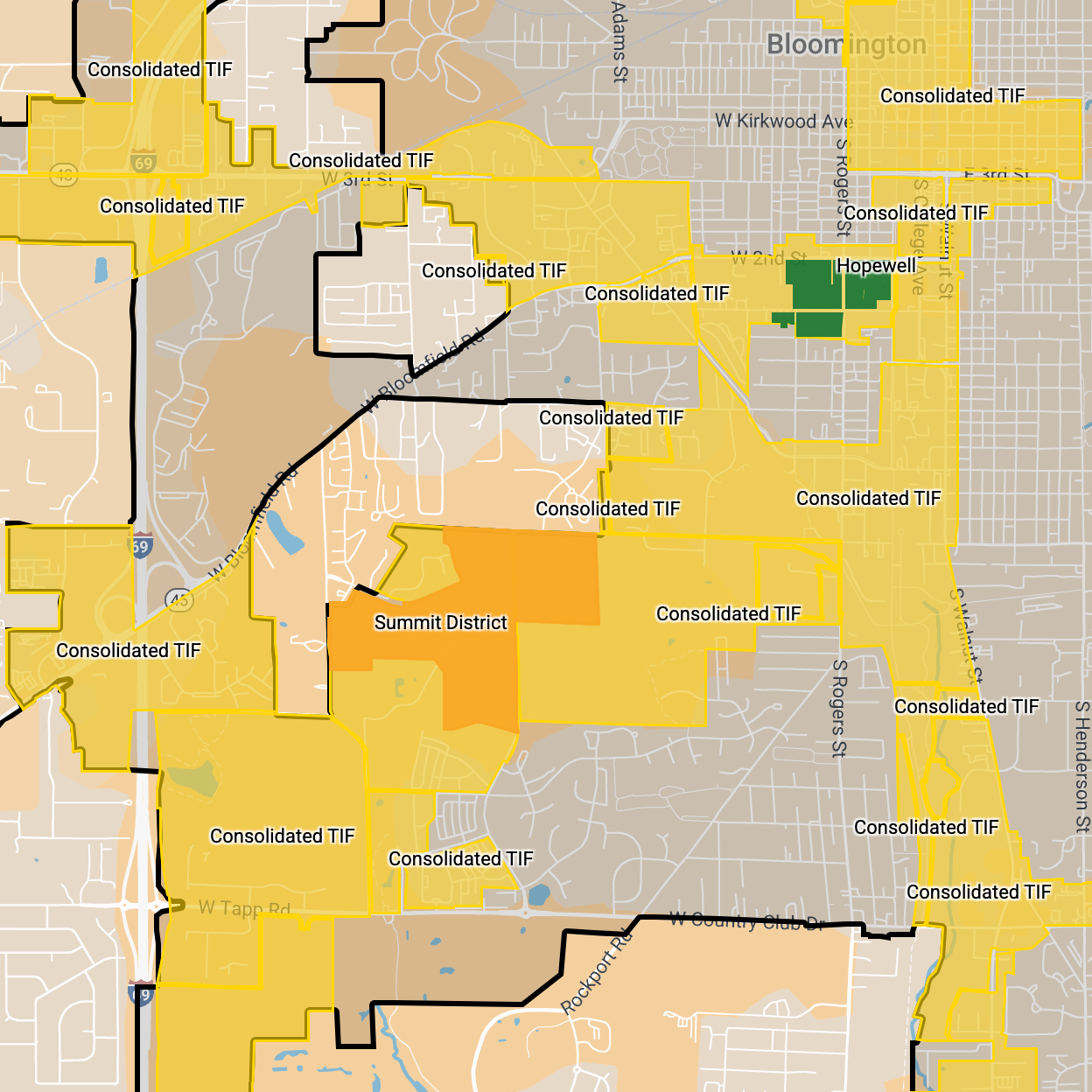
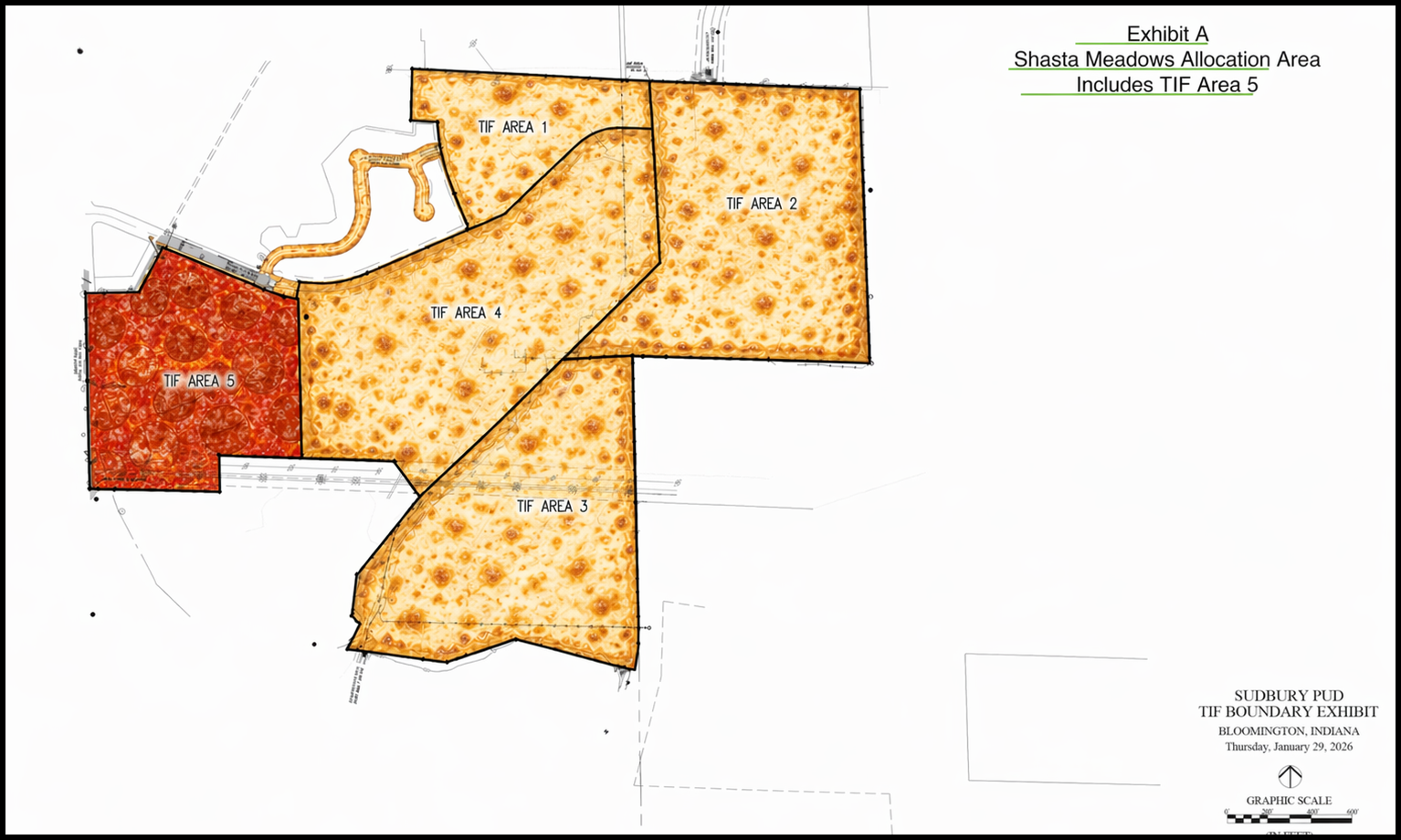
Summit District is shown in orange. Hopwell is shown in green. Bloomington’s consolidated TIF district is shown in yellow. Maps by The B Square with information from the city of Bloomington. Pizza-themed analogy for the TIF allocation area and EDA developed with the aid of DALL·E, an AI image generator developed by OpenAI. [link to dynamic map]
“If we think of an EDA and allocation area as a pizza … we’re only putting one pepperoni in there right now. Every TIF dollar generated from that pepperoni can be spent on the entire pizza.” That was the culinary analogy used by Justin Chang, of Reedy Financial Group to explain to Bloomington city councilmembers the regulations for expenditures from TIF districts inside economic development areas (EDAs).
The outcome was a unanimous vote by the city council on Wednesday (April 22) to establish Summit District as an economic development area (EDA). It’s is a 140-acre undeveloped area in the southwest part of Bloomington. The EDA is sliced up into five different TIF (tax increment finance) districts based on different neighborhoods.
The idea is to use the TIF from residential areas to pay for the development of public infrastructure like roads.
The city council’s resolution created the “Summit District” economic development Area (EDA), covering the entire Summit District PUD. That’s the “whole pizza” in Reedy Financial Group Justin Chang’s analogy. It also designated Shasta Meadows as the first TIF allocation area, as a residential TIF. Once finalized, the growth in assessed value there will be captured in Shasta Meadows and it can be spent anywhere within the Summit EDA.
The proposal now goes back to Bloomington’s redevelopment commission (RDC) for a public hearing and confirmatory resolution.
It was the RDC that got things started, with a resolution in early March, which was followed by action from Bloomington’s plan commission last week. In early January, RDC had received a briefing on the city’s planned approach to residential TIF in the city.
While TIF districts have long been used for commercial properties in Bloomington, this would be the first time a residential TIF has been used locally. In the wording of state law, Bloomington is creating a residential housing development program (RHDP)—often called a “residential TIF.”
Summit District is one of the two geographic areas where Bloomington eventually wants to use residential TIF districts. The area was approved for a rezone by the city council in May 2024. The other area envisioned for residential TIF is the planned 24-acre Hopewell neighborhood, at and around the site of the former IU Health hospital at 2nd and Rogers Streets.
While Wednesday’s meeting included a lot of discussion about the benefits of adding population to the city of Bloomington, councilmember Andy Ruff offered a dissenting view, even though he voted for the resolution on a residential TIF:
I'm at this point in my life, after being in this town over 60 years, it's been said tonight by more than one individual: This will bring lots of residents to Bloomington, which benefits us in so many ways, when we never ask ourselves: Where does that end? What's the ideal size for Bloomington—200,000? 500,000? A million?
Where does it stop? … I'm really tired of just this denial that there are downsides, and that there are a lot of people who don't agree with just the pursuit of growing the community and that it automatically results in economic benefits.
On Wednesday, assistant city attorney Dana Kerr told council members the entire Summit PUD, five neighborhoods in all, would be designated as an EDA, while Shasta Meadows would serve as the first TIF allocation area.
Kerr described the TIF as the financing mechanism for a substantial package of infrastructure in and around the development, including extending Adams Street from Bloomfield Road all the way down to Tapp Road, building a new Sudbury Road connection, constructing Vanguard Way to address the current jog and one-lane bridge on Weimer Road, upgrading at least five intersections, and supporting a potential fire station. “That’s a lot of infrastructure that needs to be done,” Kerr said.
Chang walked the council through how TIF works under Indiana’s levy-limited property tax system, stressing that under a levy system, increased assessed value alone does not generate additional revenue for local government.
A TIF allocation area, Chang said, captures the incremental value and directs the resulting revenue to the RDC. Even if there were an additional $100 million in assessed value added to the city’s tax rolls, under the levy system, without a TIF, “The city would not get any benefits from the $100 million,” he said. He described TIF as a mechanism that “is not taking any money from the city or the underlying taxing units,” but capturing revenue that would otherwise be lost to rate reductions.
He contrasted the proposed residential TIF with Bloomington’s existing commercial TIFs, noting that residential TIFs can capture both residential and commercial growth, whereas commercial TIFs cannot capture residential increment. Residential TIFs also have shorter statutory lives—20 years from bond issuance, compared to 25 years for commercial TIFs.
For Shasta Meadows, Chang said financial advisors estimate about $50 million in new assessed value, generating roughly $443,000 annually in TIF revenue. For the full Summit build-out, which is estimated at $477 million in new assessed value, that could translate to roughly $4.7 million to $9.4 million per year, depending on tax caps. Chang cautioned that those figures were “broad strokes.”
Council members also asked about impacts on other taxing units, especially Monroe County Community School Corporation (MCCSC). Chang said the effect would largely come through circuit breaker credits, estimating a “worst case” reduction of about $16,000 annually from Shasta Meadows. He added that new residential development would likely bring additional students which means more revenue based on state funding formulas, which could more than offset that impact.
City controller Geoff McKim stressed the more general point: “With the TIF, we can actually bring in more revenue for city infrastructure than we could without the TIF.”
The sharpest discussion focused not on the mechanics of TIF, but on whether the proposal represented a shift in city policy. Councilmember Matt Flaherty said Bloomington has historically required developers to pay for infrastructure associated with large projects. “Historically… we have not spent public dollars on this type of thing,” he said, making the point that the Summit TIF proposal appears to mark a departure from that approach. Flaherty expressed some frustration about the lack of a clear discussion about the change in a major policy.
Travis Vencel, one of the Summit District developers, told the council that the sequencing of the project, which requires major roads like Sudbury and Adams to be built before occupancy, makes public contributions necessary. He added that “significant public infrastructure money” had been part of discussions early on. The Summit PUD anticipated city participation, Vencel said, pointing to wording in the PUD plan that referred to utility expansion and funding sources, including TIF.
When Bloomington mayor Mayor Kerry Thomson took the mic, she described the earlier understanding more cautiously, saying there had been no firm commitment, but that financing infrastructure before development generates revenue had always been a challenge.
Councilmember Hopi Stosberg said the public funding implications felt “like a surprise.”
Councilmember Andy Ruff said he believed some level of partnership had been contemplated when the PUD was approved, but used the moment to question broader assumptions about growth. “We never ask ourselves, where does that end?”
Other councilmembers pointed to the site’s long vacancy and the city’s housing needs. Isabel Piedmont-Smith said the land had sat undeveloped for decades largely because of infrastructure costs: “We need this development.”
Stosberg said about the use of public money for infrastructure that “it feels like a bait and switch to me,” but said she would support the resolution because “it can’t proceed without these roads.”


Comments ()