
Bloomington council signals support for Hopewell South PUD zoning, but won’t vote sooner than March 25
The Bloomington city council signaled support for the Hopewell South housing development, but put off a final vote until March 25. The proposal would allow about 98 homes on 6.3 acres of city-owned land near 2nd and Rogers, more than the roughly 28 units allowed under current zoning.
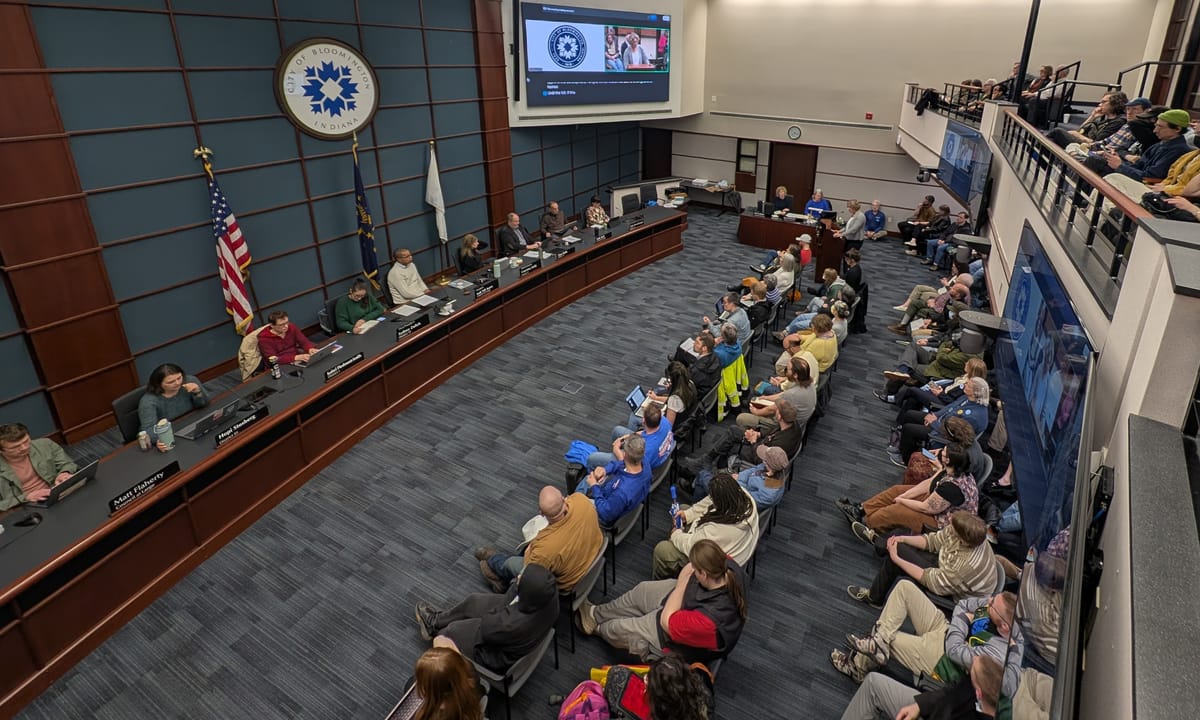
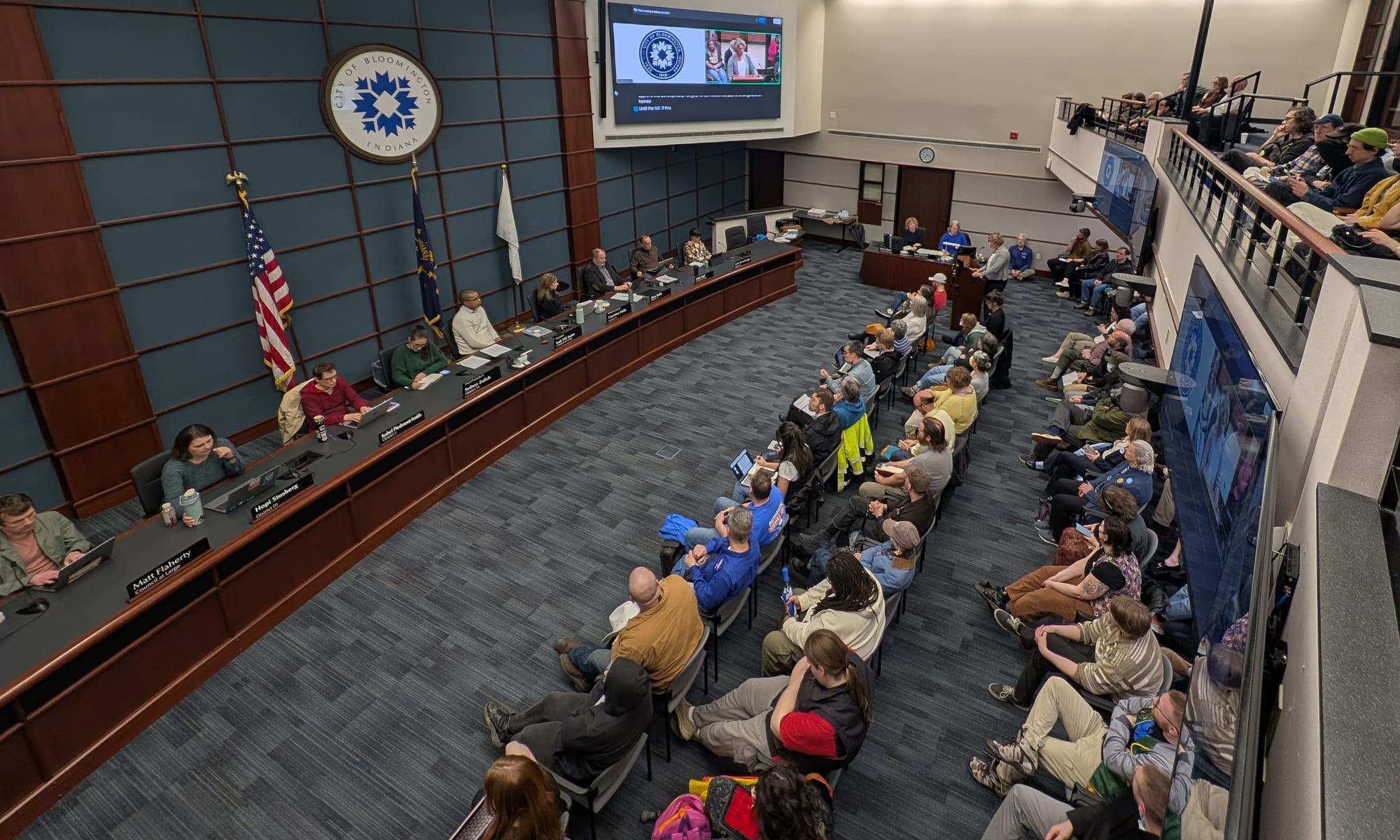
On Wednesday (March 4), the Bloomington city council signaled broad support for the Hopewell South planned unit development (PUD) rezone, but stopped short of approving it the same night it was first discussed. It will be up for more discussion and a possible vote at the council’s next regular meeting on March 25.
The 6.3-acre piece of real estate, owned by the city’s redevelopment commission, is part of the planned new 24-acre Hopewell neighborhood, at and around the site of the former IU Health hospital at 2nd and Rogers Streets. Ownership by the city’s RDC meant that the rezone petition was coming from the city itself.
The existing buildings of Hopewell South, south of 1st Street and west of Rogers, have been demolished, except for the former Bloomington Convalescent Center building at 714 S. Rogers, which the city is eying as a possible location for a new police headquarters.
The city’s plan is to redevelop all of the Hopewell South area with additional housing.
Procedural issues
At its previous meeting, on Feb. 18, the council refused to allow the Hopewell South item to be introduced, with that vote failing 2–7. Only council president Isak Asare and vice president Sydney Zulich voted in favor.
But at the same Feb. 18 meeting, the council enacted a change to the local law on the city council’s procedures, which meant that the Hopewell South PUD could get discussion on Wednesday, the same night it was introduced. Previously, any discussion of an ordinance was prohibited on the same night it was introduced.
That change in procedure also cleared the way for a final vote of the Hopewell South PUD, without the unanimous consent and two-thirds majority requirement in state law, which apply to ordinances generally if they are considered on the same day or same meeting when they are introduced. That’s because the same statute has an explicit exception for zoning laws.
Dissenting on the council’s 6–3 vote, to consider the Hopewell South PUD at its March 25 regular meeting, were Asare, Zulich and Courtney Daily, who were not opposed to the Hopewell South PUD, but who were in favor of voting on it that night, instead of waiting another three weeks.
Substance of the Hopewell South PUD
The geographic area of the PUD includes roughly a block and a half near the former IU Health hospital site, with an emphasis on small-lot, owner‑occupied housing, a mix of housing types, and pre‑approved building plans intended to streamline permitting and lower costs.
Much of the technical presentation was given by Alli Quinlan from the Flintlock LAB, the consultant hired by the city in summer 2025, who walked the council through the proposed site plan and standards.
The proposed PUD is supposed to include more housing than would be possible under the existing zoning. Hopewell South has a target build‑out of about 98 housing units, compared to 28 under the existing R4 zoning.
Planned for Hopewell South is a mix of single‑family houses, duplexes, small multifamily buildings, and townhouses, with lot sizes and building types calibrated to support lower price points. The plan relies on smaller rights‑of‑way and “lanes” that still meet fire and ADA standards, but allow more buildable land.
The plan comes with a commitment that 30% of units will meet at least Universal Design accessibility standards, with some units built to higher standard, clustered where the topography allows zero‑step entries.
Maintenance of common green areas and walkways would be handled by an HOA (homeowners association), with estimated HOA dues incorporated into the project’s affordability calculations. The PUD commits to more than 50% of the homes being affordable at 100% of area median income (AMI).
Under the PUD, the city’s redevelopment commission (RDC), which owns the real estate, would initially control the land and disposition of the affordable units.
Anna Killion‑Hanson, who is executive director of the RDC, said the RDC is agreeing to the permanent affordability requirements that are in the city’s current UDO, but stressed that its heavy reliance on deed restrictions is problematic for conventional mortgage financing.
Killion-Hanson put it like this: “A policy that makes homes technically affordable, but impossible to finance does not create home ownership, it prevents it.”
She listed out some alternative tools the administration is exploring, including: silent second mortgages (repaid on refinance or resale so subsidy can be recycled); shared equity agreements (where part of appreciation returns to the city to help the next buyer), and rights of first offer (so the city or a nonprofit can step in to preserve affordability, without permanently restricting the deed).
Killion‑Hanson told the council that most buyers will rely on Fannie Mae/Freddie Mac‑backed mortgages, which require “clear, marketable title and predictable resale rights,” and said policies that technically create affordability, but make homes unfinanceable “do not create home ownership—they prevent it.”
Advocacy from the mayor
Bloomington mayor Kerry Thomson told council members the administration chose a PUD for Hopewell South, instead of a revision to the definition of R4 zoning which would apply citywide—because those changes to the city’s Unified Development Ordinance (UDO) “would be onerous and would take a very long time,” while the city is “urgently in need of housing now.” She also said that without a PUD, the proposal would have required changes to the city’s transportation plan.
Thomson described Hopewell South as a “living model” that can demonstrate, in the near term, how more compact land use and smaller lots can yield more “attainable housing,” with the expectation that future UDO changes would reflect lessons learned from the project.
No specific ground‑breaking date was given during the meeting, but the request for council action was framed as time‑sensitive: approval of the PUD would clear the way for primary plat review by the plan commission and then for infrastructure work (streets, utilities, stormwater) to proceed in a single phase, followed by construction of homes.
Against final action at same meeting
Mitigating against the possibility of final action on Wednesday night were a couple of “reasonable conditions” that some councilmembers wanted to draft and incorporate into the Hopewell South PUD.
Councilmember Hopi Stosberg identified some places in the stated intent of the PUD where there did not seem to be good alignment with the use table. So she asked if the city would be amenable to a reasonable condition that brought them into better alignment.
The city’s consultant, Alli Quinlan, with Flintlock LAB, said she is “very open to council recommendations and thoughts on any uses, that as a condition of approval would want to be struck from that use table.” Quinlan pointed out that the use table was based on the one for R4, which needed to be modified to add multi-family buildings.
Another suggestion for a reasonable condition, to which Quinlan was amenable, was a requirement that buildings be all-electric. That suggestion came from councilmember Matt Flaherty, who pointed out that all-electric buildings are a goal of the city’s climate action plan.
Leaving aside the additional time that was needed to draft the two reasonable conditions, the majority of councilmembers were resistant to the idea of voting on the proposal that night. Stosberg said if the proposal had come from a private developer, instead of the city itself, she doubted anyone would be urging the council to “hurry up and push it through.”
Councilmember Isabel Piedmont‑Smith described herself as “generally favorable” toward the Hopewell South PUD proposal, but said that handling a PUD with the significance of Hopewell South in only one meeting “would be highly unusual.”
Councilmember Dave Rollo also said he generally supports the Hopewell South PUD but also supported a delay, saying, “It’s permanent, and it’s significant, and it’s vital for our community, and it deserves due consideration.”
Remarks in support from the public mic
Erin Reynolds-Nylund, housing solutions director with Heading Home of South Central Indiana, stressed how lack of affordable housing drives and prolongs homelessness, saying that single adults in the region take an average of 169 days to find housing again after becoming homeless. She said Hopewell South could make a positive impact by expanding attainable housing options.
Tina Peterson, president and CEO of the Community Foundation of Bloomington and Monroe County, called housing the top community challenge identified in her organization’s outreach. She described housing as an urgent need, and asked the council to support the Hopewell South PUD that night to “signal your shared understanding of that urgency.”
Eric Spoonmore, president and CEO of the Greater Bloomington Chamber of Commerce asked for a unanimous vote of the council that night, calling housing “the most pressing issue facing Bloomington.” He tied Hopewell to business recruitment and retention and argued that the pre‑approved design framework that is included with Hopewell South would make the UDO more navigable for local builders.
Ron Walker, president of CFC Properties and Workforce Housing LLC (Cook Group companies), said Cook’s experience building and selling roughly 30 below‑market-rate homes in Spencer shows how directly housing supply affects recruitment. He said Cook is “excited about Hopewell” and urged the council not to delay.
Nathan Ferreira, executive director of the Bloomington Housing Authority and its nonprofit affiliate, Summit Hill Community Development Corporation, said Hopewell includes many of the strategies that BHA and Summit Hill have been pushing for years, including mixed-income, small lots, pre‑approved plans, and permanent affordability. He called it a “large step in the right direction” and asked the council to take a vote that night.
Jason Bell, who is president and CEO of the Building Association of South Central Indiana, said he receives “at least every day, if not twice, three times a day” calls from people who work in Bloomington but cannot live here. Bell called Hopewell South “the answer” for many of them.
Markay Winston, who is superintendent of the Monroe County Community School Corporation, talked about the connection between housing and schools, saying the corporation, despite competitive starting salaries for teachers, has “lost many talented candidates because they could not find housing that they could afford within our community.” Winston said, “Affordable housing is a school issue.”
Paul Ash, with the nearby McDoel Gardens Neighborhood Association said the group met to discuss the Hopewell South. He said while the neighborhood association has some reservations about overflow parking and congestion in general, and the proposal is denser than the already compact urban form of McDoel Gardens, “We have our minds open to these innovations.
Remarks in opposition from the public mic
Bloomington resident Greg Alexander was the only commenter on Wednesday who clearly opposed the PUD as proposed.
Alexander criticized several aspects of the proposal and process. He criticized the over‑specification of individual building designs in a site‑specific PUD instead of adopting “good zoning code that anybody can use” city‑wide.
He criticized the use of PUDs generally, which he said “politicize housing.” As evidence of the politics that get injected into PUD approvals he pointed to a news release from Bloomington mayor after the council refused to allow the introduction of the Hopewell PUD at its Feb. 18 meeting. In the release, Alexander told the council, the mayor had “excoriated you in a press release because you didn’t bend your rules.”
Alexander said the city needs comprehensive zoning reform, not piecemeal PUDs “one and a half blocks at a time.” He predicted that any serious citywide zoning agenda would generate much more intense opposition than Hopewell, but that council had been elected “to do a job” that cannot be done through isolated PUDs.
[Note: The reporter is married to Mary Morgan, who is director of Heading Home of South Central Indiana, which is mentioned in the article.]
Comments ()