Bloomington paid full $95K branding contract, key deliverables still not finished 4 months later
Bloomington paid the full $95K CivicBrand contract last November, but two major parts of the branding project remain unfinished. The episode raises broader questions about the city’s payment practices, compliance with federal accessibility rules, and how public records are shared.
The city of Bloomington paid the full not-to-exceed $95,000 value of a contract with CivicBrand last November, even though two big parts of the branding project are apparently still being developed almost four months later, according to city records and statements from city officials.
The branding contract has daylighted other issues besides adherence to generally accepted accounting principles.
Other policy questions include how the city of Bloomington is planning to achieve conformance with new Web Content Accessibility Guidelines (WCAG) 2.1 by April 24, and whether the city generally makes documents generally available to the public, when they are provided to someone who asks for them under a formal records request.
Payment for work not yet completed?
In late January 2025, the city signed a $95,000 contract with the consulting firm CivicBrand for a “place branding” initiative intended to define how Bloomington presents itself to residents, visitors and potential businesses.
Under the scope of work specified under the contract, CivicBrand’s work was divided into four tasks: a kickoff; research and brand audit; a brand strategy; and implementation guidance. In the contract, payments are explicitly supposed to be tied to the percentage of the project completed.
Bloomington’s online financial records show that the final payment—covering the last 15% of the contract, and bringing the total to $95,000—was made on Nov. 21, 2025.
But a formal records request for the CivicBrand deliverables made on Feb. 22 by The B Square, yielded just two documents—a community survey summary and a 117-page brand audit prepared by CivicBrand. Those documents look like they’re related to Task 1 and Task 2 in the scope of work. The city’s March 5 response to The B Square’s records request stated: “All records have been released, and your request has been fulfilled.”
But no documents corresponding to the contract’s third and fourth tasks—brand strategy and implementation planning—were included in the city’s response.
In a March 12 email responding to questions from The B Square Bulletin, Bloomington communications director Desiree DeMolina indicated that the final two tasks remain unfinished: “CivicBrand continues to develop Tasks 3 (Brand Strategy) and 4 (Implementation) with the City,” DeMolina wrote. She added, “Those items remain deliberative and under review and are not finalized or available as standalone deliverables yet.”
The timeline raises at least two possibilities: Either the city approved payment for invoices indicating completion, before all contractual deliverables were actually finished, or additional materials exist that were already provided to the city, but not produced in response to The B Square’s public records request.
A third possibility is that an amendment of the contract was made later, or an additional contract was signed, without getting posted to the city’s repository of public contracts. DeMolina did not respond to specific questions about that third possibility.
The city has not yet provided an explanation reconciling the payment timeline with the status of the remaining work.
Branding audit: What is Bloomington’s identity?
The branding audit done by CivicBrand summarizes research from surveys, interviews, focus groups and site visits intended to guide the eventual branding strategy.
Respondents consistently pointed to Indiana University as the central driver of Bloomington’s cultural and intellectual life. The presence of the university, along with a strong arts scene, outdoor recreation opportunities and a walkable downtown, were cited as the city’s defining characteristics. Consultants summarized the city’s appeal with a concept they say surfaced repeatedly during interviews: Bloomington’s “wholesome educated weirdness.”
But the audit also identifies challenges in how the city presents itself publicly.
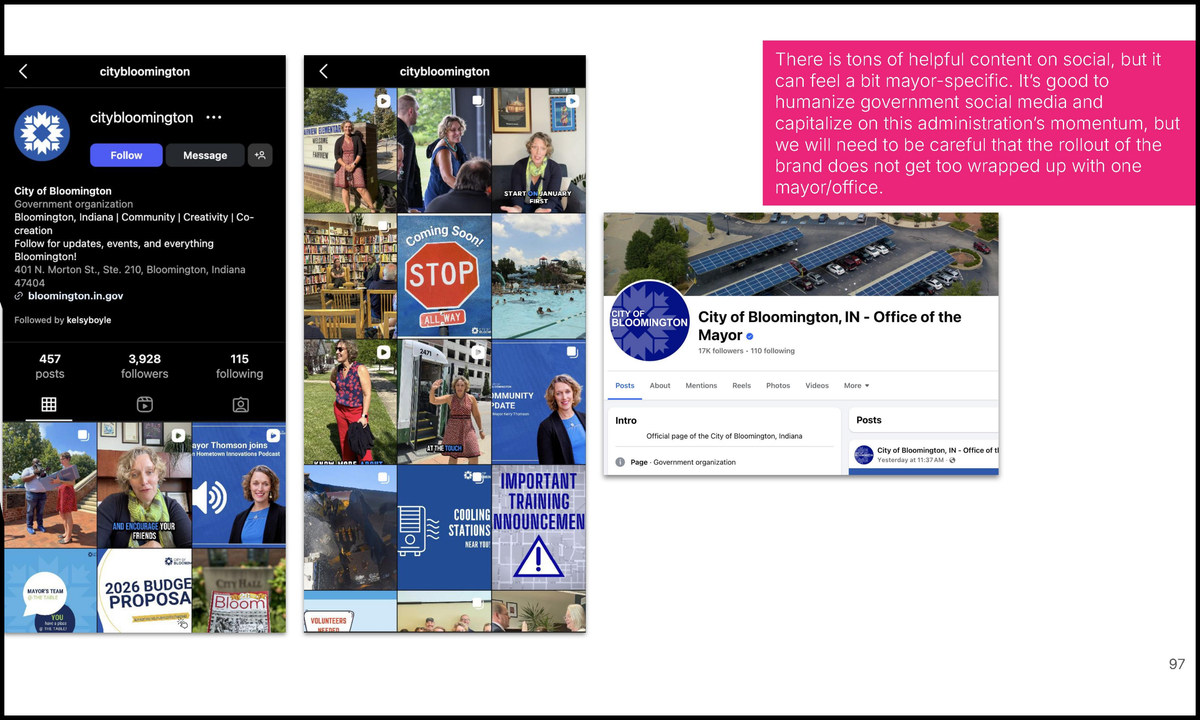
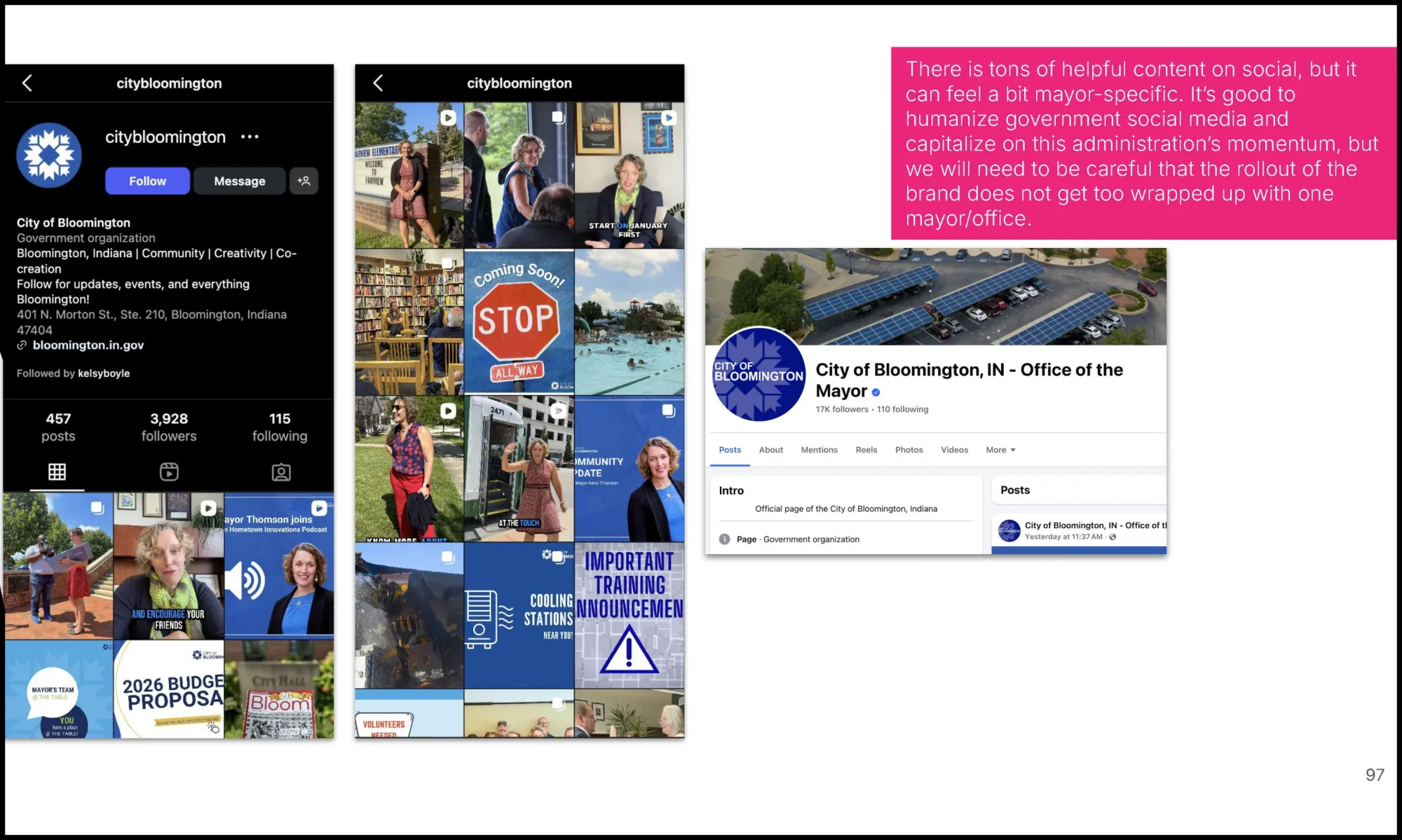
One section reviewing Bloomington’s communications notes that some messaging appears very closely tied to the mayor’s office, including social media posts and initiatives promoted through official city channels.
When civic messaging is too closely associated with a particular administration, the report notes, “it can feel a bit mayor-specific.” The consultants recommend building a civic identity that is less tied to a single administration and more rooted in the city’s long-term character.
One of the report’s core recommendations is to build momentum for Bloomington’s identity that “outlives any mayor, council, or moment in time.”
Accessibility compliance question
The release of the brand audit also prompts questions about whether the document provided by CivicBrand meets the accessibility requirements spelled out in the city’s contract with CivicBrand.
The agreement requires “final deliverables” to comply with Web Content Accessibility Guidelines (WCAG) 2.1, which ensure digital documents can be used by people who rely on screen readers and other assistive technology. However, the audit released by the city includes images containing text that cannot be highlighted or read as machine-readable text.
DeMolina’s response to a B Square question boils down to a claim that the brand audit and survey summaries were not “final deliverables” to which the contract clause refers. “The referenced Brand Audit is an internal research and analysis report produced as part of the CivicBrand engagement,” she wrote. DeMolina added: “Accessibility standards apply to materials the City publishes or intends to publish through its public-facing digital services.”
Availability of records on city’s records request platform
A potentially related issue involves how the Civic Brand documents were shared through the city’s NextRequest public-records portal. One of the big benefits to the NextRequest platform, which was adopted by Bloomington starting in 2023, is that documents released to a requester can simultaneously be released to the general public.
If documents are available to the general public, however, they will soon have to conform with the WCAG 2.1 requirements.
The city’s legal department, which handles all the records requests, has the ability to set the visibility of the produced documents to just the requestor and staff. But the decision on the visibility of the documents to the general public is made on a case-by-case basis, according to corporation counsel Margie Rice. Responding to an emailed B Square question, Rice indicated that conformance with the WCAG 2.1 requirements could factor into the decision on whether records are released to the public or just the requester, even if there has not been a “blanket change” to the city’s discretionary approach.
Rice wrote: “Separately, the City is reviewing its records practices in light of upcoming federal digital accessibility requirements.” Rice added, “For many older files, additional review or remediation may be required before they can be posted in an accessible format. Going forward, not all documents may be made publicly available; however, they will always be made available to the requester.”
Responding to a B Square question, Rice wrote that there is no written policy on whether documents are released on NextRequest to just the requester, or to the public at the same time.
For documents produced in connection to a different records request, which Rice also chose not to make visible to the public, The B Square asked for as much detail as possible on all the factors that Rice weighed in determining not to make the documents visible to the public as well as to The B Square. Rice failed to provide any details, writing, “Public records requests are fulfilled per requirements of the Indiana Code and guidance provided by the Public Access Counselor.”
Rice’s statement continues, “Nothing requires records to be made generally available to the public; however, the City may, on a case-by-case basis, decide to release documents from a particular request to the general public. Factors will vary depending upon the circumstances.” Rice concluded, “In this instance, the responsive records were provided directly to the requestor, which satisfies the City’s obligations under the Indiana Access to Public Records Act.”
Bloomington mayor Kerry Thomson is in apparent agreement with Rice that the Civic Brand brand audit should not be made available to the general public by the city, and that no reason needs to be given for that decision, given her non-response to a text from the B Square: “I am writing to ask that you direct Margie Rice to mark the $95K CivicBrand brand audit as visible to the public in the NextRequest system, or else offer an explanation as to why she has chosen to hide it from public view. Thank you for considering.”
The BloomDocs project of the B Square is a repository where such documents can be uploaded, even if the city of Bloomington chooses not to release them to the public.

Comments ()