
Bloomington RDC puts off resolution on donating land for host hotel
Bloomington’s RDC delayed action on a revised resolution that could make the $7M College Square property available at little or no cost for a proposed host hotel. City councilmembers objected, citing past commitments, as doubts persist about Dora Hospitality’s funding gap.
At its regular Monday meeting (Dec. 1), Bloomington’s redevelopment commission (RDC) delayed a vote on a resolution about making a city-owned property available at essentially no cost for a proposed convention center “host hotel.”
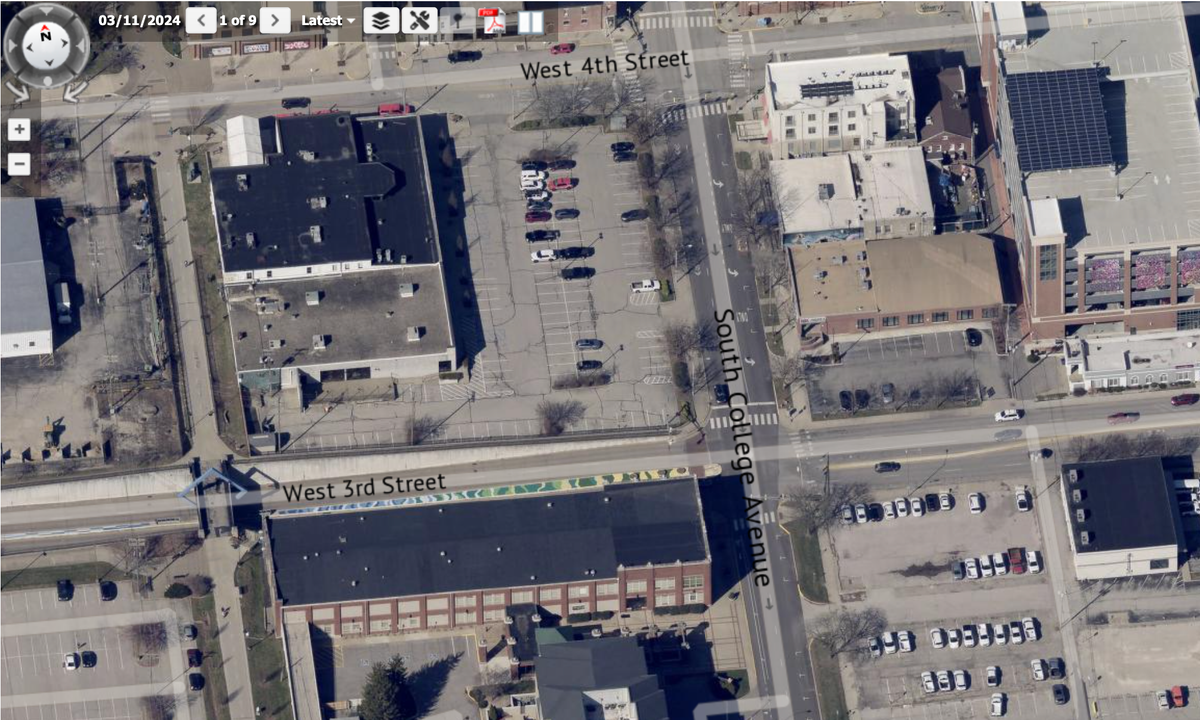
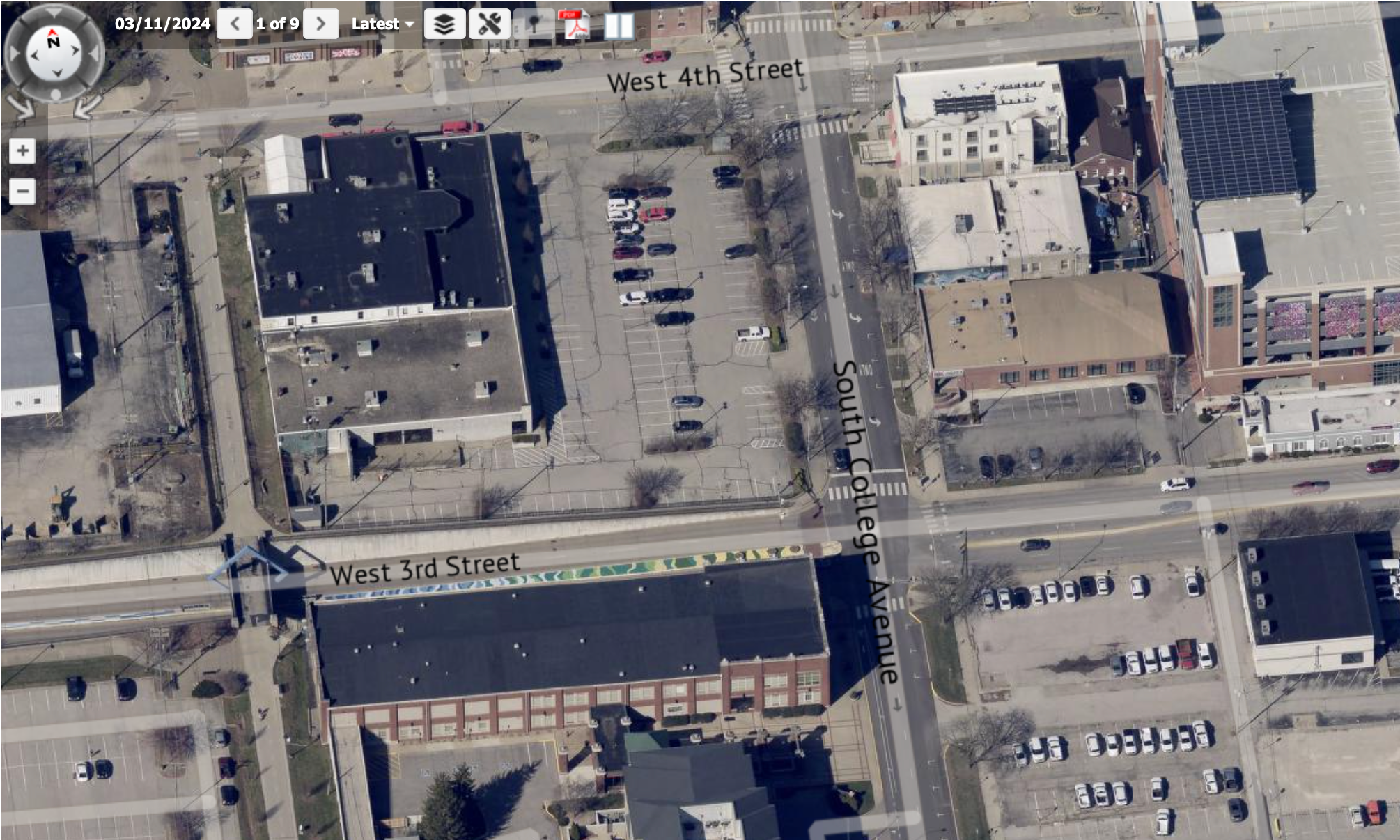
The real estate is at 4th Street and College Avenue, commonly called the former Bunger & Robertson site, but officially is College Square.
The resolution is controversial, because it flips Bloomington mayor Kerry Thomson’s previous position, which was also consistent with that of the city council, that the $7-million purchase price for the land should be recouped. Two of the five RDC positions are appointed by the city council; the other three are appointed by the mayor.
From the public mic at Monday’s meeting, three city council members weighed in against the resolution—Isabel Piedmont-Smith, Hopi Stosberg, and Andy Ruff. RDC members also reported receiving email messages from other councilmembers, also in opposition.
The reason for the delay was a decision during Monday’s meeting to swap in a revised version of the original resolution that was included in the meeting information packet. The revised version adds a hedge in a “resolved” clause, and adds some transactional history of the property in a “whereas” clause.
RDC members wanted the public to have a chance to review the revised resolution in writing before they take a vote on it, which is now set for the next regular RDC meeting, on Dec. 15.
The wording that was added in the “resolved” clause was an if-clause: “... if it furthers the best interest of economic development and the City of Bloomington.”
The additional information in the whereas clauses recounts the two separate transactions that were used to purchase the land—because it was purchased from two different owners.
The land was acquired by the RDC, using TIF (tax increment finance) revenue, in two separate transactions—one in 2019 and the other in 2023. The first transaction was a step taken by Bloomington’s then-mayor John Hamilton—an attempt to steer the convention center expansion site preference to the north of the existing facility.
The RDC’s resolution is not specific to any particular hotel developer, even though the RDC has been in negotiations on the property with Dora Hospitality for over a year.
The negotiations started after the CIB chose Dora as its preferred hotelier in October 2024. The lack of visible progress on the host hotel land deal, even as structural steel goes up for the convention center expansion, prompted the CIB to give a Dec. 17 deadline to the RDC and Dora.
Even if the RDC’s discussion of the real estate negotiations had been going on in executive sessions, closed to the public, the city’s price was believed to be a sticking point. Under Indiana’s Open Door Law, real estate transitions are one of the topics on which a governing agency can hold an executive session.
But based on the RDC deliberations on Monday, it looks like there’s still a lot of skepticism that a deal would go through with Dora, even with the possibility of getting the land at no cost, or some nominal amount, as with a $1 a year long-term lease. That’s because Dora has a big funding gap, which was not specified in a dollar amount at Monday’s meeting. RDC executive director Anna Killion-Hanson called the gap “significant.”
The gap looks like it’s more than $22 million.
That number starts with the purchase price of the real estate, which was around $7 million. The Monroe County capital improvement board (CIB) has also recently said there are several elements that it does not consider to be absolutely essential to a host hotel, like a skybridge across 3rd Street to the existing facility, underground parking, and a rooftop bar—elements that have an estimated cost of $15 million.
CIB president John Whikehart said at Monday’s meeting that the CIB and and the RDC, with its pending resolution, had done all they could do, to make possible a hotel development at the site, which he described as the best location, for a hotel to support the convention center expansion. Whikehart said: “The College Square property is clearly the best location for the host hotel because of its proximity to our square, our shops, our galleries, our restaurants, and the best walkable opportunity for visitors to interact as pedestrians with our communities.”
Whikehart said that if the RDC’s resolution passes, then he is “totally confident that both the RDC and the CIB have done everything possible for the development of the host hotel on this site.” He told RDC members: “We can ask no more of you, and we have given what we can give.” To cover any remaining funding gap, Whikehart said, it “will be left up to Dora Hospitality to increase its investment of private capital.”
The idea that the real estate would be essentially donated to the project is a significant change from Bloomington mayor Kerry Thomson’s administration’s previous position, which was that the city needed to see reimbursement from the roughly $7 million that was paid for the real estate. Thomson said the proceeds from the property need to be invested in a way that helps address the affordable housing needs in the city.
The idea that the land could essentially be donated is also at odds with the Bloomington city council’s formal position on the topic, which was expressed in a letter to the RDC dated May 6, 2024:
Any land owned by the RDC that may be considered for an expanded convention center site must be purchased by the CIB (or other entity, for example, a hotelier) for, at minimum, the price the RDC paid to acquire the property. Specifically, in the case of the RDC property west of College Avenue and between Third and Fourth Streets (sometimes referred to as the former Bunger & Robertson property), this would be a minimum purchase price of $6,895,000. The RDC may also want to consider asking for a higher purchase price if an appraisal indicates a fair market value above $6,895,000.
Councilmembers who spoke in opposition to the resolution on Monday cited their letter from more than a year ago. Ruff also stressed the idea that many councilmembers who had supported the project all along had done so with the understanding that only food and beverage tax revenue would be used to fund the convention center expansion.
The proposal to put the purchase price of the former Bunger & Robertson real estate into the hotel project, which is integral to the convention center expansion, would effectively add TIF revenue to the food and beverage tax revenue, Ruff said. That was not something that he had ever supported.


Comments ()