
Bloomington to consider establishing future residential areas as TIF districts
Bloomington’s redevelopment commission is considering carving two future residential areas—Summit District and Hopewell—out of the city’s consolidated TIF area to form separate “residential TIF” districts. No decisions are final yet. A multi-step public approval process begins Feb. 5.
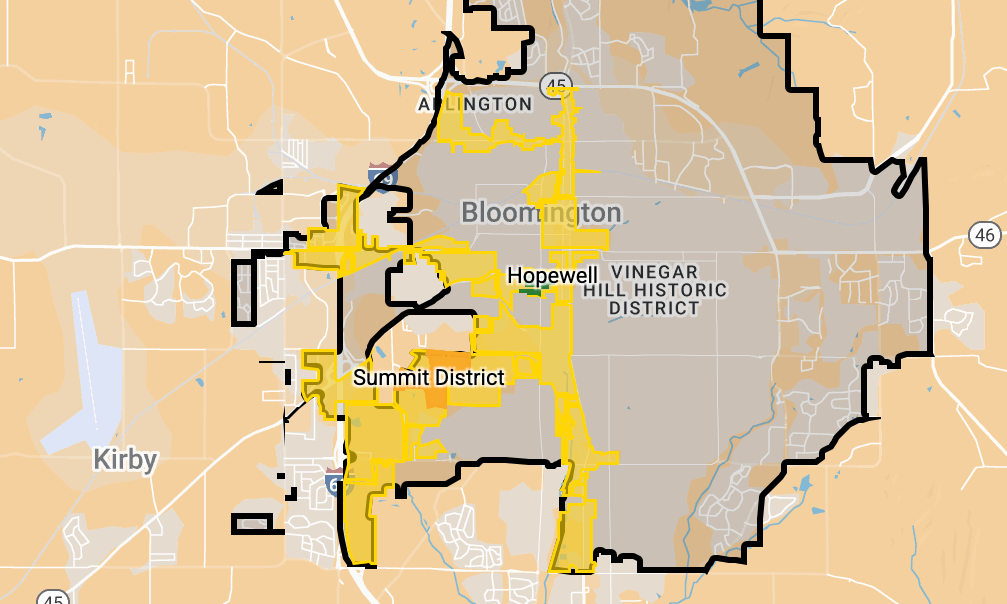
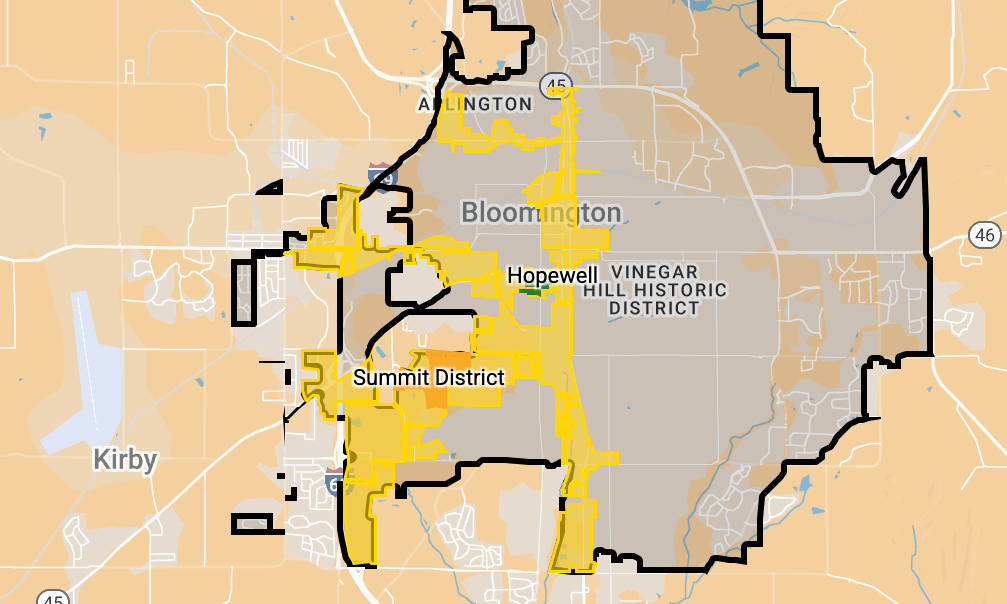
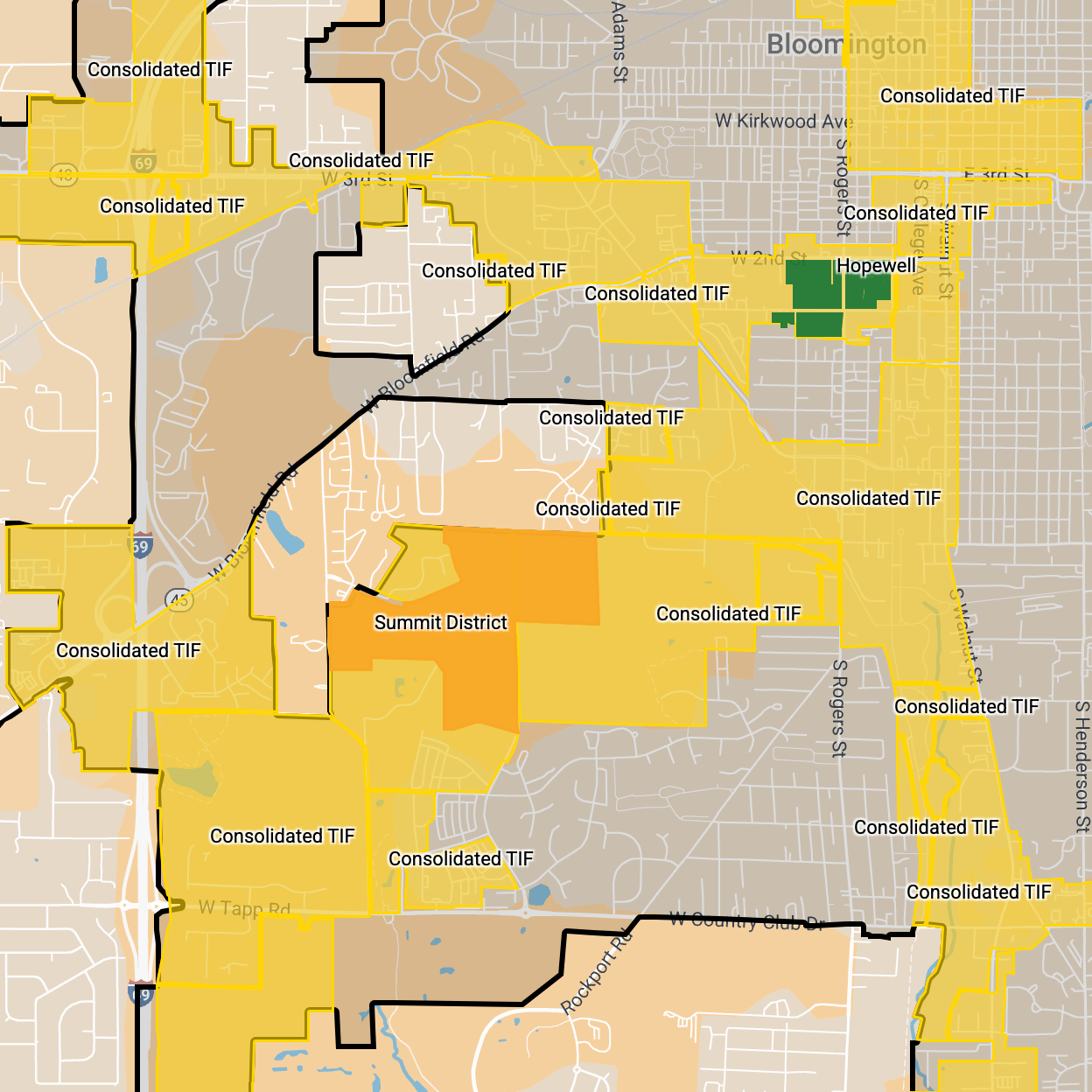
Summit District is shown in orange. Hopwell is shown in green. Bloomington’s consolidated TIF district is shown in yellow. Maps by The B Square with information from the city of Bloomington. [link to dynamic map]
On Monday (Jan. 5), at its first regular meeting of the year, Bloomington’s redevelopment commission (RDC) got a briefing on a possible significant reconfiguration of the city’s existing consolidated TIF (tax increment finance) district.
TIF districts are meant to spur economic development in a particular geographic area by allowing a city or county to use new property-tax growth from that area to pay for improvements there. It is the RDC that determines and oversees the expenditures of revenue that is generated from the districts.
Two specific areas inside Bloomington, which are planned for primarily residential development, and are already a part of Bloomington’s consolidated TIF district, would be established as their own individual TIF districts, assistant city attorney Dana Kerr told RDC members.
One of the areas is the Summit District PUD, a 140-acre area in the southwest part of the city, approved for a rezone by the city council in May 2024.
The other area is the planned 24-acre Hopewell neighborhood, at and around the site of the former IU Health hospital at 2nd and Rogers Streets.
No decisions have been made, and the process will take a few months. But the first legally required public meeting by the RDC, set for Feb. 5, has already been given published notice in the Herald-Times.
In the wording of state law, Bloomington is proposing to create a residential housing development program (RHDP)—often called a “residential TIF.” According to the newspaper notice, the draft programs for Summit District and Hopewell are supposed to be uploaded to the RDC’s website for the start of a 30-day public review period on Tuesday (Jan. 6).
Eleven days after the initial meeting, on Feb. 16, the RDC will consider the declaratory resolutions that are required for each of the two proposed TIF areas. Three weeks after that, on March 9, Bloomington’s plan commission will be asked to give its approval—that’s the regular meeting of the city plan commission.
Two weeks after that, the TIF areas are supposed to appear on the March 25 agenda of Bloomington’s city council. If all those approvals go according to plan, that will set up an April 6 meeting for a final confirmatory approval by Bloomington's redevelopment commission.
Timeline
- Feb. 5: public meeting held by Bloomington RDC
- Feb. 16: vote on declaratory resolution by Bloomington RDC
- March 9: vote by Bloomington plan commission
- March 25: vote by Bloomington city council
- April 6: final vote by Bloomington RDC
Kerr confirmed to The B Square that the new “residential TIF” districts for Summit District and Hopewell are separate propositions. Kerr also confirmed that the proposal would not stack an additional TIF on top of the existing consolidated TIF areas, but rather would remove the two districts from the consolidated TIF, to form their own TIF districts.
Generally, when a TIF district is created, the current property value defines a base. Taxes on that base value keep going to schools, libraries, and local governments as usual. But if development takes place and property values rise, the new tax revenue from that growth—the “increment” from the base—is set aside and used for projects like roads, utilities, site prep, or public facilities. The revenue from TIF capture doesn’t count against a unit’s maximum levy.
In 2024, Bloomington’s consolidated TIF area generated about $20 million. The final reports for 2025 have not yet been filed by Bloomington with the state.
In November 2025, the RDC voted in support of a $5-million set aside for TIF revenue to be spent in the southwest quadrant of the city, which includes Summit District.
The RDC has already put about $33 million of TIF revenue into the Hopewell project, which has an estimated total price tag of about $41.5 million.
The move now to carve out two separate TIF districts from Bloomington’s consolidated TIF area reflects, to some extent, a return to the pre-consolidation conditions—when there were six separate TIF districts in Bloomington. The city council’s vote in 2015 on the resolution to consolidate TIF districts passed with dissent from Andy Ruff.
By the B Square’s publication time on Tuesday, the draft RHDPs for Summit District and Hopewell had not yet been uploaded to the RDC’s website.



Comments ()