
Bloomington Transit delays vote on bus service cuts until Dec. 8, approves broader system study
Bloomington Transit delayed a vote on proposed cuts to Routes 2, 7, 11 and 16 until Dec. 8, after a 30-day comment period. At Tuesday’s hearing, riders warned of disruptions, while the drivers’ union cited driver fatigue. The board also approved a $90,500 study of the entire route system.
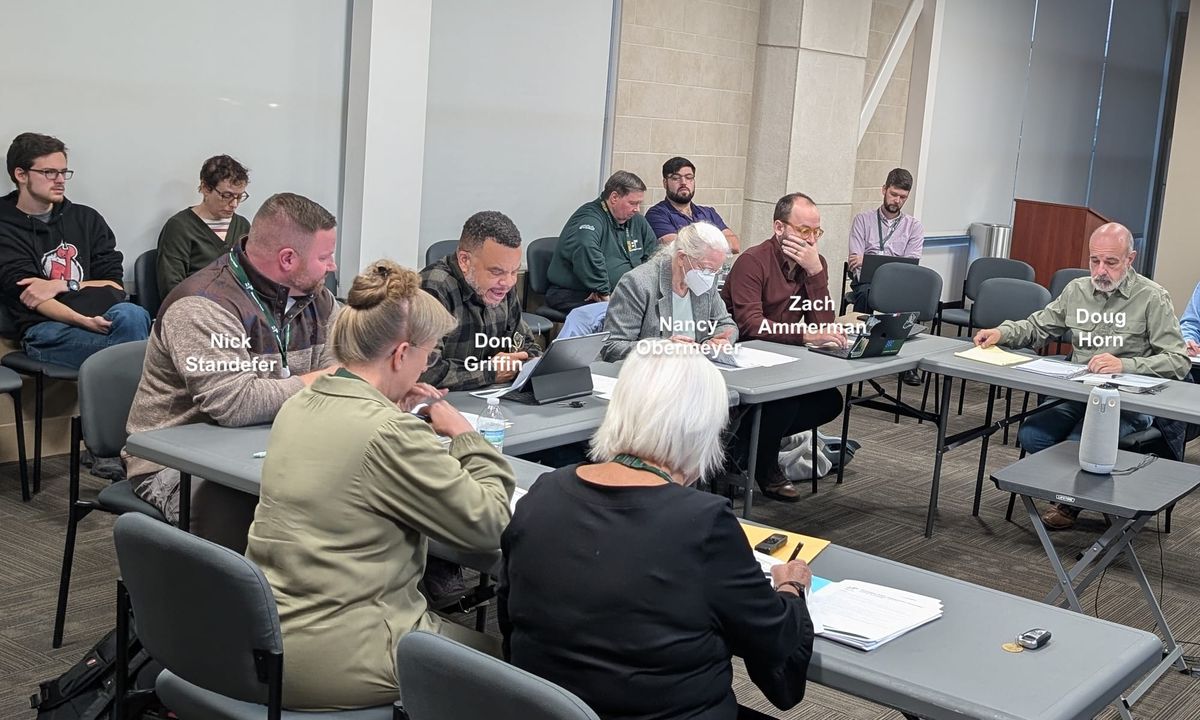
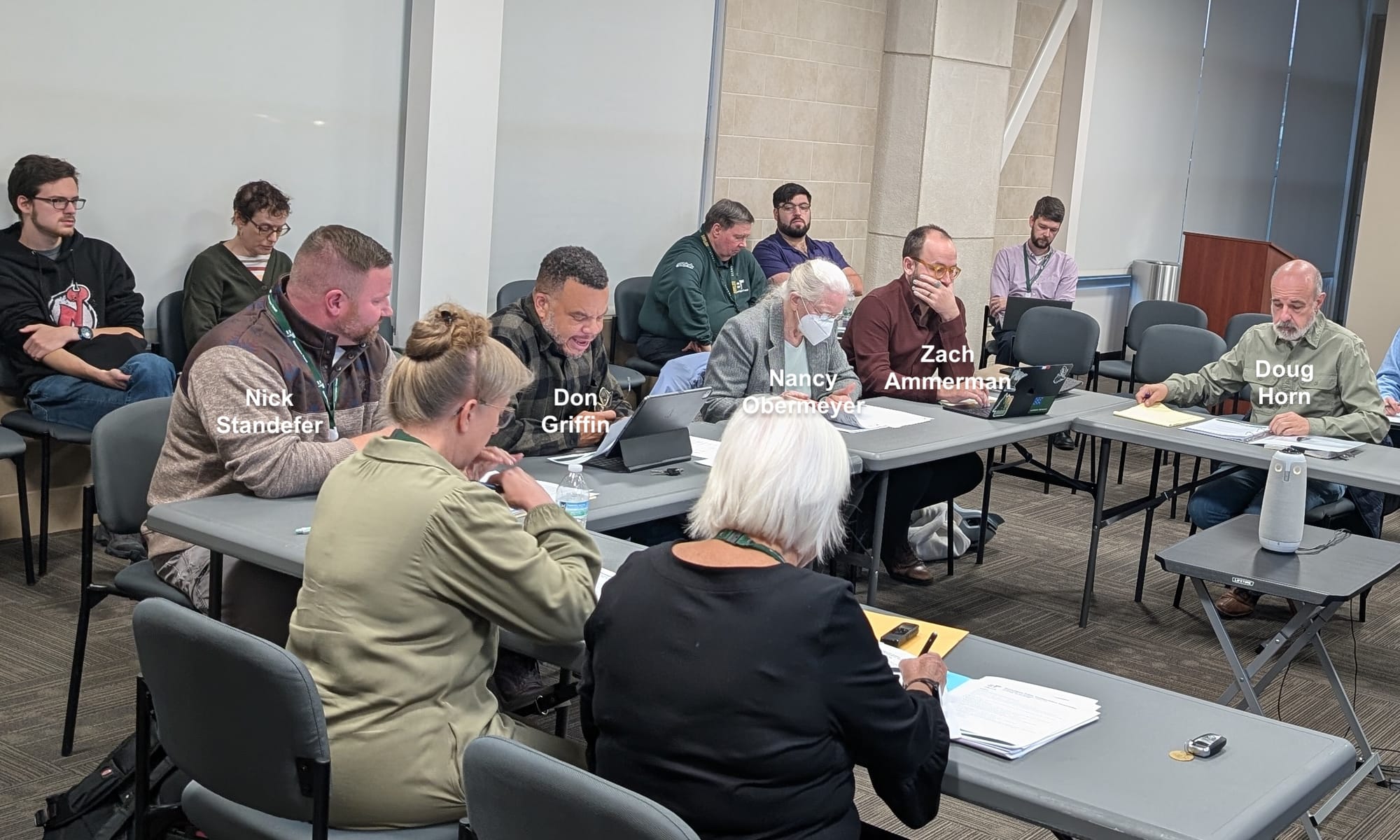
Bloomington Transit riders who are facing possible reductions in service on four bus routes will have a little longer to send in their feedback before the transit agency’s board takes a final vote.
After a public hearing Tuesday (Nov. 17), the Bloomington Public Transportation Corporation board voted to schedule a special meeting for Dec. 8 to consider the proposed reductions. That puts the decision after the close of a 30-day public comment period, instead of the previously anticipated vote immediately following Tuesday’s hearing.
The change also pushes back the anticipated implementation date from Dec. 6 to Dec. 20, if they are approved. The reductions would be temporary, with a goal of replacing them with a revised service plan by May 2027, but possibly sooner.
At its regular meeting, which followed the hearing at the downtown transit center, the board also approved a $90,500 comprehensive operational analysis to be conducted by Keolis, the company’s new management firm. The analysis is intended to produce recommendations for a broader overhaul of routes and schedules, beyond the temporary cuts now under consideration.
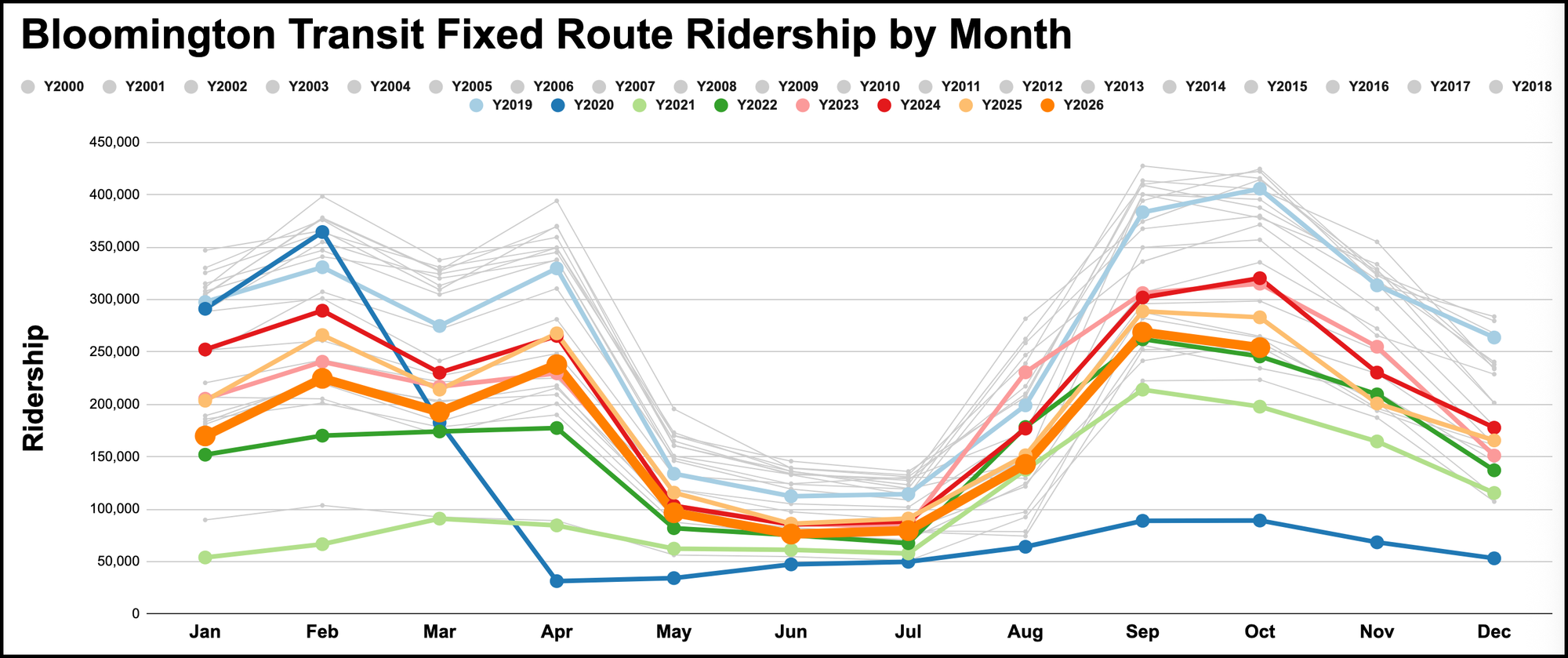
The decisions come as BT confronts a shortage of bus drivers, mandatory overtime for existing operators and declining ridership. October’s passenger count on fixed-route buses was down 10% compared with October 2025, bringing the year-to-date decline to 11.4%.
Service reductions to address driver shortage
The shortage of roughly 10 drivers has forced operators to work mandatory overtime since August. Some have worked as many as 65 hours a week. Despite the overtime, the agency has struggled to operate all its scheduled runs.
The proposed temporary changes would eliminate about 237 driver hours a week.
Routes 2 West and 2 South would be combined operationally, with hourly service on each instead of every 30 minutes. Route 7 would also be reduced from half-hourly to hourly weekday service.
Weekend service on Route 11, which connects the Atlas Apartments area on West 17th Street with the Indiana University campus, would be eliminated. Route 16, which serves Bloomington’s west side, would operate with two buses instead of three on Mondays through Saturdays, producing alternating 30-minute and 60-minute intervals between buses.
The reductions are designed to preserve geographic coverage while decreasing the frequency of service. BT planning and special projects manager Shelley Strimaitis told the dozen and a half people gathered for the public hearing that the agency deliberately avoided eliminating routes or reducing service on routes that are already operating just once an hour.
Riders describe impact of service cuts
The public hearing drew out different perspectives on the proposed reductions, including riders concerned about getting to work and school, a union representative worried about driver fatigue, and a city councilmember questioning the agency’s recruitment and retention practices.
One rider, who lives along Route 2, described neighbors who depend on the bus to reach jobs, schools, grocery stores and places offering food assistance, including Community Kitchen and the Friend’s Place shelter operated by Beacon, Inc. She said the service reductions would disproportionately affect lower-income residents, especially as winter approaches.
The Route 2 rider said she thinks the problem is not enough focus on retaining drivers. She said better wages were the solution.
The Route 2 rider’s concerns were echoed by Bloomington city councilmember Isabel Piedmont-Smith, whose District 1 includes Highland Village, an area served by Route 16. Piedmont-Smith questioned why BT had reached the point of needing to reduce service and whether more effective recruitment efforts could have prevented it. She also pointed to the contrast between the agency’s investments in new buses and a planned maintenance facility and the difficulties residents face getting to work.
Three women who are students at Indiana University came to the hearing together to express concerns about reductions to Route 7. One of them said she depends on the route to reach classes at Jacobs School of Music. Although she owns a car, paying to park on campus is not really an option. “I do have a car, but I can’t afford a parking pass,” she said.
She described taking an early bus for an 8 a.m. class, saying proposed reduction could make her commute more difficult. She also pointed to other passengers, including schoolchildren and lower-income residents, who might have fewer transportation alternatives.
Another woman who attended the hearing said had specifically considered bus service when choosing her apartment. She described already having to adjust her work schedule because of uncertainty about when the bus would arrive. Under the proposed hourly schedule, she said, she could be forced to arrive at work an hour early or risk arriving late..
The remarks from the three IU students resurfaced later, during the board’s discussion of declining ridership.
Board member Zach Ammerman pointed to the three women as examples of passengers the agency might lose for good by cutting service. Once they start using alternatives, they might not return when bus service improves, he said.
Union backs temporary cuts, wants long-term pay increase
Bill Hornaday, president of AFSCME Local 613, which represents Bloomington Transit drivers, offered a different perspective on the immediate service reductions.
He described how the shortage has left operators with little chance to take paid time off. At one point this fall, with about 47 drivers available, the agency was permitting only one driver a day to be off on scheduled leave.
The mandatory overtime has reached even the most senior employees. According to Hornaday, an operator with 33 years of experience recently had to report for a mandatory overtime assignment. He said the resulting fatigue creates concerns for driver health and public safety. Employees also face difficulty scheduling medical appointments without accumulating attendance violations.
For those reasons, the union supports temporary service reductions as a first step toward relieving the pressure on drivers, Hornaday said. That support does not mean the union considers reduced service a permanent answer. Hornaday agreed that compensation is an important factor in retaining operators.
The discussion turned to BT’s starting wages, which BT board member Zach Ammerman said fall below the 10th percentile for transit operators in Indiana, based on federal labor statistics.
General manager Nick Standefer acknowledged the wage issue and said the agency intends to compare its compensation with similarly sized transit systems.
The current collective bargaining agreement runs through the end of 2028, according to Hornaday. But negotiations on a successor agreement could begin in 2027, potentially as early as spring. Standefer said management is considering beginning discussions early and coordinating potential wage adjustments with a midyear review of the agency’s budget.
The distinction between contract negotiations and the union’s regular assignment-bidding process is important to the timing of the service changes. Operators select new route assignments periodically, and that’s done based on seniority. BT hopes to have a new service plan ready for the bidding process associated with the schedule changes expected next spring.
Even if higher wages attract more applicants, Standefer cautioned that rebuilding the workforce would take time. Background checks, licensing requirements and training can take several weeks or longer before a newly hired operator is ready to drive passengers.
Keolis to study entire transit system
The board’s approval of a comprehensive operational analysis by Keolis could ultimately have a larger effect on Bloomington Transit than the temporary cuts.
Keolis began managing BT’s operations Oct. 1, replacing RATP Dev. Standefer, selected by Keolis, also took over as general manager at that time. At Tuesday’s meeting, Standefer described the temporary reductions as the first phase of the agency’s response to its operational problems.
The second phase is a detailed examination of how the transit system should operate.
The study, with a price not to exceed $90,500, will examine routes, frequencies, schedules, paratransit, potential microtransit operations, staffing and fleet requirements. Standefer said comprehensive operational analyses commonly cost $200,000 to $300,000, making the Keolis proposal substantially less expensive than what BT might otherwise expect to pay.
BT has undertaken similar work before. A route optimization study was completed in 2019.
Tuesday’s board discussion focused partly on procurement. Board members questioned whether BT should seek competing proposals, particularly because the proposed expenditure is close to the $100,000 threshold for competitive procurement requirements.
Standefer said that issuing a request for proposals could delay the project by months. Such a delay could prevent the agency from using the study’s findings to develop a replacement for the temporary service reductions by May 2027.
The board ultimately approved proceeding with Keolis, subject to appropriate procurement review and including wording in the contract requiring completion before the temporary reduction period ends.
Standefer estimated that the analysis could be completed around February or March. That would allow time to review recommendations with the board, the public and union representatives before implementing broader changes.
Ridership decline
During the staff reports, Strimaitis presented the October ridership figures showing a 10% decline compared with the same month last year. In raw numbers that’s a drop from 283,019 trips in October 2025 to just 254,187 trips in October of this year.
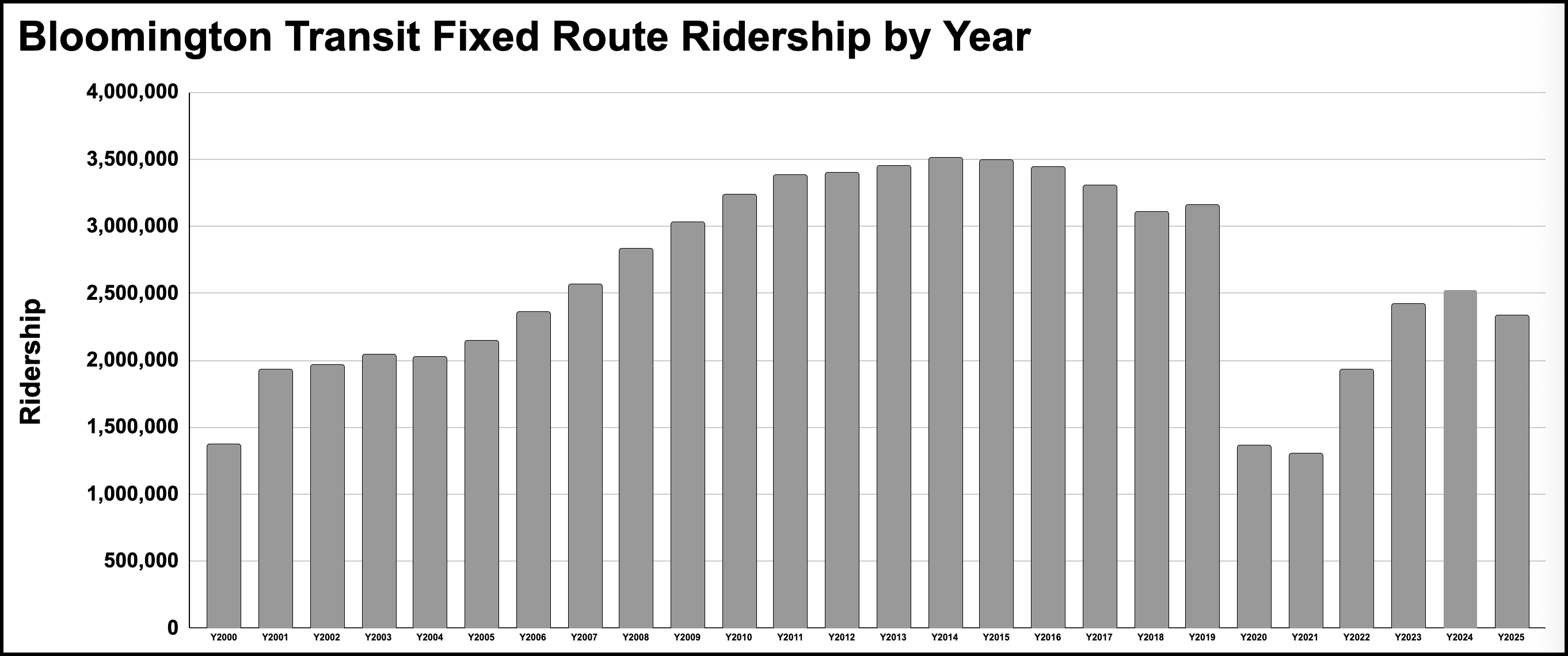
The year-to-date decrease of 11.4% raised concerns among board members about the transit system’s longer-term direction. Ammerman observed that ridership has fallen to levels associated with roughly two decades ago, despite population growth in Bloomington.
Strimaitis said the agency’s ridership peaked around 2014, followed by a longer decline that was interrupted by the sharp drop during the COVID-19 pandemic. There had been some recovery in 2023 and 2024, making the more recent losses particularly concerning, she said. Strimaitis reported that other Indiana transit agencies had also experienced significant declines, although she cautioned that this did not explain all of Bloomington’s situation.
Board members discussed possible factors, including changes in student housing patterns, competition from other transportation options and reduced service reliability.
The question of reliability brought the discussion back to the proposed temporary cuts. Reducing the number of scheduled trips could make it easier for BT to deliver dependable service with its available drivers. But reducing service frequency could also make riding the bus less attractive.
Ammerman’s reference to the three IU students underscored that risk. Their remarks during the public hearing illustrated how changes to a bus schedule can affect decisions about commuting, employment and where to live.
The Keolis analysis is expected to provide a more complete basis for addressing those questions, rather than relying on temporary adjustments driven primarily by staffing shortages.
Supplemental BT Access service
In another action Tuesday, the board authorized Standefer to finalize an agreement with BeLoved Transportation to provide supplemental service for eligible BT Access trips.
The authorization sets a maximum expenditure of $50,000. BT Access provides transportation for eligible passengers with disabilities who cannot use the regular fixed-route bus system. The proposed BeLoved arrangement is intended to provide additional capacity when demand exceeds what BT can readily handle, reducing pressure from overflow trips and emergency dispatching.
The board’s action does not establish a final operating schedule or price structure. Those details remain to be negotiated.
The final agreement has to specify the services, operating days and hours, contract dates, rates, driver and vehicle qualifications, safety requirements and performance expectations.
Standefer is authorized to execute the agreement once those terms are finalized and the necessary procurement, insurance and legal reviews are complete. Any expansion beyond the $50,000 limit must return to the board for approval.
For riders on Routes 2, 7, 11 and 16, the next big date is Dec. 8. That’s a Tuesday. It’s when the board is scheduled to decide whether fewer buses operating on more predictable schedules will be the temporary answer to Bloomington Transit’s driver shortage, while the agency works toward a longer-term plan.
Members of the public can continue submitting comments on the proposed service reductions through Dec. 5 by emailing Bloomington Transit planning and special projects manager Shelley Strimaitis at shelley.strimaitis@bloomingtontransit.com.
Comments ()