
Bloomington’s 2027 budget: No new full-time positions, still taps $5.5M in general fund reserves
Bloomington’s proposed 2027 budget has dropped. It authorizes $165.7 million in spending, excluding utilities and debt funds. It provides a 2.7% COLA for employees, and no net new full-time jobs. It taps general fund reserves for $5.47 million. City council review starts Aug. 17.
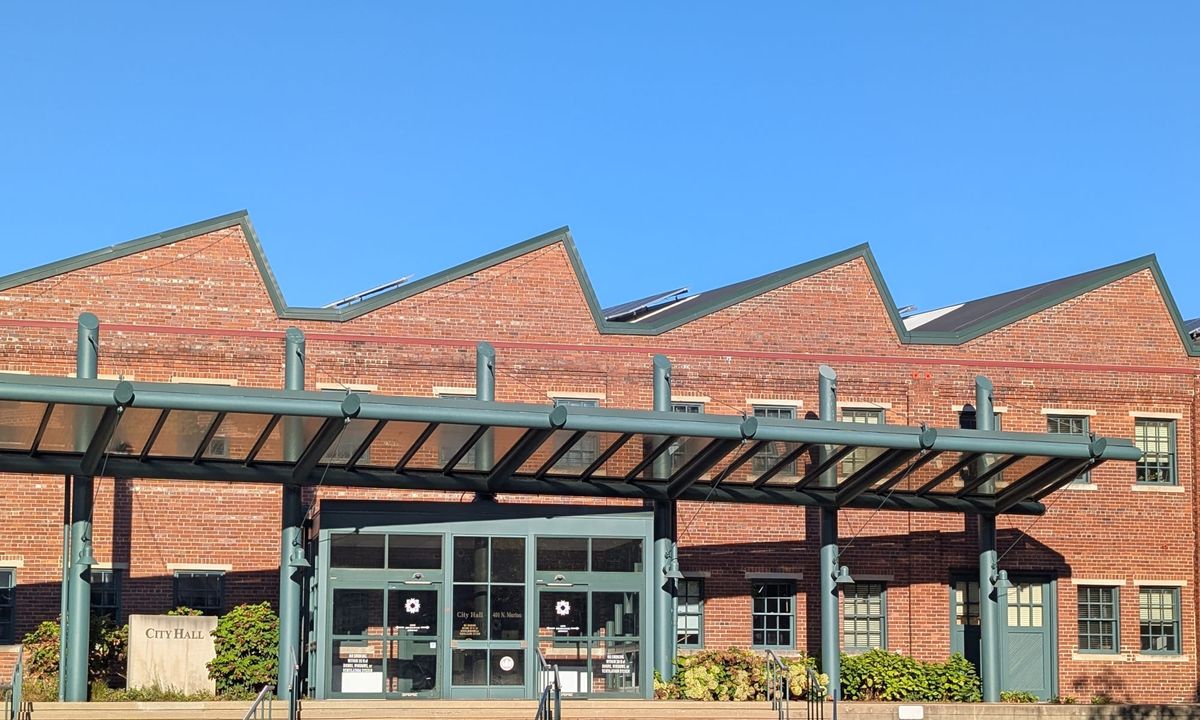
On Monday (Aug. 3), Bloomington mayor Kerry Thomson’s administration released a proposed 2027 budget that would give 2.7% cost-of-living allowances (COLA) to non-union city employees without adding any net new full-time positions.
But the salary grading system’s built-in step increases for non-union employees, and collectively bargained rate increases, mean the overall investment in city personnel will increase by an extra two percentage points beyond the COLA, or around 5.5% more compared to last year. That means about $58.8 million will be allocated to pay city workers in 2027.
For the total of the city’s tax-supported and special-purpose funds, the proposal authorizes up to $165.7 million in spending. That is an increase of $6.1 million from the $159.6 million in spending adopted for 2026.
Those totals do not include City of Bloomington Utilities (CBU), which is funded by customer rates and fees rather than the city’s General Fund. Utilities has a separate $65.3 million proposal covering water, wastewater and stormwater operations. The city controller’s $165.7 million total also excludes general-obligation debt-service funds.
To cover the $165.7 million in spending, the city controller Geoff McKim estimates in his memo about $137.7 million in revenue during 2027. Subtracting estimated revenue from the proposed spending produces a difference of about $28 million.
But in his memo, McKim cautions against treating that subtraction as a single, citywide operating deficit. The proposed budget taps funds that have been accumulating money in earlier years or using proceeds already received for one-time purposes. McKim’s memo puts it like this: “[T]hese revenues and expenditures … don’t necessarily represent operational deficits because several funds are intentionally drawing down accumulated reserves … ”
The proposal, for example, uses $3.69 million in parking reserves for projects and equipment replacement, $3 million in accumulated housing-development money and $500,000 in proceeds from a fiber-installation surety bond. The food and beverage tax fund also includes about $7.5 million more in expenses than projected revenue, chiefly to establish a stabilization reserve connected to convention center lease payments.
The general fund, which is the city’s main operating account, offers a clearer measure of the immediate operational imbalance. The administration proposes $63.7 million in general fund spending against estimated revenue of $58.3 million, leaving a projected gap of $5.47 million. Any actual deficit would be covered from reserves. According to the estimates in the budget book release on Monday, the general fund reserve expected by the end of 2027, will be $48,169,361, which is a healthy 75.3% of annual operating revenue.
But a cloud of uncertainty hangs over the city’s financial future, because of the still unknown impact of SEA 1 on the city’s revenues by 2029. A clearer picture will start to emerge, once the city decides on a strategy for approaching its local income tax revenues: Will it decide to go-it-alone by itself enacting a 1.2% rate just on Bloomington residents, or ask the county council to enact a (lower) municipal rate that applies to all Monroe County residents.
The revenue estimates remain preliminary. Final figures for local income-tax distributions and property-tax losses caused by the state’s circuit-breaker caps were not available when the budget book was prepared.
The budget requests no new full-time positions or programs, although some positions would be reorganized or reclassified. The police department, for example, proposes replacing one sergeant position with an additional lieutenant position.
For utility customers, the separate CBU proposal increases from $57.7 million in 2026 to $65.3 million in 2027. The total includes $28.9 million for water, $31.6 million for wastewater and $4.8 million for stormwater. The water budget rises about 25%, reflecting the rate increase that took effect in August 2026 and allowing more capital work to be paid for with cash. The proposal also anticipates possible wastewater and stormwater rate increases, although their timing and amounts are not yet known.
Several major capital items, including a $2.5 million aerial platform truck for the fire department and safety-related engineering projects, will instead be proposed through a general obligation (GO) bond. That’s part of a strategy that will see issuance of 6-year general obligation (GO) bonds every three years. Bond projects will be prioritized as part of a capital improvement plan.
In her memo, which is included in the budget book, Bloomington mayor Kerry Thomson described the overall proposal like this: “For 2027, the Administration is taking a conservative approach to the budget. A tight budget provides an opportunity to evaluate how the City can provide the most value to our community with the resources we have.”
The administration is asking councilmembers who seek additional spending to identify an equal amount that could be cut elsewhere.
This year, a raw data file has been provided with line-by-line revenue and expense numbers proposed for 2027 and adopted for 2026. The figures have been pivoted out by The B Square by department in a shared Google Sheet. Highlighted in red are rows where the number proposed for 2027 is at least 15% more (or less) than the 2026 figure and involves a dollar amount that is more than $10,000.
City Council Review Schedule
Materials for the budget meetings will be posted on the city council’s meeting and information page.
Monday, Aug. 17: Mayor and controller overviews; fire; police; community and family resources (CFRD); housing and neighborhood development (HAND).
Wednesday, Aug. 19: planning and transportation; engineering; streets; parking; city of Bloomington utilities (CBU).
Monday, Aug. 24: parks and recreation; economic and sustainable development; public works administration; animal care and control; facilities; fleet; sanitation.
Wednesday, Aug. 26: Monroe County capital improvement board; clerk; council; mayor; controller; legal; human resources; information and technology services.


Comments ()