
Bloomington’s trash cart rate hikes up for discussion based on ‘alarming numbers’
Bloomington’s curbside rates for trash pickup could rise sharply as sanitation costs outpace user fees. A city council fiscal committee discussed phased increases, possible recycling charges and whether more costs should be covered by users, but endorsed no specific plan.
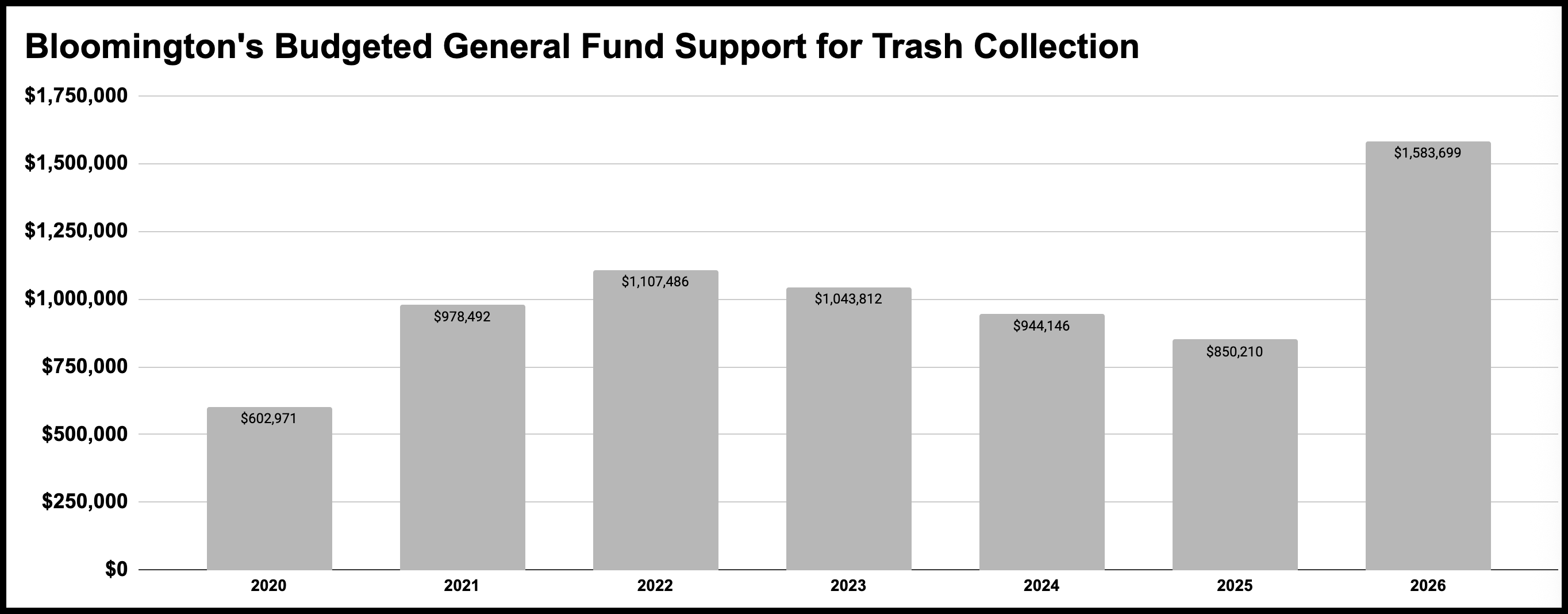
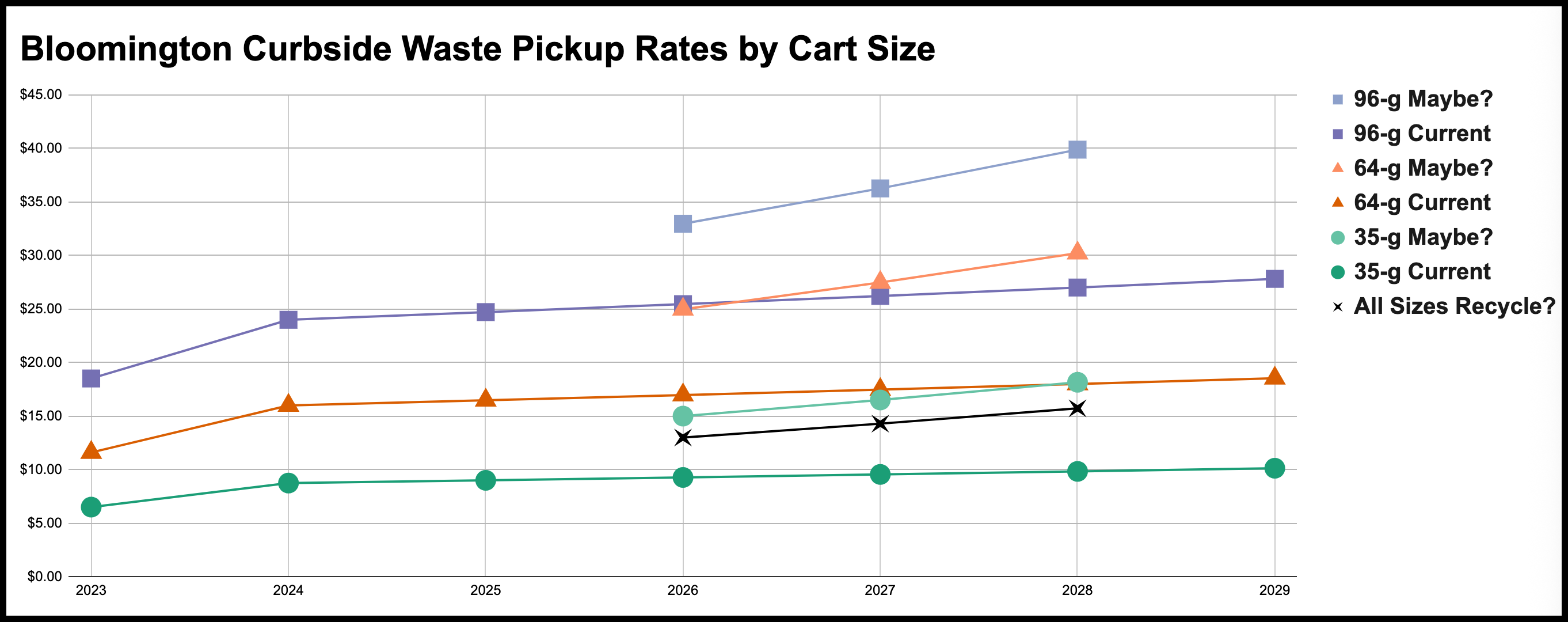
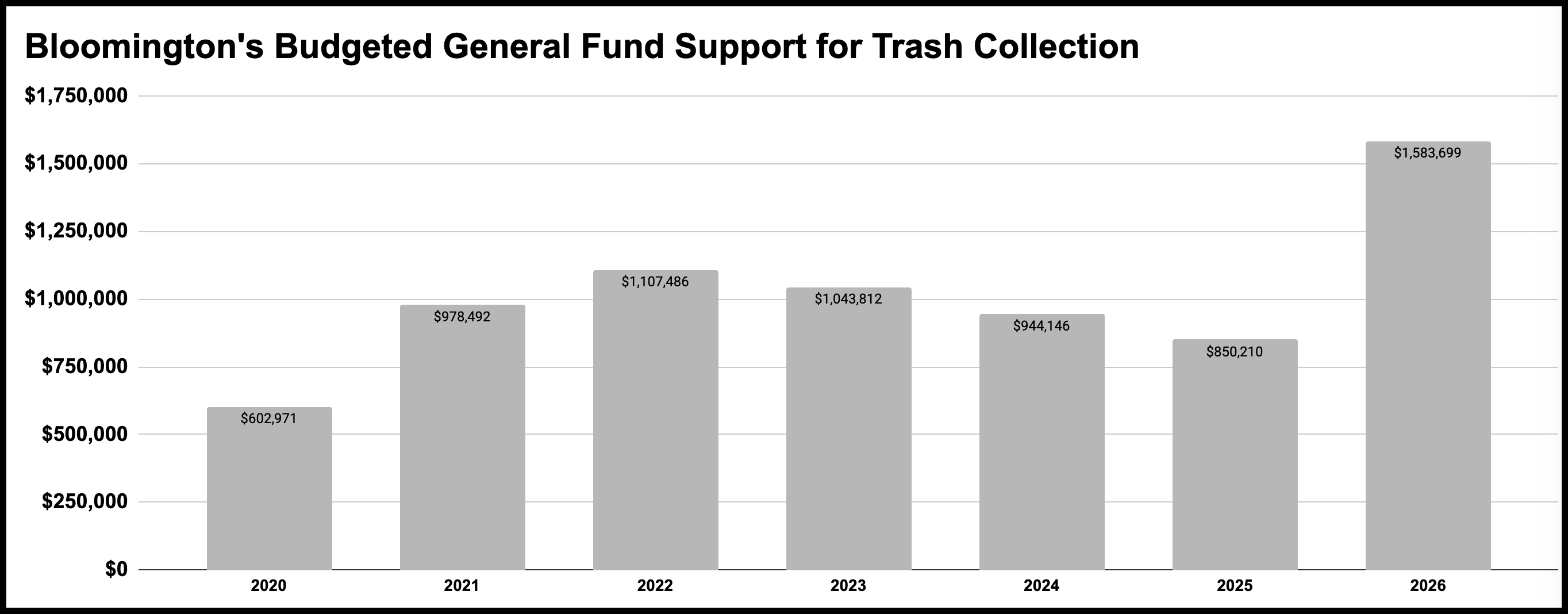
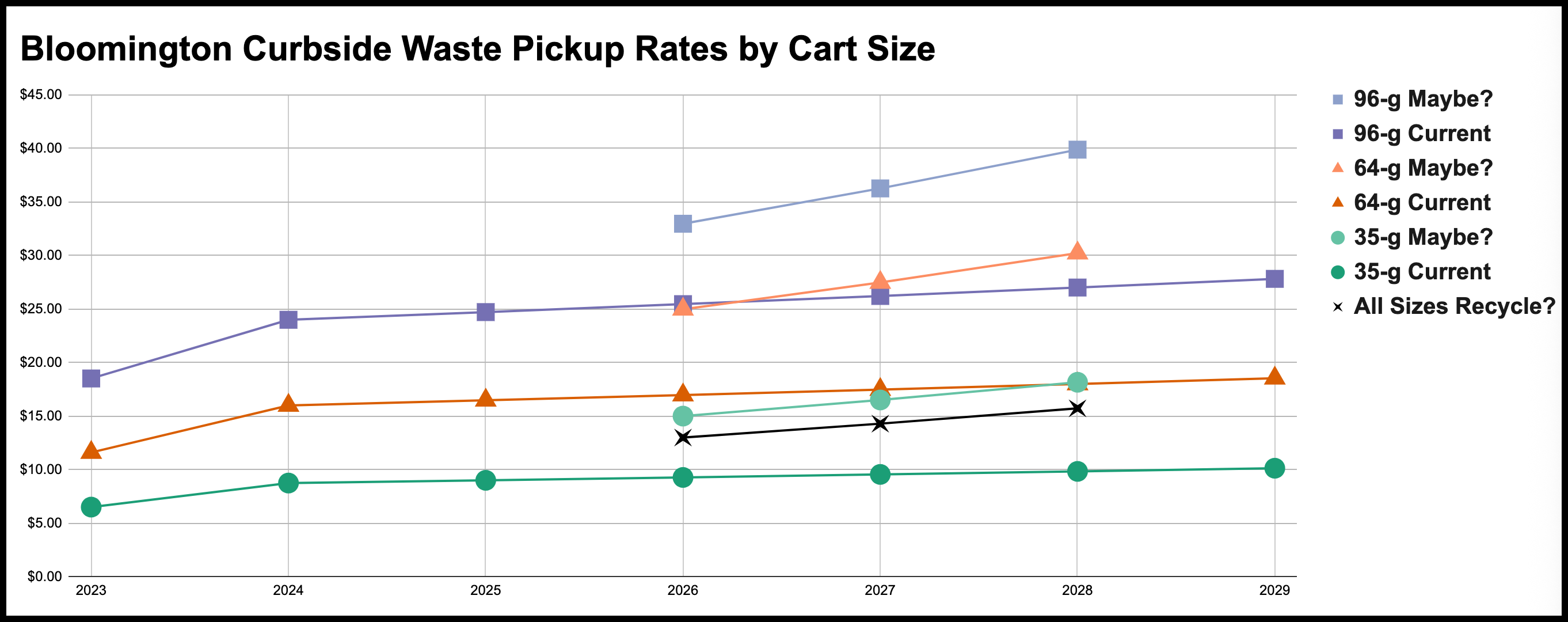
Charts by the B Square with numbers from the city of Bloomington.
Steeply rising general fund support for Bloomington’s trash collection operations prompted an extended discussion at last Friday’s (June 12) meeting of the city council’s four-member fiscal committee about significant increases to trash cart prices.
Based on some working numbers provided by public works director Adam Wason, Bloomington residents who receive curbside waste collection services could see increases of up to 55% by 2029, depending on what size cart they use.
Part of the mix could be a separate charge for recycling pickup. Currently there is no charge for recycling carts.
The current monthly rates for curbside pickup are: 35-gallon ($9.28); 64 -gallon ($16.97); and 96-gallon ($25.46). Numbers for the biggest size cart could increase to $39.89 a month, based on figures in a draft table provided a Friday’s meeting.
Driving the conversation is a dramatic increase in the budget for general fund support of sanitation operations, which for 2026 stands at $1.58 million, compared to about $850,000 last year and an average of around $920,000 for the last six years. The amount of general fund support is the difference between actual costs and the amount generated by user fees.
Attending Friday’s committee meeting was deputy mayor Gretchen Knapp, who called the figures “alarming numbers,” adding, “That’s one of the reasons why we wanted to bring them to this committee to discuss, so that there’s transparency on why this problem is so hard to solve,” she said. Knapp added. “This is not a plan. This is an exploration and a reality check.”
The council committee stopped well short of endorsing any specific package of fee increases, but did talk generally about the principles at stake, when considering how much of the cost should be recovered through user fees as opposed to citywide tax dollars.
Weighing in solidly in favor of covering the full cost was councilmember Matt Flaherty, who has historically advocated for that position, reasoning that roughly half of the city’s residents don’t receive curbside waste collection services and should therefore not help to defray the cost to residents who do. Under Bloomington local law, it’s only buildings with four residential units or fewer that are eligible for curbside trash and recycling collection.
Knapp countered by putting sanitation among the public benefits that are routinely funded through broad tax bases rather than purely through users. “In taxes, that is how it works. You don’t have children, you’re still paying for [schools]. You don’t use the library, you’re still paying for that,” she said. For Knapp, trash collection falls into that category. “Sanitation, having a clean city, is a very high priority for most residents, and so they would consider … [that] everyone benefits,” she said.
Besides Flaherty, the other three members of the fiscal committee are Hopi Stosberg, Isabel Piedmont-Smith, and Dave Rollo.
The reason for the big jump in the amount of general fund support for sanitation services came from Wason, who said the 2026 budget figure looks especially large because it now incorporates capital replacement for the trash fleet. That’s instead of relying on what he described as “cobbled together” funding out of several other sources in past years.
Wason said the city is trying to move toward best practices, which say that fully automated trucks with side arms should be replaced on a seven‑year cycle. Bloomington gets more use out of them: “We average 10 to 12 [years]. Sometimes our sanitation trucks have made it 15 or 18 years. It’s not ideal. The longer you wait to replace capital, the more you’re spending on maintenance,” he told the committee.
The cost of a new truck has climbed from roughly $340,000 in 2017 to the $440,000–$500,000 range today, at the same time fuel prices are spiking, Wason said. City controller Geoff McKim added that, because the sanitation fund pays salaries, state standards require it to carry a cash balance of roughly 25 to 30% of annual spending.
One of the questions in a memo from Knapp, which was provided in the meeting information packet, was about the possibility of recovering the cost of recycling pickup.
There did not seem to be much appetite among committee members for shifting the full cost of recycling to the monthly bill. “I would not like to. My preference is not to,” Dave Rollo said. Isabel Piedmont‑Smith said “maybe a small fee” could be appropriate, but said that recycling should continue to be subsidized.”
Stosberg, who said she is reluctant to base decisions only on “philosophical” arguments without numbers attached, pushed staff to quantify the budget impact of operational changes.
At Friday’s meeting, there seemed to be a consensus among committee members that any significant rate increase designed to cover more of the actual cost of curbside waste collection should be phased in over a few years.
The topic of trash cart rates collection seems likely to get more conversation as the city heads into budget season in earnest, starting in six weeks. That’s roughly the time between now and the deadline for department heads to submit their memos to the city council.

Comments ()