
Committee vote on reorg plan for Ellettsville and Richland Township sets stage for possible Nov. 3 ballot placement
A plan to merge the Town of Ellettsville and Richland Township moved closer to the Nov. 3 ballot after a committee approved an amended draft plan. The proposal now goes to the town council and township board. A majority of voters inside and outside Ellettsville have to support it, in order to pass.
Last Wednesday night (April 8) a proposal to reorganize the Town of Ellettsville and Richland Township into a single local government moved a step closer to the Nov. 3 ballot. The joint reorganization committee voted unanimously to approve an amended draft plan and send it to the township board and town council for action.
After the committee’s attorney, Darla Brown, walked members through a final set of edits, a motion to approve the amended plan passed unanimously. The committee’s action does not finalize the proposal, but it sends the document to the two elected bodies, which have to hold public hearings and adopt the plan, before it can be put on this fall’s general election ballot.
The potential reorganization comes against the backdrop of new legislation that creates some pressure for townships across the state generally to consolidate. Local Ellettsville and township officials say the reorganization is a “proactive step” to keep essential public services in place, preserve local identity, and create a sustainable structure for future growth.
Under Indiana state law, a public ballot question has to be certified to the county election board by noon on Aug. 1, 2026, in order to appear on the Nov. 3 ballot. The Monroe County election supervisor has asked that the ballot wording be submitted to the county election officials by July 15, so that there’s enough time to complete the steps involving the Department of Local Government Finance (DLGF).
If enough voters support the proposal in a referendum, Richland Township would dissolve and be consolidated into a new Town of Ellettsville. The plan calls it the “Reorganized Town of Ellettsville,” which would have a seven-member town council, including two at-large and five district-based seats. The new government would take effect on Jan. 1, 2027.
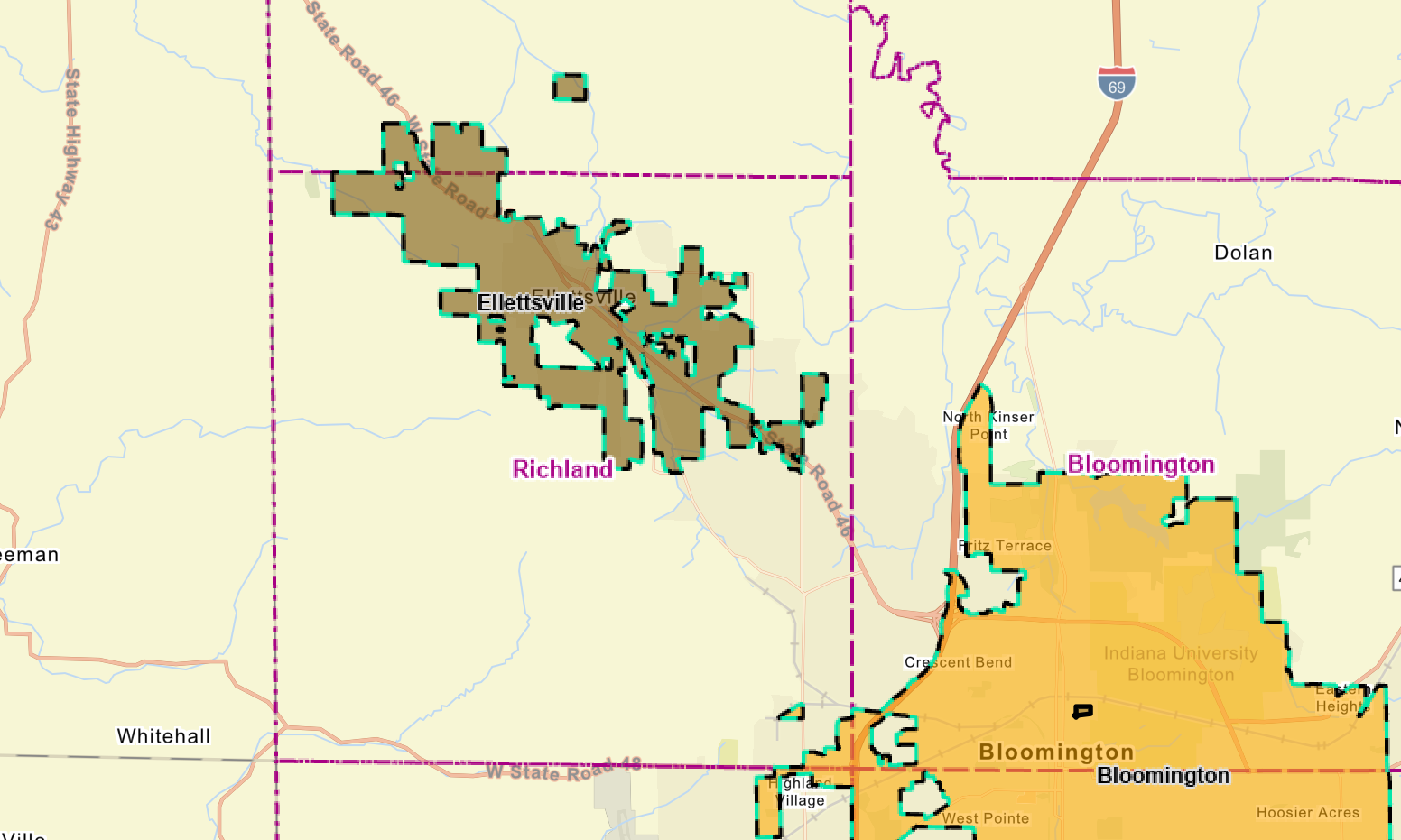
Ellettsville includes about 7.33 square miles, while Richland Township covers about 35.4 square miles. When U.S. Census population numbers are cited for Ellettsville (roughly 6,700) and Richland Township (roughly 15,000), the figure for Richland Township factors in nearly all of Ellettsville’s population. The non-Ellettsville population in Richland Township could be ballparked at around 8,000.
Under state law, in a referendum on the question of reorganization, votes cast by residents living inside the Town of Ellettsville are counted separately from votes cast by residents of Richland Township who live outside the town limits. A third tally combines all votes across the township. For the proposal to pass, each of those three tallies has to have at least 50% support.
That means the proposal could fail even if a majority of voters across the township support it overall—if either the town voters or the township voters outside the town reject it.
Reorganized town council
If the consolidation takes effect, Richland Township would cease to exist as a political subdivision. The offices of township trustee and township board would be eliminated, and their responsibilities—such as township assistance and cemetery maintenance—would transfer to the reorganized town government.
The reorganized municipality would operate under Indiana statutes governing towns but would also take on the responsibilities currently handled by township government.
The governing body would be a seven-member town council. The initial council would consist of the existing five Ellettsville council members plus two members of the current Richland Township board. The two township board members who receive the most votes in the 2026 township election would fill those new at-large seats beginning Jan. 1, 2027, and serve through Dec. 31, 2030.
Over time the council would settle into a structure with five district seats and two at-large seats elected by voters across the entire reorganized town.
Even though the reorganized government would have a seven-member council, committee members last Wednesday spent time discussing how residents outside the current town limits would have a voice during the transition.
The plan calls for creating a temporary five-member advisory board that would provide recommendations and feedback to the council during the first two years after reorganization.
Committee members reached a consensus that the advisory board would be composed of residents from outside the current town limits. Town manager Mike Farmer said the idea was to ensure that township residents had a clear channel for input during the transition. “The spirit of it was to make sure the township was heard, represented,” he said.
Under the draft plan, the advisory board members would be appointed by the town manager.
Taxes and services: Rural and town districts
To determine certain tax rates and service levels, the reorganization plan also establishes two internal districts—called the Town District and the Rural District, which are independent of the elected council districts.
Under the proposal, properties inside the current town limits would be designated as the Town District, while properties outside the town limits but within Richland Township would be classified as the Rural District. The dividing line would follow the town boundary as it exists at 11:59 p.m. on Dec. 31, 2026.
Committee member Scott Reynolds said he had initially worried that the “rural” designation might affect zoning rules, but came to see it differently as discussions progressed.
“As far as I understand it today, those two districts, rural versus town, talk about taxes and they talk about services,” Reynolds said. Land-use decisions, he said, would still be governed by the town’s Unified Development Ordinance and the comprehensive planning process.
The plan itself says the districts are meant to align taxes with service levels while preserving rural character where appropriate. Committee chair Andrew Henry said, “The way this reorganization is being proposed, there aren’t any major changes to zoning, taxes or services that are automatically triggered the instant reorganization happens.” Henry continued, “The process for them will still be a process with public hearings and ordinances. It’s not that on January one, everyone wakes up and up is down.”
Taxes tied to service levels
The fiscal framework proposed in the plan ties certain property taxes to specific areas based on the services provided. Some taxes—including those supporting police services, certain capital funds and existing town debt—would continue to apply only within the current town boundaries.
Other taxes, including those supporting fire protection, parks and recreation, town administration and township assistance, would apply across the entire reorganized jurisdiction.
The fiscal impact analysis estimates that property taxes would increase about 6.9% for properties currently located in unincorporated Richland Township. Properties already inside the town would see smaller increases, and many homes already subject to Indiana’s property-tax caps would see no change attributable to the reorganization itself.
Attorney Darla Brown told committee members that the next step is consideration by the two elected bodies—the town council and the township board. They need to meet in the next 30 days or six weeks, she said.
As the committee concluded its meeting, members acknowledged that the next phase will involve explaining the plan to voters. “You need to boil down the things you’re excited about… because sometimes you only have 30 seconds to talk to someone about it,” committee member William Ellis said. “We just need to get it into a format that people can really understand and digest it.”
Rural compared to Urban: Rates, services
[from the draft reorganization plan]


Comments ()