
Convention center sign variances OK’d by Bloomington BZA
Bloomington’s BZA approved sign variances for the convention center expansion’s wayfinding plan, allowing larger, taller, and more numerous signs—including some in the right-of-way. Officials said standard rules don’t fit the site’s multi-block “campus” layout.
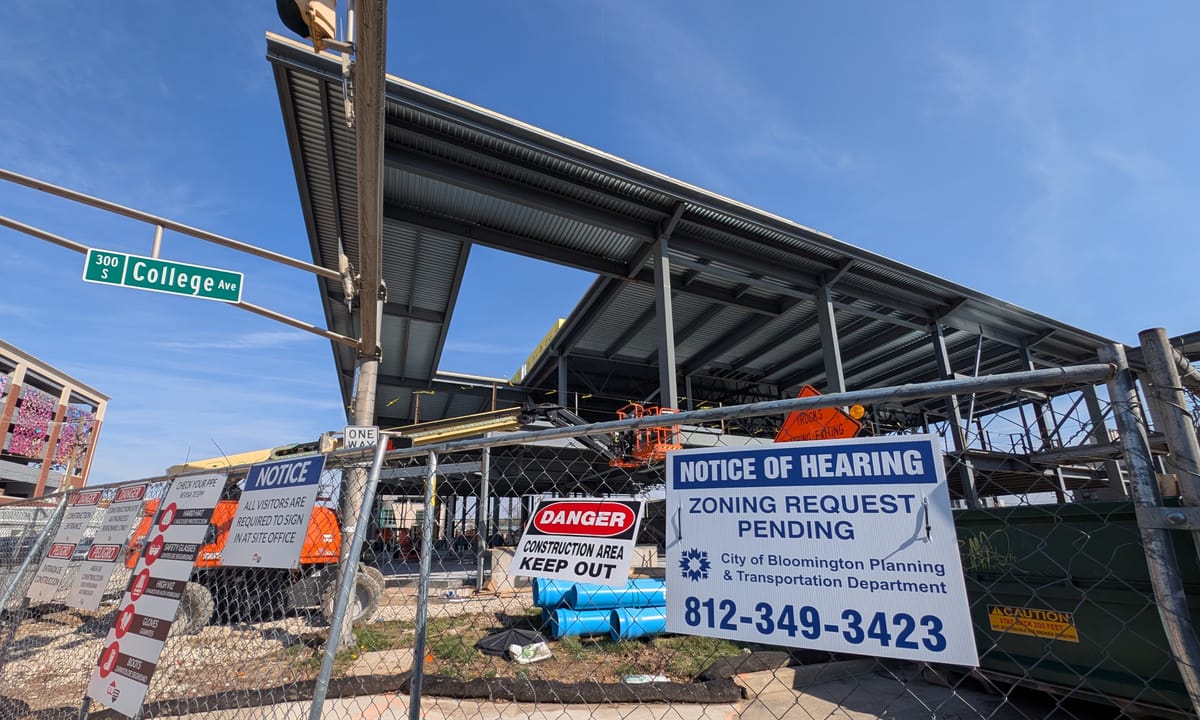
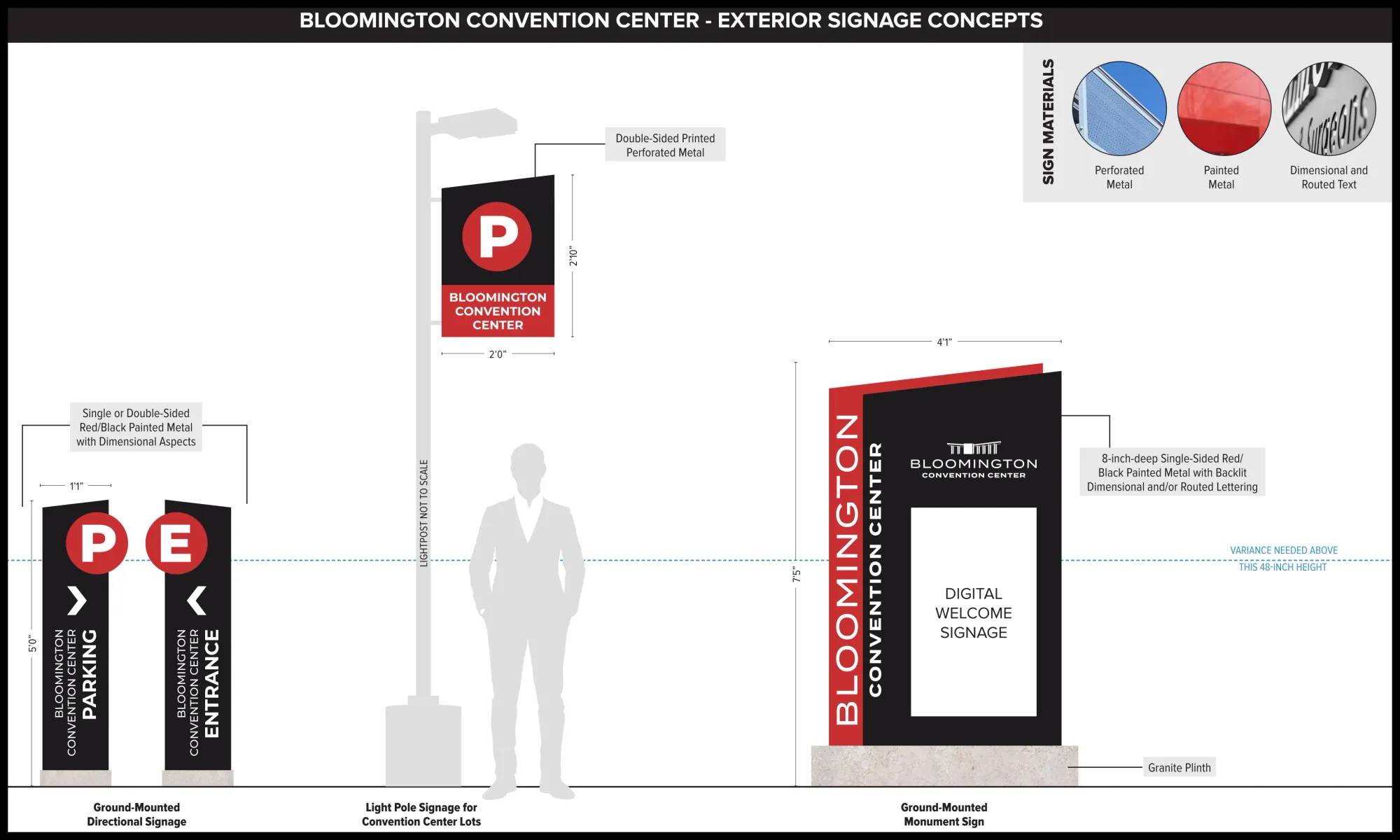
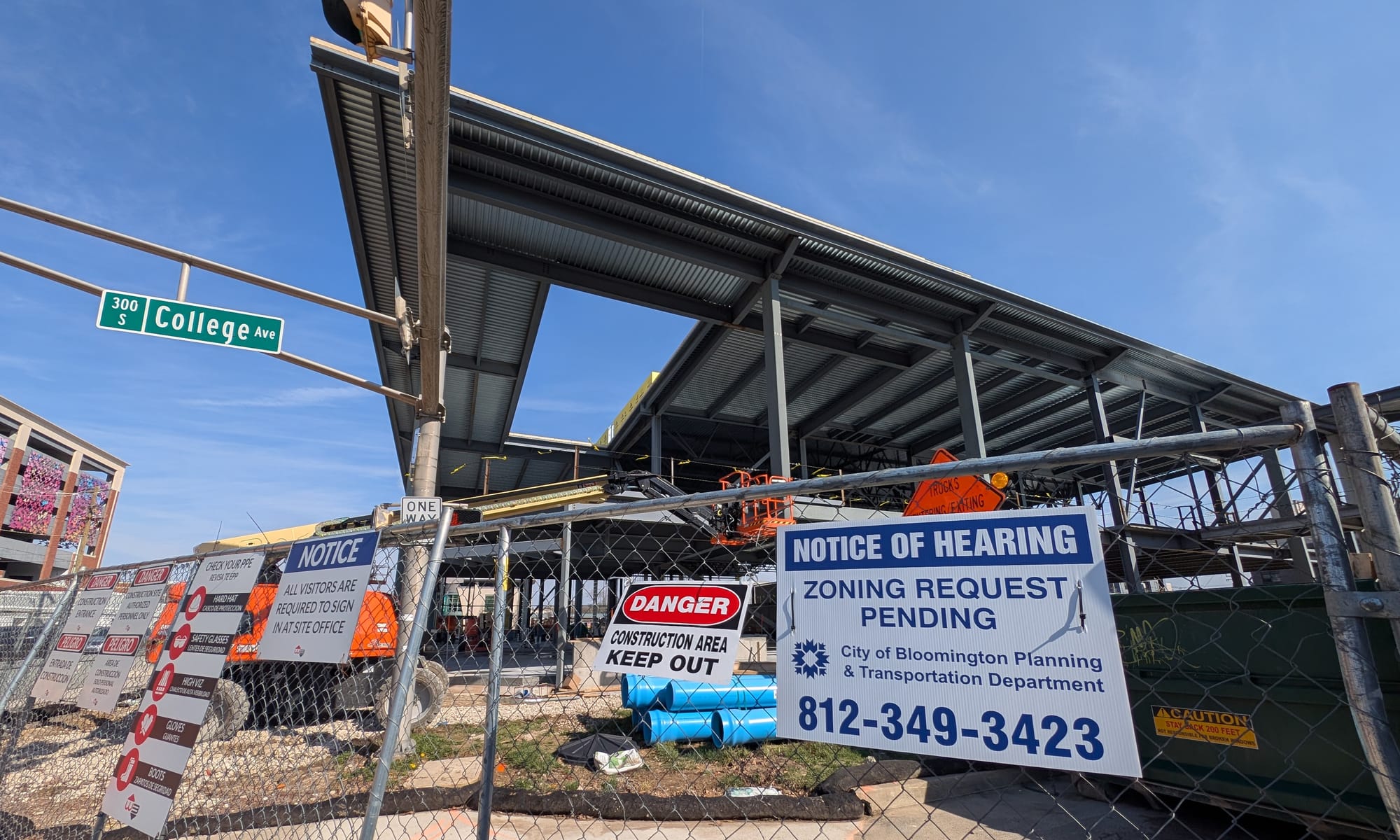
Left: Wayfinding sign examples for the Bloomington Convention Center from Schmidt Associates. Right: The notice of the BZA hearing was posted onsite at 3rd Street & College Avenue where the convention center expansion project is under construction. (Dave Askins, March 26, 2026)
On Thursday (March 26), as part of the convention center expansion in downtown Bloomington, the Monroe County capital improvement board (CIB) asked for and received several sign variances from the Bloomington board of zoning appeals (BZA) for its wayfinding package.
The convention center grounds cover about 6 acres along South College Avenue, South Walnut Street and South Madison Street. In the vocabulary of wayfinding experts, the area counts as a “campus.”
The variances from the usual limits, which were all granted by the BZA without controversy, cover three kinds of signage. Presenting the request to the BZA members was Bloomington’s assistant planning director, Jackie Scanlan.
For nine freestanding directional signs, the city’s rules generally allow just one sign per site, require it to sit at least 2 feet back from the right-of-way, cap the height at 4 feet, and call for landscaping at the base, with a base that’s at least 40% as wide as the sign is tall.
The variances allow some of those signs to be placed in or right next to the right-of-way, allow more than one per site, skip the landscaping, use narrower bases, and bump the height up to 5 feet. Also granted was a variance from the rule that ties freestanding signs to buildings set back at least 15 feet from the property line.
For 16 pole-mounted directional signs, Bloomington’s code generally keeps signs small—about 1.5 square feet—and doesn’t allow a freestanding pole setup. The variances granted by the BZA allow larger signs mounted on poles, including two that would sit in the right-of-way.
For replacement of the existing monument sign along South College Avenue, variances were granted from the usual rules, which limit that kind of sign to 15 square feet, 4 feet tall, and don’t allow internal lighting or digital displays. The new sign will be a little over 30 square feet—more than twice what’s normally allowed—stand taller than 4 feet, and include both internal lighting and an electronic message board. Planning staff recommended a condition that would cap the height at 6 feet.
In its report, city planning staff say the sign rules are designed for individual lots, not a multi-block campus like the convention center. Applying the rules as written, the report says, would create a “practical difficulty” for the site to function as a single, coordinated facility.
Giving brief testimony on behalf of the CIB’s petition was Sarah Hempstead with Schmidt Associates, the architect for the convention center expansion. (It’s literal testimony given at the BZA, because everyone who speaks is sworn in.)
Hempstead told the board that the signage package is driven by three main goals: improving safety for pedestrians, cyclists, and drivers navigating a multi-block convention center campus; creating a consistent, unified look across both old and new portions of the site; and making it easier for visitors and neighbors alike to understand where convention-related parking is located and how to move between parking areas and entrances.
Offering testimony from the public mic was Randy Cassady, who was not speaking in his capacity as a member of Bloomington redevelopment commission:
It’s the right thing to do. We’re building a convention center. Everybody needs to be able to see the signage, the directions to direct them where they need to be, the safety and the benefit of our community. This is something that is important, because while we may know where we are, as we bring people into our community, they need to know where they’re going, how to get there and have that impression of Bloomington with the positive aspect and while we may regulate signs, we also need them to help us through things.
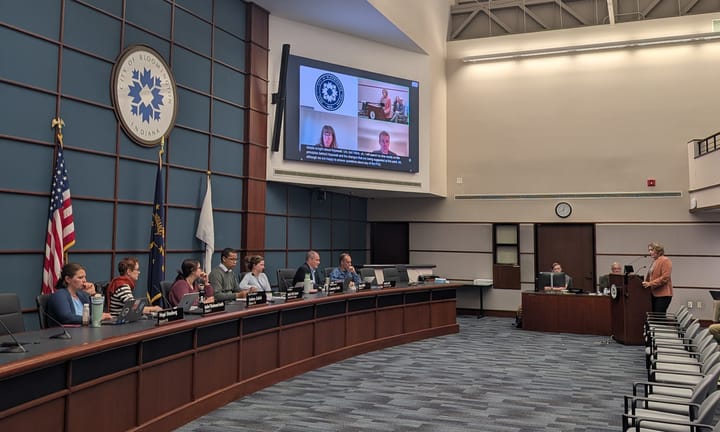
The three members of the BZA who were present on Thursday to give the approval were Jo Throckmorton, Tim Ballard, and Flavia Burrell.
Before hearing the CIB’s variance request, Throckmorton had a quick sidebar with assistant planning director Jackie Scanlan to confer on the question of a potential conflict of interest presented by Throckmorton’s work as filmmaker documenting the convention center construction with the “Hard Hat Video” series. Throckmorton confirmed to The B Square that his contract is with Visit Bloomington, not Schmidt Architects or the CIB.

Comments ()