
County council stand against North Park jail location backed by Bloomington counterparts
Bloomington’s city council voted unanimously on Wednesday to oppose a new jail at North Park, backing an in-city alternative as legal deadlines approach for the county government. County officials warn that delays risk renewed litigation and higher costs.
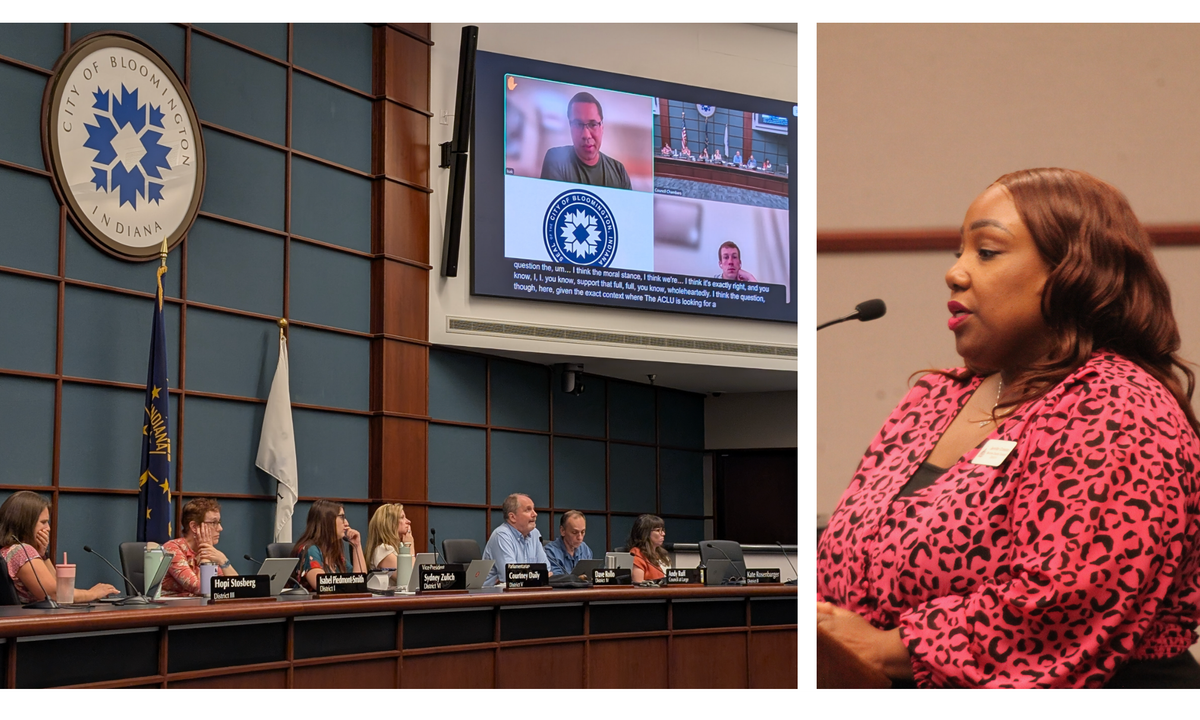
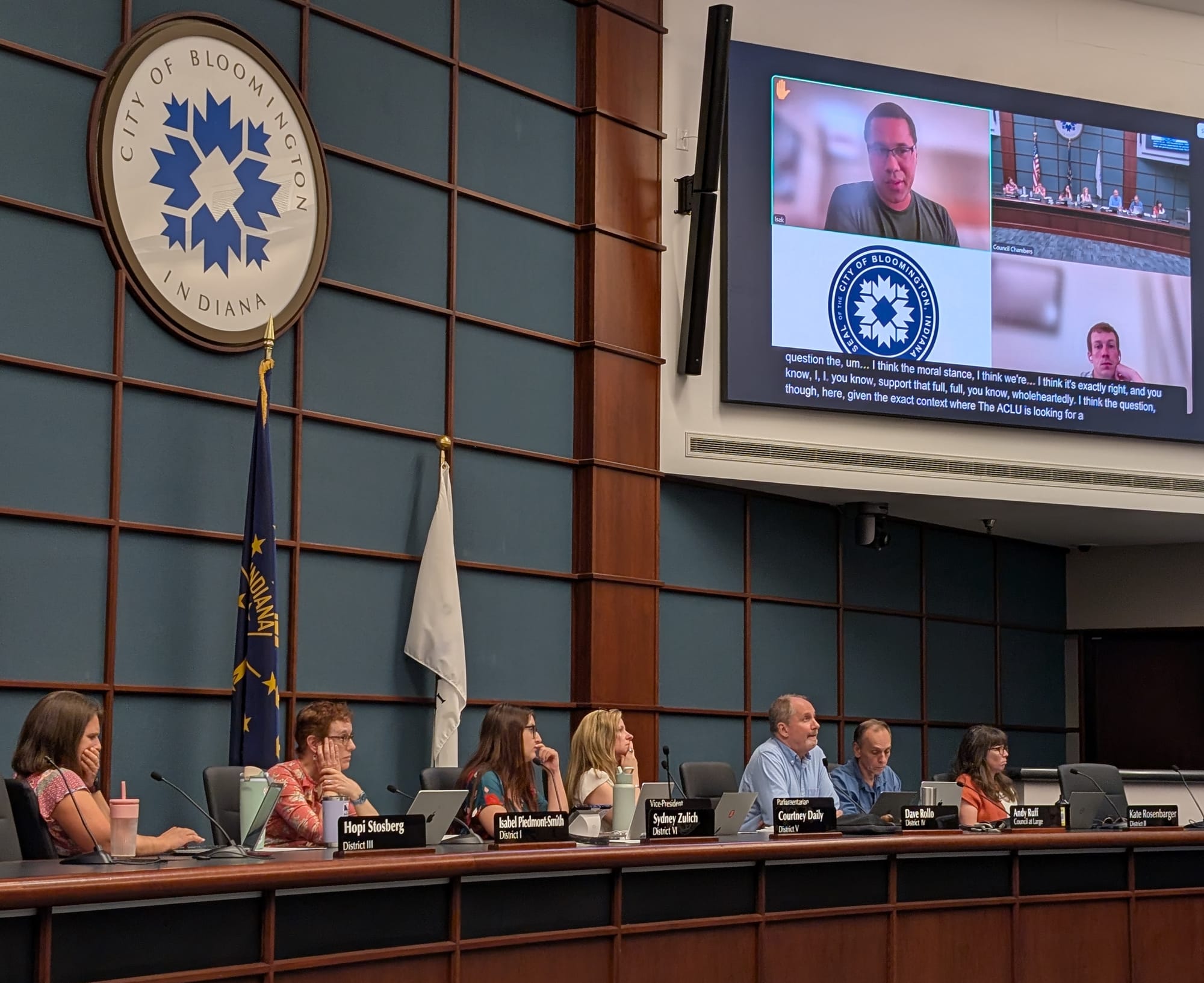
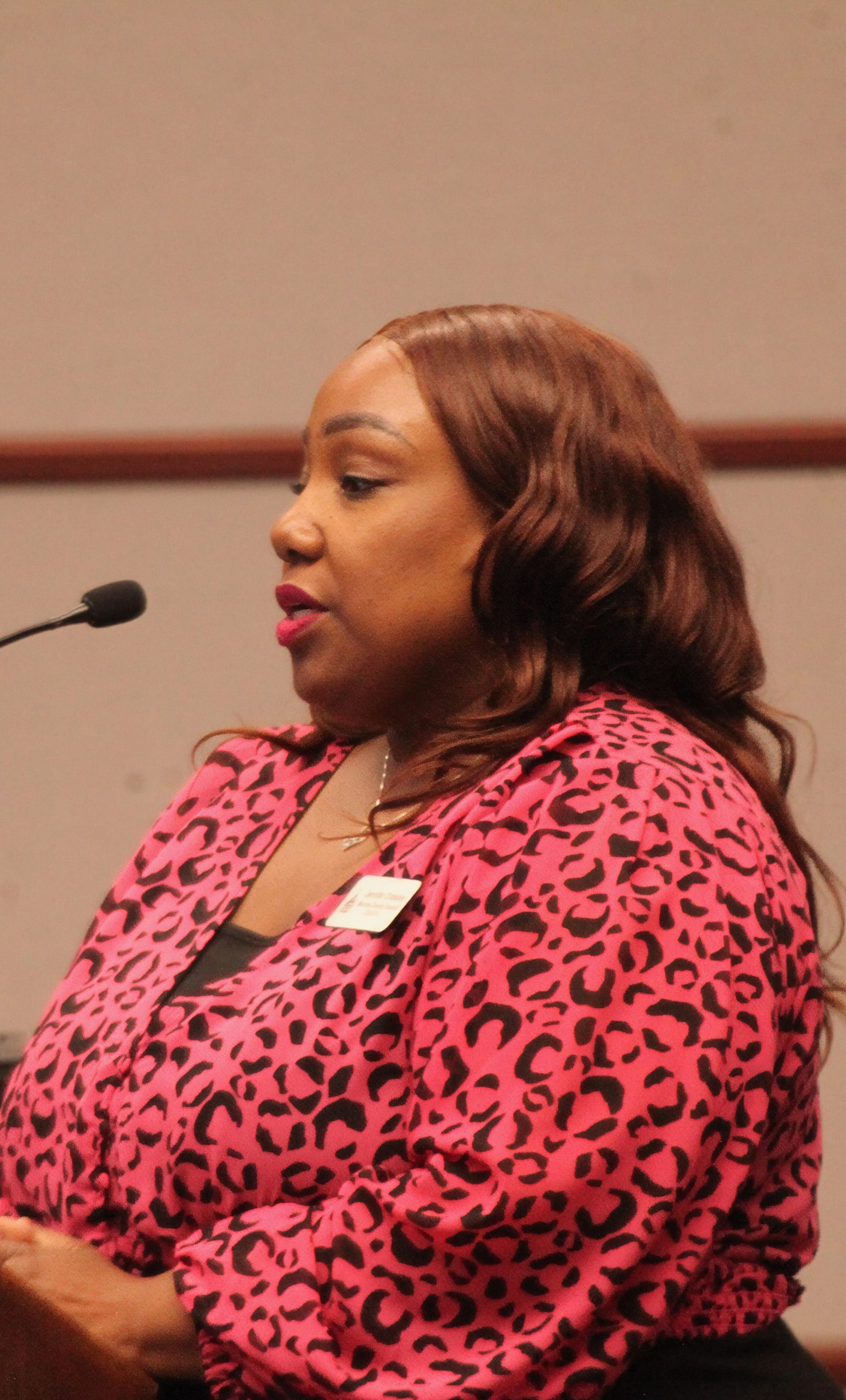
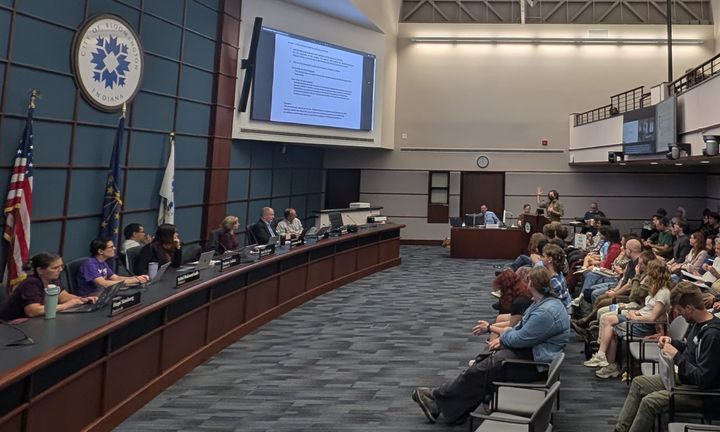
Left: Bloomington’s city council. Right: Monroe County councilor Jennifer Rose Crossley. (Dave Askins, April 22, 2026)
Bloomington’s city council has formally joined the Monroe County council in opposing construction of a new county jail at the North Park site. The council voted unanimously on Wednesday (April 22) to adopt a resolution that rejects the location off SR46 north of town and urges an unspecified alternative inside the city limits.
The resolution says the city council “stands with its county council colleagues and their decision not to fund the purchase of the property at North Park.” It also pledges that the city will work with county officials “to support an expedited zoning and permitting process for the construction of a new jail within city limits.”
The vote came as county officials face renewed legal pressure tied to a long‑running federal lawsuit over jail conditions. A 2008 lawsuit over overcrowding led to a private settlement agreement that has been periodically extended.
The latest extension, through May 29 of this year, was approved by the court on April 14, which was the day before the extension of the settlement agreement expired. In mid-January this year, the ACLU, which represented the plaintiffs in the original lawsuit, agreed only to a 90-day extension, after agreeing for several years to a year-long extension. It was a measure of frustration for the ACLU over lack of progress on constructing a new jail.
Under the most recent court filing, county commissioners are supposed to approve a new purchase agreement for North Park by the end of April. If the county council does not approve that agreement at either its May 12 or May 26 meeting, the filing says, the ACLU anticipates moving to dismiss the settlement agreement, which opens the way to new litigation.
While a new purchase agreement for North Park had been expected to appear on the Thursday (April 23) regular meeting agenda for the county commissioners, that meeting has been canceled. That leaves April 30 as the last remaining regular meeting date in April when commissioners could approve a new North Park purchase agreement.
Background: County council v. County commissioners
In October last year, county councilors unanimously rejected the appropriation that was needed for commissioners to close the real estate deal on North Park. County councilor have since approved their own resolution declaring they are not interested in pursuing the property.
Since last week’s news of the settlement extension, county commissioner Jody Madeira has stressed in online commentary that the conditions tying the settlement extension to a North Park purchase came from ACLU lawyers, not from local elected officials. “The ACLU is the party that is imposing the requirement that the council approve the purchase agreement,” she wrote. “That requirement was announced to commissioner and council leadership and was not something that county officials had the opportunity to negotiate. It’s either take it or leave it.”
A subsequent news release from commissioners stated that “the conditions attached to that extension were imposed by the ACLU, not by the Commissioners.”
Sentiments from Bloomington city councilmembers
At the city council’s Wednesday meeting, councilmember Sydney Zulich framed the North Park decision as both an access issue and a financial one. She said the scale and cost being discussed for the North Park project would translate to about $5,000 per county taxpayer.
“This is a project that at the North Park property would cost every taxpayer in this county $5,000,” she said. “I’m happy to pay my taxes, but I would much rather those resources be going towards prevention services and keeping people out of jail and in their own homes with their families.”
Zulich also urged a shift in mindset about capacity. “When we look toward the future of criminal justice in our community, our goal should never be to maximize space,” she said. “The space will be filled if it is created. How will we invest in resources that reduce crimes instead of building bigger spaces to confine those that commit them?”
Councilmember Courtney Daily called the North Park concept “far, far too expensive for our community” and questioned the size of the proposed facility. “I agree that we need adequate space, but this planned expansion is not a realistic need for our current incarceration needs,” she said. “I’m deeply uncomfortable with creating vastly more space than we currently need because, hey, that’s got to be filled one way or another—so it will.”
Daily said that dollars should be shifted to mental health support, addiction recovery and other programs that keep people out of jail, and warned that a remote site would make it harder for families to visit and for people leaving custody to connect with services.
Councilmember Isabel Piedmont‑Smith tied the resolution to an Oct. 22, 2025 letter written by Zulich, which the city council ultimately supported, urging county officials not to move forward with North Park. She reiterated her support for the county‑owned Thomson property on South Rogers, which was purchased years ago for a juvenile justice center and located in her city council district, as a better option.
“There is a property that already belongs to the county that was purchased for a juvenile justice center, and that’s the Thomson site,” she said. Even if utility lines there need to be moved, she added, “I think it would still come to less money than what it would cost at North Park.” Piedmont‑Smith also cautioned against building far more beds than are currently needed, saying, “If there are vacant beds…you know, ICE is going to come and knock on our door and say: We’ve got some people to store.”
Councilmember Hopi Stosberg said she is ready to support moving an in‑city project as quickly as realistically possible, but noted that current councilmembers cannot dictate how fast independent bodies like the plan commission or board of zoning appeals will act.
Andy Ruff said that if the community did “full cost accounting,” including social and environmental costs and not just construction, renovation of the existing facility would likely emerge as the least expensive option overall.
Sentiments from county commissioners
County officials used the public commentary time during the city council’s meeting to underscore what they see as hard deadlines and real legal risk. Speaking via a Zoom video conferencing connection, Madeira told city councilmembers that their resolution was like “rearranging deck chairs on the Titanic after it’s hit the iceberg.”
Madeira continued by saying after 17 years under the original lawsuit, “it’s too late to complain that you’re being rushed into litigation.” Letting the settlement lapse without a concrete plan, she said, would force the county government to operate a “constitutional jail” under direct court oversight, with added costs to house people in other counties, transport them, hire more staff, and pay for lawyers and monitors.
“This isn’t caution or compromise,” Madeira said about the city’s resolution. “It’s not simply a symbolic expression of preference about geography or social equity. This is an invitation to continue down a path that sends the county off a cliff into a lawsuit it can’t defend, and that’s the part that the public deserves to hear clearly. You are pushing us through the courtroom doors.”
County commissioner Julie Thomas, also speaking from a remote electronic connection, focused on the mechanics of building and financing a new facility. She said the county’s bond counsel has advised that a bond to pay for construction has to be issued by July 2026. North Park, with a purchase framework already in place, is “shovel ready,” she said, while the Thomson site would require a change to its planned unit development (PUD) as well as work on karst, dirt removal, relocation of high‑voltage power lines. Duke Energy estimates the powerline relocation will take at least a year and a half, Thomas said.
“The city plan commission and city council must approve a change to the planned unit development. We cannot proceed without that approval,” Thomas said. “It is a necessary public process that we respect, and it cannot be shortened nor avoided. That fact alone makes any project on Thomson impossible to complete either by Falk’s deadline…or the bond counsel’s deadline of July of 2026.” Ken Falk is the lead attorney for the ACLU on its lawsuit.
Thomas said the ACLU is focused on getting a constitutional jail in place as soon as possible, with a full justice center to follow. She told city councilmembers that transit access to North Park would have to be addressed by the county under obligations that will arise in 2029 under the constraints of SEA 1.
Sentiments from county council president
Speaking in person from the public mic in city council chambers was county council president Jennifer Crossley, who thanked the city council for taking up the issue, but pressed for something more specific than a general promise to “expedite” approvals. She said county officials have heard informally that city planning and zoning steps could take nine to twelve months and said that the ACLU would need clear, written commitments from the city to accept an in‑city alternative.
Crossley asked for something specific. “Whatever we can do to put words to paper, that would be my humble ask, because we just need something,” she said. Crossley also warned that if the county continues toward North Park, everyone in the room could look forward to higher taxes.
Sentiments from the public
Members of the public echoed concerns about both cost and location. At least six city residents spoke directly on the jail item. Several, including Seth Mutchler, urged a serious look at renovating the existing downtown jail, pointing to past consultant estimates that put renovation in the tens of millions—well below the projected $200‑million‑plus price tag for a new facility. “Since 2020 we have not exceeded 233 average daily population, and in 2023 we were under 200,” Mutchler said. “We don’t need more beds. We need to do the work to incarcerate fewer people.”
Others emphasized reentry and family access, pointed to existing bus routes and nearby services at the current location. They warned that a remote jail along a four‑lane highway would make it harder for people leaving custody to reach food, treatment, and housing supports, and harder for families to visit, especially those without cars.
Reservations from the city council president
Council president Isak Asare, who was participating in the meeting from a remote electronic connection, ultimately joined the unanimous vote in favor. But that was only after laying out reservations about passing a largely symbolic statement that the city might not be able to back up with concrete action. He said he agreed with the direction, which was opposing North Park and favoring a site inside the city.
But Asare worried that promising to “expedite” zoning and permitting without specifics could amount to little more than posture: “If we’re just standing with you, but we can’t follow through with the way that we’re standing with them, don’t we think that that language needs to be very specific?”
Asare also questioned the way the two units of government were communicating mainly through resolutions instead of direct joint work, suggesting that particular dynamic itself helps explain why the issue has dragged on for years.
After indicating he would support the resolution, Asare immediately turned to what should happen next: “My call would be that, after we vote for this, that, you know, that we move to either have some joint session or something that we actually can just get around the table and figure out what needs to be done.”
Zulich welcomed that idea, noting that Daily had already suggested a joint discussion on the jail. She said the city “would love to host” county councilors and commissioners “to hash out how we might be able to expedite the planning process.”
Asked for comment after the city council’s decision, Madeira said by text message to The B Square: “Tonight’s vote by the Bloomington city council marks a disappointing turn in what should be a collaborative community process. Advancing a resolution that supports placing the jail downtown—despite clear legal concerns—puts Monroe County on a path toward unnecessary and costly litigation and delays any solution to the human rights nightmare in the current facility.”
Madeira continued, “My priority is to ensure responsible stewardship of public resources as well as pursue solutions that reflect broad community input, public safety needs, and fiscal accountability. Moving forward under the threat of this lawsuit does not serve those goals. I remain committed to finding a path that is lawful, transparent, and grounded in cooperation rather than conflict. Our community and our jail residents deserve such a process.”

Comments ()