
Hopewell anchors busy February for Bloomington's redevelopment commission
Bloomington’s redevelopment commission has a packed February which includes: launch of a process to establish the city’s first residential TIF districts, a second plan commission hearing on Hopewell South, and more—as the city tries to tie financing, zoning and land strategy to housing goals.
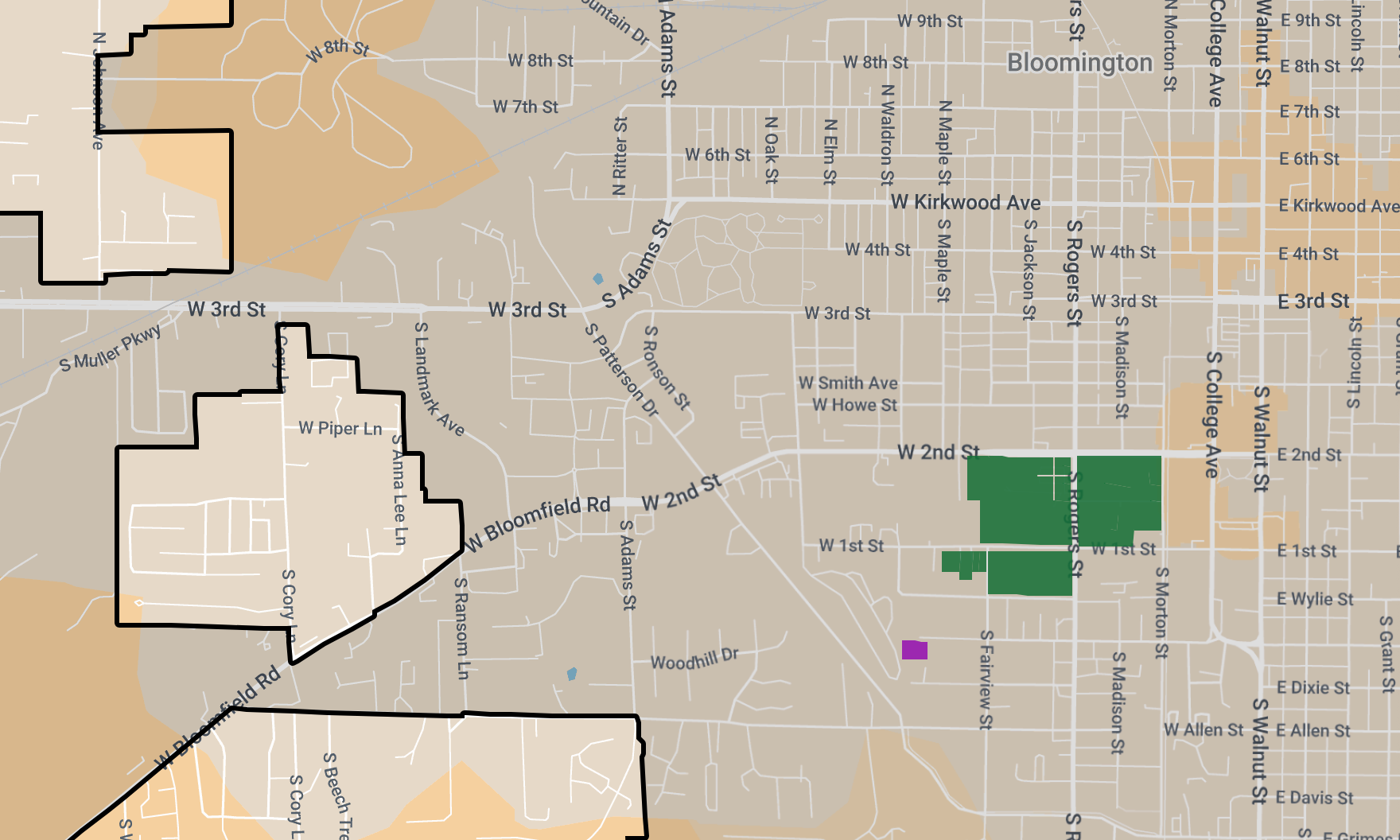
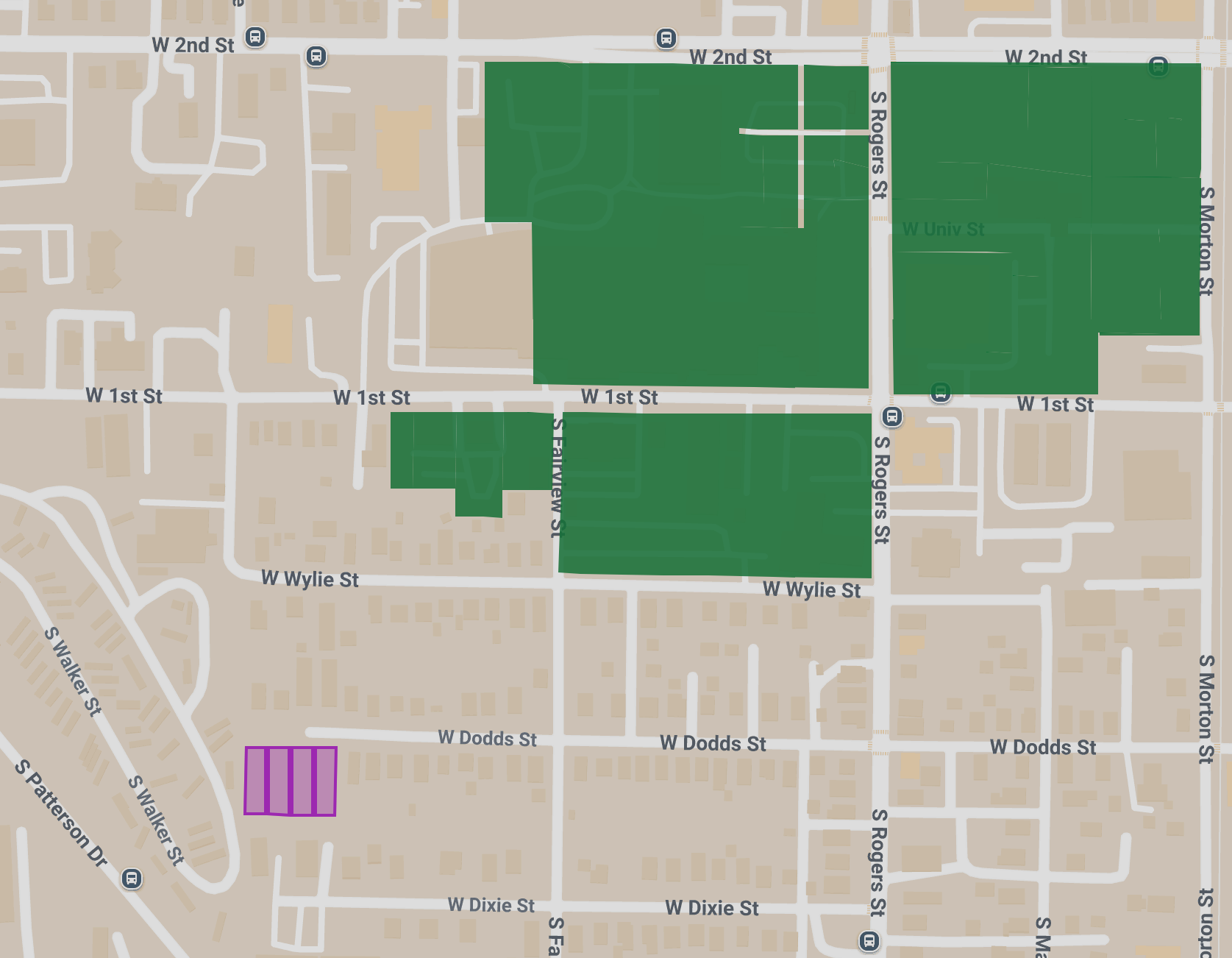
The area shaded green is the planned new Hopewell neighborhood. The area shaded purple includes the four lots on Dodds Street that could soon be put up for public offering. Maps by the B Square.
At the start of its Monday (Feb. 2) meeting, Bloomington’s redevelopment commission (RDC) got a rundown of some future topics from executive director Anna Killion-Hanson, who also serves as the city’s housing and neighborhood development (HAND) department director.
Killion-Hanson’s briefing ranged from the start of a process on Thursday (Feb. 5) to establish Bloomington’s first residential TIF (tax increment finance) districts, to a lecture to be hosted a week later, on Feb. 12, featuring a nationally known planner, Eric Kronberg.
Between those two dates, on Monday next week (Feb. 9), the Bloomington plan commission will be considering for the second time a proposal to rezone the Hopewell South property as a planned unit development (PUD).
Killion-Hanson’s update to the five-member RDC also included the number of snow clearance tickets that the city’s HAND inspectors issued after the snowstorm last week, which was 228. Under Bloomington city code, it is property owners who are legally responsible for clearing the snow from sidewalks next to their land.
The members of the RDC are: Deborah Myerson and Randy Cassady (city council appointments); and Sue Sgambelluri, Laurie McRobbie, and John West (mayoral appointments).
Hopewell, in particular Hopewell South, is a common thread for all three dates on the calendar that were highlighted by Killion-Hanson.
Residential TIF
The Hopewell neighborhood is one of the areas where the city wants to consider establishing a residential TIF district. The other is the Summit District PUD.
TIF districts are meant to spur economic development in a particular geographic area by allowing a city or county to use new property-tax growth from that area to pay for improvements there. It is the RDC that determines and oversees the expenditures of revenue that is generated from the districts.
Summit District PUD is a 140-acre area in the southwest part of the city, approved for a rezone by the city council in May 2024. The planned 24-acre Hopewell neighborhood is at and around the site of the former IU Health hospital at 2nd and Rogers Streets.
Timeline for Residential TIF
- Feb. 5: public meeting held by Bloomington RDC
- Feb. 16: vote on declaratory resolution by Bloomington RDC (This meeting could be rescheduled due to possible quorum issues for the RDC.)
- March 9: vote by Bloomington plan commission
- March 25: vote by Bloomington city council
- April 6: final vote by Bloomington RDC
Hopewell South rezone
The requested rezone for the Hopewell South project is slated for its second appearance in front of the plan commission next Monday (Feb. 9). The proposed rezone will likely get some kind of recommendation from the plan commission, so that when the city council knows the plan commission’s view of the proposal. But the plan commission has the option of forwarding the PUD to the city council with no recommendation. The city council will likely enact some version of the Hopewell PUD by the end of March.
The RDC is the owner of the Hopewell South property. The RDC’s petition is to rezone about 6.3 acres—blocks 8, 9 and 10 near West First and Rogers streets—to a PUD (planned unit development). PUDs are commonly described as a kind of custom zoning. The land is south of 1st Street across from the former main campus of the former IU Health Hospital site.
The PUD would replace standard R4 zoning and the existing Transform Redevelopment Overlay (TRO) with a custom ordinance and preliminary plan. The west side would largely follow R4-style residential rules with major modifications, while the east side, which includes the former Bloomington Convalescent Center building (714 S. Rogers St), would follow mixed-use standards and could accommodate uses such as a potential police headquarters.
The concept calls for a mix of single-family homes, duplexes, triplexes, four-plexes and a handful of small multifamily buildings, totaling around 100 units. City staff and consultant Alli Quinlan with Flintlock LAB, say smaller homes on smaller lots are key to lowering prices. Buyers would choose from a pre-approved “housing catalog” of plans already vetted by planning and building staff, allowing lots and permits to move quickly and potentially creating a model that could be used elsewhere in the city.
Lecture on zoning principles affecting Hopewell
Next week’s Thursday lecture (Feb. 12) will feature a speaker that Killion-Hanson described on Monday as a “nationally renowned planning whisperer” and Incremental Development Alliance faculty member: Eric Kronberg. The city’s news release about Kronberg’s lecture says that registration is required.
The city’s news release says, the intended audience for Kronberg’s lecture is residents, builders, and community partners. The talk is meant to “take a closer look at Hopewell and a broader conversation about what housing attainability can look like when development is designed to reflect Bloomington’s values.”
Four Dodds Street lots
Also related to real-estate, just a couple blocks southwest of the planned new Hopewell neighborhood, Killion-Hanson told RDC members on Monday she has asked for appraisals for four RDC‑owned lots on Dodds Street.
Based on a review of the properties on Beacon, which is Monroe County’s online GIS parcel information system, the RDC bought the four vacant lots from Habitat for Humanity in 2022.
Once the appraisals are complete, Killion-Hanson anticipates bringing forward a proposal for a public offering of the vacant lots. The RDC approved the purchase of the four lots in the first half of 2022.
Based on deliberations at the May 23, 2022 meeting, the RDC acquired the parcels from Habitat so that the RDC could intentionally structure an affordable/workforce homeownership project there, rather than leaving the fate of those lots entirely to the open market. The public offering is likely to reflect those goals of affordable homeownership.
Comments ()