
Hopewell South PUD pushed to April 22 as Bloomington council, mayor spar over conditions
On Wednesday, Bloomington’s city council postponed a vote for a third time on the Hopewell South PUD after a long debate over permanent affordability levels, street design standards, and whether the council can legally impose “reasonable conditions” on the project.
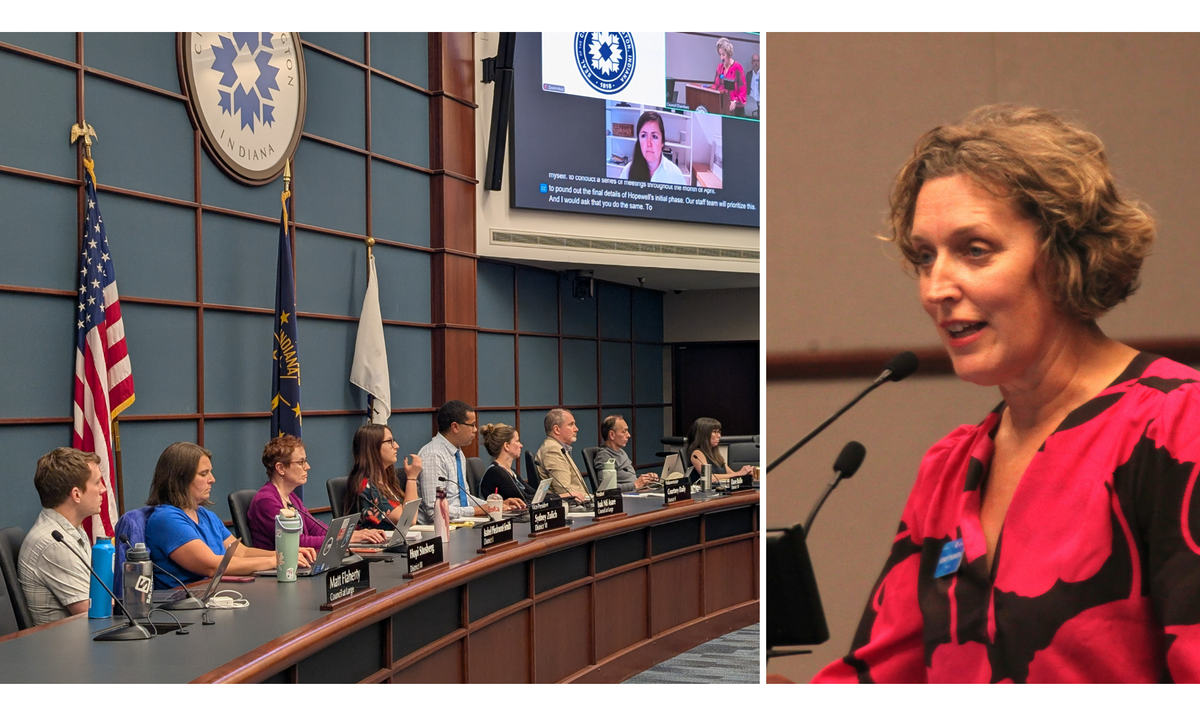
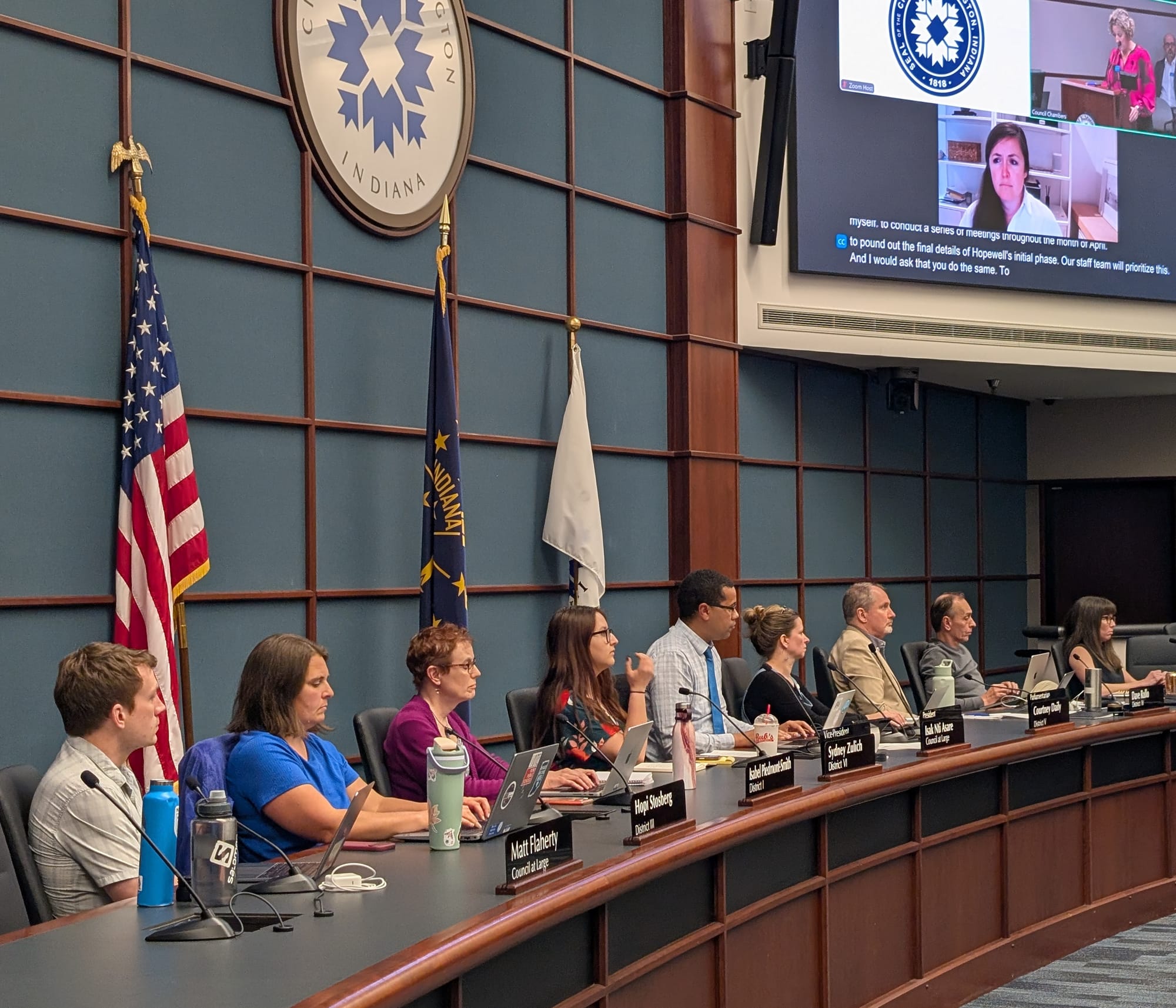
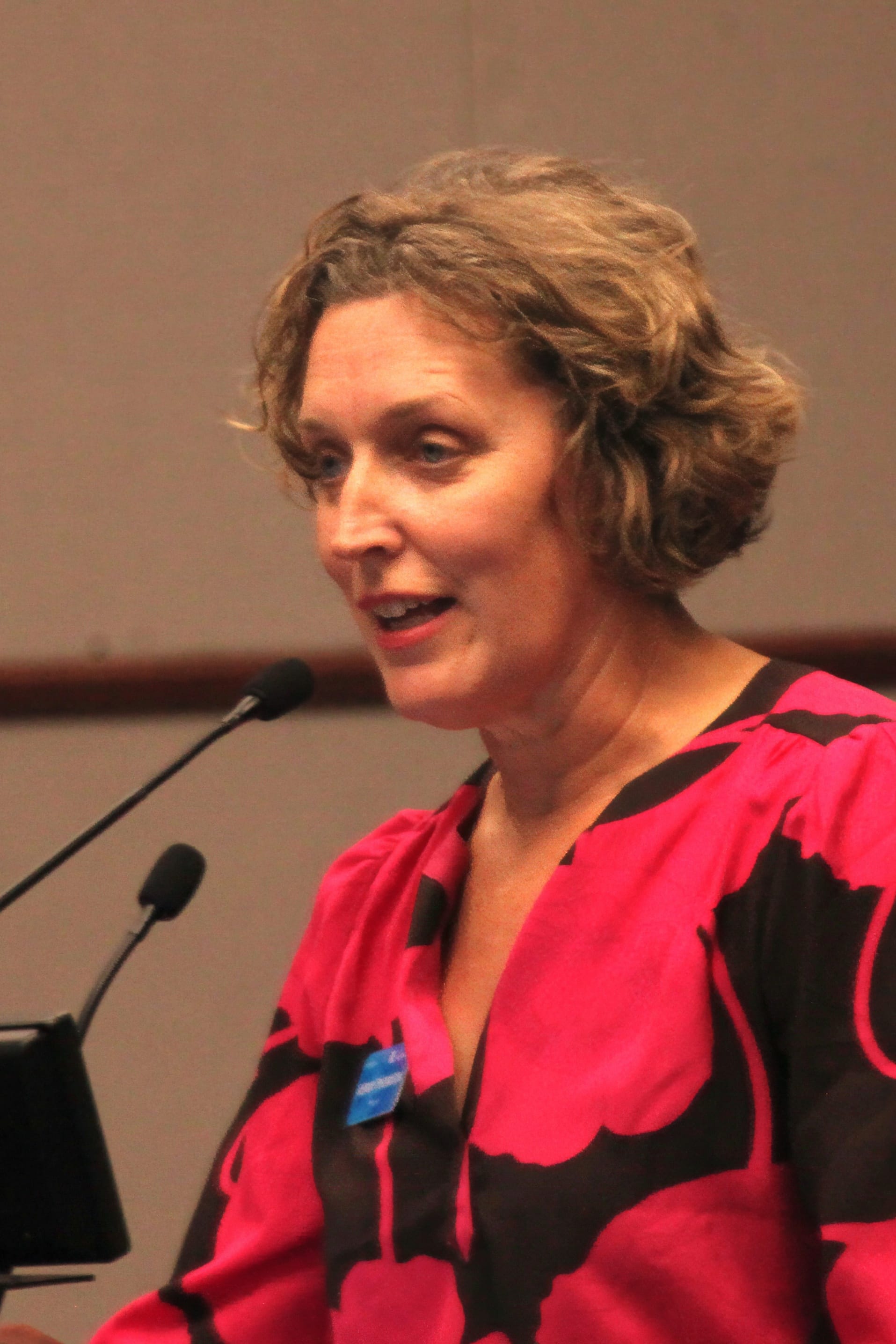
Left: Bloomington city council. Right: Bloomington mayor Kerry Thomson (Dave Askins, April 2, 2026)
Bloomington’s city council has for the third time postponed a vote on the proposed Hopewell South planned unit development (PUD), and will take more time in April to resolve disagreements with mayor Kerry Thomson’s administration over affordability, street design, and the council’s legal authority to place reasonable conditions on the project.
After more than four hours of discussion on Wednesday (April 1), councilmembers voted unanimously to delay a final decision on the Hopewell South PUD, which would rezone a 6.3‑acre portion of the former IU Health hospital site for a 98‑home neighborhood south of First Street. A PUD is a kind of custom zoning based on, but different from, the existing zoning of an area.
The PUD ordinance is now set to return to the council’s April 22 agenda, with a work session on April 15 possibly dedicated to the Hopewell redevelopment project.
Thomson led off her remarks with a possible gambit that might have for a relatively short evening, by asking the council to use the month of April to work out the fine points of Hopewell South, with the goal of taking a final vote by council’s meeting on May 6.
“I call on every council member and myself to conduct a series of meetings throughout the month of April to pound out the final details of Hopewell’s initial phase,” Thomson said. “Our staff team will prioritize this, and I would ask that you do the same.”
But Thomson said that if the council were to adopt conditions that “materially change” the proposal from the administration,” her office and the Bloomington redevelopment commission (RDC) would need to “go back to the drawing board,” including costs and layout, before proceeding. It sounds like the RDC could get briefed before or at their next regular meeting next Monday (April 6). The RDC is the legal owner of the Hopewell real estate.
The council was not looking to abbreviate the meeting, and wanted to dive into the specifics of “reasonable conditions” on affordable housing and street layouts, as well as a general legal question about the idea of reasonable conditions themselves in the context of state zoning law.
Impact of new PUD zoning for Hopewell South?
Under existing zoning, which is R4 (residential urban) and RM (residential multifamily) in the Transform Redevelopment Overlay (TRO), staff and consultants say only about 28 homes could be built on the site. The proposed PUD would allow 98 small homes in a compact, alley‑served neighborhood with a mix of one‑, two‑, and three‑bedroom units and a central green corridor.
Consultant Alli Thurmond Quinlan of Flintlock LAB, hired to design the neighborhood, stressed in her remarks on Wednesday that the project has been developed through extensive coordination with city engineering, fire, sanitation, and planning, and has been recommended by the city’s plan commission, which placed conditions on the proposal.
She characterized the current plan as “code‑compliant” from a land‑use perspective and framed many of the council’s 13 proposed “reasonable conditions” as carrying significant trade‑offs in cost, unit count, and engineering.
Core Dispute: How much permanent affordability?
A central point of contention is how many of the 98 homes should be permanently income‑restricted, and by what legal mechanism.
Councilmembers noted that Bloomington’s Unified Development Ordinance (UDO) requires PUDs that are based on a claimed public benefit of affordable housing to provide at least 25% of units as permanently affordable—15% base plus an additional 10% tied to PUD qualifying standards.
Councilmembers Hopi Stosberg and Kate Rosenbarger, co‑sponsors of proposed Reasonable Condition 4 (RC 4), noted that the Hopewell South PUD as proposed commits only 15% of units to permanent affordability and 50% to one‑time affordability, leaving it short of that 25% permanent requirement unless adjusted.
Stosberg framed their condition as both bringing the PUD into compliance with the UDO and taking advantage of a unique opportunity because the city owns the land: “The original ordinance commits 15% to permanently affordable and 50% to just generally affordable… The PUD requirements actually require 25% at a minimum to be permanently affordable.”
As drafted RC 4 would require 50% of dwelling units in Hopewell South to be permanently affordable. That portion would be further broken down so that 15% of total units be affordable to households at or below 90% of area median income (AMI) and 35% of total units be affordable to households at or below 120% of AMI.
The mechanisms for permanent affordability in RC 4 be: deed restrictions or covenants; ground leases where the land is owned by a community land trust (CLT); or other legal mechanism for permanent affordability if the city council approves it as a PUD amendment.
Concerns were raised about how deed restrictions and other permanent affordability tools affect access to mortgages, the ability to sell homes, and accumulation of equity over time for buyers.
Nathan Ferreira, executive director of Summit Hill Community Development Corporation and the Bloomington Housing Authority, which operates a local community land trust, said their ground‑lease model works, but is not easily scaled: “We have struggled greatly with lenders. It’s not a conventional model… that’s been the bulk of our work is finding lenders who will do the shared equity lending.” He said the land trust model is “not right for every low to moderate income buyer,” and that right now the Bloomington area market seems to be saturated. He thinks additional community land trust units at Hopewell would likely “delay people getting housing.”
Ferreira added a broader warning: “If we push too far, we run the risk of making this project financially infeasible, or delay it to the point that it doesn’t move forward and it has to be abandoned.” He added, “I am sure there is a luxury student housing developer just waiting to get their hands on this property.”
Also weighing in from the public mic on Wednesday was Steve Bishop, with First Financial Bank and also a member of the Bloomington plan commission, which unanimously recommended the council adopt the Hopewell South PUD. He began with a quick poll of the councilmembers for their relevant experience—none raised their hands—and concluded by drawing the distinction between affordability, which he said the council could not impact, and attainability, which he said they could:
Anybody on the council involved in real estate? Any of you with a lending background? Because I hear a lot of conjecture around both those topics, and I don’t see any experts on the panel or any being convened to talk in front of you. … The point of affordability that you keep focusing on really doesn’t come into play at all. You all have the purview to help with attainability, which is the purchase of that home. You don’t have anything to do with affordability because you don’t have control over taxes or insurance. Indiana currently leads the country in foreclosures because people can’t afford their escrow accounts—that’s taxes and insurance. So unless you plan to cap those somewhere, there is no affordability permanence for any of this.
Core dispute: Sidewalks, tree plots, and fire access
Another major point of disagreement involves whether the Hopewell South PUD should follow the city’s adopted transportation plan and UDO subdivision standards for: sidewalk width; tree plots; alley width; and fire apparatus access.
Councilmember Matt Flaherty has proposed RC 8–RC 11 which are aimed at bringing Hopewell South into alignment with the city transportation plan. Flaherty’s RCs would mean 6‑foot minimum sidewalks along streets, rather than five‑foot or monolithic sidewalks. Tree plots (landscape strips) would be required separating sidewalks from the curb, including for Wylie Street. Alleys would be narrowed from 20 feet to around 15 feet to free up space for sidewalks and green space without reducing unit count, while still meeting fire code.
Flaherty argued that allowing the city, via a PUD, to build street sections below the standards required of private developers is “extremely bad governance and bad policy precedent,” and contrary to the stated purpose of PUDs, which is to provide benefits beyond base code.
Stosberg raised a concern about equity: “Are we okay with the poor people living in a place with crappier sidewalks?” she asked, questioning whether “delegating certain parts of our population” to sub‑standard public space, in the name of lowering unit prices, is acceptable.
Quinlan Thurman responded to Stosberg by saying that the transportation plan itself anticipates flexibility in existing neighborhoods, citing page 25, which states that “existing streets shall not be required to conform to these cross section standards.”
Quinlan Thurman that clause was used to preserve existing mature street trees along Wylie Street and to avoid expanding pavement and stormwater runoff. A six‑foot sidewalk compared to a five‑foot sidewalk represents a 20% increase in impervious area, she noted.
Widening rights‑of‑way to achieve six‑foot sidewalks plus six‑foot tree plots on both sides of the interior street would require shaving depth from Block 9, which she said would cost roughly 14 lots if applied uniformly. On Wylie specifically, she pointed out that the PUD retains an existing monolithic sidewalk and setback pattern, in part to preserve trees and “minimize impacts for the neighbors across the street.”
Bloomington’s planning Director David Hittle backed the consultant’s broad approach, saying from the mic that projects “rarely benefit from democratic design.” The planning department’s approach had been to “let her cook, let her do her thing.” He added, “I think you put a certain measure of trust in somebody when you bring them in to do that, and you don’t arrange and try to micromanage that work.”
Hittle then offered a critique of the council’s approach: “I have to say, I’ve never seen this from a legislative body in my 20 years—to have a city council argue about 12 inches here, 12 inches there, argue about what a PUD is.”
Hittle added, “This is a staggering conversation for me. The fact that a legislative body, a city council, is—‘meddling’ is the best word—in something that they shouldn’t be meddling in. This is plan commission material, if anything.”
Subsequent deliberations, which included Bloomington fire chief Roger Kerr, focused on how fire-access requirements might be met if lanes were narrowed, including possible reliance on hose-reach rules, sprinklers, or alternative access designs. Kerr said state fire code generally calls for 20 feet of clear width for apparatus access, though some exceptions exist, and warned that any accommodation could create precedent for future projects. Flaherty and Quinlan Thurman batted back and forth the practical constraints of utilities in the alleys and the potential cost and insurance implications of installing sprinklers across the development.
Core dispute: Legal authority for reasonable conditions
Overlaying the substantive land use policy debates is a legal disagreement. Corporation counsel Margie Rice and assistant city attorney Dana Kerr, who provides legal support to the Bloomington RDC, take the view, expressed in a memo, that the only options for the city council at this stage in the PUD approval process is to adopt or reject, with no option to amend. They based their position on a 2007 court of appeals case called Crown Point v. Misty Woods.
Since the previous week, when the city council postponed Hopewell South PUD for the second time, the outside firm of Clark, Quinn, Moses, Scott & Grahn was hired by the council to analyze the city legal department position. The city council’s two staff attorneys both resigned in mid-February.
Clark Kirkman and Kelly Shaw with Clark Quinn appeared onscreen via a Zoom video connection to give their perspective which was summarized in a memo.
Kerr said on his view any change to the Hopewell South PUD that changes its text, drawings, or exhibits—including added obligations not accepted by the petitioner—is a prohibited amendment of a zone map change, not a permissible “reasonable condition.”
Kerr said that does not bar all reasonable conditions, but limits them to clarifying how existing PUD terms are met—for example, specifying which tool is used to meet the extra 10% affordability requirement already allowed under the UDO. He characterized the 50% permanent affordability requirement of RC 4 as an amendment, and, even if voted on as a reasonable condition, would be “legally an unreasonable condition” because of its financial impact.
Clark Quinn attorney Kirkwood, hired by the council, took a different view. He pointed to the 1500-series of state planning law , which expressly authorizes the legislative body to “impose reasonable conditions” when acting on a PUD district ordinance, separate from the general rezoning provisions that were applied in the Misty Woods case.
Kirkwood said Misty Woods involved a conventional rezoning, not a PUD, adding that the case “does not contemplate the 1500 series” of the zoning statutes that govern PUDs. Kirkwood also pointed to a part of state zoning code that describes a reaonsble condition as “a condition imposed upon approval relative to any other development requirement that must be met before any other secondary approval may be granted or building permit may be issued.” “To the extent that there’s a definition of reasonable condition,” Kirkwood said, “I would submit that that statement … would be a good place to start.”
Kirkwood argued that the council’s conditions should be evaluated under an “arbitrary and capricious” standard, considering whether they further legitimate public goals and are roughly proportional to the project’s impacts.
Compared what they were hearing from their own outside counsel to the advice they’d been given the previous week by the city’s legal department, councilmember Isabel Piedmont‑Smith said she found the administration’s broad rejection of the council’s authority to impose reasonable conditions “very disturbing,” given that councils and mayors have attached similar conditions to PUDs for decades. Piedmont-Smith put it like this:
I think it is important and not to be glossed over, that the administration’s legal department says that this Common Council is not allowed to do something that we are indeed legally allowed to do and have done for decades,” she said. “If we have a mayoral administration that denies the legal rights and responsibilities of council, that’s going to be a problem longer term.
Councilmember Dave Rollo warned that accepting the administration’s interpretation would set a precedent undermining the council’s ability to improve PUDs in the public interest: “This is precedent‑setting, so if we surrender that at this point, then it’s probably going to affect future PUDs. Rollo added, “I think that this body has positively affected PUDs in the past in a negotiated process to improve PUDs for the public good,” he said.
Even if the mood in council chambers on Wednesday night was predominantly frustration, Flaherty at one point stated, “We are making progress…” Negotiations could continue between the administration as early as the council’s next work session on April 15.

Comments ()