
Hopewell South PUD vote postponed by Bloomington city council until April 1
Bloomington’s city council postponed a vote on the Hopewell South PUD vote for a second time, splitting 6–3 after debate over permanent affordability and legal limits on amendments. The project returns April 1, a day after the mayor’s state of the city address.
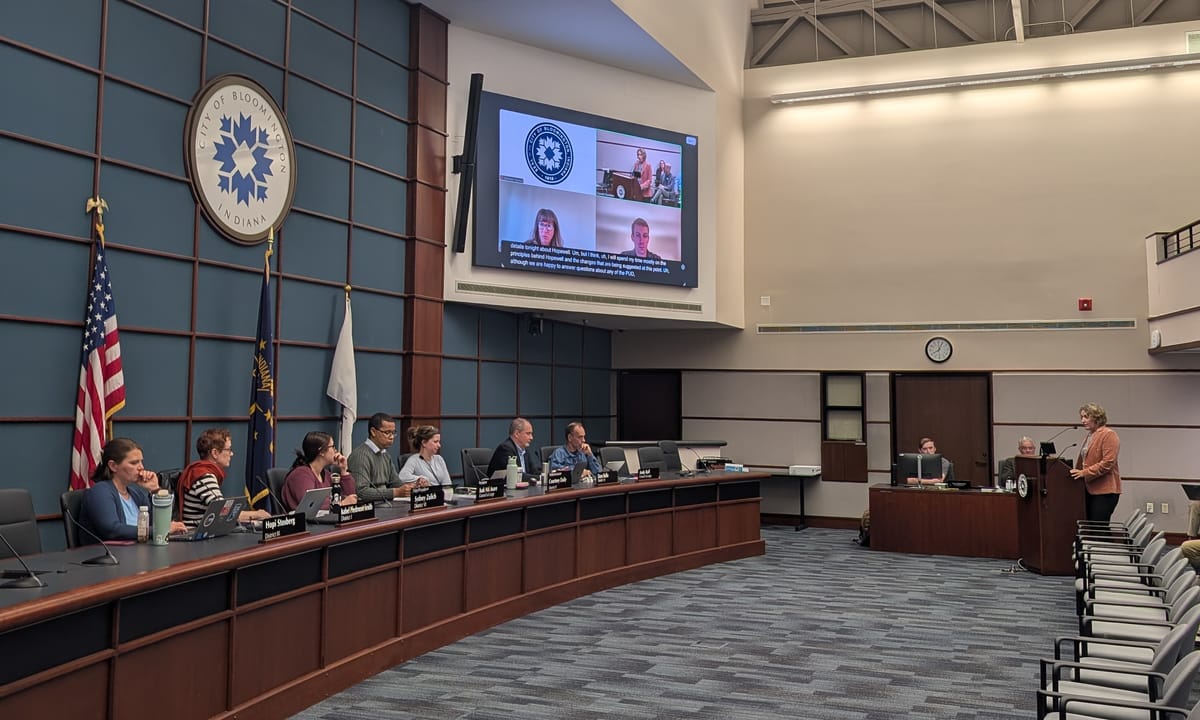
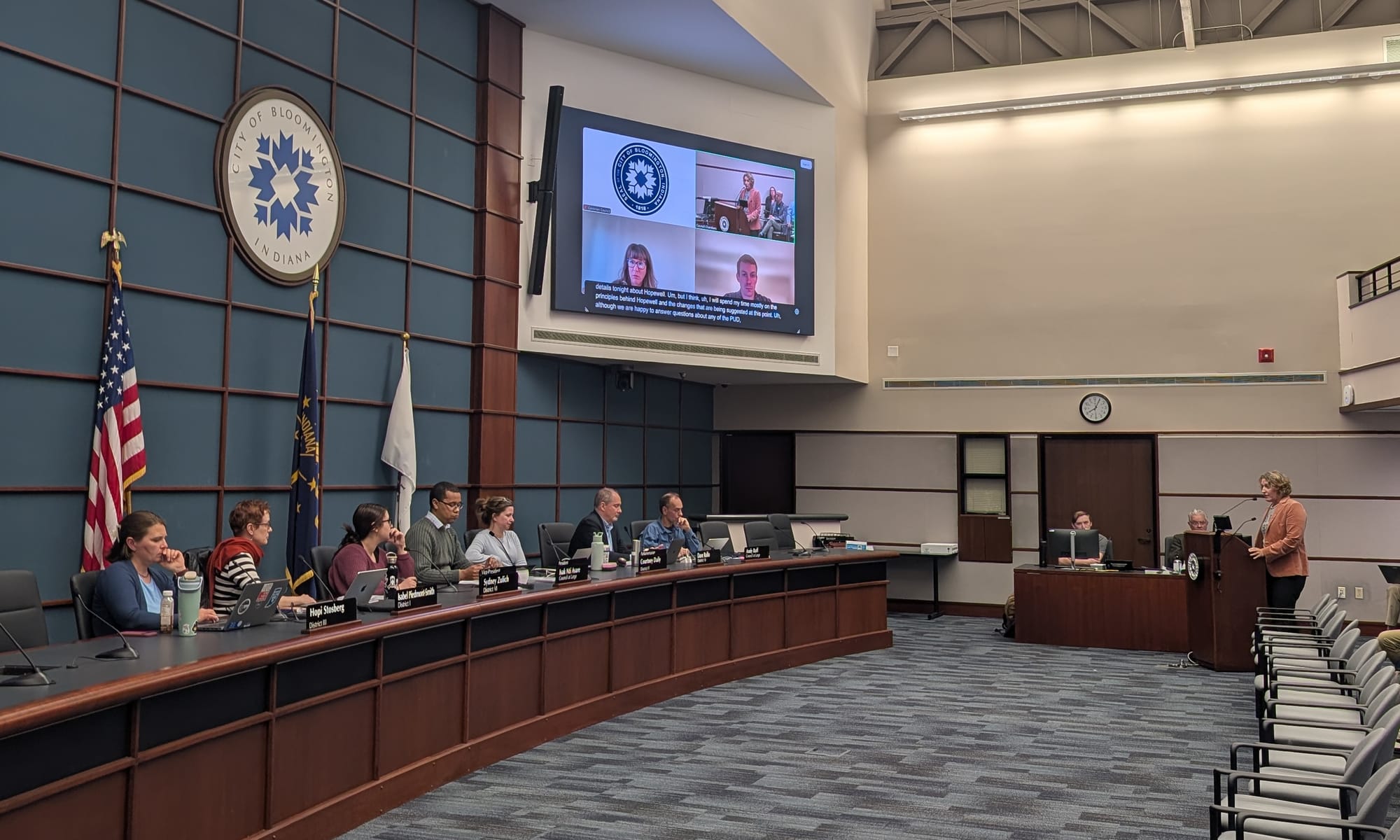
On April 1, Bloomington’s city council will consider the Hopewell South planned unit development (PUD) for a third time, after voting 6–3 Wednesday night (March 25) to postpone a decision at least until next week.
The council’s decision to delay came after more than two hours of discussion that included one substantive issue and one legal issue. The substantive issue was how much permanent affordability for housing the city has to lock into the project. The legal issue is whether the council can amend a PUD that has already been recommended for approval by the plan commission and certified to the council.
Dissenting on the 6–3 vote to postpone were all three council officers: Isak Asare (president); Sydney Zulich (vice president); and Courtney Daily (parliamentarian). They wanted to vote to approve the Hopewell South PUD that night.
It was the same 6–3 tally that resulted in postponement of the Hopewell South PUD three weeks ago.
Two weeks before that, on Feb. 18, the council refused to allow the Hopewell South item to be introduced, with that vote failing 2–7. Only Asare and Zulich voted in favor.
What’s the Hopewell South PUD?
Hopewell South covers roughly two blocks near the former IU Health Bloomington Hospital site, now owned by the city’s Redevelopment Commission (RDC). The PUD rezoning considered by the council would set the zoning and development rules just for the Hopewell South portion of the site, which with an emphasis on small-lot, owner‑occupied housing, a mix of housing types, and pre‑approved building plans intended to streamline permitting and lower costs.
Bloomington’s redevelopment commission purchased the site in a $6.5-million deal, after IU Health decided to move its hospital to the eastern edge of town off the SR 46 bypass. Hopewell South makes up about 6.3 acres of the 24 total acres of Hopewell.
The proposed PUD is supposed to include more housing than would be possible under the existing zoning. Hopewell South has a target build‑out of about 98 housing units, compared to 28 under the existing R4 zoning.
Planned for Hopewell South is a mix of single‑family houses, duplexes, small multifamily buildings, and townhouses, with lot sizes and building types calibrated to support lower price points. The plan relies on smaller rights‑of‑way and “lanes” that still meet fire and ADA standards, but allow more buildable land.
The plan comes with a commitment that 30% of units will meet at least Universal Design accessibility standards, with some units built to higher standard, clustered where the topography allows zero‑step entries.
Support from the mayor
Addressing the council on Wednesday night, Bloomington mayor Kerry Thomson framed the project as both a rare opportunity and a test of how Bloomington makes housing policy.
“This is also only the first part of a much larger neighborhood,” Thomson told councilmembers. “We have an opportunity today and an obligation into the future to set a clear path for what housing in Bloomington can be and just as importantly, how we lead together to make that happen.”
Thomson said the administration prioritized two main goals for Hopewell South: keeping homes as affordable as possible at market rates, and building a walkable neighborhood close to jobs and services.
“The design presented to you tonight does an exceedingly good job of meeting those two goals,” she said. “It has hit the mark on those two goals exceedingly well, and we still do very well on the others.”
But several councilmembers contended that the PUD, as written, falls short of the city’s own standards for permanent affordability—as expressed in Bloomington’s Unified Development Ordinance (UDO)—to a project on city‑owned land.
How permanent is “permanent affordability”?
Under the UDO, a PUD that claims affordable housing as a key public benefit has to go beyond the city’s base affordability incentives—either by making more units permanently income‑restricted, or by serving households at lower income levels than are required for the incentives.
The Hopewell South PUD, requires 15% of total dwelling units to be “permanently income-limited” at up to 120% of area median income (AMI). The affordable housing requirement in the Hopewell South PUD also says that at least 50% of total dwelling units within the PUD will be affordable to home buyers under 100% AMI.
In a written question submitted to the administration before Wednesday’s meeting, councilmember Matt Flaherty questioned whether making the initial price point affordable to home buyers under 100% AMI would meet the UDO requirement. At Wednesday’s meeting, it was Hopi Stosberg who pressed the issue.
“These should be permanently affordable units,” Stosberg said, pointing to UDO wording that expects either more units or lower AMI levels for a PUD relying on affordability as a qualifying standard. “That extra 10% should be permanently affordable, and this reasonable condition says, ‘Nope, that’s OK, just 15% being permanently affordable, and we can just kind of waive and adjust that requirement for these other units, they don’t need to be permanently affordable.’”
Stosberg and several colleagues backed a proposed “reasonable condition” on the PUD, which the council could impose, that would require 50% of units to be permanently affordable, with 15% at 90% AMI, using tools such as ground leases, deed restrictions, or other shared‑equity models subject to council approval. The reasonable condition backed by Stosberg was proposed by councilmember Kate Rosenbarger.
A competing reasonable condition put forward by councilmember Sydney Zulich, and favored by the Thomson’s administration, would keep the minimally required 15% permanently affordable at up to 120% AMI and allow the city to use alternative tools—such as silent second mortgages and rights of first refusal—instead of traditional deed restrictions.
Corporation counsel Margie Rice told the council that Zulich’s condition “makes no change to the exhibits or modifies the PUD” and simply “clarifies what is already existing in the PUD,” while higher permanent‑affordability proposal from Rosenbarger would conflict with the ordinance as recommended by the plan commission. That’s a key legal issue that was given extended separate discussion by the council.
Housing and Neighborhood Development (HAND) department director Anna Killion‑Hanson stressed that affordability details are still being worked out and tied closely to overall project costs.
“What we’re considering right now [with the Hopewell South PUD] is land use—it is not affordability, and the reason is because we cannot develop the affordability framework completely without knowing what’s getting approved,” Killion‑Hanson said. The various “reasonable conditions” proposed by different councilmembers (13 in all) will increase costs, Killion-Hanson said: “So how do you commit to affordability, not knowing what the overall cost is?”
Councilmember Isabel Piedmont‑Smith summarized the point of friction like this: “The sticking point is the permanent affordability.”
Council vote on Reasonable Condition 5
Zulich’s proposed Reasonable Condition 5 on the affordable housing component was the one put to a vote on Wednesday.
Comment from the public mic underscored how the choice of affordability mechanism could shape both financing and long‑term access. Ryan Langley, branch manager for Ruoff Mortgage in Bloomington, warned that strict deed restrictions that cap resale prices or limit future buyers by income can make homes unmarketable as collateral.
“If a borrower defaults, can that home be sold on the open market at market value?” Langley asked. “If the answer is no, many lenders will not make that loan in the first place because the risk is too high,” he added.
Langley cautioned that such structures can “work against one of the most important benefits of owning the home”—building equity and long‑term wealth.
Sarah Woolford, housing solutions director for Habitat for Humanity of Monroe County, said her organization moved away from deed restrictions because of the burden on families served by her organization. Now, Habitat relies primarily on silent second mortgages and rights of first refusal, she said.
“The last 40 houses that I’ve worked on with Habitat have all utilized these other kinds of alternatives rather than deed restrictions.”
She added that a right of first refusal, if consistently exercised, can preserve affordability across several sales: “As long as the city continues to choose to purchase the home back, that is something that will not just work for the first occupant of the home, but something that is continuously utilized.”
Ryan Still, with Summit Hill Community Development Corporation, which operates a local community land trust, urged the council not to lock the city into a single model. “My only encouragement here would be to not limit the restriction to a specific one,” he said. “Different styles work better with different groups of people and with different markets,” Still added.
The council’s vote on Zulich’s RC 5 failed 3–6 with support only from council officers—Zulich (vice president), Isak Asare (president), and Courtney Daily (parliamentarian). The competing RC proposed by Rosenbarger was put off, along with a raft of other RCs that were included in the release of the meeting information packet the previous Friday.
Dispute over legal authority and “reasonable conditions”
Layered on top of the policy debate is a sharp disagreement about the council’s legal power to alter a PUD at this stage in the process.
State law allows a legislative body to impose reasonable conditions when adopting or amending a PUD ordinance. Councilmembers have proposed 13 such conditions covering topics from use tables and phasing plans to electrification, permanent affordability, and short‑term rentals.
Corporation counsel Margie Rice drew a hard line between clarifying conditions and what she called impermissible amendments. She relied on a 2007 case involving the City of Crown Point which decided the question of whether a city council can amend a zoning ordinance, after it has been certified by the plan commission. In City of Crown Point vs. Misty Woods Properties, a panel for the Indiana court of appeals decided that the only options were those in state zoning code—to adopt or reject, but not to amend.
“The General Assembly intended that the local legislative body have no power to unilaterally amend a recommended proposal to change a zone map,” she said, citing the Misty Woods decision. “Procedurally, you are allowed to adopt or reject just as certified before you.”
She told the council that four of the 13 proposals from councilmembers—numbered RC 1, RC 2, RC 5 and RC 6—are consistent with the PUD recommended by the plan commission and can be accepted as clarifications. The remaining items, including the stronger permanent‑affordability requirements and several transportation‑related standards, she characterized as attempts “to go back in time and … amend the PUD.”
“I’m on record as saying we think those are impermissible amendments,” Rice said.
Several councilmembers questioned that interpretation, noting that past city councils have added reasonable conditions to PUDs.
Councilmember Matt Flaherty drew out the fact that the reasoning in the actual outcome of the Misty Woods case turned crucially on the petitioner’s decision not to withdraw its petition, when the council amended the plan commission’s certified recommendation to the council .
Flaherty pointed to the crucial passage of the opinion on the Misty Woods case:
Although the Council did not have the statutory authority to amend the proposed ordinance to change zone maps on its own, Misty Woods certainly had the power to amend or withdraw its own request. When the Council indicated that it would approve a zone change from A-1 to R-1 only, but not necessarily a zone change including R-1 and R-2, Misty Woods effectively amended its petition by telling the Council that R-1 was acceptable, both by its statements at the February meeting and its actions in not attending the March meeting. … The Council, as the legislative body with the ultimate authority to enact or reject a proposed ordinance, had the authority to act on this amended ordinance without sending it back to the Plan Commission, which has a merely advisory role in the rezoning process.
Rice indicated basic agreement with the point Flaherty was making—that the council could amend a PUD if the petitioner agreed with the amendment. Further, if the council amended the PUD and the Thomson administration did not register its objection to it, then the council’s action would stand as lawful. And the clearest way for the administration to register its objection would be to withdraw the petition.
The situation with the Hopewell South PUD is different from Misty Woods, Rice said, because the petitioner in this case, namely Bloomington’s redevelopment commission (RDC), does not agree with the amendments that some councilmembers are proposing.
That led councilmember Dave Rollo to question whether the RDC had been consulted for its view on the 13 proposed reasonable conditions. Rice said the RDC had expressed its position when it voted to approve the petition that was put in front of the city plan commission. She said as corporation counsel, she is the attorney for “the city” which means she represents all the boards and commissions within the city, including the redevelopment commission—so she was speaking for the RDC.
Based on the discussion of the Misty Woods case, Rice’s position was: If the council were to approve a reasonable condition that in her view was an impermissible amendment—one that the Thomson administration disagreed with—then the clearest option to make clear
Vote on postponement
Before dealing with Zulich’s proposed Reasonable Condition 5, which failed 3–6, the council approved on unanimous votes three other reasonable conditions, which Rice said the RDC considered to be clarifications, not amendments: RC 1, RC 2, and RC 6.
The lateness of the hour, and the unresolved legal issue about the status of reasonable conditions as permissible amendments to the PUD, led to the motion to postpone the Hopwell South PUD.
Zulich, who opposed delay, emphasized how long Hopewell has been under discussion.
“Earlier today, I heard someone say that we’ve been discussing Hopewell since 2017,” she said. “On January 1 of 2017 I was 14 years old… almost 10 years later, I’m 23, I’m this council’s vice president, and our city still has a housing crisis.” She continued, “Out of the nine of us up here, I am the only one who does not own property. All of my eight colleagues do, and my generation has no hope of following in their footsteps if we continue to let perfect prevent good.” Zulich wrapped up by saying, “The people of this city deserve results, and that is why I will be voting against postponement.
Councilmember Courtney Daily also voted no, warning that “the longer we delay, the more issues we find, the more we nitpick and try to get to perfect,” and that escalating costs could further strain affordability.
On the other side, Stosberg defended the pause as necessary to resolve both affordability and legal questions. “It is not better if it’s not good,” she said. “I am not convinced that it’s good enough yet. I’m very concerned about this affordability issue.” Stosberg said that city‑owned land should be used to maximize long‑term affordability, not primarily to help a limited number of first buyers build equity.
Councilmember Dave Rollo, who made the motion to postpone, said he wants independent legal advice before moving forward. “We have conflicting legal judgment from the sponsors of the reasonable conditions and [from] corporation counsel,” Rollo said.
Council president Isak Asare voted against postponement because he felt the discussion that night was not tied to the real either-or choice.
He pointed out that the council was spending a lot of time on whether they could lawfully adopt reasonable conditions as amendments, but had not squarely confronted a scenario on specific reasonable conditions. Asare said, if the council had considered one of the reasonable conditions objectionable to the administration and pushed it to the point of likely adoption, then the Thomson administration could have said: If you adopt that reasonable condition, then we’re withdrawing the petition. And in response, the council could have said, “Well, [withdraw] it then,’ or would we have had a different, more productive conversation, Asare said.
Asare added that the council had not heard from the RDC about the implications of delaying another week.
For her State of the City address next Tuesday (March 31), the Hopewell South PUD will not make the list of boxes that Kerry Thomson can check as accomplishments a little more than two years into a four-year term, having first taken office at the start of 2024. However, the project could still factor into her remarks, with the council scheduled to meet the following day, for what could be a vote on the Hopewell South PUD.


Comments ()