
MCCSC trustees review redistricting study, construction projects, preschool contracts, new cell phone law
Beyond initiating the sale of the former H-T building, MCCSC trustees reviewed progress on an elementary redistricting study, heard updates on construction projects, approved preschool partnerships for next year, and discussed a new Indiana law requiring stricter limits on student cell phone use.
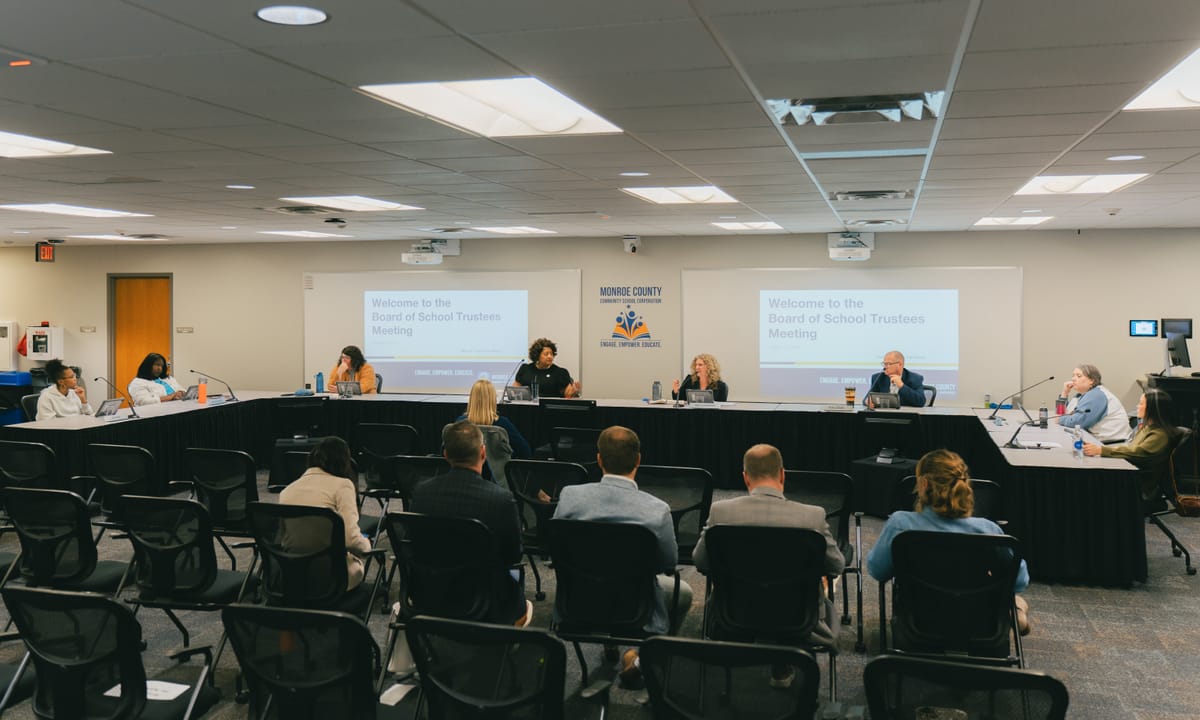
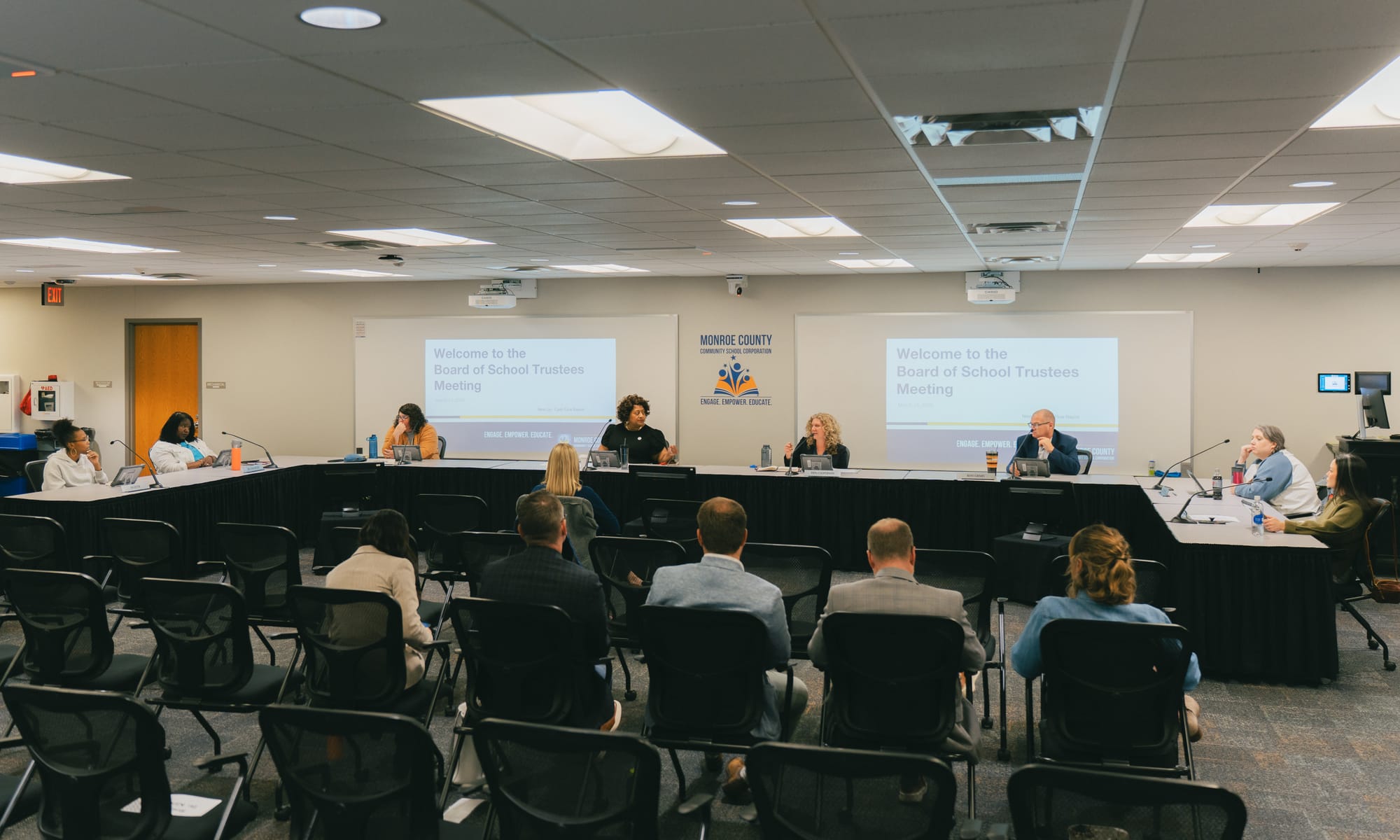
Even if the big news out of their Tuesday (March 24) meeting was a decision to initiate the sale of the former Herald-Times building, the Monroe County Community School Corporation (MCCSC) trustees covered a raft of other issues. Meeting topics ranged from the status of a redistricting study to construction projects, preschool partnerships, and new state requirements on student cell phone use.
Elementary school redistricting
Two years ago in February 2024, the MCCSC board adopted Resolution 2024-05 that began a redistricting study. In the wording of the resolution, it was “the process of examining attendance zones with the intent to create greater balance between elementary schools.”
In April 2025, MCCSC formed a Redistricting Study Commission with 92 community members. The board charged the commission to study redistricting options with two goals: balancing student socio-economic status (SES) among the schools; and ensuring cost-effectiveness. The commission identified factors for evaluating new catchment areas and evaluated potential map scenarios, wrapping up its work in December 2025.
Tuesday’s meeting featured a presentation to the board about the commission’s work from Tim Dowling, the district’s director of early learning and enrollment. According to Dowling’s presentation, over the course of during nine meetings, the commission studied 50 possible redistricting scenarios. He said the commission focused on four “top considerations” as determined by the school board and public input: capacity, resource allocation, and class size; minimizing student reassignment; transportation; and the idea of neighborhood or community schools.
According to the presentation, the result of the commission’s work will be a final report that will include a review of the commission’s research, methodology, results from each meeting, and a summary with key findings. The final report is expected sometime in spring 2026.
Dowling stressed throughout his presentation that the report will not include any recommendations. Rather, it will contain “objective information for the board’s further consideration.” He also said that the report will not include building ages and conditions, staffing allocations, full and comprehensive cost analyses, or student enrollment of specific populations—such as transfer students, or impacts of special programming.
Board member April Hennessey said she understood that the report won’t contain any recommendations. She asked about other ways different alternatives might be distinguished from each other: “Were there, in the study of these maps, some maps that rose to the top as more feasible? And in that case, would you present those as findings to us?”
Hennessey said that the board asked for a review of maps to see which of the options would produce the most socio-economic status balance. On that particular metric, Hennessey indicated she was hoping in the report to see some of the maps “called out in some way so that we could ... identify which ones were better than the others.”
Dowling responded by saying that the commission was focused on universal takeaways from study of the 50 different maps: “What can we learn about redistricting by looking at all of these maps? What can we learn about cost-effectiveness, or transportation, or student reassignment in aggregate?”
“There was nothing in the findings that would make me feel comfortable saying that this map or these other maps stood out among these other ones that we considered—just because we didn’t take that approach,” Dowling said.
Board president Erin Cooperman asked Dowling about the fiscal efficiency aspects of the report such as building utilization and class sizes. He said, “We didn’t get into class sizes, but building utilization was a central data piece for all the scenarios we looked at.”
After Dowling’s presentation MCCSC superintendent Markay Winston said that once the board receives the information, “there are a variety of directions that we could possibly go.” She told the board, “There may be some additional pieces of data that, as the board, you may want us to consider and begin to explore.”
Based on an exchange between Cooperman and Winston after the redistricting presentation, the board will receive the final report at either a regular meeting or a work session. A work session would be subject to the same Open Door Law requirements as a regular meeting, with the only difference being the board would not plan to take any action at a work session.
Construction updates
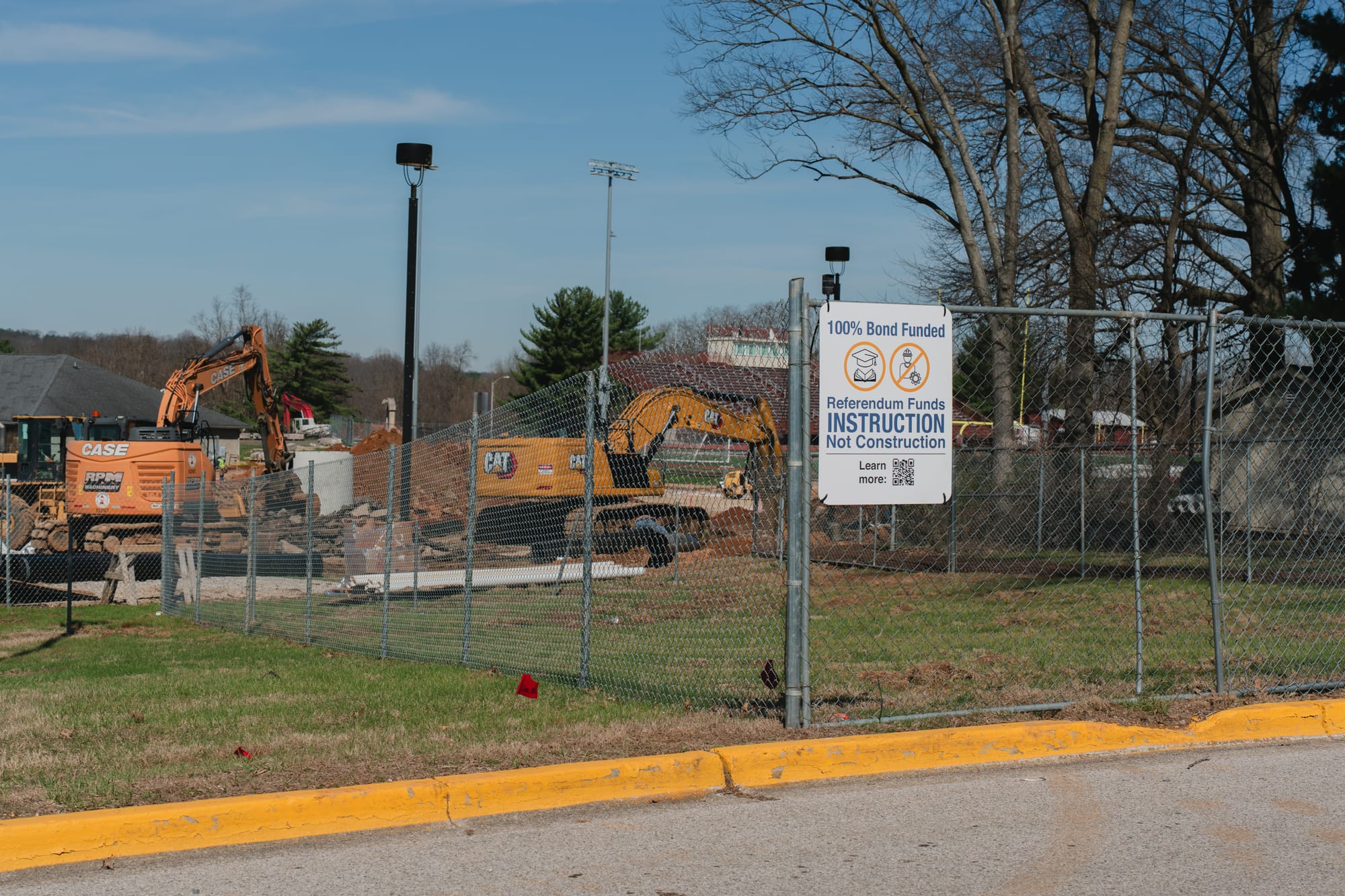
An update on the district’s recent and ongoing construction projects came from Jeffry Henderson, MCCSC’s assistant superintendent of human resources and operations. Henderson said that construction projects are fully funded by bonds, and that no money from the referendum, education fund, or operations fund is used for them.
Bloomington High School North’s (BHSN) 10 tennis courts were relocated and rebuilt. Henderson said the new courts are built with pre-tensioned concrete, so they “will not crack and separate the way a traditional concrete board or asphalt board court will do,” reducing long-term maintenance costs. The facility’s accessibility features are compliant with the Americans with Disabilities Act (ADA). Henderson said that some handrail and fencing still need to be completed, but the courts are available for student use. The project cost about $3.6 million.
Bloomington High School South’s new soccer field is a synthetic turf field rather than traditional grass, which has improved durability and drains more quickly, allowing it to be played on more quickly after rain. Henderson said, “The site will see approximately four times as much use annually as a grass field would see.” He also said the new field removes long-term expenses such as mowing, fertilization, and weed control. The only part of this project remaining before it’s completed is some landscaping, Henderson said: “We’re removing some rocks along the edge of the field and putting some additional synthetic turf in there.” He said that work will be finished in April. The project cost about $1.6 million.
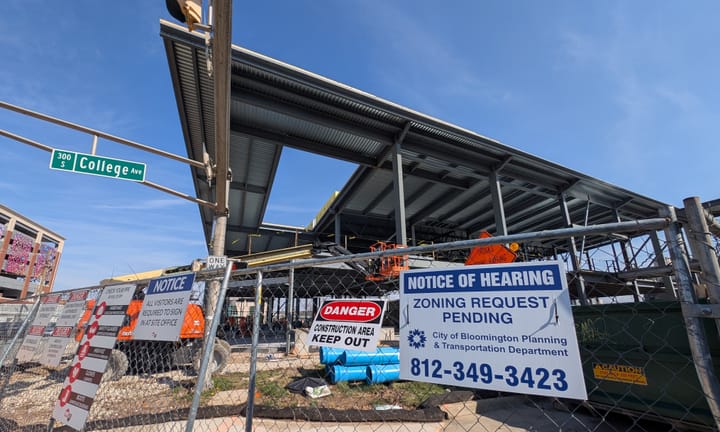
The newest construction project Henderson reported on is BHSN’s “Athletics and Parking Improvement Project.” It will include new field throwing facilities, a new athletic facilities building, a synthetic turf soccer field, batting cages, a concessions area, restrooms, and a new parking lot. The new parking lot will be south of the current football field, which is closer to the school building than the existing parking lot west of the field. This project’s total cost is around $8 million and estimated completion is fall 2026.
Other district updates: Cash flow
During his monthly cash flow report, MCCSC chief financial officer Matt Irwin told the board that the district received a solar tax rebate from the Internal Revenue Service (IRS) for a previous energy efficiency project. He said that because of this one-time funding source, the revenue projection for the district’s operations fund is higher. “Very excited that that came in,” he said. The district is anticipating another solar tax rebate from the IRS: “We’ve done everything that we need to do, and I’ve continued to check in.”
Sarah DeWeese, the district’s communications director, presented on the district’s public relations work. This included online audience statistics across web, email, and social media; print materials and mailers; and website pages with information on the district’s finances and construction projects.
Early childhood education contracts
The school board approved five agreement renewals with early education providers that will offer preschool programs for 3- and 4-year-olds in Monroe County for the upcoming school year. The 2023 referendum covers costs for early learning. On Tuesday, each early learning contract was presented by assistant superintendent for curriculum and instruction Alexis Harmon and voted on separately by the board.
That’s different from the approach taken in January, when a single board vote covered several early learning contracts for the spring 2026 semester. One of them was with Covenant Christian Early Learning Place. Board member Ashley Pirani abstained from the vote; she told The B Square at the time that she abstained because of the contract with Covenant Christian Early Learning Place, which is a religious school.
Indiana House Bill 1102, passed in 2025, removed the requirement that preschool partnerships “may not be religiously affiliated.” Pirani said in January, “I wanted to abstain because I don’t agree with [it]. I feel like that’s a breach of separation of church and state.”
Covenant Christian Early Learning Place was on the agenda again for Tuesday’s (March 24) meeting, along with four other early learning contracts, for the 2026-27 school year. Before voting on the contract, Pirani said she would abstain: “Morally, I object to partnering with any religious-affiliated organization because I feel that is a violation of separation of church and state.”
Board member Hennessey said, “I agree in large part, Ashley, with your position and your stance. I, too, would take that position and stance ordinarily,” she said, but because she voted yes in January, she would do that again “in favor of equal treatment.”
Board president Cooperman brought up the fact that Covenant Christian offers K-12 education through the Covenant Christian School, and is therefore in direct competition with MCCSC for K-12 students. None of the other four organizations offer K-12 education. Neither MCCSC’s guidelines for early learning partnership, approved unanimously by the board, nor a resolution renewing the early learning program in February, include a distinction for organizations based on whether they provide K-12 education.
“I’m going to vote in favor of the contract tonight,” Cooperman said, “but I would like us to consider for the future, whether we change our criteria for these partnerships.”
Hennessey agreed: “I hadn’t considered the possibility of partnering with organizations that also do K through 12 or K through 8, and that is concerning to me, so I would like to revisit, if possible.”
The contract with Covenant Christian Early Learning Place passed with six in favor and one abstention from Ashley Pirani.
Board member Ross Grimes got confirmation from assistant superintendent for curriculum and instruction Alexis Harmon that the difference in dollar amounts for each contract was based on the capacity of each provider. Without further board discussion, the other four early learning contracts were unanimously approved.
Board president Cooperman told The B Square after the meeting that the contacts were presented separately this month “in anticipation of the possibility that there would be more discussion around one of them.”
Legislative update: Cell phones
Board member April Hennessey gave the final legislative update for the year, following the end of the Indiana General Assembly’s 2026 session at the beginning of March. Hennessey mentioned five bills that were signed by the governor.
The one that received the most attention was Senate Bill 78, which bans student use of wireless communication devices throughout the school day, including cell phones and smartwatches. The bill mandates either a no-device policy that prohibits students from bringing such devices to school or a storage policy under which devices may be brought to school, but must be “stored away, powered off, and inaccessible to a student throughout the school day.”
Current state legislation, which was passed in 2024, requires only a policy prohibiting cell phone use during “instructional time,” which doesn’t include lunch or recess. SB 78 also requires the Indiana Department of Education (IDOE) to publish model policy language and guidelines for implementation. The law takes effect over the summer, before the 2026-27 school year.
Superintendent Winston said, “We have been closely monitoring this, as you can well imagine.” She said that the district leadership plans to speak with teachers, administrators, and students, “so that we will begin to look at the two options that they’re putting out for us.” She said that the district plans to wait for the IDOE’s model policy and guidance.
The Indiana Legislative Services Agency said in its fiscal impact statement on SB 78 that “devices available to schools to store student cellphones are estimated to cost between $15 to $30 per storage device.” Assuming one phone per device at the $15-per-device price point, if every student has a cell phone, storage would cost $50,505 for the MCCSC’s 3,367 ninth–12th graders, and $24,450 for its 1,630 seventh and eighth graders. (2026 Enrollment data is from the IDOE.)
Community advisory council
Towards the end of the meeting, MCCSC superintendent Winston mentioned the launch of the Strong Schools, Strong Community Advisory Council. She said the district is looking for 40 community members, including MCCSC employees and students, who want to learn about challenges and opportunities facing the district and to offer their perspectives.
Applications for the council are open until Tuesday, March 31. Applicants must live within the MCCSC boundaries and commit to attending all three sessions, which will be from 6 to 8 p.m. on April 15, April 29, and May 6. More information, and a link to the application, is on the district’s website.

Comments ()