
Monroe County commissioners OK policy requiring 30‑day notice for clearing homeless encampments
Monroe County commissioners have adopted a policy requiring at least a 30-days notice before clearing homeless encampments. No notices are supposed to be issued until March 2, 2026. The move followed backlash over a Dec. 1 eviction notice, with just a one-week deadline.


A new 30-day notice policy for clearing homeless encampments was adopted by Monroe County commissioners at their regular meeting on Thursday.
The policy directs county government staff to give no less than 30 days notice before removing “unlawfully stored personal property” under Chapter 257 of the Monroe County code, which covers “camping, littering, and storage of personal property.” The code chapter requires just 72 hours notice.
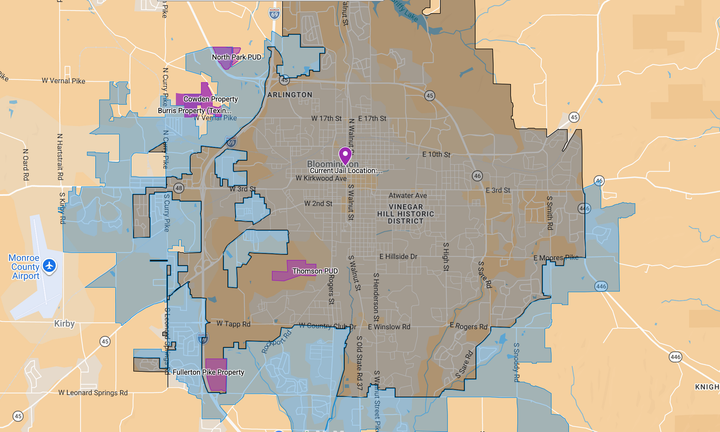
The 30-day policy comes after notice was posted on Dec. 1 at a homeless encampment at the county-owned Thomson PUD property off Rogers Street, with a deadline to vacate the premises one week later, on Dec. 8. After significant backlash, commissioners relented and delayed the deadline by one week, until Dec. 15.
But after a meeting with activists on Dec. 11, commissioners delayed again, this time indefinitely. Monroe County sheriff Ruben Marté indicated he would not help enforce the clearance of the encampment during bitter cold weather, which would, he said, put people “in harm’s way.”
Activists had called for a delay at least until April of next year. The resolution passed by commissioners on Thursday says that no 30-day notice can be issued until March 2, 2026, “for locations that a reasonable person would conclude that the property is associated with a homeless encampment.”
The new resolution includes exceptions to the 30-day requirement, including scenarios when an emergency is determined by law enforcement, the Monroe County health officer, or the city of Bloomington formally requests removal, or the commissioners themselves extend or modify the notice at a public meeting.
The agenda for Thursday morning’s meeting was not posted to the county website until Thursday morning, and even then did not include the resolution on homeless encampments.
The resolution also calls for “other Monroe County and city of Bloomington elected leaders to meet to discuss steps to address homelessness in the community.”
President of the board of county commissioners, Julie Thomas, framed the resolution as a temporary, first step, not a comprehensive solution: “I would like us to begin that process of determining next steps. But I’m afraid that we’ve been stuck in paralysis by analysis for far too long, and so I think we need some action…”
Thomas said, “We’ll be sending an email invitation to our colleagues in the city and on the county council to join us in the creation of a working group to determine the next steps.”
County parks director Kelli Witmer asked about definitions: “For instance, at a park, if we have one tent, is that an encampment? … If that tent stays for 30 days, we might have two tents and then three tents. I’m not sure what the resolution says.”
County attorney Jeff Cockerill told Whitmer that the intent is to distinguish between casual or short‑term presence and a true camp: “In my mind, one tent does not an encampment make, but if it grows to two or three or four, then I think it becomes an encampment.”
From the public mic, county councilor Peter Iversen generally praised the resolution but raised concerns about how notice is communicated, noting that the recent notice “hit Reddit first” before other county officials heard about it: “I just want to make sure that that doesn’t happen again… that started a rumor mill, and that started all sorts of hearsay.”
At Thursday’s meeting, administrator for the county commissioners, Angie Purdie, said she had reached out to Heading Home executive director Mary Morgan, and that Heading Home is willing to act as the “focal point” for notices.” If a notice is posted, it would be forwarded to Heading Home, which would ensure that it also is forwarded to service providers like HealthNet Beacon, and Wheeler Mission.
Commissioner Jody Madeira said, “I think that the resolution is just a very tentative first step, and we have many, many conversations to engage in, and those conversations will inform what takes place.”
Weighing in from a remote electronic connection through Microsoft Teams, a resident of the Thompson property encampment that helped trigger the recent debate, said the resolution falls short of what encampment residents had asked for: “This is not what the community asked for,” adding, “It honestly has so many caveats as to make it almost meaningless as protection against winter evictions.” The resident also criticized a lack of transparency and community involvement in shaping “the proposed next steps.”
County councilor David Henry, weighing in from the public mic remotely, questioned whether the county’s approach treats encampments as a property trespass problem rather than a humanitarian one, and urged a framework more like disaster response: “If we were to imagine 70 people displaced from a tornado in our community, … we’d conduct this work in a very different way… “ Henry said that the timeframe for the notice could be established as 30 days, 45 days, or 15 days, but that is “still just adding pieces to an ordinance that itself is not treating the challenge we’re having with encampments as the emergencies they are.”
About the resolution, Thomas said, “It doesn’t solve a long‑term problem, but what it does say is that there will be a minimum of 30 days notice.” She added: “We know this isn’t the end, this is the beginning.”
A 30-day notice is one feature of the guidance from South Central Housing Network (SCHN) on the topic of shutting down encampments. Also a feature of the SCHN guidance for closures is the idea that encampment residents should be paid to help clean the encampment.
SCHN is the entity that developed the Heading Home plan in 2014, and Heading Home of South Central Indiana is a nonprofit formed more recently, with startup funding from the city of Bloomington and Monroe County governments, and subsequently with support from Lilly Endowment through the Community Foundation of Bloomington and Monroe County.
[Note: The reporter is the spouse of Heading Home executive director Mary Morgan, who is mentioned in the article.]

Comments ()