
Monroe County council backs $30K in BEDC funding; commissioners to decide donation claims in separate vote
The Monroe County council unanimously approved a $30,000 donation to the BEDC but the money won’t be paid unless county commissioners approve the formal claim. The claims for two donations—to the BEDC and to Seven Oaks Classical School—will have their own agenda item on Thursday.
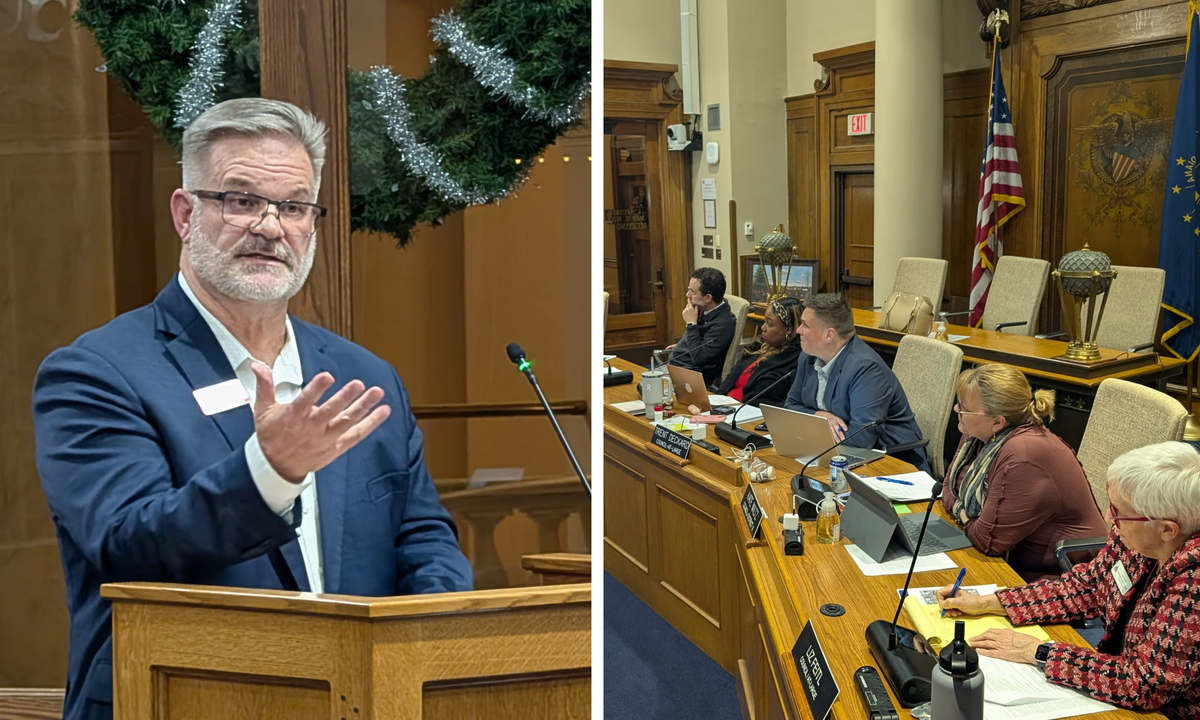
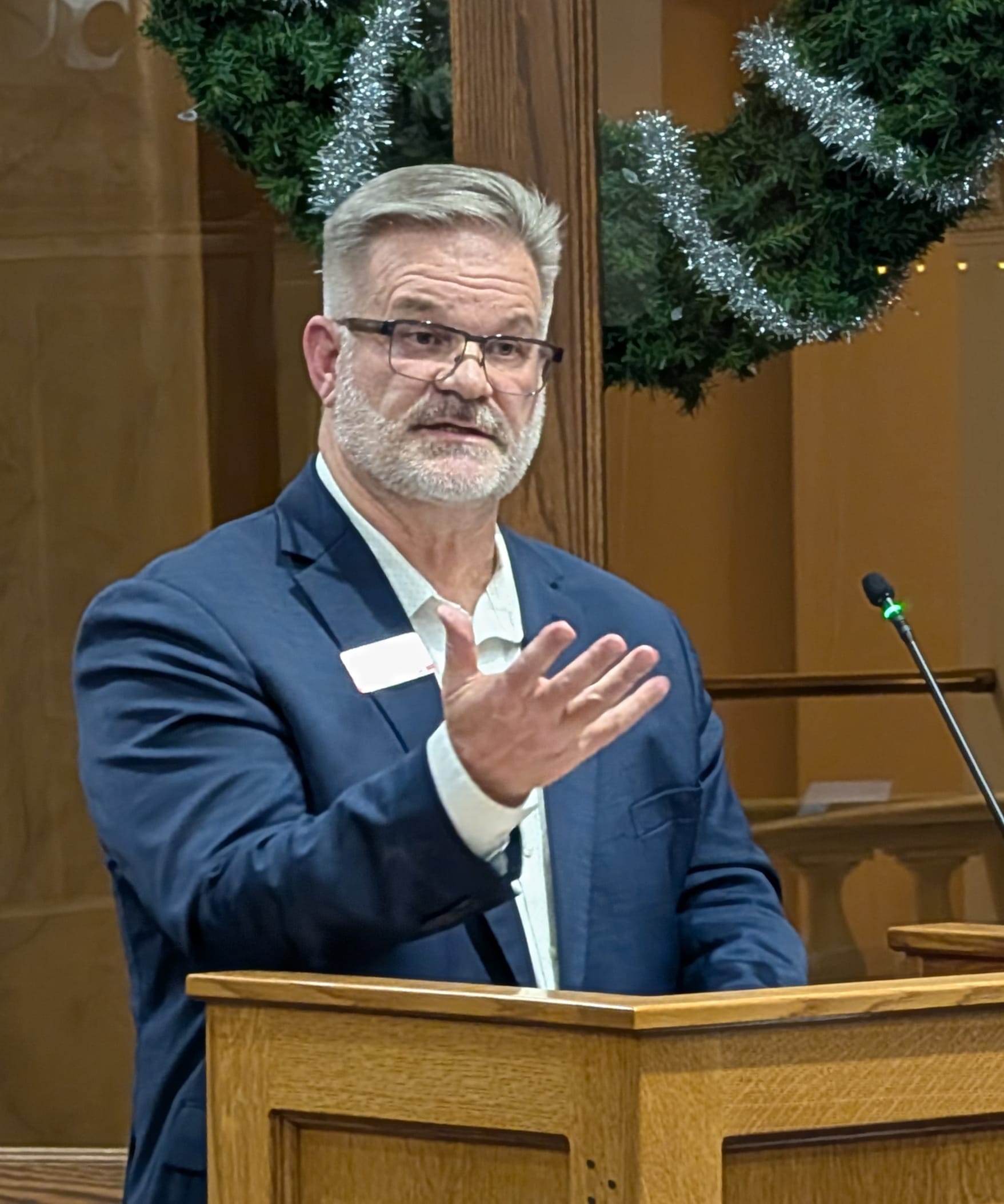
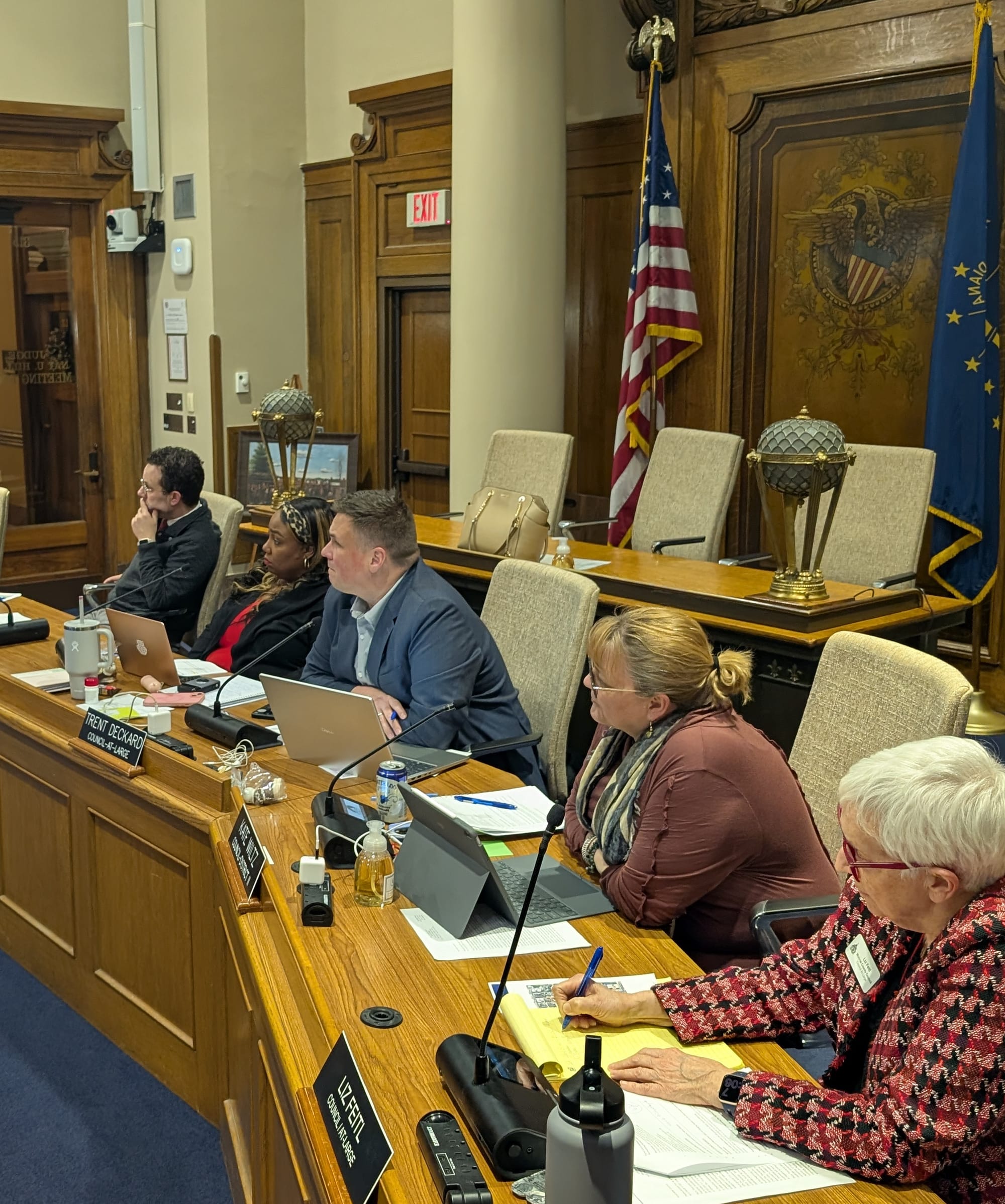
Left: Interim Bloomington Economic Development Corporation interim president Clark Greiner addresses the Monroe County council. Right: Monroe County councilors listen to Greiner, from left: Peter Iversen, Jennifer Crossley, Trent Deckard, Kate Wiltz, Liz Feitl. Attending by remote Teams connection was David Henry. (Dave Askins, Dec. 16, 2025)
The Monroe County council has approved a $30,000 donation to the Bloomington Economic Development Corporation (BEDC). The unanimous vote came at the council’s regular Tuesday (Dec. 16) meeting.
But the money will not be paid until county commissioners vote on Thursday to approve the claims docket that explicitly includes the donation. That’s a vital procedural step that last week did not result in approval of a similar donation to a nonprofit—after county commissioners removed from the claims register a $1,800 donation to Seven Oaks Classical School, which had been approved by the county council.
Last week, county commissioners did not vote explicitly to deny the $1,800 claim. They simply removed it from the list of other claims. The Seven Oaks donation stems from a situation when the county council had recommended the school receive the award as one of several grants to be paid out of the Sophia Travis social service fund this year.
But when the approval of the individual contracts with all of the Sophia Travis grant awardees came in front of the county commissioners, the Seven Oaks contract was separated out and denied on a 2–1 vote. Jody Madeira dissented from the majority made up of Julie Thomas and Lee Jones. Thomas gave as reasons for denying the contract past litigation between the county government and Seven Oaks over pandemic masking policy, and the fact that Seven Oaks is a charter school, benefiting from public support.
The county council’s response to the denial of the Seven Oaks contract was to approve a $1,800 donation without a related contract. Only the commissioners, as the executive branch of county government, can approve a contract.
Even though the claim for the Seven Oaks donation was left undetermined by commissioners last week, its disposition will get settled this Thursday (Dec. 17), along with the claim for the donation to the BEDC. That’s because the council legal staff have been asked to prepare a separate agenda item on the two donations, separate from the claims docket.
The question was raised on Tuesday when councilor David Henry referred to last week’s handling of the claims docket: “We conveyed through resolution our desire to do a donation last week to the board of commissioners. That somehow didn’t happen,” Henry said. “I’d hate to see us go through another round of our intent not being clear, because we clearly wrote a resolution to that effect.”
Council president Jennifer Crossley pressed more, asking what more she should do to ensure the BEDC item is not lost “in the sauce.”
One of the Monroe County attorneys, Molly Turner-King, has now indicated the commissioners will have a separate, explicit agenda item for claims related to donations to the BEDC and to Seven Oaks Classical School—in an effort to avoid any ambiguity about the decision by the board of county commissioners.
Last year, there emerged a situation with the BEDC that was roughly parallel to the one this year with Seven Oaks. County commissioners refused to ratify a memorandum of understanding (MOU) for a $30,000 grant to the BEDC, but the county council approved a donation, and the commissioners approved the claims docket at their next meeting. But this year, there was never an MOU in front of the commissioners about the $30,000 grant to the BEDC.
On Tuesday, the case for the donation to the BEDC was presented by Clark Greiner, interim president of the BEDC, who painted the organization as the county’s primary driver of business retention, attraction, and expansion.
“Over the last six years, we’ve tried to function in that capacity as a sole economic development organization for the county,” Greiner told councilors. He said that historically, “for every $1 that you invested in the BEDC, there was … $289 in capital investment back into all of Monroe County,” resulting in more than 900 new jobs and over $1 billion in capital expenditures.
Councilor Henry called that return on investment “pretty good ROI” for the $30,000 donation, adding that the county would otherwise have to perform that work in-house.
Councilor Peter Iversen emphasized BEDC’s role in connecting elected officials with employers and workers: “I have been able to get out there and tour a lot of these factories, a lot of these sites … meeting the people working there,” Iversen said. “That is really the key indicator … and that’s just great access to folks that I otherwise wouldn’t have access to.”
Councilor Trent Deckard framed the BEDC’s work as a hedge against economic shocks, given declining population numbers and political headwinds facing higher education and life sciences: “I think the BEDC either this year, next year, many years, all years … is our only hope, in case something gets more wild than it is, and those population numbers do not lie.”
Even though she voted in favor of the donation, councilor Liz Feitl had some concerns about the adequacy of communication from the BEDC to the county council. Two weeks ago, the council had put off voting on the BEDC donation. “I remember we tabled it because we wanted more information about some of the developments that had been occurring in BEDC,” she said. “Honestly, I don’t feel like I know much, and I think that’s disappointing as a partner in this endeavor.” Feitl added, “I would like continued updates on what’s happening within the organization.”
Councilor Kate Wiltz pressed Greiner for details on how BEDC is responding to SEA 1, legislation enacted earlier this year that reduces revenue to local governments through revisions to property tax law and the structure of local income taxes. Greiner said the group plans more aggressive outreach to companies offering good-paying jobs and wants to work with employers and local governments on housing and development standards to encourage workers to live inside Monroe County, rather than in neighboring counties.


Comments ()