
Monroe County council to clerk: Run ‘robust’ primaries, request more money to cover general
After cutting most of the clerk’s $242,781 request, but adding $5,000 for overtime, the county council signaled it expects 8 a.m. to 6 p.m. early voting hours and 28 polling sites. It looks like something clerk Nicole Browne will support at Thursday’s election board meeting.
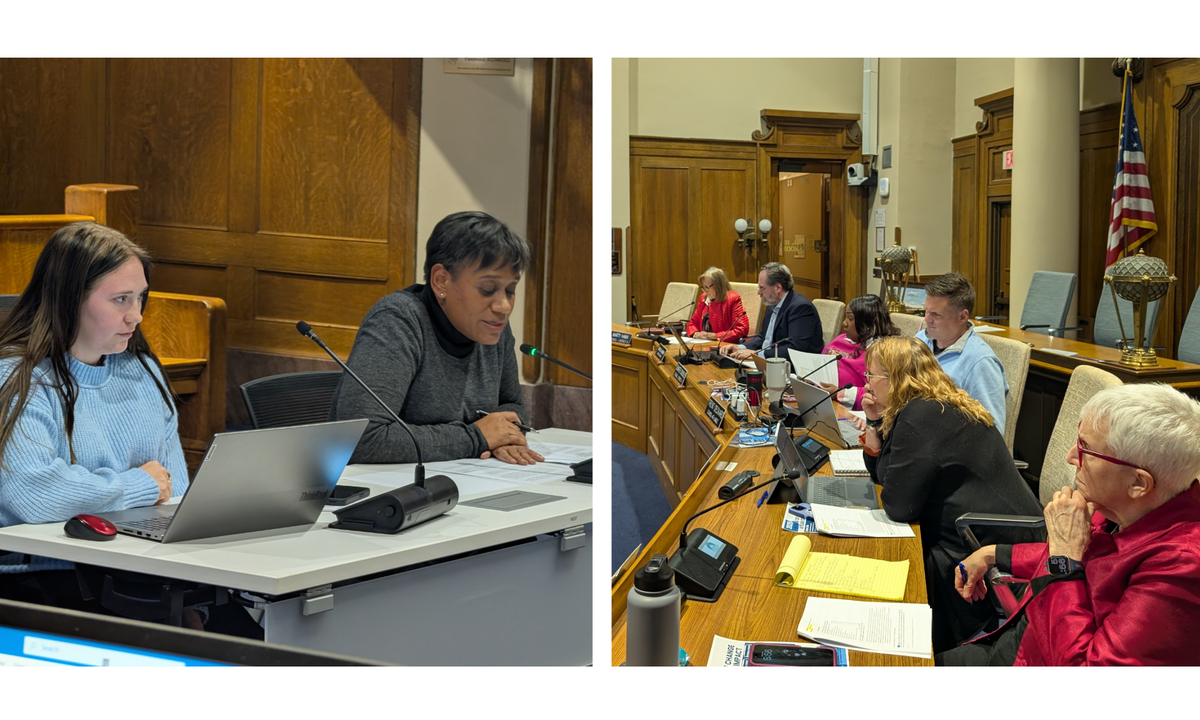
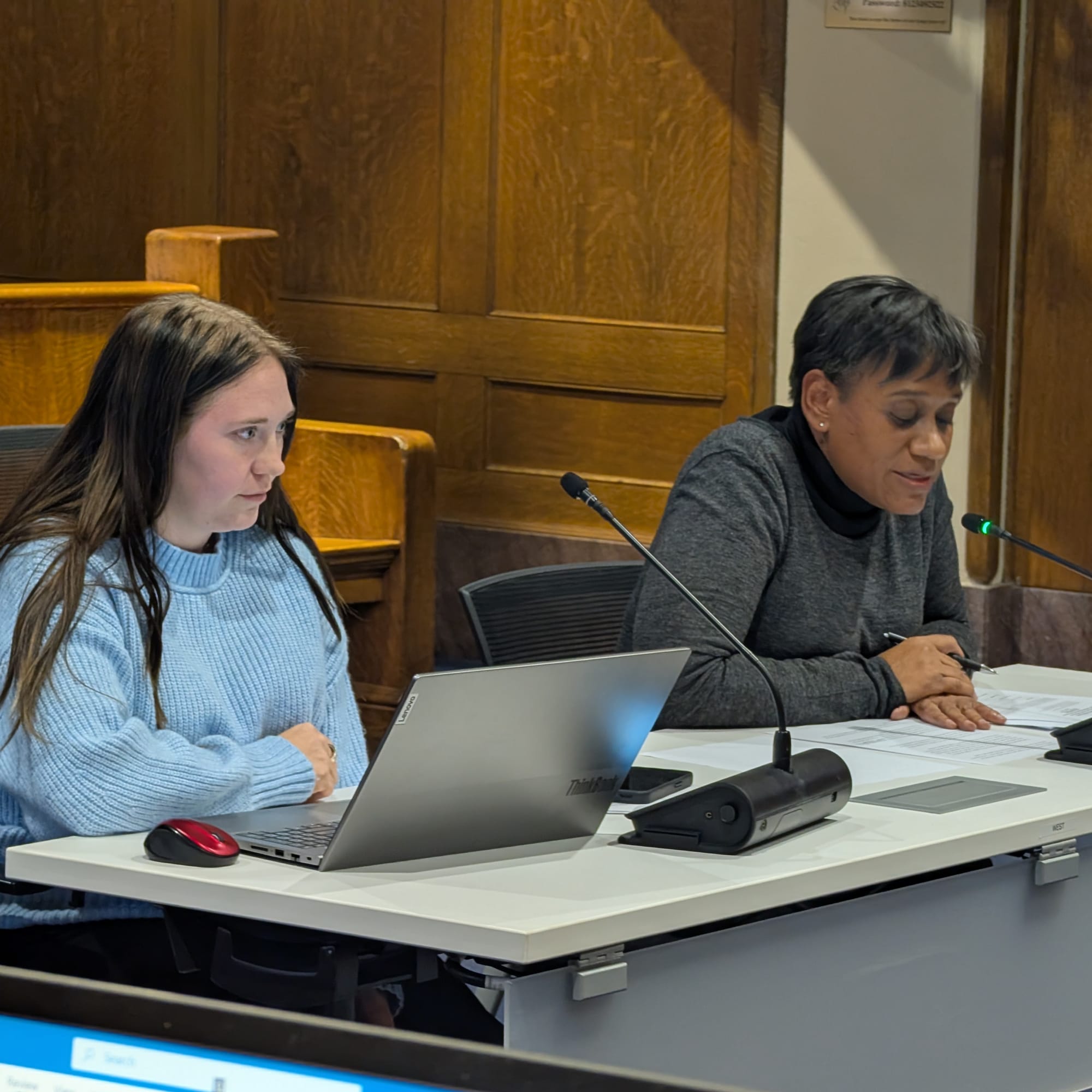
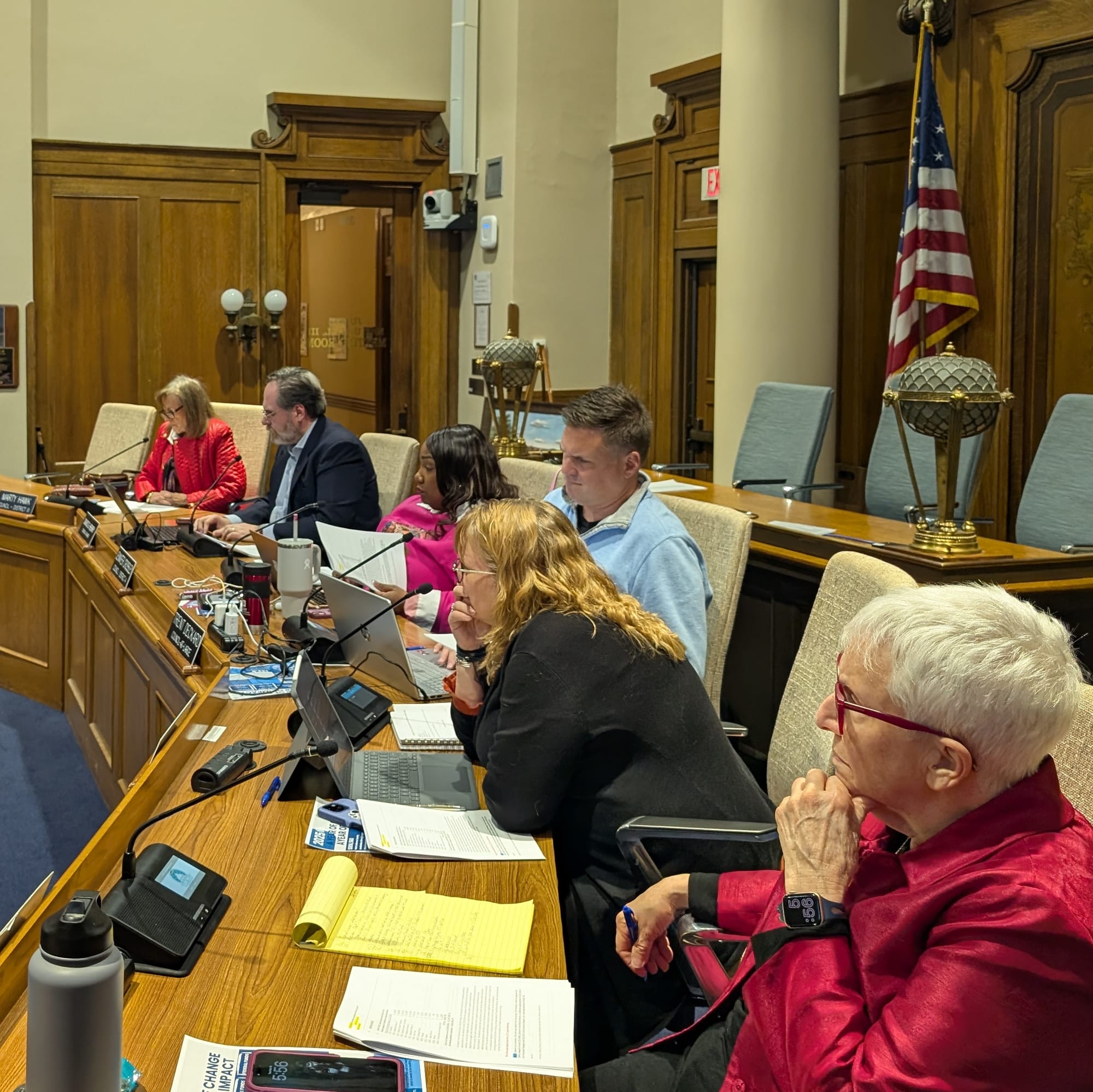
Left: From left Monroe County election supervisor Kylie Farris and Monroe County clerk Nicole Browne Right: Monroe County councilors from left: Marty Hawk, David Henry, Jennifer Crossley, Trent Deckard, Kate Wiltz, Liz Feitl. (Dave Askins, Feb. 11, 2026)
In action taken by the Monroe County council on Tuesday night (Feb. 10), the stage has been set for a special meeting of the election board on Thursday, for a vote on the daily hours for early voting in the May 5 primary election, as well as polling locations on Election Day.
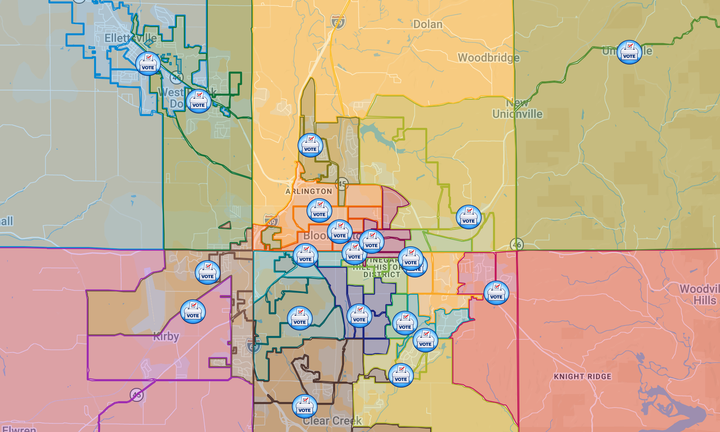
It is now the expectation of county councilors that the daily hours will be set by the election board for their customary 10 hours a day, from 8 a.m. to 6 p.m. and that 28 polling locations will be used.
Based on remarks from Monroe County clerk Nicole Browne on Tuesday, that’s a scenario she is likely to go along with on Thursday. Under state law, the board’s vote on the setting of early voting hours has to be unanimous. As the elected county clerk, Browne serves on the three-member election board, along with appointees from the Democratic Party and the Republican Party.
Browne had raised questions about funding for elections late last year, and previously warned that she would not support anything but a shorter eight-hour daily schedule, based on the amount of money needed to cover the primary and the general election.
The 2026 election calendar has early in-person voting starting on April 7.
On the surface, the county council’s formal action fell far short of Browne’s request for an additional appropriation of $242,781. All of the lines in the request were zeroed out except for $5,000 for the overtime line. The wording in the council’s motion tied the council’s action directly to running what councilors called a “robust primary” with 8 a.m. to 6 p.m. early voting hours for the four weeks leading up to the May 5 primary.
The basic position of county councilors was to point to the mostly unspent money in the clerk’s budget, just six weeks into the year. They want the clerk to use the necessary money to fund the primary election the way it has customarily been run—and after the primary is done, assess how much additional money might be needed to cover the general election in November.
After the primary elections, it will be the right time to request an additional appropriation, which they say they will be prepared to approve.
Browne and election supervisor Kylie Farris confirmed to the council on Tuesday that, if the general election is not factored in, there is enough money in the budget to pay for the kind of primary election that Monroe County voters are accustomed to, but it could mean transferring money between budget lines.
Starting late last year, Browne had warned that the cuts made during the 2026 budget process left her office short, even for the statutory minimum of hours for early voting in both the primary and general elections.
Calling elections core infrastructure, Browne said “free and fair elections are not free,” and argued that overtime pay is needed to cover evenings and weekends.
Council president Jennifer Crossley framed the dispute as one of timing, not availability of funds. “The funds are there,” she said. Crossley told Browne: “Use what you have and then come back.”
Councilor Marty Hawk pointed to long‑standing budgetary practice. “You have dollars that are already appropriated,” she said. “Proceed with your normal business and come back to us if things run short.” She later added, “No one’s telling you not to run a good and fair election. The money is there. All you have to do is come when you’re out of money … and get another appropriation, just like every other department in this county.”
Hawk said out loud the political worry in the room, telling Browne: “I think that there’s a lot of concern that you will leave here and say to the public, ‘Oh, we can’t have this election the way we wanted, because they won’t give us the money.’”
Responding to Browne’s complaint about cuts to the clerk’s office budget, Kate Wiltz said the cuts last year, as part of the process to adopt the county spending plan for 2026, were applied uniformly across departments. “When we made cuts, it was not out of any favoritism or to punish any one office over another,” she said.
One thread connected to overtime pay came from David Henry, who pointed to Farris’s 287 hours of overtime in 2024, plus around 60 hours each logged by two other full‑time elections staff. Henry indicated that to him those numbers might suggest that the office is missing some part of a full-time equivalent (FTE) in staff. Henry put it like this: “Somewhere we’re losing a human that should be an FTE, if we have that many hours of overtime.”
From there, Henry turned to Browne’s statutory role as voter registration director. He asked whether some of the work generating overtime hours could be done by Browne, in her role as voter registration director. Henry asked: “Is that voter registration director role … being delegated down to personnel to conduct that activity in your office?” Browne answered by distinguishing voter registration work from election administration work: “Voter registration role? No. Election? Yes.” Henry replied, “I think I’ll leave it hanging in the air from there.”
Council Trent Deckard, who previously served as state election director, said he worried the conflict over election funding had become “a fight that is putting the voter at jeopardy” even though the two sides might not be far apart. Deckard echoed the sentiments of other councilors about the idea of spending the needed money to fund a customary primary election, and then checking in late May or June on the status of additional appropriations that might be needed to cover the general election.
County election director Farris told councilors that in 2024 for the whole election cycle, overtime pay amounted to $20,603. She said she would be comfortable with a budget line of $10,000 for overtime.
Deckard made a motion to insert $10,000 into the overtime line. Wiltz offered a friendly amendment cutting that to $5,000, which Deckard accepted. The council unanimously approved the $5,000 overtime appropriation.
A follow‑up motion, also passed on a unanimous vote, zeroed out all other lines in Browne’s additional appropriation request, while explicitly tying the $5,000 to operating a “robust primary” with 8 a.m. to 6 p.m. early voting. Legal staff were asked to prepare any needed amendment to the county’s overtime ordinance so the clerk’s office can use that line.
Crossley said she expects the board to follow through on Thursday with a daily schedule of 8 a.m. to 6 p.m. now that the council has explicitly funded that plan. “I really hope I don’t get disappointed in the meeting on Thursday after doing all of this,” she said.
Comments ()