
Monroe County election board sets hearing on Davis write-in bid, delays on Trimble complaint
Monroe County election officials set an Aug. 12 hearing on whether Joe Davis can stay a write-in candidate for clerk after losing the Democratic primary. The board also delayed action on a complaint against assessor candidate Lisa Jeneé Trimble while seeking additional legal guidance.

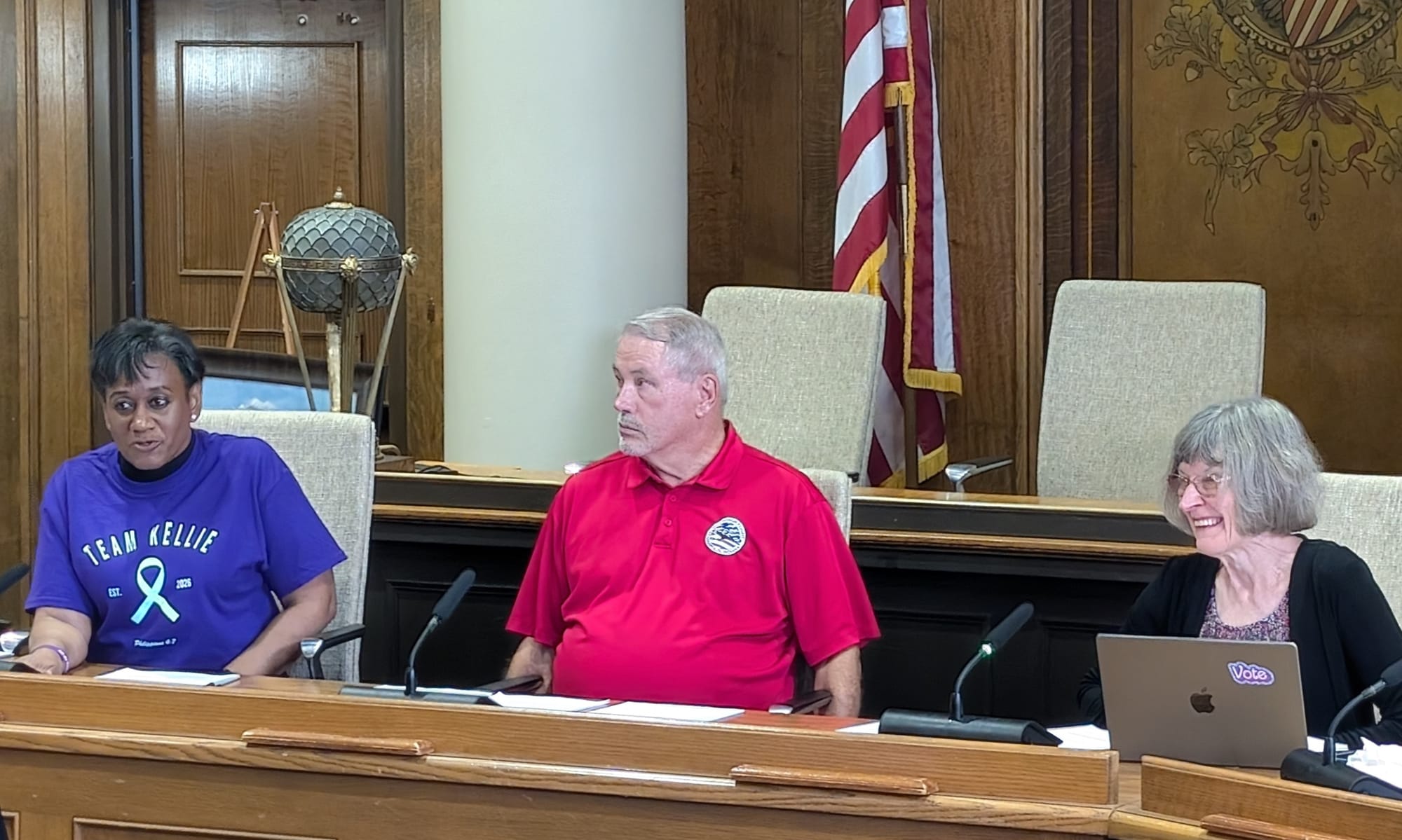
The Monroe County election board will hold a hearing next Wednesday (Aug. 12) on the question: Is Joe Davis legally eligible to remain a declared write-in candidate on Nov. 3 for county clerk?
The issue arose after five people challenged his candidacy under Indiana’s so-called “sore loser” law. Davis lost the Democratic Party primary race for clerk.
The decision to set a hearing on the challenges to Davis for Aug. 12 at 9 a.m. was made at the board’s regular meeting on Thursday (Aug. 6).
Also on Thursday, the board delayed until its Sept. 3 meeting a decision about whether to hold a separate hearing on an election-law complaint against independent county assessor candidate Lisa Jeneé Trimble.
The two proceedings have different stakes and timelines. The challenges to Davis could disqualify his write-in candidacy and have to be resolved by Aug. 14, according to county attorney Molly Turner-King. If Davis is determined not to be eligible, no blank line would appear on the ballot for a voter to fill in.
The complaint against Trimble would not remove her name from the ballot and does not face the same short-term deadline.
The election board did not decide Thursday that Davis is ineligible. It decided only to receive the challenges and schedule a hearing when Davis and the challengers can present their cases.
Five challenges to Davis candidacy
Davis filed paperwork on July 6 declaring himself a write-in candidate for Monroe County clerk after finishing third in the May 5 Democratic primary for the same office. He received 2,549 votes, or about 21% of the primary vote.
Election staff told the board Thursday that five CAN-1 candidate challenge forms had been filed, questioning Davis’s candidacy. Board chair Danny Shields, who is the Republican Party’s appointee to the election board, described them as raising the same central question: Is Davis eligible to be a write-in candidate after losing the primary?
Indiana state election law says that someone defeated in a primary is not eligible to become a candidate for the same office in the next general election.
Davis has previously acknowledged the statute, but said he wants to challenge its constitutionality. He has referred to the provision as the “sore winner” law rather than the “sore loser” law.
During Thursday’s election board meeting, Shields said the label Davis uses for the statute is beside the point. “He can call this law whatever he wants to call it,” Shields said. “Is he eligible? The question is: Is he eligible to run as a write-in under that law?”
The deadline for submitting candidate challenges is noon Friday, Aug. 7. Turner-King told the board the challenges must be resolved by Aug. 14. Any additional challenge received before Friday’s deadline will be scheduled for Aug. 12 after the Davis proceeding.
Turner-King said she’ll send Davis copies of the five challenges, the relevant statutes and the board’s hearing procedures. Notice will be sent by email and certified mail. The board plans to hear the five substantially similar challenges together rather than conducting five separate proceedings.
State guidance sought on Trimble complaint
The board spent considerably longer discussing what to do about the complaint against Trimble, who is challenging incumbent Democrat assessor Judy Sharp in the Nov. 3 general election. Trimble submitted more than 797 signatures by June 30, which was enough to have her name appear on the ballot.
Sharp submitted her complaint in April after seeing a Facebook post in which Trimble offered to help property owners understand their assessments and the appeals process. In the post, Trimble wrote that the assistance would “come with a price,” which was one petition sheet containing 10 voter signatures, provided in advance.
In May, the election board put off considering Sharp’s complaint because Trimble had not yet completed the process of becoming a candidate. Trimble later submitted enough verified signatures and completed her independent candidacy.
The legal question centered on a specific part of election law: IC 3-14-2-1. That law makes it a Level 6 felony if someone “pays or offers to pay” someone else “any property based on the number of signatures obtained to place a candidate or public question on a ballot.” The statute also says that it is not unlawful to pay someone to gather signatures when the compensation is not tied to the number of signatures collected.
Turner-King quoted Indiana state law criminal code for the definition of “property,” which includes anything of value, as well as labor and services.
The board weighed whether Trimble’s offer of property-tax guidance could qualify as a service of value and whether Trimble’s Facebook post offered that service in exchange for somebody obtaining signatures, as opposed to paying somebody to sign the petition.
Election supervisor Kylie Farris said she understood Trimble’s post as asking people to collect signatures rather than personally sign the petition.
“The way that I’m reading it,” Farris said, “is if you are wanting the service, I will be requesting that you get signatures, collect signatures, not sign my sheet.”
Clerk Nicole Browne initially moved to dismiss the complaint. She said the filing itself did not identify a specific election-law violation and did not contain enough information to justify putting Trimble through a hearing.
“If this isn’t going to remove the candidate [from the ballot], let the voters decide,” Browne said.
Democratic Party board appointee Penny Githens said that Sharp should have an opportunity to present evidence. She said Trimble’s written offer appeared to involve a service provided in exchange for collecting a specified number of signatures and that for her the issue turned on the definition of “property.” The board should at least hold a hearing to determine whether the matter warrants referral to the prosecutor, Githens said.
Shields initially appeared inclined to dismiss the complaint without setting a hearing, but the question about the definition of property gave him pause: “I’m not interested in having laws be violated and going unpunished, but I’m also not interested in going down rabbit holes when we’re not we’re not we’re not completely sure of the definitions.” He added, “Definitions matter.”
Turner-King recommended seeking more specific guidance from the Indiana Election Division before deciding whether to schedule a hearing. Because the complaint does not affect Trimble’s ballot placement, she said, the board has time to revisit the matter at its regular Sept. 3 meeting.
The statute discussed by the board applies not only to completed payments of property but also to an offer to pay. Whether Trimble’s post constituted an offer of “property” is a question the board wants Turner-King to ask the Indiana Election Division to help clarify.
On Githens’s motion, the board voted 2-1 to put off a decision on whether to hold a hearing, with Browne casting the dissenting vote. The Sept. 3 proceeding will not itself be a hearing on the complaint. It will be a discussion and vote on whether a hearing should be held.
Trimble from public mic: Says she received nothing
During public comment, Trimble told the board no one had provided her with signatures, money or anything else in exchange for the property-tax information she offered.
If there is a hearing, she said, “There will not be one piece of evidence presented because I didn’t receive a sheet of signatures, one signature, not one dollar, nothing for the help and advice that I offered the taxpayers,” Trimble said.
From the public mic, Trimble also accused Shields of targeting her candidacy and attending an Ellettsville petition-signing event to observe who participated. After Trimble spoke, Shields denied Trimble’s allegation. He said he and his wife had eaten at a Chinese restaurant in the same shopping center and said his presence there was coincidental.


Comments ()