
Monroe County local income tax group mulls shared municipal rate approach
Monroe County’s MUST ended its first meeting without recommending a local income tax rate. But members showed support for a shared municipal-services approach that could let Bloomington replace revenue a city-only rate could not. Bloomington Transit funding is an open question.

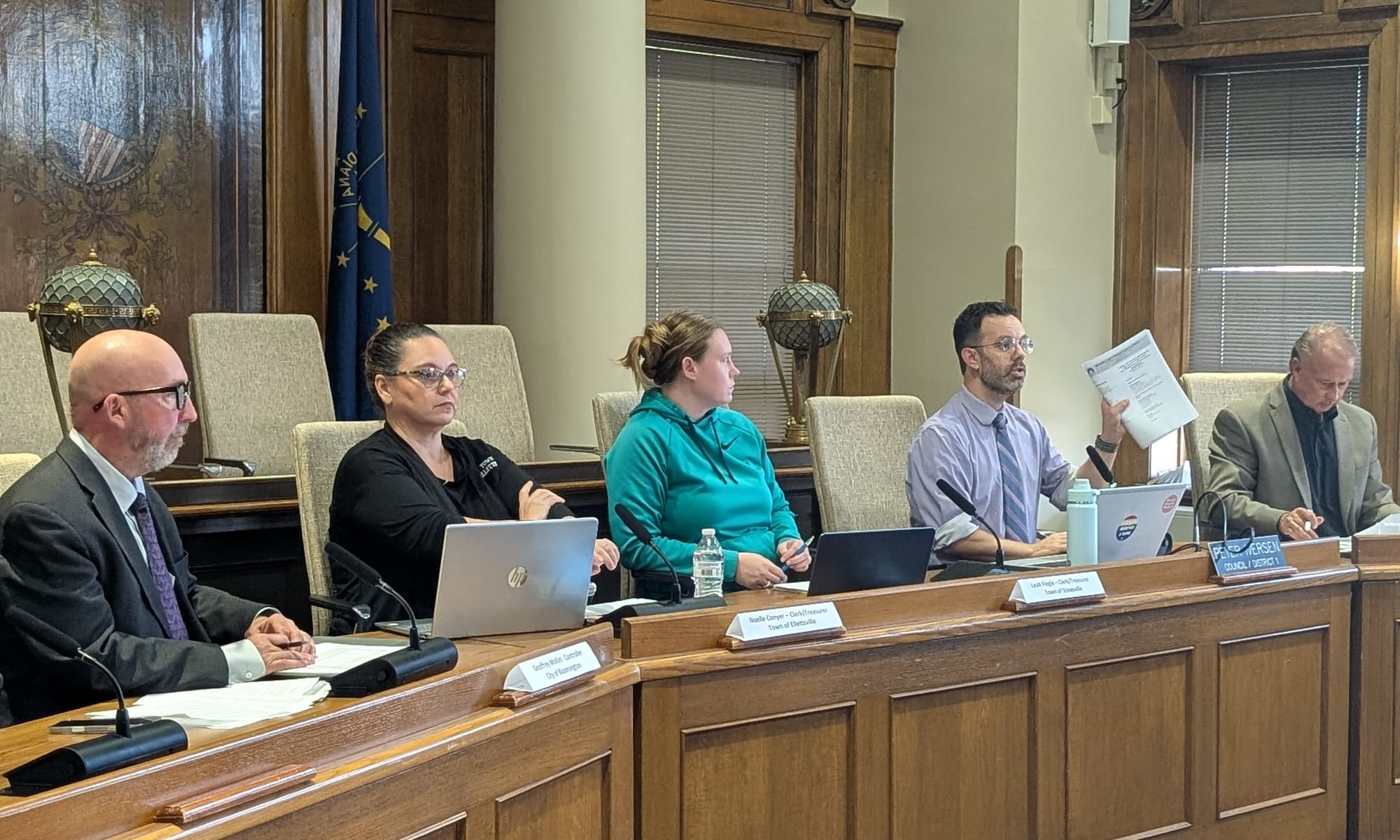
Monroe County’s MUST (Municipal Unit Strategic Taskforce) wrapped up its first meeting Friday (Sept. 18) without recommending a local income tax rate.
But one approach seemed to have at least some support. That would be to put Bloomington and the county’s towns into a shared municipal-services local income tax (LIT) base, which would also include residents of unincorporated Monroe County.
No formal decision was made on that approach. But on Friday, Bloomington controller Geoff McKim explicitly supported the shared municipal services approach. One financial model presented at Friday’s meeting by the county’s financial consultant, Financial Solutions Group (FSG), assumed Bloomington, Ellettsville and Stinesville would all participate. The four voting members also agreed Friday that they should not recommend a specific rate yet.
The MUST is a temporary, optional county-level body created under Indiana’s new local income tax framework to discuss how future LIT revenue should be structured and distributed.
The four members with a seat at the MUST table on Friday were: Monroe County council representative Peter Iversen; Bloomington controller Geoff McKim; Ellettsville clerk-treasurer Noelle Conyer; and Stinesville clerk-treasurer Leah Fiegle. That reflects state law, which defines the membership as one county council representative, plus the fiscal officer of each city and town in the county.
Under the new system, which scraps most of the different kinds of local income tax in the current system, it’s ultimately the seven-member Monroe County council that has the most control over how the new LIT rates are set. Iversen said on Friday that it gives the seven councilmembers “immense power” over the county’s 41 taxing units. He said it made him personally “pretty uncomfortable to be given that much power and control.”
The next meeting of the MUST was tentatively set for Friday, Oct. 23 at 1 p.m. It’s possible at the meeting that a vote will be taken on a non-committal statement that essentially says that there are too many knowns to recommend any specific rate.
Impact on Bloomington
For Bloomington, the difference between the shared approach and going it alone is substantial.
Bloomington’s goal is to maintain its current LIT revenue and make up for an estimated $2.43 million in property-tax revenue that the city is projected to lose in 2029. Under Indiana’s new LIT framework, Bloomington could impose its own municipal income tax just on residents of the city.
But that rate would be capped at 1.2%. And based on an estimated adjusted gross income of $2.44 billion for Bloomington residents, FSG calculates Bloomington would need a 1.7923% municipal rate to hit the revenue replacement goal. The needed rate to hit the goal just wouldn’t be legally possible.
Bloomington’s estimated 2027 LIT revenue is $41.32 million: $17.24 million in certified shares, $4.90 million in public safety money and $19.18 million in economic development revenue. FSG added the projected $2.43 million property-tax loss, to arrive at what it called a $43.74 million 2029 LIT “goal” for Bloomington.
Based on FSG’s estimated adjusted gross income base for Bloomington of $2.44 billion, the maximum 1.2% city-only rate would generate about $29.29 million. That would leave Bloomington about $14.46 million short of the $43.74 million target.
The shared-rate calculation looks a lot different. FSG modeled a 1.049% municipal-services rate applied across Bloomington, Ellettsville, Stinesville and unincorporated Monroe County. That would produce about $51.47 million, with an estimated $43.75 million going to Bloomington, $3.68 million to Ellettsville, $112,000 to Stinesville and $3.93 million to the county government for the unincorporated area.
What “opt in” means
Under the new framework, municipalities with populations of at least 3,500 can choose to participate in the county municipal-services system instead of imposing their own separate municipal rate. That’s called opting in.
The shared-rate revenue would be distributed primarily according to population, but not on a simple per-capita basis. Under the formula in state law, if all the municipalities participate in the shared rate, each gets a share equal to 1.5 times its share of the total county population, with the remainder going to the county government.
So under the scenario modeled by FSG, a resident of unincorporated Monroe County would pay the shared municipal-services rate even though that person does not live in Bloomington, Ellettsville or Stinesville. The unincorporated population would be included by the statutory formula that gives the remainder revenue to county government.
In FSG’s model, Bloomington would receive about 85% of the $51.47 million pool, based on its share of the population used in the formula.
Fire and EMS would be additional
There is another significant part of the FSG model: Its $43.74 million Bloomington “goal” does not appear to include the proposed fire and EMS LIT, which has a separate rate that can be enacted by the county council.
FSG separately modeled a 0.1885% countywide fire and EMS rate that would generate $9.25 million. Its preliminary allocation is shown by FSG as $3 million to the Bloomington fire department, $550,000 to Ellettsville fire department and $5.7 million to the Monroe Fire Protection District.
For Bloomington, that means the model contemplates $43.75 million in municipal-services revenue plus $3 million for fire and EMS, or about $46.75 million altogether.
That is about $5.43 million more than Bloomington’s current $41.32 million LIT distribution. The difference consists of roughly $2.43 million to replace projected property-tax losses plus the separate $3 million fire and EMS distribution.
Another way to look at the arithmetic: A maximum 1.2% Bloomington-only rate would leave a $14.46 million gap against the $43.74 million municipal target. Even adding the proposed $3 million fire and EMS distribution would leave an $11.46 million gap.
The $3 million would not simply be unrestricted city revenue. McKim noted Friday that Bloomington currently pays fire expenses from multiple funds, making it difficult to identify one existing LIT-supported portion of the fire budget.
Under state law, county councils will have flexibility in dividing fire and EMS LIT revenue, but have to consider each provider’s service boundaries and the population within them.
FSG’s full analysis comes to a 2.389% LIT rate, compared with Monroe County’s current 2.205%. That difference of 0.184 percentage points works out to about $92 a year on $50,000 of taxable income.
FSG’s Greg Guerrettaz stressed at Friday’s meeting that those numbers are scenarios, not recommended rates.
Bloomington Transit: A $3.8 million question
Bloomington Transit presents another wrinkle in the effort to preserve existing local-government revenue.
FSG’s model shows BT doing relatively well under the new nonmunicipal-unit LIT structure. Its estimated direct LIT distribution rises from $723,907 in 2027 to $809,580 in 2029. After accounting for a projected $74,260 property-tax loss, that would put BT about $11,400 above FSG’s “made whole” target. The model uses a 0.0165% rate for the special-district category, which is below the 0.05% statutory cap.
During Friday’s presentation, FSG consultant Greg Guerrettaz specifically pointed to Bloomington Transit as a local unit that appeared to fit within the new framework, in contrast to the Monroe County Public Library, whose modeled revenue falls well short of its target. “There’s nothing more important than getting people up and down the road that don’t have a car,” Guerrettaz said.
But that analysis does not separately preserve another much larger stream of LIT money that BT has been receiving from the city of Bloomington for the last few years.
Under a five-year agreement running from 2023 through 2027, Bloomington has committed $3,806,100 a year to BT from the city’s economic-development LIT revenue. The 2027 payment is the fifth and final installment under the existing agreement.
That money is different from BT’s direct LIT distribution. The $723,907 shown for BT in FSG’s 2027 column is revenue allocated directly to the transit corporation under the existing LIT distribution system. The separate $3.8 million comes out of Bloomington’s share of ED LIT. FSG’s analysis treats that revenue as part of Bloomington’s existing LIT base when establishing the city’s $43.74 million revenue target. It does not establish a separate $3.8 million target for Bloomington Transit.
So the FSG model could technically “make Bloomington Transit whole” while BT still loses a revenue stream several times larger than its direct LIT distribution. The current city-BT agreement provides no automatic continuation after Dec. 31, 2027. Continuing some or all of that support would require a new decision about how Bloomington uses its future municipal revenue.
And the $3.8 million has been used for one-time capital purchases of buses and land for a new operations center. But BT has also used portions of the city LIT allocation for ongoing expenses, including $300,000 a year for Sunday bus service. In its 2024 budget, BT also allocated $200,000 of the city LIT money to two staff positions, for marketing and development, and grants and procurement, as well as $200,000 for microtransit service. Those same types of operating expenses continued to appear in later budgets.
That means the transition to the new LIT system raises a big question for the county council to make on when it comes to a rate for Bloomington Transit. Should the county council enact a rate that is only adequate to replace the roughly $724,000 BT now receives directly, or should it enact a rate that allows BT to continue its recent new initiatives or possibly even more? At the maximum rate of .05%, BT could receive around $2.4 million a year.
Thoughts from four MUST members
McKim gave the clearest support for the opt-in approach. He said Bloomington’s own modeling, done with the city’s financial adviser, produced a roughly 1.09% break-even rate. That’s close to FSG’s 1.049%. He also said the city needs better geographic income data from the state before final decisions are made. He also raised concerns about preserving funding for 911 dispatch, schools, and libraries, and providing predictable fire and EMS funding.
Conyer said Ellettsville’s goal is stable and predictable LIT revenue while limiting the impact on taxpayers. She also pointed to the proposed Ellettsville-Richland Township reorganization, which could change municipal boundaries and affect the calculations.
Fiegle said Stinesville, with roughly 200 residents and little room for growth, has few alternative revenue sources, making LIT especially important to the town.
Iversen stressed how much authority the new system gives the seven-member county council over revenue affecting dozens of local units. With another legislative session approaching, he said the county wants to preserve flexibility rather than commit now to numbers that could soon be superseded by changes the legislature makes in its 2027 session.
One more meeting, then possibly a vote, but not on rates
The MUST itself is optional. Indiana state law allows counties to convene one before Oct. 1, 2026. Any agreement it reaches has to be unanimous, but the statute does not require the members to reach an agreement at all.
That makes the likely next step for Monroe County’s MUST relatively simple.
FSG prepared a draft statement recommending no specific rates. Instead, it says Monroe County does not yet have enough information to sign off on 2029 rates. It asks lawmakers for more flexibility in funding townships and libraries, continued flexibility in distributing fire and EMS revenue, protection against revenue losses for existing units, and authority to include school corporations in future LIT distributions.
At Friday’s meeting, all four MUST members agreed that no specific rate should be recommended. FSG’s Greg Guerrettaz said one more meeting should be enough to review the statement, revise it if necessary, and vote.
The draft is likely to see at least one revision. Ellettsville’s Conyer asked for some wording that addresses municipal boundary changes if the Ellettsville-Richland Township reorganization is approved on Nov. 3.
The underlying state law could change, too. That uncertainty was one of the main reasons members Friday favored a statement preserving as much local flexibility as possible rather than locking Monroe County into particular rates.
The MUST members tentatively set their meeting for Friday, Oct. 23 at 1 p.m.



Comments ()