
Monroe County prosecutor candidates clash on non-prosecution pledges, protest role
At a Bloomington DSA forum, prosecutor candidates Erika Oliphant and Benjamin Arrington drew contrasts on marijuana prosecution, ICE cooperation, surveillance, and protest roles.
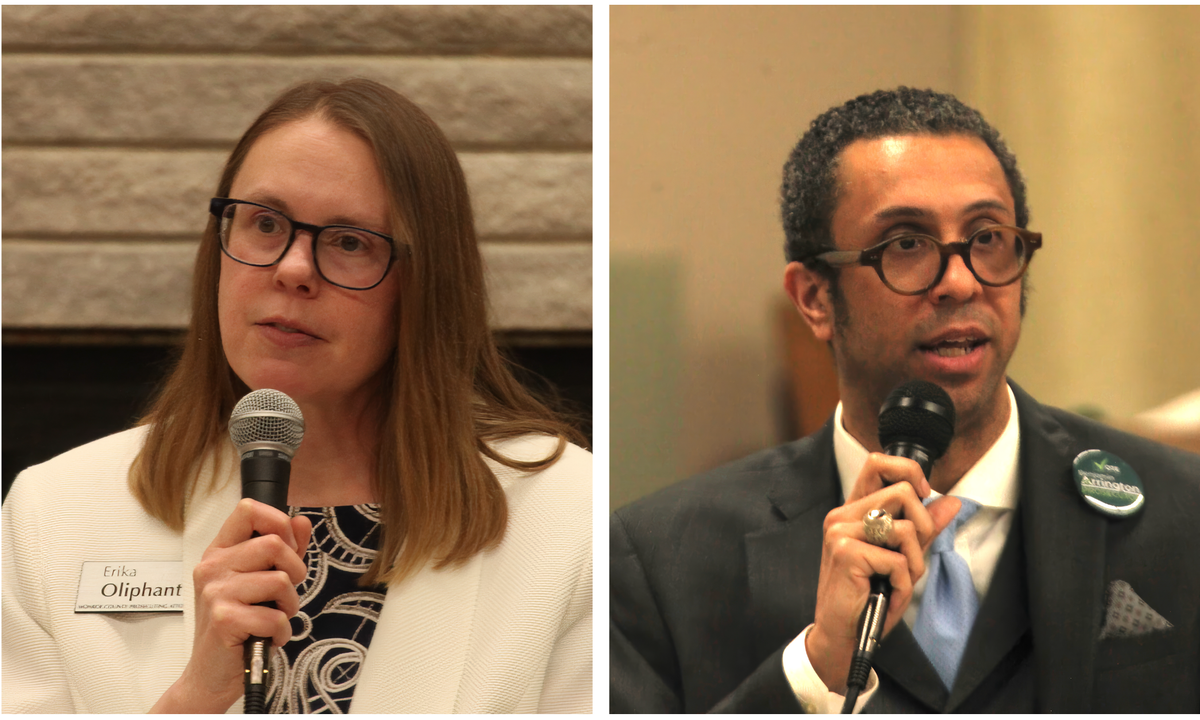
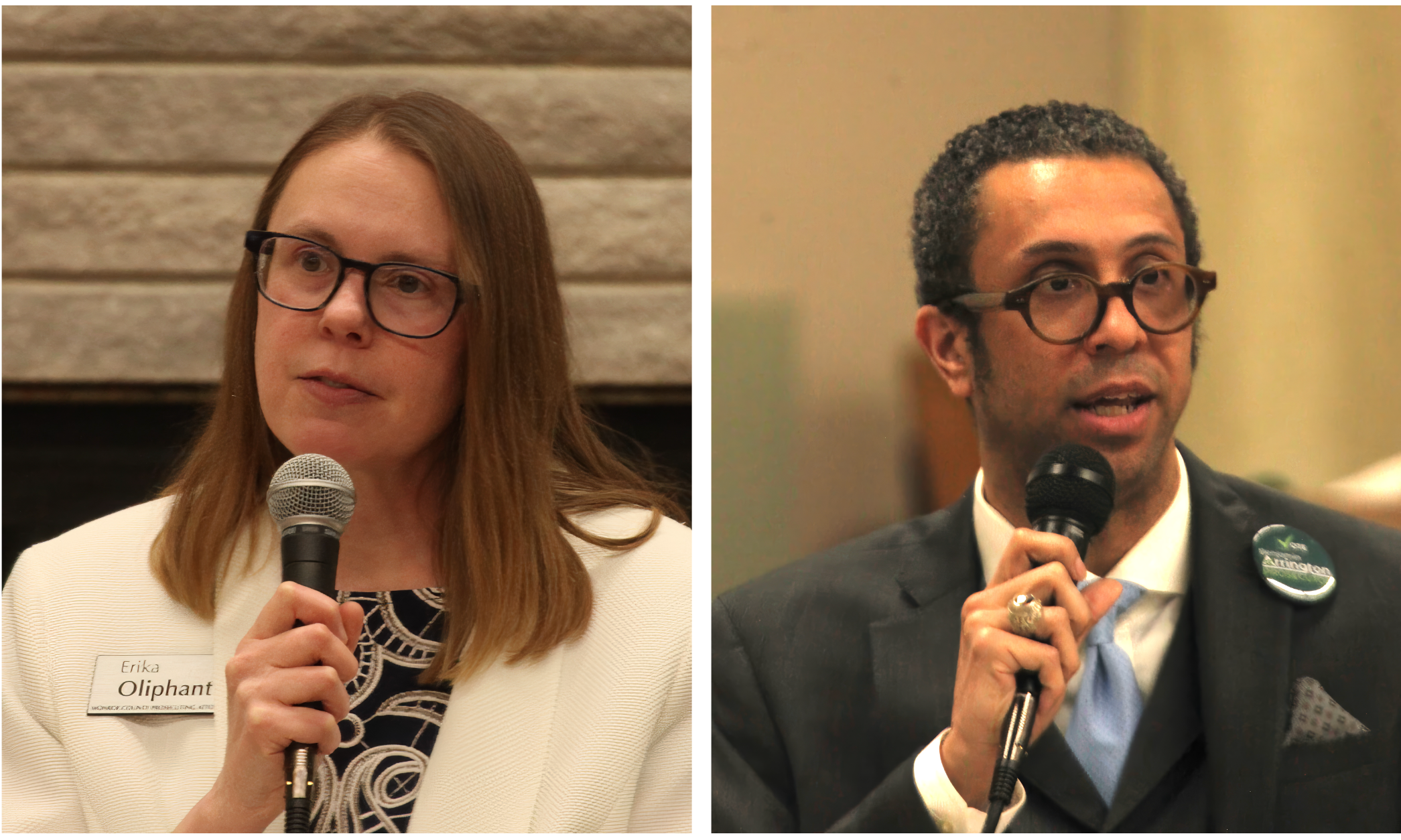
At a forum hosted on Thursday night (Feb. 26) by the Bloomington Democratic Socialists of America, Benjamin Arrington and Erika Oliphant fielded questions that ranged from marijuana prosecutions and harm‑reduction policies, to ICE cooperation and the use of Flock surveillance cameras, to how the justice system treats unhoused and working‑class residents.
The two are candidates for the Democratic Party’s nomination for Monroe County prosecutor.
Oliphant is the incumbent, after winning election in 2018, having won a three-way primary against Margie Rice and Matt Schulz. Oliphant started working as a deputy prosecutor in 2009 right after graduating from law school.
Since 2024, Arrington has served as staff attorney for Pro Bono Indiana in Bloomington, which provides civil legal services, including family and eviction law assistance. Since graduating from law school in 2016, Arrington has also served stints as deputy prosecutor in Lawrence County and in Monroe County.
In a November 2025 report to the Monroe County council, Oliphant gave the following breakdown for the number of cases her office filed: 1,832 misdemeanor cases; and 1,086 felony cases.
The questions at last Thursday’s forum, held at First United Church, revealed some clear contrasts between the candidates.
Life stories, who understands poverty
Both candidates invoked their personal histories to claim some insight into poverty and the criminal system.
Arrington brought up his background in his opening remarks, telling the crowd: “I am, in fact, a high school dropout.” He described his early work history starting at age 16. He recounted his time working in a flea market, fast food outlet, a call center, and as a vacuum cleaner technician, 18‑wheeler over-the-road truck driver, and deputy prosecuting attorney.
Arrington said, “I am the product of a single mother of five children who understands poverty, because I have lived in poverty, and I have been unhoused more than once in my life.” He added, “My father went to prison when I was a child.”
Later, when asked how he’d advocate for poor and working‑class residents, especially in landlord disputes, he said he would visit elementary schools to show students that they could be a high school dropout and still become the elected prosecutor: “You can still do things with your life, even if you mess up.”
With respect to landlords, Arrington said, it is possible to enforce laws against unethical business practices. He said, “If you’re going to be a capitalist trying to push people around and take advantage of them, the prosecutor’s office is watching out.” He said he would stand for poor people and against abusive landlords.
Oliphant began her answer to the same question by saying, “I am really interested to hear Ben say his life story, because though I worked with Ben for a little bit, I’d never heard it before.” That was an allusion to the time when Arrington worked as a deputy prosecutor in her office.
Oliphant continued, “But I just want to say, I also was homeless for a period of time, and I also had a struggle. I was a farm kid in Versailles, Indiana, and I came up with a single mom who was never around and an abusive father.” She added, “We all have stories to tell.”
On the question of landlords, Oliphant said, “I just want to say: I’ve had abusive landlords; I’ve had great landlords.” But she distinguished between criminal law and civil law, saying that “most landlord tenant rights are actually contained in civil law… they aren’t necessarily criminal offenses.” She added, “Certainly, if someone was violating the criminal code, I would hold them to account.”
Oliphant said, “I think that one thing that we can do is make sure that we look at the resources we have… like landlord‑tenant assistance projects and our townships to make sure that people can stay in their homes.”
Marijuana: Public pledge of non-prosecution
Arrington told the audience what his approach to prosecuting marijuana offenses would be: “If elected, on day one, I will stop the discriminatory prosecution and wasteful prosecution of simple possession of marijuana one ounce or less.”
He said he would follow the lead of Marion County prosecutor Ryan Mears, who announced in 2019 that his administration would not prosecute marijuana offenses for one ounce or less. Arrington said, “Monroe County can and should be a leader for progressive policies in the state of Indiana, right alongside Marion County.” Arrington said, “Prosecutor Mears is seeking re‑election for his third term and is still in office, and everything is working out just fine. Marion County is not prosecuting one ounce or less of marijuana.”
Responding to the Arrington’s promise to declare non-prosecution of marihuana offices for one ounce or less, Oliphant said public non‑prosecution declarations could be dangerous and unnecessary: “What Ben is proposing is making a public declaration that he will not prosecute a criminal law that is on the books. We have taken oaths to uphold the Constitution and to uphold the law.” She continued, “It is the Indiana General Assembly’s sole discretion… to decide what is illegal and what is legal. Once we have prosecutors who are willing to decide what is legal and what is illegal, that can work in your favor or it can work against you.”
A public declaration doesn’t really change anything practically, Oliphant said, but she cautioned: “By making a public declaration, we draw the attention of the Republican supermajority to our local resources.” Oliphant added, “What we should be doing, instead of making public declarations that put us all in danger from state and federal intervention and home rule, is make sure that we continue to focus our resources on those violent and repeat offenders that cause the greatest harm in our community.”
Oliphant later pointed out that in 2025, her office had just two convictions for possession of marijuana. She added, “I think in both of those cases, there was something else going on, like impaired driving …”
Arrington indicated some skepticism about the significance of the two convictions, saying, “I believe prosecutor Oliphant is being a little disingenuous when she says two convictions. Two convictions. How many marijuana charges were filed throughout the year of 2025 is what I would like to know, not the number of convictions. Convictions occur after someone is charged.”
Oliphant gave some additional detail on the marijuana cases. She said, “About 27 cases did pre‑trial diversion for possession of marijuana in 2025 and maybe 30 were just outright dismissed.”
Oliphant also cited the creation of Indiana’s “non‑compliant prosecutor” law, tying it directly to the kind of public stance Arrington wants to take. Because of the public declaration about non-prosecution by Marion County prosecutor Ryan Mears, Oliphant said, “There is now a non‑compliant prosecutor law that—it fortunately has no teeth—but is actually trying to limit the discretion of prosecutors who were elected to respond to the values of their communities.”
Harm reduction
One of the questions asked about harm reduction, which is measures like needle exchanges and overdose-reversal drugs intended to reduce deaths and disease, if not eliminating drug use.
Oliphant said she believes in harm reduction and supports it. On a personal level, she said, “I have long been a financial supporter as well as a volunteer occasionally for Indiana Recovery Alliance.” In the prosecutor’s office, she said she had developed the policy that says her office would not charge syringe services program participants with possession of syringe or possession of paraphernalia.
She said, “It’s really unfortunate that our lawmakers are choosing to try to restrict the syringe services program,” adding that “these syringes are shown to reduce the instances of hepatitis and HIV in our community… and connect people with treatment and give them a chance to avoid coming into contact with me professionally.”
Arrington tied harm reduction directly to choosing not to prosecute marijuana. He said that he would, like prosecutor Ryan Mears in Marion County, declare he would not prosecute possession of small amounts of marijuana. “That’s what you’d be electing, if you give me an opportunity to serve you.” He continued, “I believe harm reduction starts with making a conscientious decision on what is right.” He added, “That way, at the end of the day, you can at least say you stood up for what is right.”
Responding to Oliphant’s concern about drawing the attention of Republican lawmakers, Arrington said, “Drawing attention of the supermajority Republicans? Good. Maybe we can show them what is right. Maybe we can show them … what honorable people do that care about their community.”
Showing up to protests
Arrington and Oliphant disagreed sharply about whether the prosecutor should literally show up at protests.
The question from the moderator went like this: “The Trump administration has taken steps to repress and criminalize acts of resistance to the spread of fascism. How will you protect residents of Monroe County who exercise their right to speech and protest?”
In his remarks, Arrington alluded to the pro-Gaza protests in the spring of 2024 in Dunn Meadow on the Indiana University campus. Arrington said, “When I saw a sniper on the roof because students were out protesting, I thought to myself: You know, if I was the Monroe County prosecutor, I’d go out there and stand up there with them.” He asked, “What—are they going to arrest me? Come on, point the sniper rifle at me!”
Arrington said, “I’m going to be out protesting with the people. I’m going to be out with the people,” adding “you can count on me, if you elect me, to be there with you.”
Based on the evidence, Oliphant chose not to prosecute those who were arrested in Dunn Meadow. Oliphant said, “I think I have a track record of not charging people who are peacefully protesting and standing up for their First Amendment rights.” She added, “I believe very deeply that our constitutional rights are the only thing that keep us safe from oppression from our government, and I’m going to defend them.”
She said she would not join protests, because it would make her a witness and could lead to the appointment of a special prosecutor. She put it like this: “One reason that you won’t find me out on the picket lines when you all protest is because if I am there and I’m a witness and you are arrested illegally or otherwise, that would be grounds for a special prosecutor to be appointed.
She laid out why the appointment of a special prosecutor would not be a good outcome: “The special prosecutor pool is typically older white Republicans who aren’t from this community, and I just don’t think that’s what you all want.”
Flock cameras, surveillance
The question put to the candidates was: "Will you commit to ending the use of Flock cameras owned by the county?"
Oliphant described the Flock cameras, with their license plate reading technology, as a “law enforcement tool.” She told the audience, “I can say I have prosecuted one case where someone was charged with attempted murder. He shot somebody in the chest. He was identified because of a Flock camera—so it is a law enforcement tool.”
Oliphant added, “However, I understand we have a lot of concerns where we cannot control the use of that information once it’s collected, where ICE is going to be able to have access as long as these cameras exist.” She called for a “public debate” on the question of whether it’s worth having the tool or not.
Responding to Oliphant’s call for a debate, Arrington said, “I’m saddened to hear that she wants to have a debate about this, because the answer is clear: We do not need a surveillance state monitoring everywhere we go. Flock cameras need to go. Flock cameras need to go.” He added: “What in the flock is going on here?”
Arrington called for working together as a community: “If we work together as many, we’ll have a strengthened and powerful community.”
Cooperation with ICE (U.S. Immigration and Customs Enforcement)
Candidates were asked to comment on SB 76, which has been passed during this year’s legislative session, and requires local units to cooperate with federal immigration enforcement and allow the attorney general to penalize noncompliant governments and employers.
The specific question asked the candidates what advice they would give to teachers and school administrators.
Arrington said, “My instructions to teachers are, stand up for your little children in your class. We are not going to be helping ICE.” He described how Larry Krasner, district attorney in Philadelphia, had declared that when ICE officers break the law they will be prosecuted. “I would have used the bully pulpit, had I been in office, and said the same thing for Monroe County, because we need to take a stand and do what’s right,” Arrington said.
Oliphant started her response by saying she can’t give legal advice to teachers, but will prosecute law‑breaking, including by ICE agents. She put it like this: “Unfortunately, as prosecuting attorney, it’s unethical for me to provide legal advice to anyone other than my deputy prosecutors.” She pointed to Exodus Refugee as an organization has good advice on safety planning and what to do when you encounter ICE agents.
About the current situation with ICE agents, Oliphan said, “The unfortunate truth is we have an overreaching enforcement of immigration, where we’re not narrowly targeting towards those who are committing criminal offenses at all, and we have this broad recruitment of new people who are not trained, who are given unconstitutional directives to go out there and just knock heads and cause a ruckus.”
She added, “If I have credible evidence that someone has broken an Indiana law, and I can prove it beyond a reasonable doubt, no badge of authority is going to keep anybody safe from prosecution.
[CATS recording of Feb. 26, 2026 candidate forum, cued to start of prosecutor forum.]
Comments ()