
Monroe County test run clears voting machines for May 5 primary
Monroe County’s voting machines passed a routine logic and accuracy test using about 4,000 ballots designed to trigger every scenario. Under bipartisan oversight, results matched expected results, clearing a key step ahead of the May 5 primary.
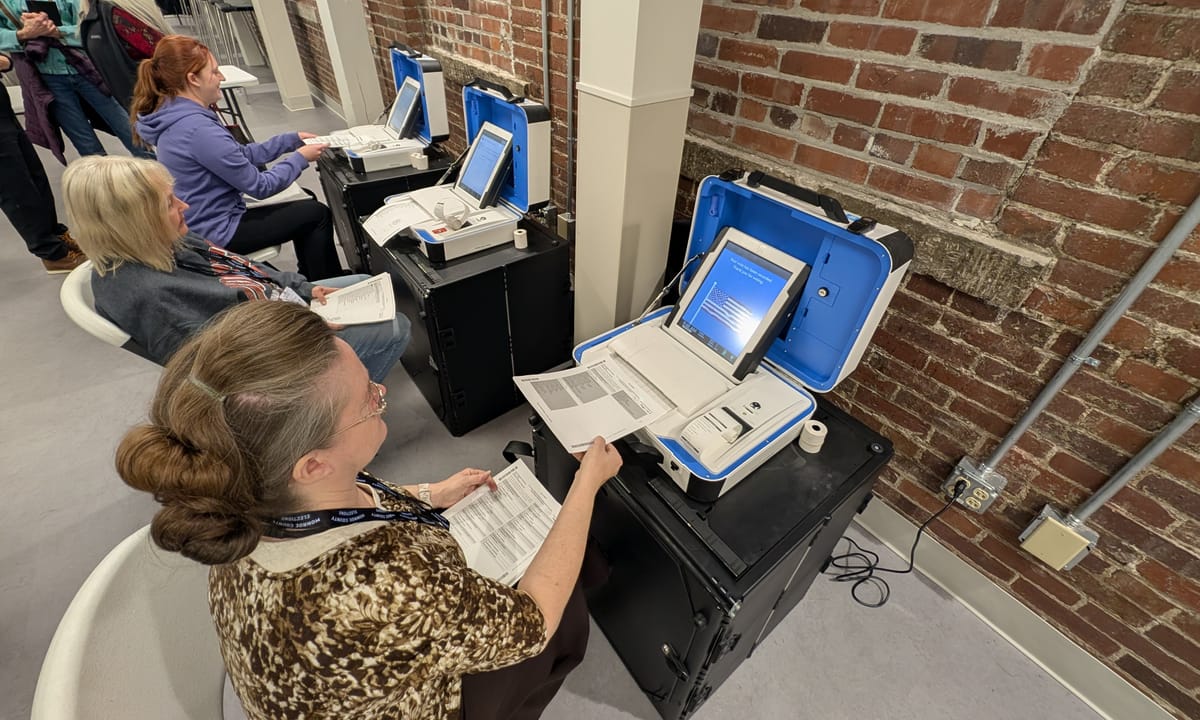
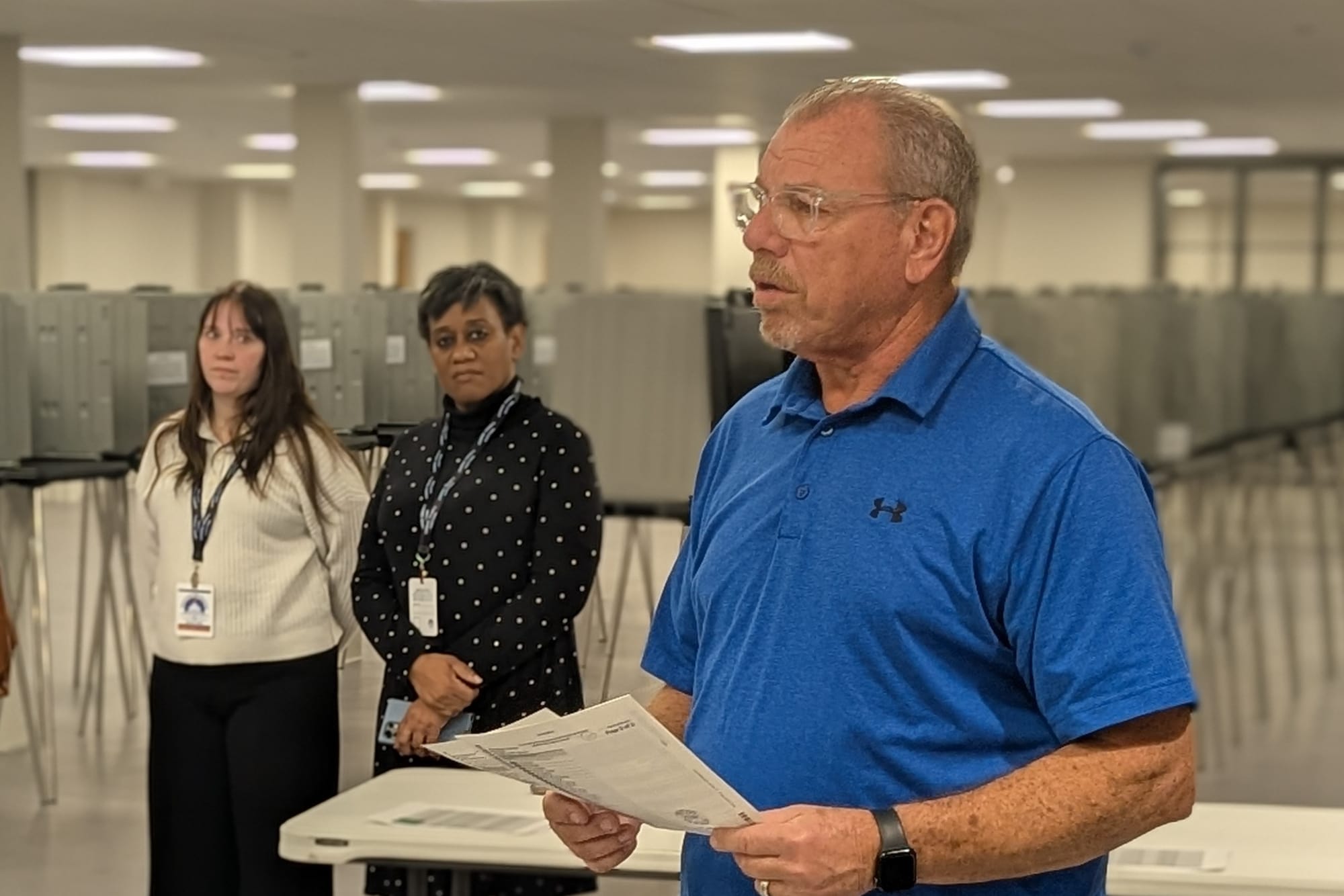
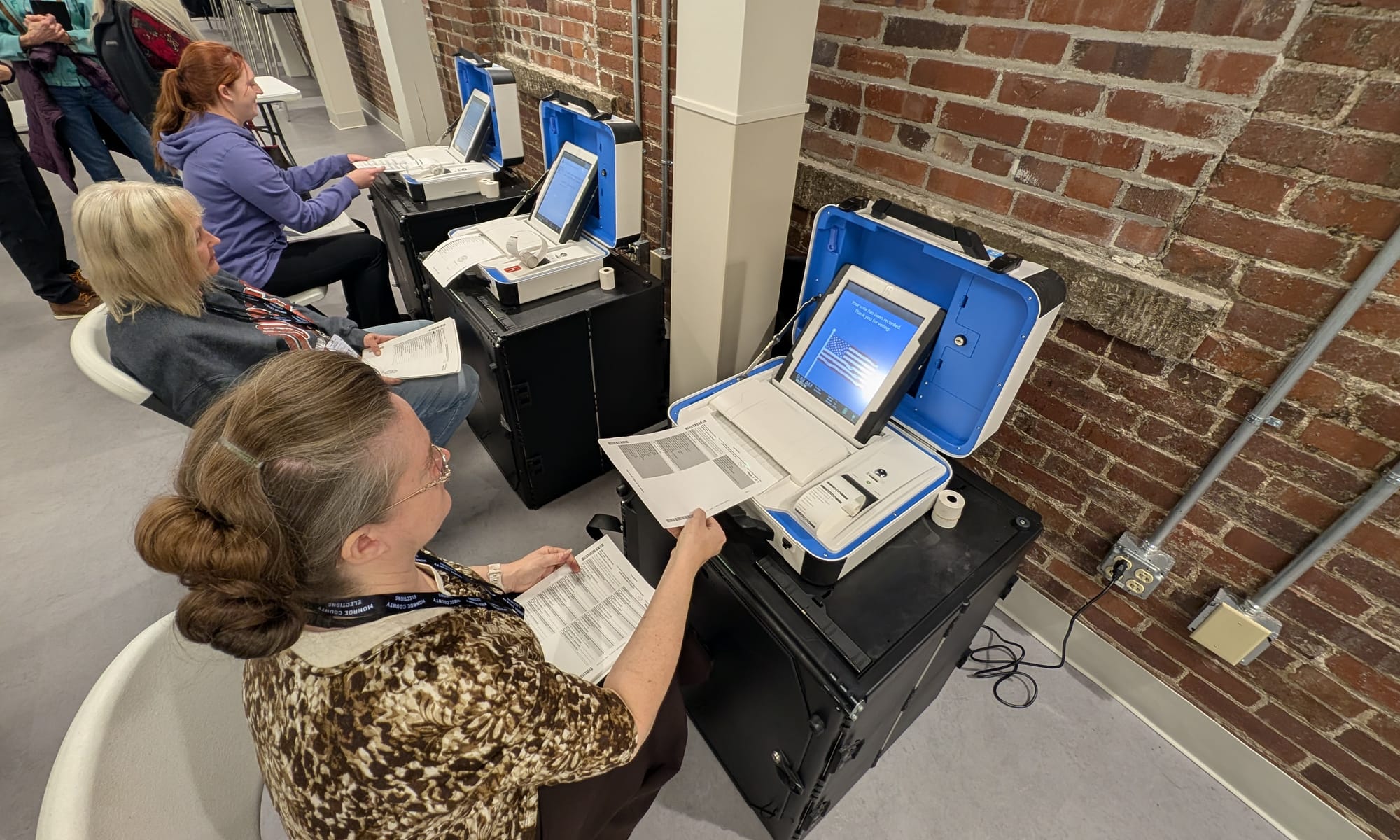
Left: Bob White, owner of B&L IT Services, briefs observers about the logic and accuracy test for election equipment. Standing in the background are Monroe County election supervisor Kylie Farris and Monroe County clerk, Nicole Browne. Right: Election staff feed test ballots into the scanners. (Dave Askins, March 24, 2026)
Monroe County’s voting equipment passed a routine logic and accuracy test Tuesday morning, clearing a key procedural task ahead of the May 5 primary election.
Briefing observers of the equipment test was Bob White, owner of B&L IT Services, which has been used as an election equipment consultant by Monroe County government since about 2013. His work includes equipment testing, polling logistics, and troubleshooting. White serves as a key local point of contact for county election staff and for employees of the Hart InterCivic, which manufactures the voting machines the county uses for its elections.
The basic idea of Tuesday morning’s test was to run thousands of pre-marked test ballots through a randomly selected set of scanners used on Election Day to verify that the optical readers and software will count votes correctly.
A few hours later, Monroe County election supervisor Kylie Farris, confirmed to The B Square that the equipment had passed muster.
White told observers of Tuesday’s event was his 19th logic and accuracy test for the county. For this round, a test deck of around 4,000 computer-generated ballots was used, designed to test every contest, every ballot style, and every kind of voting scenario the system might encounter on Election Day.
“What the computer does is it votes every ballot style, every contest on every ballot style, and all of our precincts and polling locations on every ballot,” White said.
The test deck covers everything from blank ballots to under-votes (where a voter chooses fewer candidates than allowed) to over-votes (where a voter chooses too many).
During the public test, staff in the election division fed the test ballots into the six different randomly selected tabulators. White warned that 70–80% of the ballots would be rejected on the first pass—not because the equipment is malfunctioning, but because the test deck is intentionally designed to produce all the common problem scenarios.
Rejected ballots are returned with messages such as “blank ballot” or “over-vote.” In real elections, voters can choose to correct their ballot or accept it as-is. For the test, staff just accepted the ballots as scanned.
Once the initial scanners read the ballots, reports with the tallies are generated. Those results are then compared against a pre-computed set of expected results generated by the Hart Intercivic, the voting machine manufacturer.
Observers asked how ballots that are rejected with errors are handled, especially during early voting. White explained that early in-person ballots are placed in a ballot box and later scanned in bulk with high-speed scanners, which means an early voter doesn’t have a chance to re-vote their ballot.
But ballots that the high-speed scanner flags for issues—such as ambiguous marks or over-votes—are sent to the county election board for adjudication on Election Day. Board members review enlarged images of the ballots and try to determine voter intent. If they conclude that a contest is in fact an over-vote, for example, that specific race is not counted, but the rest of the ballot still counts.
The test was conducted under bipartisan oversight. Monroe County Democratic Party chair Chrissie Geels and vice chair Rob Council both attended. Vice chair of the Monroe County Republican Party Noelle Conyer attended. All three election board members were present: Monroe County clerk Nicole Browne, GOP appointee Danny Shields, and Democratic Party appointee Penny Githens.
Election board members signed the official IEC-9 form, which certifies that the equipment passed the test.
Have a listen to what democracy sounded like on Tuesday morning.
Sound: Scanner test snippet
The logic and accuracy test is part of the county’s preparation for the May 5 primary election. Early voting begins April 7. The last day to register to vote is April 6. The state of Indiana offers an online voter registration service.

Comments ()