
Murky picture for Monroe County innkeeper’s tax revenue even muddier due to short term rentals
At Tuesday’s meeting of the Monroe County convention and visitors commission, a report on long-term trends for innkeeper's tax revenue was complicated by a shift in monthly distributions last year, as well as the exclusion of some short-term-rental revenues.
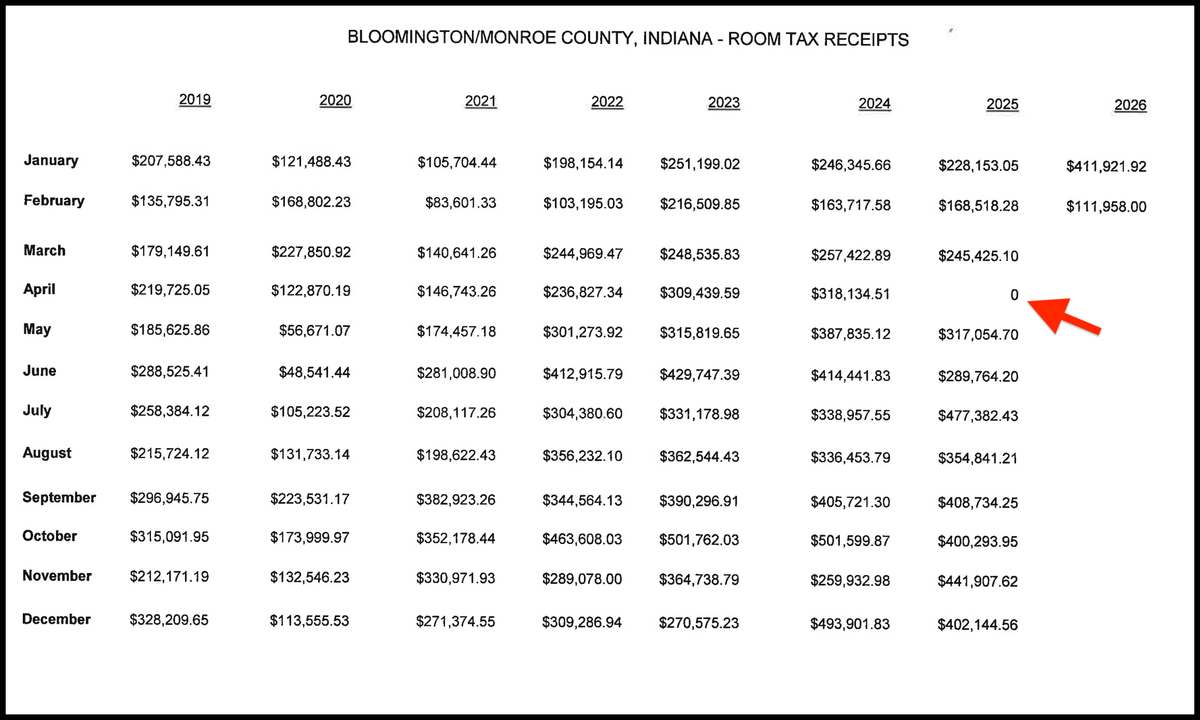
At Tuesday’s (March 11) meeting of the Monroe County convention and visitors commission (CVC), commissioners got their regular briefing on innkeeper’s tax collections.
Monroe County’s 5% innkeeper’s tax applies to all lodging charges for stays shorter than 30 days. The tax also applies to short-term rentals such as Airbnb and Vrbo.
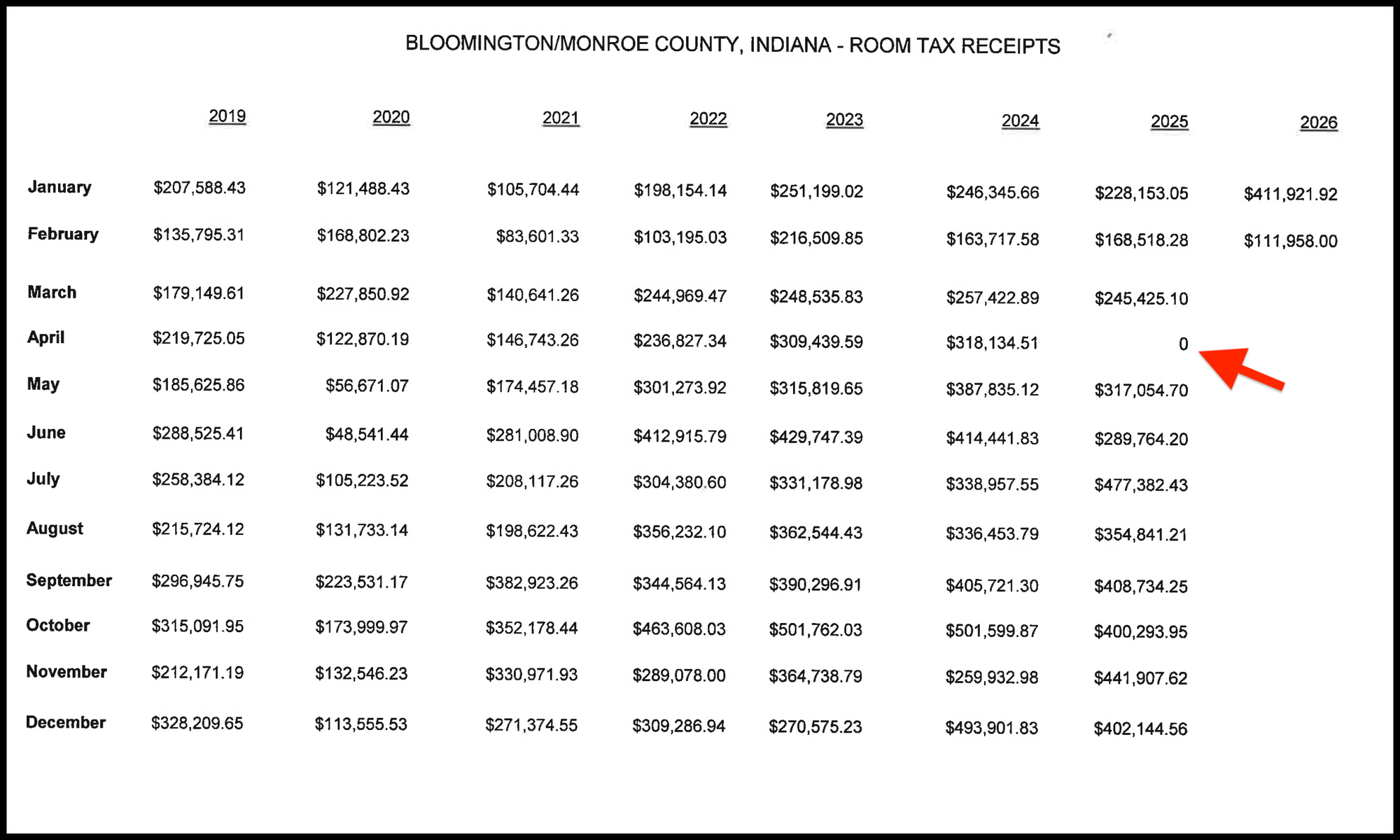
At first glance, the $411,922 in revenue from the innkeeper’s tax for January 2026 looks like a dramatic increase (80% more) over the $228,153 in revenue for January 2025. But that’s due to a one-month shift in the distributions, which took place in April last year, when none were reported. As CVC president Mike Campbell pointed out, all the distributions are now effectively one month behind where they would have appeared under the old system.
Campbell serves on the CVC, in his role as director of Indiana University hospitality, overseeing the IU Memorial Union. State law calls for membership on the CVC for the director of the IMU.
The number to compare to January 2025 ($228,153) is the figure in the report for February 2026 ($111,958), which is dramatically lower, by about half. But a clean year‑over‑year comparison is complicated by non‑reporting for short-term rentals, Campbell said. The February figure doesn’t include short-term rental innkeeper’s tax revenue, Campbell said, adding that those figures would be included in the March collections.
This May, which will be the first month after the shift in distributions last year, it will be a clean year-over-year comparison, Campbell said.
At Tuesday’s meeting, Visit Bloomington executive director Mike McAfee gave some perspective on short-term rental (STR) performance in the Bloomington rate market, based on data from AirDNA.
January 2026 STR revenue ($690,000) was down 18% compared to January 2025, and February 2026 STR revenue ($920,000) was down 31% compared to February 2025
The number of STR listings for each of those months was also down by single-digit percentages, McAfee reported. He attributed part of the short‑term decline to weather and seasonal factors.
But the pattern may not be purely seasonal. McAfee said that over the last few months there seems to have been a softening in STR supply. “I do feel that the last few months, we’ve seen a little bit of decline, versus ‘24 and ‘25 numbers, in some of the units available,” he said.
Even factoring in the Indiana University football team’s recent success, McAfee said, “I feel like it is going to continue to start to level out some—hopefully.” McAfee said “hopefully” because he thinks there are too many STRs in the market.
Regulation of short-term rentals could be on the horizon, McAfee said, which could ultimately impact innkeeper’s tax revenue. McAfee reported that the most recent word from Bloomington mayor Kerry Thomson’s office, is that the city still intends to address STR regulation sometime this year.
Responding to an emailed B Square question, Desiree DeMolina, the city’s communications director wrote: “We’ve been looking at the options available under current state law regarding short-term rentals. Indiana law places tight limits on what cities can regulate and the range of tools available is narrow.”
The response from the mayor’s office continued, “We’ve talked internally about a few possibilities—whether zoning districts allow certain restrictions and whether approaches like registration or inspection systems make sense. Each of those comes with practical considerations around staffing and enforcement.”
According to the mayor’s office, city councilmember Dave Rollo has an interest in assisting with drafting legislation on STRs. The goal, according to the statement is to ensure “that our currently scarce housing is primarily targeted towards full-time residency.”
The topic of regulating STRs got some talk during 2024, the first year of Thomson’s mayorship, but did not lead to any concrete action.
Campbell noted towards the end of the CVC’s Tuesday meeting that HB 1210 had been enacted, which adds another member of the CVC, which is currently a five-member agency. The sixth member is to be appointed by the mayor.
Responding to an emailed B Square question, DeMolina, in the mayor’s office, indicated that Thomson is aware of the appointment to be made and will be ready in July, when the law goes into effect, to make it.
Comments ()