
New Kirkwood closure proposal could revisit conflict over who controls Bloomington streets
Two Bloomington meetings next week will spotlight the question of who controls city streets. One is a board of public works bridge-related road closure on Club House Drive in Lower Cascades Park. The other is a new proposal from the city council for permanent seasonal shutdown of Kirkwood Avenue.
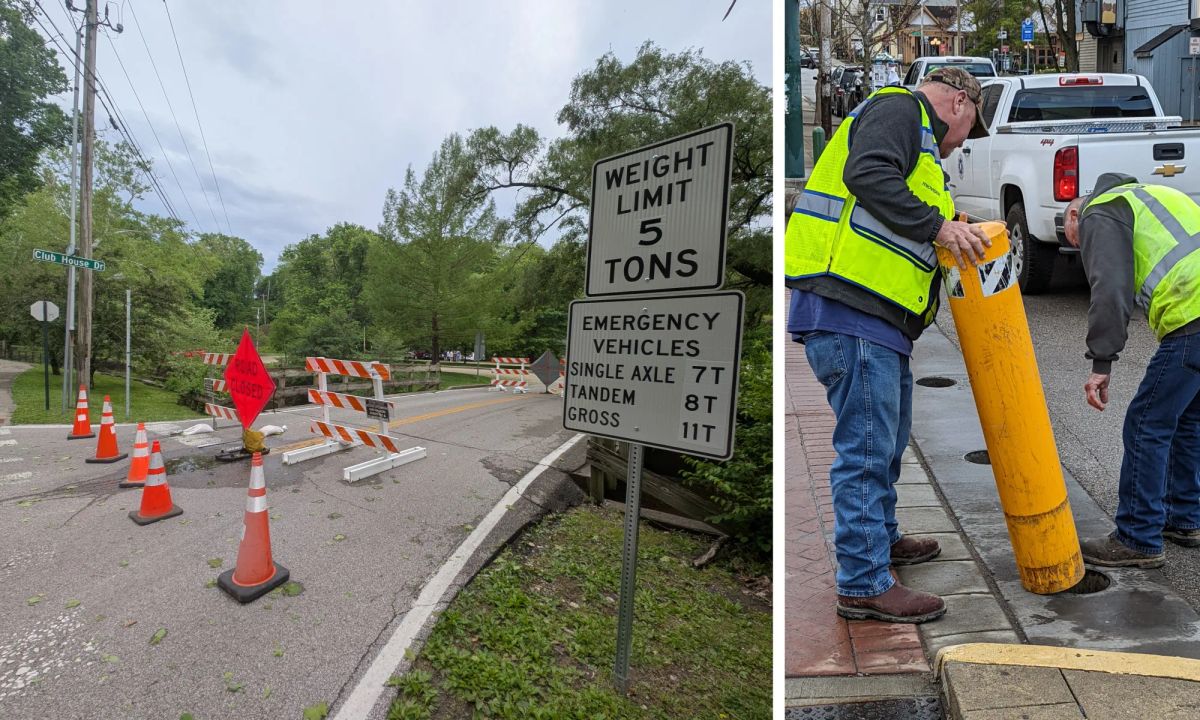
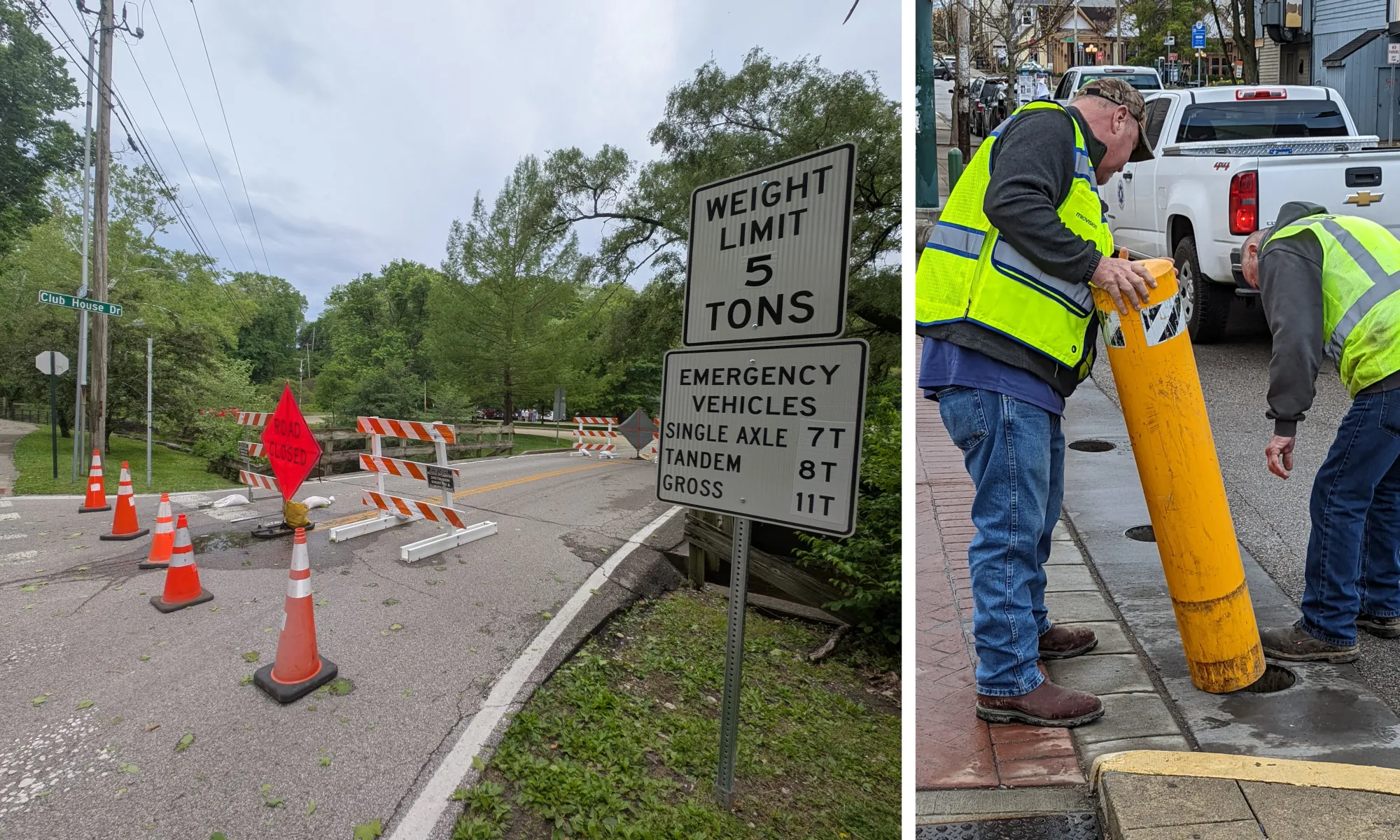
Bloomington’s board of public works on Tuesday (May 19) and the city council on Wednesday (May 20) will each take up proposals involving the closure of public roads.
The board of public works will be asked to confirm a city staff decision to close a road leading to a failing bridge. For its part, the council will be introducing an ordinance that could potentially make seasonal closures of Kirkwood Avenue to motor vehicle traffic a permanent feature of the iconic east-west corridor.
Underlying the two decisions is a potential disagreement between the council and the administration over who actually has authority over Bloomington’s streets.
Closing road leading to failing bridge
On the agenda for Tuesday’s board of public works meeting is the ratification of the city administration’s decision last week to close the road leading to a 27-foot bridge on Club House Drive in Cascades Park. The closure came after a county bridge inspection found “major deterioration” in one of the structure’s main support beams.
The board’s resolution on road closure says the bridge itself is not under city authority, but that the city can close portions of Club House Drive to prevent access. According to the staff memo supporting the resolution, public works crews closed the roadway on May 15, ahead of approval from the board of public works, in consultation with engineering, parks, and legal staff.
Neither the staff memo nor the resolution mention the Bloomington city code section that says the city engineer or the police chief can make regulations to deal with emergency conditions. But that code section also limits the duration of those emergency regulations to 180 days, and makes any permanent measure subject to city council approval.
Instead, the resolution cites Title 12 of city code for the authority under which the board of public works Bloomington oversees rights-of-way and street closures. Since Bloomington mayor Kerry Thomson took office in 2024, the city’s legal department has interpreted state law to mean that it’s the city engineer or the board of public works who have the authority to open and close roads, to decide the placement of stop signs and traffic signals, and to install traffic calming measures.
The bridge itself is also part of a separate and potentially growing conflict between Bloomington and Monroe County government, over ownership and maintenance responsibility for certain bridges inside city limits. But that broader intergovernmental dispute is not the focus of Tuesday’s meeting.
New proposal for Kirkwood closure
Then on Wednesday, the Bloomington city council will see the introduction of an ordinance that would permanently codify seasonal closures of Kirkwood Avenue from April 1 through Nov. 15 each year. The ordinance would prohibit motor vehicle traffic on Kirkwood from Walnut Street to Indiana Avenue during those months. The closure schedule would be put into Title 15 of Bloomington’s municipal code.
On Wednesday, the ordinance closing Kirkwood will be making its first appearance on the council’s agenda, which means it can’t be approved the same night without unanimous consent. The topic of Kirkwood closures has history dating back to the pandemic. The city’s transportation plan of 2019 calls for the redesign of Kirkwood as a shared street.
Wednesday’s proposal for permanent seasonal closure comes after the Thomson administration earlier this year suspended the seasonal Kirkwood closures in connection with the outdoor dining program for 2026. On Feb. 12, city engineer Andrew Cibor issued an order reopening Kirkwood to vehicle traffic, citing “lack of participation and impracticality (budget)” under authority granted in the council’s 2025 outdoor dining ordinance. Later that month, the board of public works approved an outdoor dining plan that kept the street open except for one-off events.
Some councilmembers sharply criticized the administration’s move at the time, arguing it violated the spirit of the ordinance they had adopted in January 2025. That ordinance had established an ongoing annual outdoor dining program and restored the Kirkwood conversion element after council amendments removed sunset language and reinstated the full closure concept.
The clash over Kirkwood is part of a broader disagreement between the Thomson administration and some councilmembers about whether the council has legal authority over permanent roadway decisions at all. Over the last several months, corporation counsel Margie Rice has argued that state law places authority over traffic controls, roadway design, and related public-way decisions with the executive branch through the city engineer—not the legislative branch through the city council.
That interpretation surfaced publicly in disputes over neighborhood greenways, stop signs, and the ordinance establishing the new transportation commission.
The ordinance that would make seasonal closure of Kirkwood Avenue permanent could get a vote on enactment at the council’s June 3 meeting.
Against that backdrop, this coming week’s two meetings could provide some additional clarity on the question: When Bloomington closes a street, who ultimately gets to decide? If the current set of city elected officials can’t arrive at an understanding on the topic, state law offers the explicit option of asking the circuit court to settle it.

Comments ()