
No land deal yet, but CIB keeps Dora in game for Bloomington Convention Center host hotel at least until Jan. 21, 2026
With no land deal in hand, the Monroe County CIB has given Dora Hospitality a bit longer to produce a viable host-hotel proposal. Talks over the College Square site remain stalled by a major funding gap; without progress, the CIB will issue a new RFP at its Jan. 21, 2026 meeting.
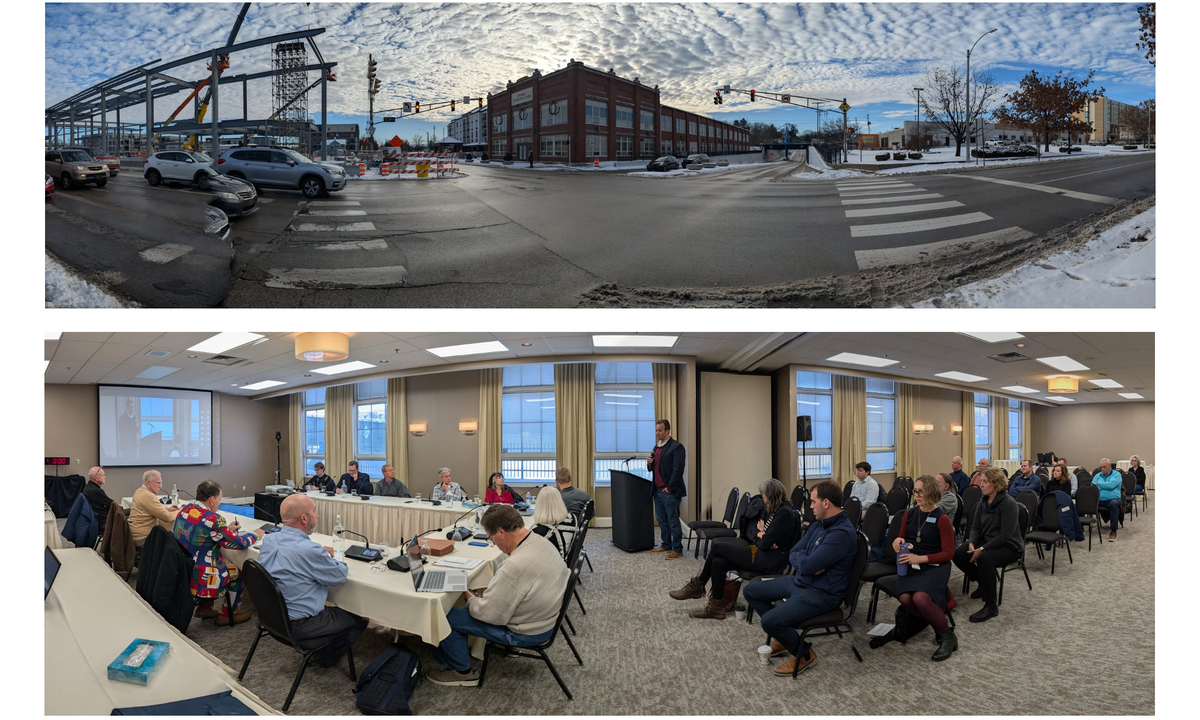

Bloomington’s current effort to land a host hotel for its convention center expansion is still alive. But in football terms, there’s only seconds showing on the clock, Team Hotel is down by a touchdown, and the quarterback has dropped back to heave a Hail Mary pass from his own end zone, with his a lone receiver draped in triple coverage.
But Monroe County’s capital improvement board (CIB) is not going to put an ‘L’ on the board while the ball is still in the air. In a contest that started over a year ago, the game clock won’t show double zeros until Jan. 21—and only then will the CIB let another team take the field to try to score a hotel.
The CIB, an interlocal collaboration between Bloomington and Monroe County governments, is the agency that is overseeing the construction of the convention center expansion. The CIB is responsible for selecting a hotelier for the project.
Minus the sports talk, the CIB will be waiting until its next regular meeting, three weeks into the new year on Jan. 21, before declaring dead the possibility of a hotel deal with Dora Hospitality. But if Dora does not have concrete prospects for a real estate deal to report on Jan. 21, that’s when CIB will be issuing a new RFP (request for proposals) to select a hotel developer.
That’s the postgame wrapup from CIB’s last regular meeting of the year, on Dec. 17. Dora Hospitality and Bloomington’s redevelopment commission were supposed to report on any concrete prospects for a land deal by that date, but there were none to report.
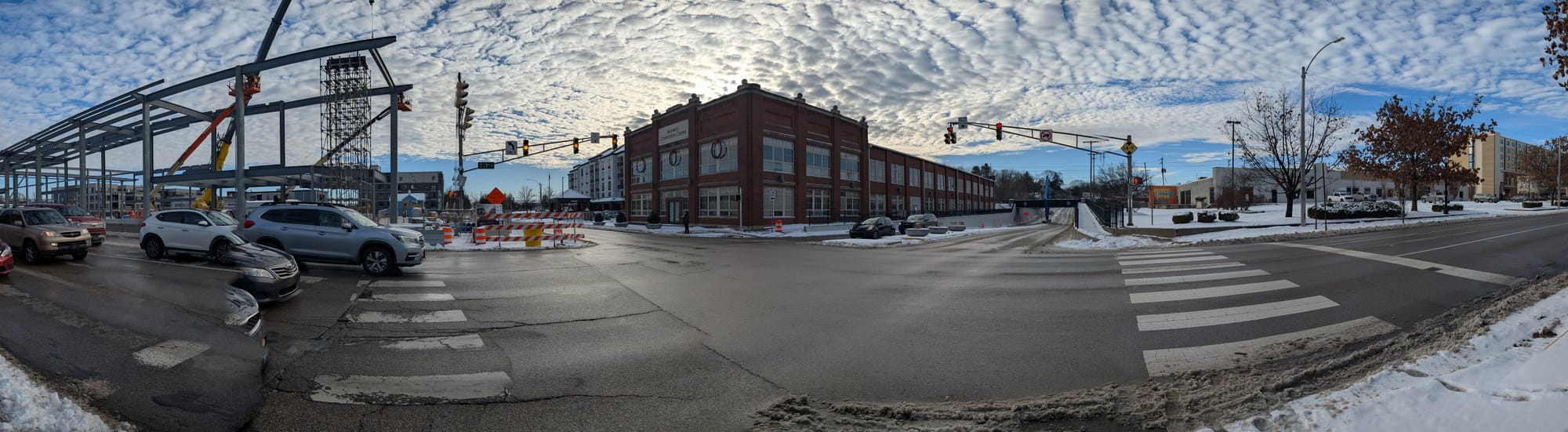
Since the CIB selected Dora as its preferred hotelier in October 2024, Dora has been negotiating with the city’s redevelopment commission for the real estate at College Square at Fourth Street and College Avenue, which is commonly known as the former Bunger & Robertson lot. At the one-year mark of the negotiations, the CIB gave Dora a deadline of Dec. 17 to report concrete progress on a deal for the land.
Report from Dora Hospitality, RDC (Dec. 17)
Not a surprise on Dec. 17 was the report to the Monroe County capital improvement board (CIB) that no concrete prospects existed for a deal with Dora Hospitality to develop a host hotel on the former Bunger & Robertson property. A week earlier, that was already the clear indication given at a work session of the RDC held on Dec. 10, which was also attended by Bloomington’s city council.
At the CIB’s Dec. 17 meeting, it was city economic and sustainable development director Jane Kupersmith delivered the official news. She told board members that the city’s redevelopment commission (RDC), which is the owner of the former Bunger & Robertson parcel, has been unable to reach a deal with Dora Hospitality for a hotel on the Bunger & Robertson site, north of the convention center.
Kupersmith put it like this: “The RDC has not been able to reach a deal with Dora Hospitality at the Bunger & Robertson property.” Following Kupersmith at the mic was hotel developer Vince Dora, who signaled he is still not yet ready to walk away from the deal.
“I’ll just echo what Jane [Kupersmith] said—disappointed that it’s taking so long, but I’m here to just tell everyone that I remain resolute in my belief that we get this deal done,” Dora said.
“Whether it’s this site or another site …, I still firmly believe the host hotel [for the] convention center is something that’s needed, and I’m willing to keep working on that,” Dora said.
CIB president John Whikehart characterized the Bunger & Robertson site talks as effectively stalled, and asked Dora at the Dec. 17 meeting, if Dora would consider looking instead at either of the parcels south or west of the existing convention center facility—sites that were part of the original RFP.
Dora said, “Yes, we are committed to figuring this out, whether it’s one of the other two parcels or the Bunger & Robertson property.”
Whikehart then proposed that the CIB be prepared to do one of two things at its Jan. 21 meeting—move ahead with a concrete proposal that Dora brings, or issue a new RFP.
CIB member Jay Baer offered a bit of pushback, pressing for a clearer breakpoint in the process with Dora: “The other option would just be to say: We’ve concluded this process with Dora Hospitality, and if Dora Hospitality chooses to bid on a new RFP… that’s fine.” Baer said that other potential developers may think it’s really not worth pursuing until the current process is declared over. Baer described it as “a line in the sand” where the CIB would say, “We’re done now, and now we’re going to try it again.”
It looks like the line in the sand won’t get drawn until Jan. 21. That is, the Jan. 21, 2026 CIB meeting is the target decision point: Either Dora returns with a credible proposal on some parcel, or the CIB board moves to relaunch the search for a host-hotel developer.
Role of real estate in bridging the funding gap
The reason no deal has been reached to develop a hotel at the former Bunger & Robertson site is the gap between the amount of capital Dora can tap to build the project and the cost to build the project. Typically, host hotels for convention centers rely on public subsidies in ways that current local Bloomington decision makers have only recently begun to understand, even if a report commissioned six years ago spelled that out.
At the Dec. 17 meeting of the CIB, Bloomington economic and sustainable development director Jane Kupersmith described Dora’s proposed hotel as having “major funding gap,” adding, “We can’t understate it.”
Beyond the real estate itself, which was purchased by the RDC using TIF (tax increment financing) funds for around $7 million, Kupersmith said the RDC does not have more other sources to use as incentives to support the host hotel project. The other TIF financing that could conceivably be used, Kupersmith said, is dedicated to other projects, which means it’s not available for subsidy for the project.
Among the other projects the RDC is looking to fund with TIF revenue are infrastructure improvements for Hopewell neighborhood redevelopment and the Summit District PUD.
Kupersmith also pointed out that the city council has indicated its desire to use only food and beverage tax revenues and inn keeper’s tax revenues in support of the convention center expansion and host hotel project. Kupersmith put it like this at the Dec. 17 meeting: “We simply can’t close the gap with resources that we have available.”
RDC resolution on “nominal cost”
As a way to partially meet its funding challenge, Dora Hospitality was looking to acquire the former Bunger & Robertson property at essentially no cost. Based on a resolution considered by Bloomington’s RDC at its Dec. 1 meeting, there was an indication the RDC was willing to put the Bunger & Robertson property in the mix at “nominal cost”. But the RDC put off a vote on that resolution until its following meeting.
Between meetings on its regular calendar, on Dec. 10, a work session was held by the RDC, which was attended by city councilmembers. There, the RDC got a clear reminder that city councilmembers had expressed their view on the issue of reimbursement for the former Bunger & Robertson property a year and half earlier, in a letter signed by eight of nine councilmembers.
Specifically, the council’s letter says that reimbursement of the purchase price of around $7 million is expected. At the time the letter was written, Bloomington mayor Kerry Thomson shared the view that the $7 million purchase price should be recouped. It was purchased during her predecessor, John Hamilton’s administration.
At the Dec. 10 work session, councilmember Matt Flaherty was pointed in his remarks on the topic, calling the consideration by the RDC of the resolution “disconcerting.”
The original wording of the RDC resolution affirmed the RDC’s support of the property as the site of a host hotel. But it also included the phrase “nominal cost.”
At its Dec. 15 meeting, RDC president Deborah Myerson made a motion to amend the wording in the resolution that had been introduced at the group’s previous meeting— to remove explicit mention of the phrase “nominal cost.” In its original form, the resolution said “[T]he real estate at College Square if necessary for the host hotel, may be made available, in some form, to the host hotel project at a nominal cost to the project, if it furthers the best interests of economic development and the City of Bloomington.”
The revised version, which was approved by the RDC, deleted the phrase “nominal cost” and swapped in some additional wording about protecting the city’s interests. The revised wording read: “[T]he real estate at College Square, if necessary for the host hotel, may be made available in some form and on terms to be determined by the RDC and structured to protect the city of Bloomington’s best interests and limit public risk.”
The deletion of the phrase “nominal cost” was enough to cause RDC members John West and Sue Sgambelluri to dissent on the amendment. But with the support of Myerson and Randy Cassady, who were joined by Laurie McRobbie, the amendment passed. Myerson and Cassady are the two city council appointees to the RDC. The other members of the RDC are appointed by the mayor. The resolution as amended passed with dissent only from John West.
At the city council meeting two days later, the deletion of the phrase “nominal cost” was enough for Flaherty to declare a victory of sorts. During councilmember report time at the start of the meeting, Flaherty thanked the two city council appointees to the RDC, as well as McRobbie, for introducing and voting on the amendment that removed “nominal cost” from the wording of the resolution.
Flaherty said at the city council’s Dec. 17 meeting, “That resolution, consistent with the clear policy position of the city council, confirmed that the RDC does not intend to give away a $7 million piece of property to a private hotelier in order to subsidize the convention center host hotel.” Flaherty added, “So this is a $7-million win for the residents of Bloomington, whose tax dollars can now be leveraged for resident benefits.”
Role of Bunger & Robertson land in future deal?
It looks like there’s enough nuance in the wording of the amended resolution that the Bunger & Robertson property could still be part of an incentive package offered by the RDC for a host hotel development. The resolution still says the property could still be made available under “terms to be determined by the RDC and structured to protect the city of Bloomington’s best interests and limit public risk.”
At the Dec. 17 meeting, CIB member Geoff McKim weighed in for the idea that there is public benefit from the use of the former Bunger & Robertson property, that could be valued at somewhere between $0 and $7 million.
When it comes to putting a host hotel at the Bunger & Robertson location as opposed to one of the other locations, McKim framed it like this: “I do think that there is a community benefit to having the hotel at the Bunger & Robertson property versus the other locations. Is it worth $7 million? I don’t know.” McKim continued, “It’s certainly not worth zero.”
McKim added, “Unfortunately, the idea of trying to extract all of the $7-million purchase price from the property would essentially value that community benefit at zero—I don’t think that’s accurate.” McKim wrapped up by saying, “I don’t think that any of us would agree that having the host hotel to tie to the downtown so directly has zero community benefit.”
The Dec. 17 CIB meeting was McKim’s last, as he resigned in order to become the city of Bloomington controller, starting in mid-January.
Comments ()