
Perry Township Democrats weigh background, legacy in Gordon–Combs trustee race
At a Monroe County Democratic Party forum, Perry Township trustee Leon Gordon and challenger Levi Combs offered contrasting backgrounds but similar priorities for the office. The May 5 primary will likely decide the seat, with no Republican currently on the ballot.
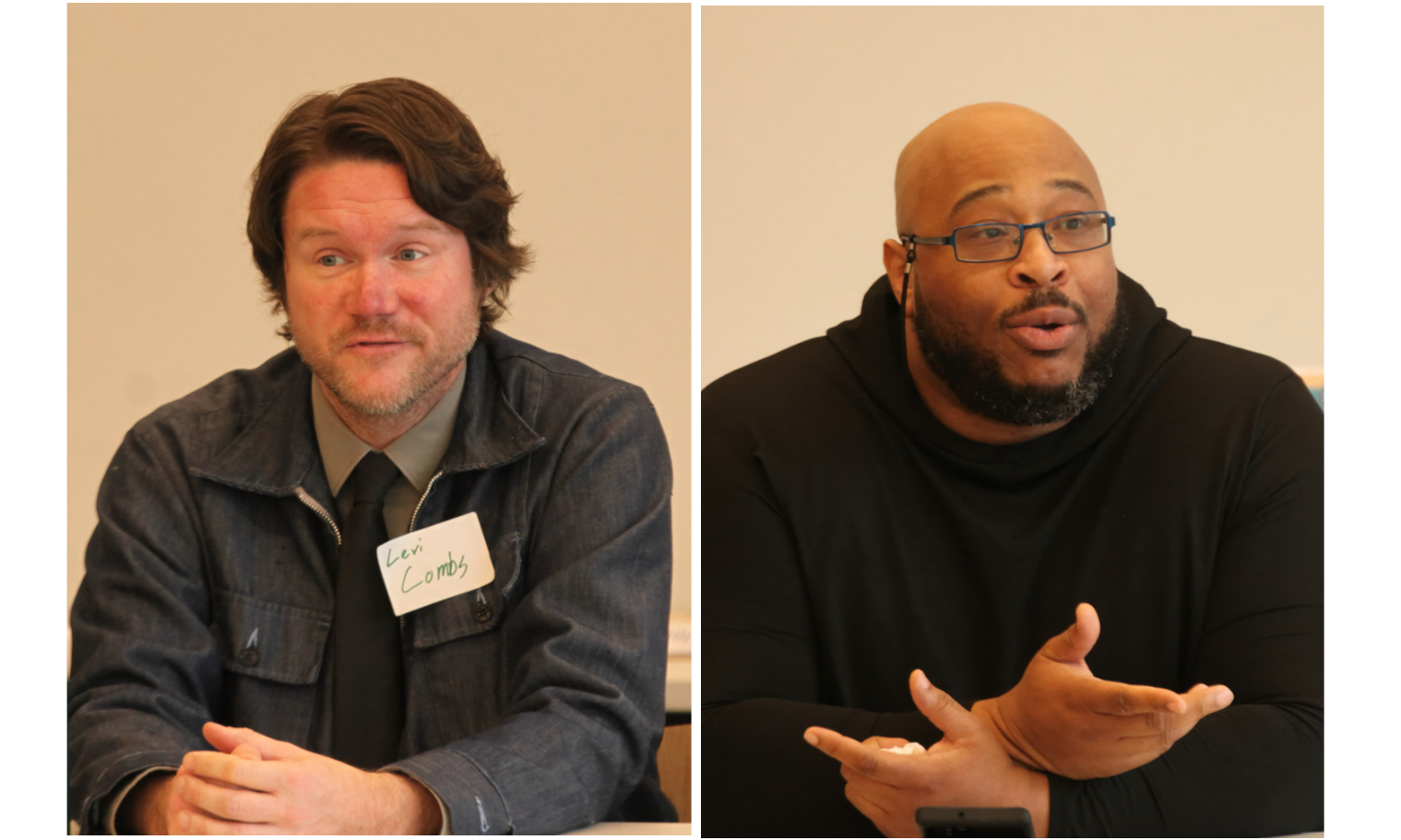

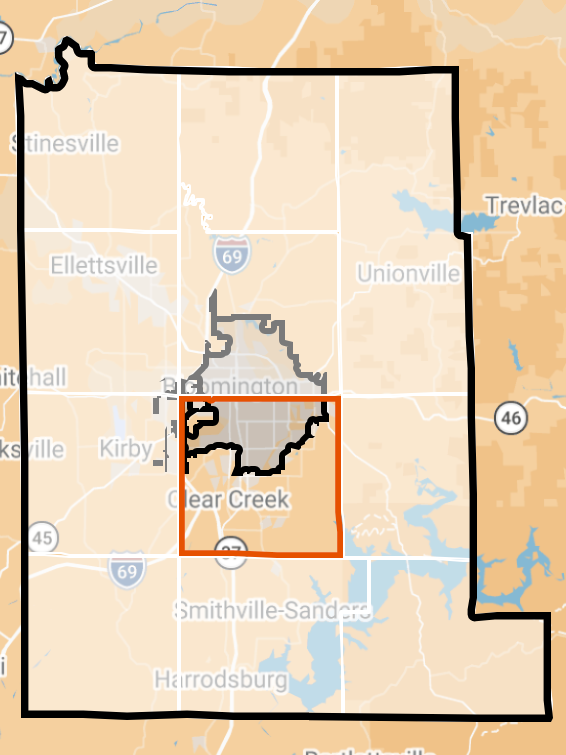

Left: Levi Combs. Right: Leon Gordon. (Dave Askins, March 7, 2026) Middle: Perry Township includes the southern half of the city of Bloomington. Map by The B Square.
At a candidate event last Saturday (March 7), hosted by the Monroe County Democratic Party at the southwest branch of the Monroe County Public Library, incumbent Perry Township trustee Leon Gordon and challenger Levi Combs offered voters two different profiles for voters on May 5, who will select the Democratic Party’s nominee for township trustee.
No Republican candidate is currently on the ballot, so it’s likely the winner of the Democratic Party’s primary will win election to the trustee’s office in November.
The Perry Township office was led for nearly four decades by Levi Combs’s late father, Dan “Carp” Combs, who died early this year.
Township government is the most local level of government in Indiana. Its main job is to provide township assistance—short-term help for residents who cannot meet basic needs such as rent or mortgage payments, utility bills, food, medical care, and burial expenses.
Townships divide counties into geographic areas that can overlap with cities and towns—meaning they are a layer of government on top of municipal government. In Monroe County, for example, Perry Township covers the southern half of the city of Bloomington, even though the city has its own government.
Each township is led by an elected trustee, who administers the assistance program, and a three-member township board, which adopts the budget and oversees township spending
Gordon was selected in a party caucus on Jan. 31 to fill the vacancy in the trustee’s office after Dan Combs’s death. Gordon prevailed over Levi Combs and a third candidate, Eric Petry. Petry has since withdrawn from the primary. Combs remains on the ballot, setting up a contest between the the son of the long‑time trustee and the appointed incumbent.
Gordon, a social‑services administrator with a background in housing and shelter programs, is leaning on his previous professional experience, and now five weeks on the job, to make a case for continuity, legislative vigilance, and new outreach efforts like a mobile “township office” and a planned Community Outreach Resource and Education (CORE) Center. Gordon left his job at New Hope for Families to take on the role as township trustee.
Combs worked about 17 years for the department of public works in the city of Bloomington, ending in 2021. Combs grew up in the Perry Township office—his mother was the township office manager—and lived in the same low‑income neighborhoods his parents served. He is emphasizing on‑the‑ground crisis response, the emotional and institutional legacy of his father’s 40‑year tenure. He also warned about the trajectory of state legislative policy toward townships and people experiencing homelessness.
Both candidates talked about the potential impact of SB 270 enacted in this year’s legislative session, even if they both think that Perry Township and Bloomington Township will not be affected by the potential mergers required under that bill.
Questions were put to the candidates by Monroe County Democratic Party chair Chrissie Geels, as well as audience members.
Gordon: “Uniquely prepared,” continuity of Combs legacy
Gordon framed his candidacy as the continuation of the professional work that his career up to now has prepared him to do.
He described a background rooted in housing and social services administration, citing roles as administrator of housing and supportive services programs for the Bloomington Housing Authority, shelter program director, and most recently as direct case management professional for New Hope Family Shelter.
Alluding to his selection by precinct chairs at the Jan. 31 party caucus to serve out the remainder of Dan Combs’s term, Gordon said, “I knew that taking on this role was not only something that I could do well, but it was something that I’ve been uniquely prepared for,” he added, saying he was “grateful for the precinct chairs to trust me with the responsibility.”
Having served as township trustee for five weeks at the time of the forum, Gordon emphasized that he has been “building foundations with staff and securing clearances and access to systems.” He said his background allowed him to “jump immediately or seamlessly into the core work of the township, which is the provision of financial assistance.”
Gordon also framed his work in connection to the Combs era: “The legacy of late trustee Combs is evident by virtue of what I stepped into—a social services kingdom,” Gordon said. “The unique connections and existing partnerships that were developed under his tenure have laid the foundation that I now stand on and aim to preserve, enhance, and strategize for continued improvement.”
On outreach and public awareness, Gordon said that too many residents and even professionals don’t know what the Perry Township government is able to do. He said he had recently met with family nurse practitioners who didn’t know about the township’s medical assistance program until he explained it.
As one of his first concrete initiatives, Gordon described a “mobile office tour”: “We’re gonna go set up at strategic places and sit and table, myself and another case worker, and do outreach, hand out information on how to get in touch with us.” He added: “We can’t forget about the folks outside of Bloomington and the city and rural areas.”
He also spoke of a longer‑term idea for a CORE Center—Community Outreach, Resource and Education Center—which is intended as “a place where we’re doing outreach, providing resources and education to prevent the loss of stable housing and to “go upstream” rather than function solely as a last resort.
On the topic of future funding for township government, Gordon warned that changes to the state’s local income tax structure could constrain the township’s general fund after 2027. The new local income tax scheme in SEA 1, which was enacted last year, makes township revenue from such taxes contingent on approval from the county council. Gorden called for close coordination with county officials, saying he had already spoken with them about ensuring that townships receive “their fair share” of local income tax distributions.
Combs: Township politics, disaster response
In his introductory remarks and in response to questions, Levi Combs leaned on his biography and on lived experience inside Perry Township’s office and out in the field.
Combs noted that both his parents worked in the Perry Township office: “It’s controversial, but my mother also worked in my dad’s office the entire time when he was there, and she retired three years ago.” He recounted how he was steeped in the culture of township government: “I was raised with township government being at the dinner table, at the coffee table, at every event that I went to, every conversation that we had at home.” He put it like this: “I was raised inside the Perry Township office.”
Combs described growing up in a southside Bloomington mobile home park living among the low-income residents his parents were serving, and working in the city of Bloomington’s public works department.
In his role with public works, Combs said, “I got out into the community… being the person that has to go out there and see everybody in the eye as you put the sign in their yard, the curb in front of their house—everything that people hate,” he said. “I’ve been taking words from the community for a long time.”
That experience, Combs said, gives him “a pretty good grasp on what this community really holds on to and values and expects.”
Combs painted township government as a largely under‑acknowledged, but essential part of the local safety net. He emphasized what he sees as the core mission of township government, which is not building new housing stock, but keeping people from becoming unhoused.
He put it like this: “The township isn’t ever going to create housing alone. Township’s goal is to create an opportunity for people to avoid being unhoused. We want to keep people in houses. It’s attacking homelessness and housing from another angle.”
A major theme for Combs was disaster response, especially after the May 16, 2025 tornado in southern Monroe County. He said that recent statutory changes have, in practice, thrust township governments into the role of front‑line disaster responders, but without adequate resources.
“There’s not going to be any government agency that’s going to come in and help out people,” he said. “It’s been left up to the county and the townships.”
After the May 16, 2025 tornado, the township trustee’s office staff had to go out in the field, to actually go to those people and bring services to them, Combs said. “Nobody [else] even got the numbers of the people who were displaced. The township had to go out and do that,” Combs said.
Combs said that Perry Township should be more assertive in pushing COAD—Community Organizations Active in Disaster—to fulfill its intended role, and that the trustee has to be ready to “jump up and get out there to service the people of Perry Township, whenever they’re at their lowest.”
Combs brought up a concern about the “criminalization of homelessness,” which refers to SB 285, which has now been signed into law by Indiana governor Mike Braun, and takes effect on July 1. The bill makes it illegal to camp, sleep, or set up long-term shelter on land owned by the state or local governments—unless that place has been officially designated for camping. If law enforcement officers find someone camping on public land, they have to first check whether the person should be taken for emergency mental-health detention; if not, the person can be charged with a misdemeanor.
Combs said he thinks SB 285 would likely lead to police removing people from public spaces. With incumbent Monroe County prosecutor Erika Oliphant sitting in the audience of the forum, Combs said “We might not have prosecutors that are going to necessarily keep the charges there, but I do believe that we’re going to have officers that are going to put people in cuffs and remove them from properties.”
Combs added, “I’ll take this opportunity to say I would advocate for the people out there in the parks.” He said, “The township trustee is at least the first person they can look at and see somebody in government who will do something to try to get this situation figured out for them.”
Like Gordon, Combs acknowledged that township capacity is constrained, that assistance is often “case by case,” and that staff are already stretched. He stressed the importance of coordination with other agencies so that township dollars are used last, to close gaps after churches, nonprofits, and other programs have done what they can.
SB 270 and the future of township government
On state‑level policy more broadly, both candidates treated SB 270, the township merger bill, as part of a broader pattern of state‑level pressure on township government, but they approached it from slightly different angles.
SB 270 would evaluate Indiana townships and require those that score poorly on certain performance metrics to merge with neighboring townships or, in some cases, be absorbed into a nearby city or town. The goal is to shrink or reorganize township governments across the state by 2029, replacing them with larger units that are meant to operate more efficiently.
Gordon focused on organizational response and advocacy within existing structures. He said he has begun working through the Monroe County Township Association, describing it as “our collective where we are strategizing and communicating with a collaborative spirit as SB 270, the township merger bill, goes into effect.”
“I aim to be a voice of proactivity,” Gordon said, adding that townships must “strategize, monitor, and actively combat against future legislative efforts that may come to chip away at our township capacity.”
He tied SB 270 to other fiscal shifts, like changes to the local income tax. He framed his role as making sure Perry Township can “fortify our financial future” and preserve its existing social‑service partnerships despite those changes.
Combs stressed more the political and existential stakes of consolidation. He said that by 2030 “they’re estimating about 300 townships will be eliminated because they get merged,” and that lawmakers seem to expect those mergers to proceed “without much detail.”
Combs called it “terrifying” to have the requirements of SB 270 lurking in the background. For Combs, SB 270 is less an isolated statute than a signal that “some people were very complacent with what townships could be doing for them,” and that the era of benign neglect is over. He cast Perry Township’s challenge as showing, through performance, that “the consolidation doesn’t have to happen on the rate or scale they think.”
A choice between types of experience
On broad priorities—keeping people housed, addressing food insecurity, navigating hostile state policy, and maintaining the Dan-Combs‑era social service infrastructure—the two candidates were essentially aligned.
The contrast is one more about the nature of their past work experience: Gordon as the recently appointed administrator focused on data, mobile outreach, and new program structures; Combs as the heir to a four-decade township legacy focused on lived experience, and on‑the‑ground crisis response.
Both asked voters to think of them when they go to the polls.
Early voting starts on April 7. Primary Election Day is May 5.
Comments ()