
Plan commission backs big Bloomington zoning changes, attorneys disagree on incentives
Bloomington’s plan commission voted 6–2 to recommend UDO changes that ease small-scale housing development and end parking minimums. The commission heard two different legal opinions about the city’s existing affordable-housing incentives and whether they violate Indiana law.
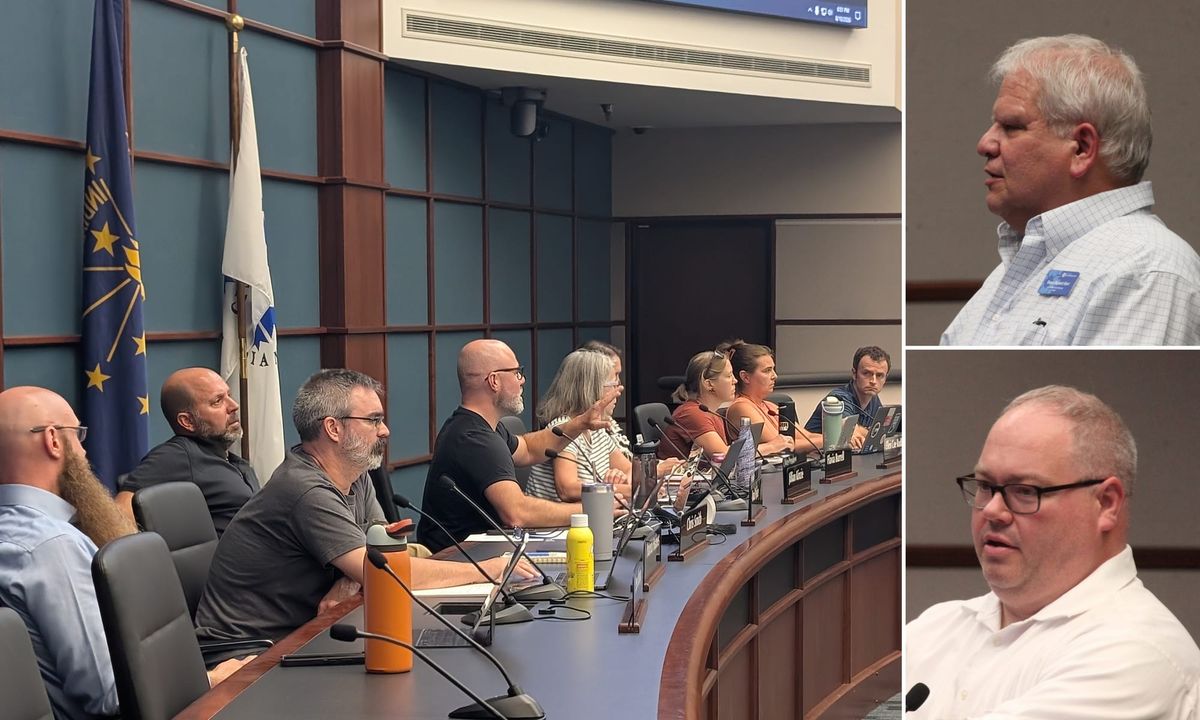
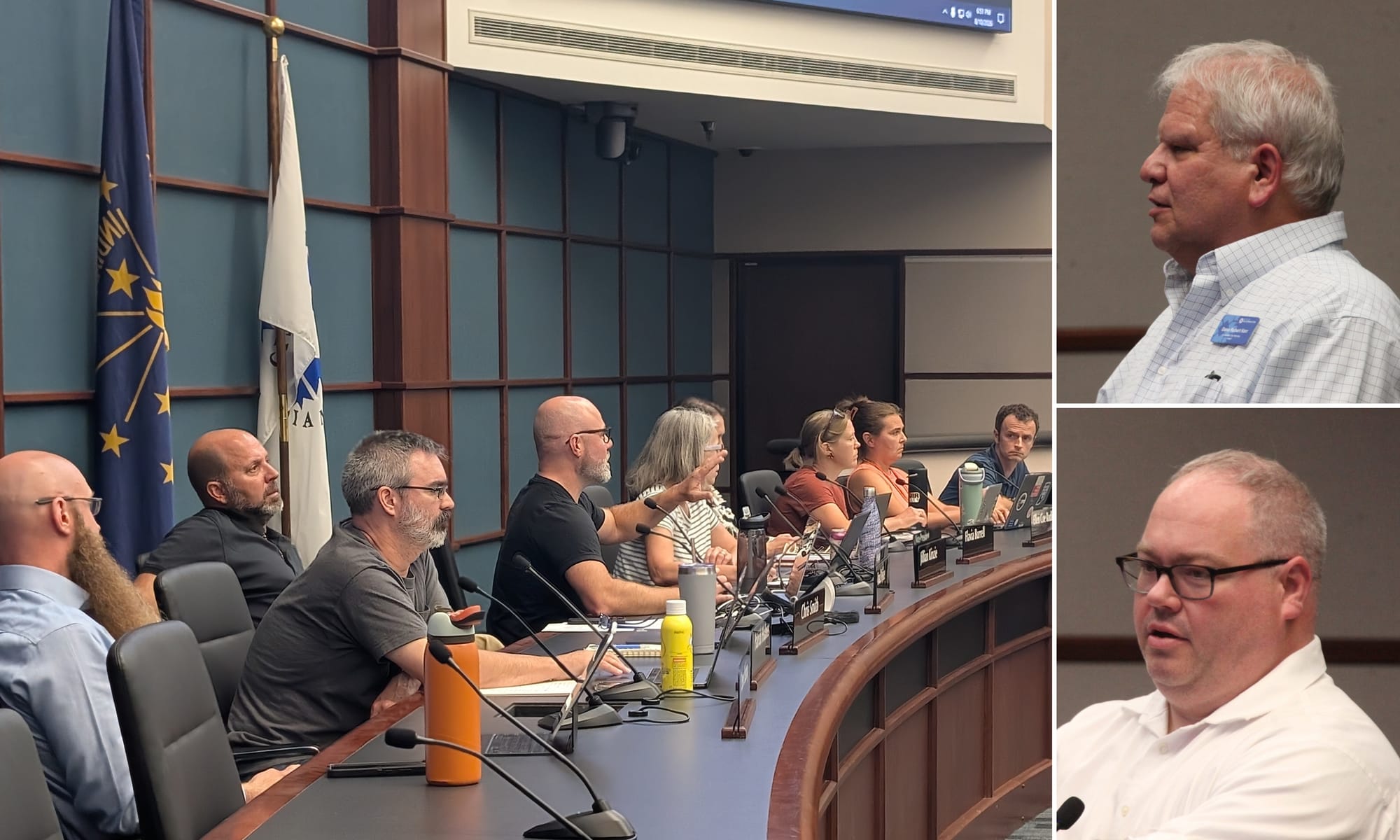
A package of changes to Bloomington’s Unified Development Ordinance (UDO) aimed at making small-scale residential development easier won a 6–2 recommendation for approval from the city’s plan commission on Monday (Aug. 10). The package includes the elimination of parking minimums.
The vote tally did not add up to 9 because Ellen Rodkey had to leave the meeting before it concluded.
The package will next land in front of Bloomington’s city council.
But the plan commission’s action came after an unusually stark disagreement between two attorneys over not just one of the proposed changes, but also part of Bloomington’s existing zoning law.
Assistant city attorney Dana Kerr told commissioners that a proposed electrification requirement for developments using the city’s sustainability incentives would violate Indiana state law and wrote a memo supporting that position.
When Hopi Stosberg, who is the city council’s representative on the plan commission, pressed Kerr on the similarity of his reasoning to existing affordable-housing incentives in Bloomington’s UDO, Kerr went further: In his view, those existing UDO provisions are also contrary to state law.
“The affordability provisions that are in the UDO, looking at them fresh, would not be allowed either,” Kerr told the commission.
Interim city council attorney Larry Allen then gave commissioners the opposite legal interpretation. On affordable housing, Allen pointed to IC 36-1-24.2-4, which generally restricts local regulation of housing affordability.
But in the law’s own wording, it explicitly says the law doesn’t prevent a property owner from “voluntarily” agreeing to an affordability requirement “in exchange for incentives or grants provided by the county or municipality to the owner of the privately owned real property.”
“It’s explicitly in the statute,” Allen said. “You don’t need additional case law.” Allen likewise disagreed with Kerr’s reading of the state law governing energy sources.
The council had initiated the UDO amendments in May through its authority under Indiana’s state zoning code.
The package includes substantial reductions in minimum lot sizes and widths in residential zoning districts, smaller setbacks and other changes intended to make development of small lots easier. For example, the R1 minimum lot area would fall from 20,000 square feet to 7,200; R2 from 7,200 to 5,000; and R3 and R4 to 2,500 square feet. The RM and RH multifamily districts would have no minimum lot area. Minimum lot widths would also be reduced substantially.
City development services manager Eric Greulich told commissioners the changes are intended to remove barriers to incremental housing construction. For example, they allow someone with a large lot to split off part of a yard to build another house. He cautioned that Bloomington’s already-built environment means the changes probably will not produce redevelopment everywhere.
“We’re again trying to move the needle a little bit, make it easier, reduce some of the burdens, some of the barriers to people achieving new housing within the community,” Greulich said.
Legal dispute over electrification, existing affordability rules
Planning staff came into Monday’s meeting recommending that the commission give a negative recommendation to the electrification provisions, based on an Aug. 7 legal memo from Kerr.
The proposed wording was intended to require developments taking advantage of Bloomington’s sustainable-development incentives to rely on electricity or on-site renewable energy for significant energy needs. New PUDs would, in turn, be required to satisfy the sustainable-development incentive standards.
Kerr concluded that the proposal conflicted with IC 8-1-2-101.2, which limits local government regulation of utility service based on the source of energy.
Stosberg questioned that conclusion because the sustainability standards are incentives: A developer can build without using them. Kerr indicated that distinction did not matter. Even if participation were voluntary, he said, the UDO would still be an ordinance conditioning a governmental benefit on the developer forgoing certain energy sources.
Stosberg then drew the comparison to Bloomington’s affordable-housing incentives. State law restricts mandatory local affordable-housing requirements, but Bloomington has for years required affordability in exchange for voluntary development incentives.
That exchange prompted Kerr’s broader conclusion about the existing UDO.
Kerr said the determination that Bloomington’s affordability incentives were permissible had been made before he joined the city legal department. After examining the statute himself in connection with the electrification question, he said he had concluded that state law did not permit the existing affordability provisions, either.
Stosberg told Kerr that his interpretation “differs from every other attorney that I have encountered over the last three years.” She said multiple former and current council and city attorneys had reviewed Bloomington’s affordability incentives. Kerr said there was no case law resolving the issue one way or the other.
Allen, speaking during public comment in his capacity as interim city council attorney, disputed Kerr’s reading of both statutes.
On energy sources, Allen stressed that the statute does not prohibit every local rule involving a fuel source. It bars regulations that “prohibit” or have the effect of prohibiting utility service based on energy source. If a developer can simply decline the sustainability incentive and proceed with a project using natural gas, Allen argued, the incentive does not prohibit natural gas service.
Allen said the affordable-housing statute reinforced that interpretation, because in that statute the state legislature expressly allowed property owners to agree to voluntary affordability requirements in exchange for local incentives.
The commission did not resolve that legal disagreement on Monday. But Stosberg proposed rewriting the electrification clause, to change the focus from the “service” which is the topic of state law, and to focus instead on building design.
Rather than say qualifying developments must “only be served by electricity or on-site renewable energy sources,” the amended provision says developments must “only include buildings designed to use” electricity or on-site renewable sources for significant energy needs.
Stosberg said the new wording more closely reflected the council resolution and acknowledged that “the legal question is potentially still out there.” The commission unanimously approved Stosberg’s proposed wording change.
Other amendments: Impervious surface, bicycle parking
The commission made three other amendments before sending the package to the city council.
At commissioner Chris Smith’s request, the commission changed standards for the mixed-use neighborhood-scale (MN) and mixed-use medium-scale (MM) districts to allow maximum impervious surface coverage of 70%, paired with a 30% minimum landscaped area. Smith said that those districts, which often border core residential neighborhoods, should not be more restrictive than the neighborhoods themselves in ways that frustrate development.
The commission also went beyond planning staff’s interpretation of the council’s direction in its resolution to eliminate minimum parking requirements. Staff had treated that wording in the council’s resolution as applying to motor vehicles.
On an amendment proposed by commissioner Bishop, the commission also eliminated minimum bicycle-parking requirements. The amendment to eliminate bicycle parking minimums passed with the bare minimum of five votes of support.
Stosberg opposed eliminating bicycle parking minimums on the grounds that the council’s resolution to eliminate minimum parking requirements was aimed at motor vehicle parking, not bikes, and was explicitly about enabling developments that provide little or no car parking as a way to support affordability. She argued that striking bike minimums went beyond the resolution’s intent and undercut non‑car modes the city says it wants to encourage.
Plan commissioner Steve Bishop countered that mandatory bicycle parking can impose an undue financial burden, particularly on small businesses and change‑of‑use projects, forcing them to install racks even where few or no cyclists are likely to come;. Removing the minimum requirements, Bishop said, doesn’t prevent anyone from providing bike parking, it just stops the city from compelling it.
A final amendment removed a proposed requirement that an existing lot be less than 150 feet deep before a rear lot could be created using a six-foot no-build access easement. Remaining in the proposal is the restriction that no part of a new structure be more than 150 feet from the street, unless approved otherwise by the fire department.
Earlier in the hearing, Bloomington fire marshal Jeff Yutmeyer told commissioners that the relevant fire-code concern is whether firefighters can reach all portions of the structure with their hose, not the depth of the property itself. That meant it was not crucial to be concerned with lot depth, but only with distance from the street.
Final remarks
When the amendments were finished, commissioner Jillian Kinzie moved to send the entire package to the city council with a positive recommendation.
“We’ve been asked to move on this by council,” Kinzie said, adding that councilmembers could make further changes when the legislation reaches them.
Plan commission president Brad Wisler said he would vote to send the package forward, but expressed a view opposing incentives on policy grounds, as he often has previously. Wisler remains critical of using sustainability requirements as the price developers have to pay for additional density. On Monday, he said, “If we want prices to come down, if we want things to be affordable, we should just make it easy to build more dense housing,” Wisler said, rather than making developers “jump through a bunch of hoops.”
The final vote was 6–2. Voting in favor were: Steve Bishop, Andrew Cibor, Jillian Kinzie, Christ Smith, Hopi Stosberg and Brad Wisler. Opposing the positive recommendation were Flavia Burrell and Patrick Holmes.


Comments ()