
Point of contention for Monroe County commissioner candidates: Listening versus results
At a League of Women Voters forum, Democratic commissioner candidates Trent Deckard and David Henry contrasted styles—collaboration versus results—while debating vote centers, a new jail site, ICE cooperation, and restoring public trust in county government.
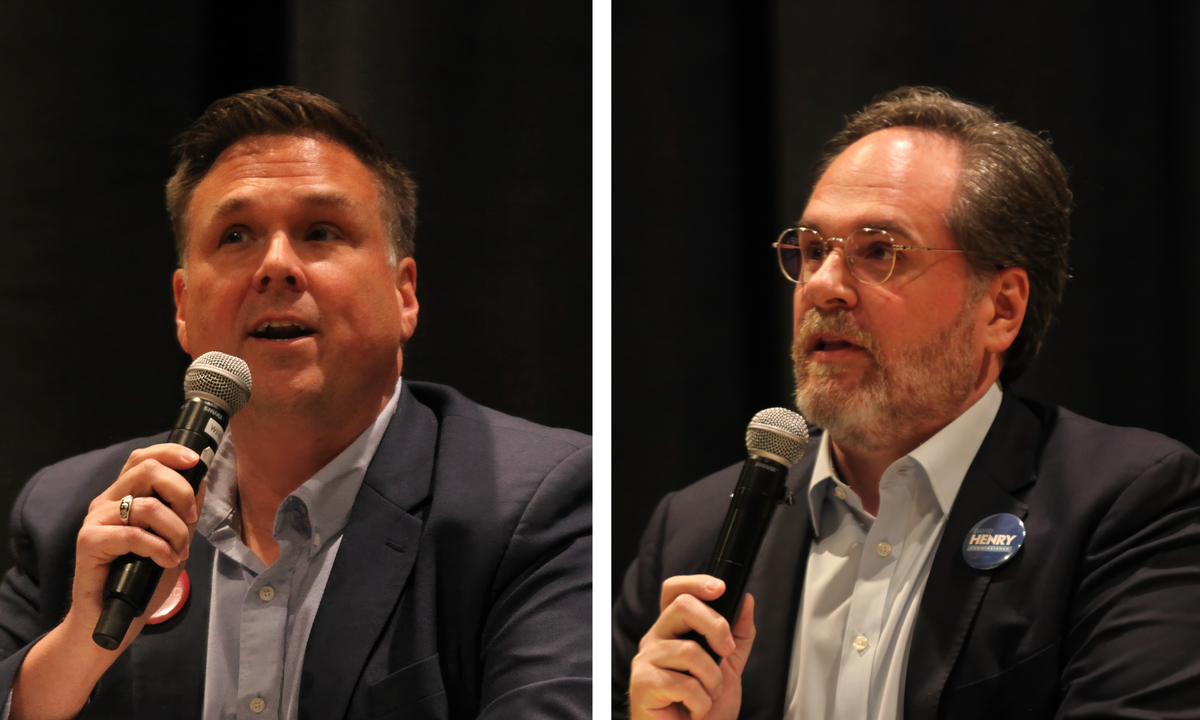
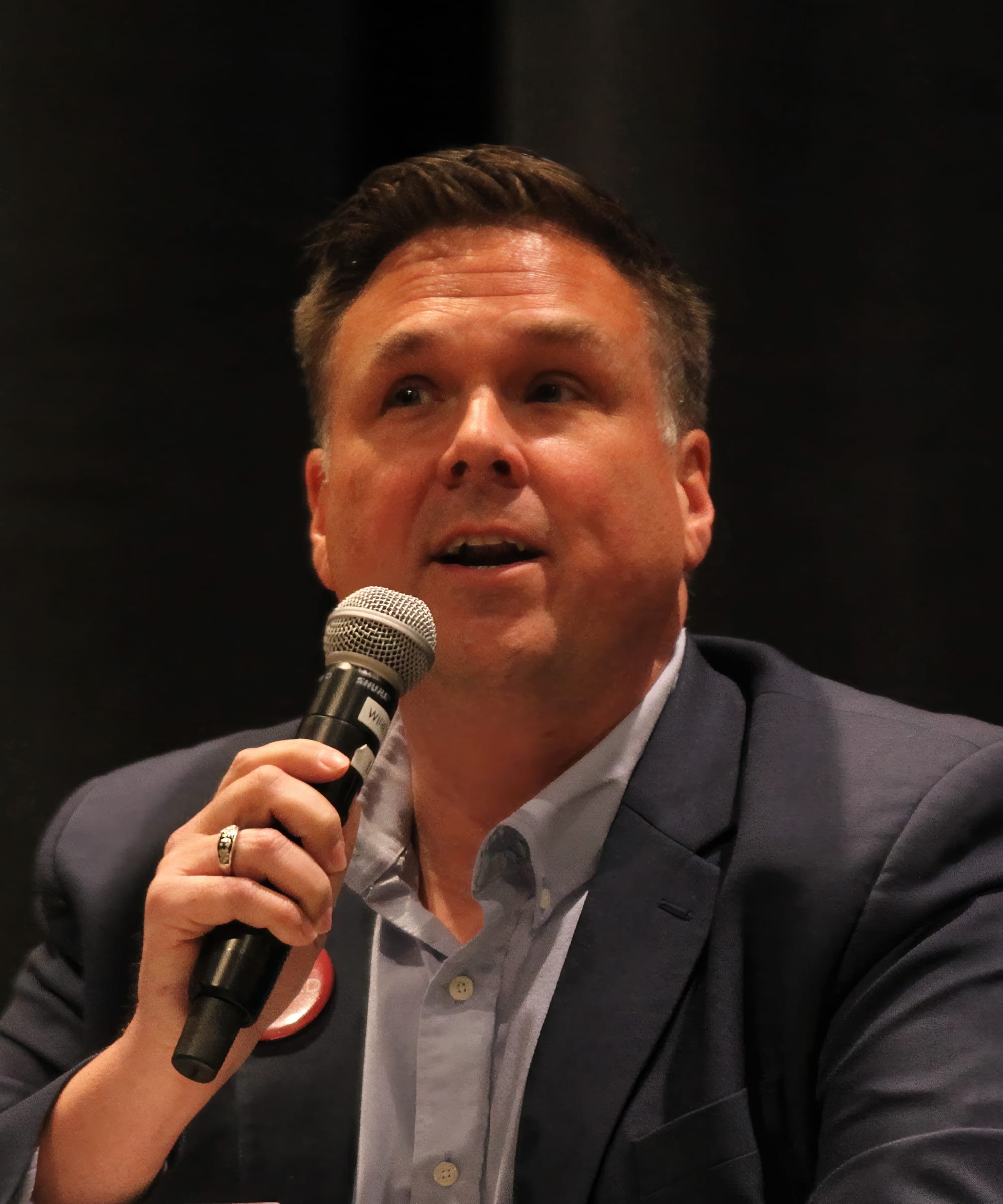
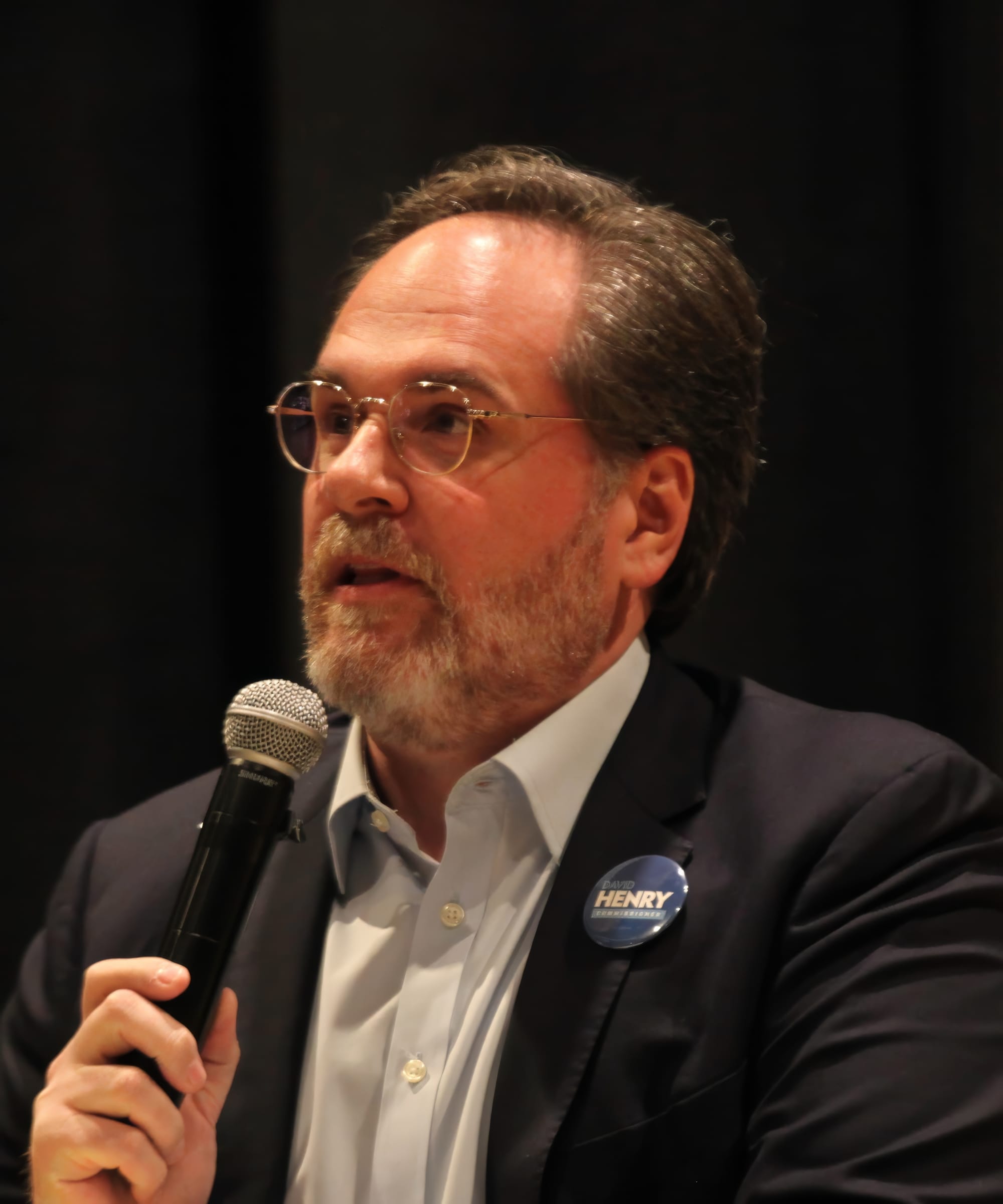
Left: Trent Deckard. Right: David Henry. (Dave Askins, March 23, 2026)
At a forum hosted Monday night (March 23) by the League of Women voters, Trent Deckard and David Henry fielded questions on topics ranging from how they’ve handled bipartisan work on elections and vote centers, to their plans for a new jail and criminal justice reform, affordable housing and economic development, cooperation with ICE and protection of civil rights, and public trust in county government.
The two are candidates for the Democratic Party’s nomination for Monroe County commissioner, District 1. The pair of Democrats currently serve together on the seven-member county council, as at-large representatives.
The forum took place at Tri-North Middle School in Bloomington.
The county council is the fiscal body of the county government, while the three commissioners make up a combined legislative and executive branch.
The two were most recently elected to serve on the county council in 2024. Henry’s election that year was his first. It was Deckard’s second, after winning election in 2020, having been selected in a Democratic Party caucus in 2019 to fill the vacancy left by Lee Jones, after she won election in 2018 to the District 1 county commissioner seat. That is now the seat that Deckard and Henry are looking to win. Jones is not seeking reelection.
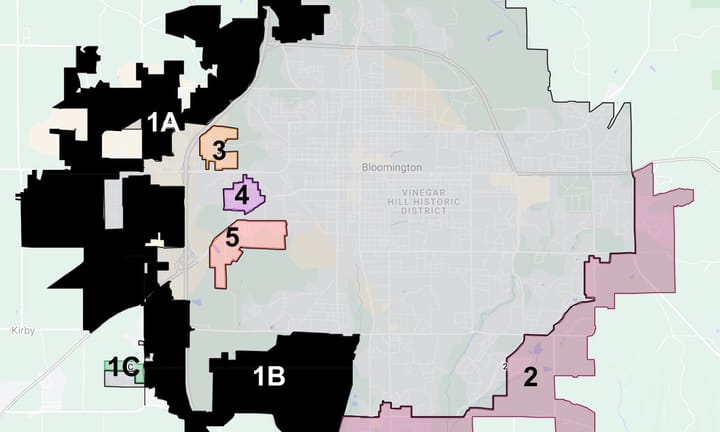
Even though candidates for the District 1 commissioner seat have to live in the geography of District 1, which is a western slice of Monroe County, all voters in the county will see Deckard and Henry on their ballots in the May 5 primary.
After an event hosted by the Democratic Socialists of America about a month ago, and again on Monday night, one big contrast between the two candidates, which has come into clear focus, is their idea of what it means to serve as elected official.
Deckard focuses on the idea of collaboration and listening; Henry focuses on the idea of bringing ideas to the table and getting results. [CATS video recording]
Listening, getting things done
Responding to a question about the planned new jail, Deckard said:
And then also, we have partners that are also in government—the city of Bloomington. We heard from their council. They want to weigh in on this. We also heard from residents that they want to weigh in. So again, I go back to collaboration. Friends, we’ve got to be very wary of “my way or the highway approaches” on how these things work, because that has put us in some of the messes that we’re in.
Or in responding to a question about affordable housing, Deckard said:
We need elected officials that can get people to the table to have the tough conversations. And when I say people at the table, I mean residents, business leaders, concerned parties, who can come to the table and then say: How do we do this and take care of your concerns? How do we do this and move forward, versus what we’ve had, friends, and that is “my way or the highway” that leads to stalemate.
Henry responded explicitly to Deckard’s attempt to paint Henry’s approach as “my way or the highway”:
I believe in listening, and as your county councilor, I’ve done it on the jail. I listened to residents to make sure we weren’t pursuing a facility that was too expensive. ... When frontline nurses sounded the alarm at the closing of our family planning clinic, I was there in paper, and demanding results and demanding accountability for why we closed that clinic in times of crisis. I’ve worked with townships to make sure we don’t forget about those less fortunate when the tornado strikes and the news has moved on, but people are still trying to get a tarp off their roof and get their houses repaired. That’s not a “my way or the highway” approach to county government.
In support of the idea that candidates for office are supposed to have proposals for solving problems, not merely pledge to listen, Henry invoked the late Charlotte Zietlow, who in her long period of public service also served in the office he and Deckard are now seeking. The allusion Henry made depends on a bit of local knowledge: Zietlow was also known for her collection of hats.
Because elections are really about ideas. We do the listening before we file for office—at least that’s the way I’ve always run campaigns since I was 16 years old, running people for judge back in Ohio. We run on ideas. This is the League of Women Voters. You know, Charlotte Zietlow didn’t run as a hat. She ran on issues. You bring your issues to the table and you put them before the public, and we vote on them to get results in our community.
Deckard’s platform, which he calls “community of care” stresses working together. That platform means “that we take experience, we take the elected officials that we have, and we work together in a collaborative fashion to get things done,” Deckard said.
Voting for him, Deckard said, gives you a county commissioner who “listens, works together and really loves and cares for all this…”
Responding to a question about how the candidates would make people more confident in county government, Deckard said, about the attitude voters have towards government: “They think we fight too much, that we don’t get enough done.” He added, “It’s probably time for us to reflect on how things get done by us being more collaborative and trying to figure out, how do we get more people in the room so we can get these hard things discussed and figure out ways that we can move forward together?”
Henry pushed back on the idea of collaboration for collaboration’s sake calling it “just a tool in the toolkit.” Henry added, “In a primary [election] it should be about results. Are we delivering results in our community, or is it four more years of collaboration and listening sessions?”
Vote centers: A resolution not considered
Henry used the first question of the night to question Deckard’s support of vote centers. On an unsuccessful election board vote taken a little less than a year ago, Monroe County failed to adopt vote centers.
The question asked the candidates to talk about an occasion when they had worked with people on opposite sides.
The vignette Henry chose involved the partisan challenge of achieving a unanimous vote of the county election board, which is required in order establish vote centers—which are polling locations in the county where any voter registered in the county can cast a ballot. That’s different from the precinct-based polling locations still used by Monroe County and a minority of other counties in the state.
The election board’s vote on establishing vote centers had two votes in mid-May last year, but not the third one, from the Republican Party appointee, so it failed the requirement that it be unanimous. Henry described his own role in mid-2023, when he was Monroe County Democratic party chair and a member of the county election board, when it voted to establish a vote center study committee. The committee is a part of the required process for establishing vote centers.
At Monday’s forum, Henry described the effort on vote centers like this: “That required a lot of negotiation. It required setting up a truly bipartisan committee of experts on both sides of the aisle and independent voters in the community, including with the League [of Women Voters], to help inform that plan.” Henry also said, “That required a lot of work with our Republican colleagues. In fact, we had the vote to move forward on vote centers for the county, with the Republican vote on that committee, Judge [Judith] Benckart was very much in favor of that, as well as myself and my successor, John Fernandez, on the election board.”
When Benckart, the Republican appointee, stepped down towards the end of 2024, then GOP chair William Ellis, appointed John Arnold to the election board, who in early 2025 stated he would not be supporting vote centers. When new GOP chair Cory Grass was elected in early March 2025, he appointed Danny Shields, who cast the crucial vote against vote centers a few months later.
Henry said Monday night that a missing piece of support in the early effort was a county council resolution. Deckard served part of the council leadership as president pro tem in 2023 and as president in 2024. Henry put it like this: “We had the Republican vote, I didn’t necessarily have the council’s vote at the time—the resolution was never brought forward by the council president.” Henry added, “I think that’s unfortunate.”
It was on June 28, 2023, a few days ahead of the election board’s vote to establish a vote center study committee, that the county commissioners voted on a resolution in support of vote centers. A day before that, the county council considered, but did not vote on such a resolution.
County commissioner Julie Thomas expressed her disappointment that the county council had not taken a vote the night before. Thomas put it like this: “I really hope that [the change to vote centers] happens. And the sooner the better.” She added, “I was unhappy that the council didn’t go ahead and vote last night on this, because I hope it doesn’t delay the process.”
At the county council’s meeting on June 27, 2023, Deckard said about the resolution in support of vote centers, that it was worded to mean that the council would not have another chance to weigh in, once the actual plan was put together. Deckard said, “The way I read the resolution that’s prepared, this body would vote, and then we are done voting. For that reason, I don’t think we should vote on this tonight.”
On that occasion nearly three years ago, Deckard wanted to see more detail about the proposal for Monroe County, drawing analogy to an exercise plan: “If I’m starting an exercise plan, and the exercise plan includes that you’re going to lay on the couch and eat Cresent donuts all day, which would be fun, right? But not necessarily what some people wouldn’t define as an exercise plan ...”
At Monday’s forum, Deckard went second on the question, and took the general topic Henry had introduced as a way to talk about his own work across the aisle on vote centers. Deckard recalled when he had served as the Democrat co-director of the state’s election division, where “literally everything they do” needs bipartisan support.
Deckard talked about vote centers in the context of his work in the state election division, saying that it was around that time when vote centers were first conceived. “I actually was the voice on that, that talked to counties how we responsibly adopt those, so that you can be guaranteed that your distance to a voting location is not extreme or burdensome.” Deckard continued, “Republicans at that time wanted to let vote centers run wild. He added, “I support vote centers here, as long as we’re keeping existing polling places and access doesn’t go away.”
Answering the question from the moderator, Deckard said that serving on the county council means working with the sole Republican councilor, Marty Hawk. “While I don’t always agree with her a lot of the time, she definitely is a commanding presence, and you have to work with her in that role in a variety of different subjects.”
Location of new jail
Monroe County’s search for a new jail site has stretched for years, driven by a 2008 ACLU lawsuit over overcrowding and a consensus that the current facility is “failing.” After evaluating several locations—including Fullerton Pike, Hopewell, Vernal Pike, and the Thomson PUD—officials settled on North Park, with both commissioners and the county council approving a purchase agreement in 2024.
But in late October 2025, the county council cast a pivotal 0–7 vote rejecting the appropriation needed to buy the North Park site, effectively killing that location and leaving the project without a clear path forward.
On Monday, one question put to the candidates was: What would be the ideal location for a new jail? Henry went first, joking, “At Trent’s house, that’s where it should go!”
He then gave his serious answer: “It needs to stay in the city limits of Bloomington. It needs to be close to service providers and people that can help with keeping people out instead of in, and making sure they’re close to services.” Henry added, “It’s a civil rights [issue] and making sure we’re not over spending taxpayer dollars to build a palace instead of answering the specific questions of constitutional care, of overcrowding and exercise in that facility.”
Deckard stressed shared decision‑making and tradeoffs about co‑location. “Once we’re done with the politics, we still have to get back to having a constitutional care jail, and the bottom line is, on location, it has to be a place that meets the needs of access to the facility,” Deckard said. Deckard also cautioned that if all the other components of the justice complex are not in the same location as the jail, the challenge of dealing with that lack of co-location has to be met.
Deckard said the county council had heard from the city of Bloomington’s city council with its view, as well as from residents about the best location for a jail. That teed up Deckard’s characterization of Henry’s position as uncompromising: “So again, I go back to collaboration. Friends, we’ve got to be very wary of ‘my way or the highway approaches’ on how these things work, because that has put us in some of the messes that we’re in.”
ICE, law enforcement
Candidates were asked how Monroe County should balance public safety, fiscal responsibility, and protection of families and students, if local law enforcement is asked or pressured to cooperate with ICE (U.S. Immigration and Customs Enforcement).
Deckard cited his affiliation with Indiana University—Deckard is a lecturer at Indiana University’s Kelley School of Business, “As a member of the IU Bloomington Faculty Council, I’ve been a loud voice about ICE encroachment on this campus, and frankly, friends, we said: Hell no, we don’t want that.”
Deckard said, “As long as I’m a commissioner—and I will work with any other elected official that will help me championing that—it is our job to stand at the doors… to prevent a bully from getting either a child in this school or a child in this community, or any person that wishes to make this home and otherwise has caused us no harm.”
On the topic of ICE, Henry alluded to the lawsuit that Indiana’s attorney general Todd Rokita has filed against Monroe County sheriff Ruben Marté for not assisting with immigration enforcement. In that case, the two sides have now decided to swap in amended cross motions for summary judgement for previously scheduled oral arguments on March 13. The deadline for amended motions is April 20, with responses to the other side due on May 6.
Henry said, “Every elected official—whether you’re a commissioner, a county councilor, a prosecutor, a judge, a sheriff—has taken an oath to the Constitution. Alluding specifically to the Fourth Amendment, he continued: “I took an oath of the Constitution. I’m not going to violate it for anybody.”
Henry called on the county’s legal department to get into “good trouble” because the county would be dealing with it soon. “Good trouble” is the tagline of John Lewis, the late civil rights leader and longtime U.S. congressman from Georgia. The reason the county’s lawyers need to get ready, Henry said, is that SB 76, has now has been signed into law and Indiana has an Attorney General who is seeking to harm our community with it.
SB 76 requires local units to cooperate with federal immigration enforcement and allows the attorney general to penalize noncompliant governments and employers. It expands the existing law under which the attorney general sued Marté.
Early voting starts April 7. Primary Election Day is May 5.

Comments ()