
Revised Bloomington Convention Center hotel plan collides with housing affordability crisis at Seminary Pointe apartments
Plans for a convention-center host hotel are colliding with the fate of Seminary Pointe apartments—among Bloomington’s cheapest rentals. Tenants paying $400–$700 a month face non-renewal notices as officials weigh transferring the property for hotel development.
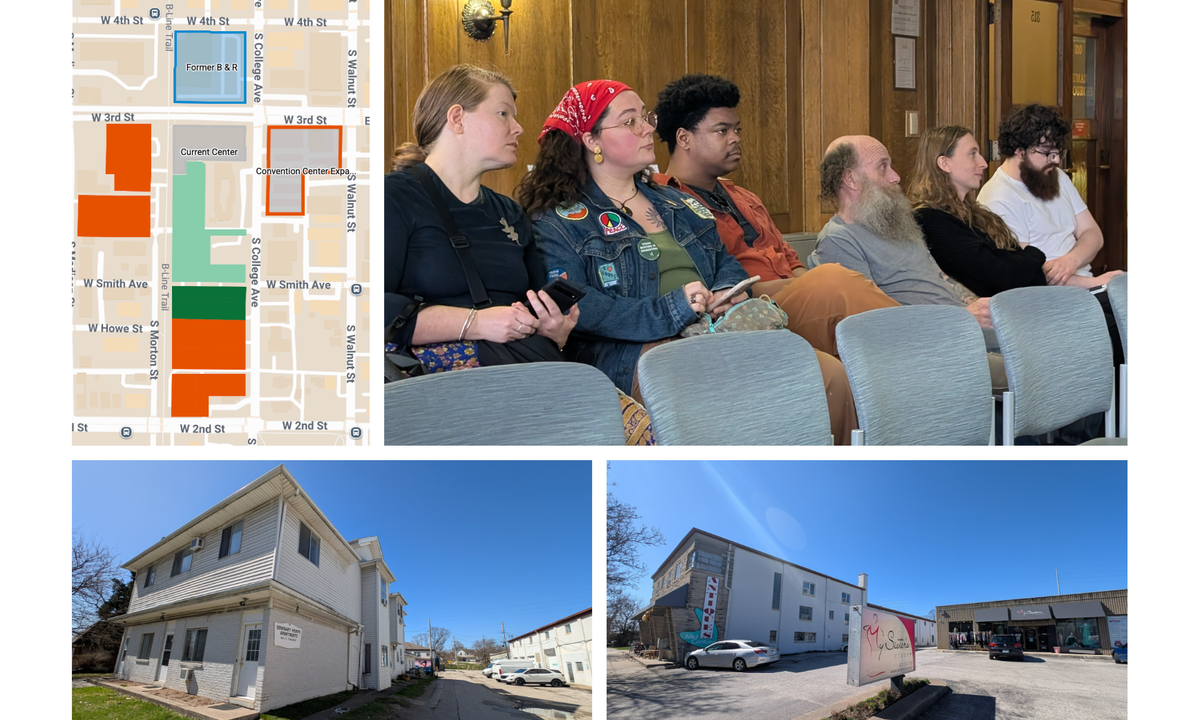
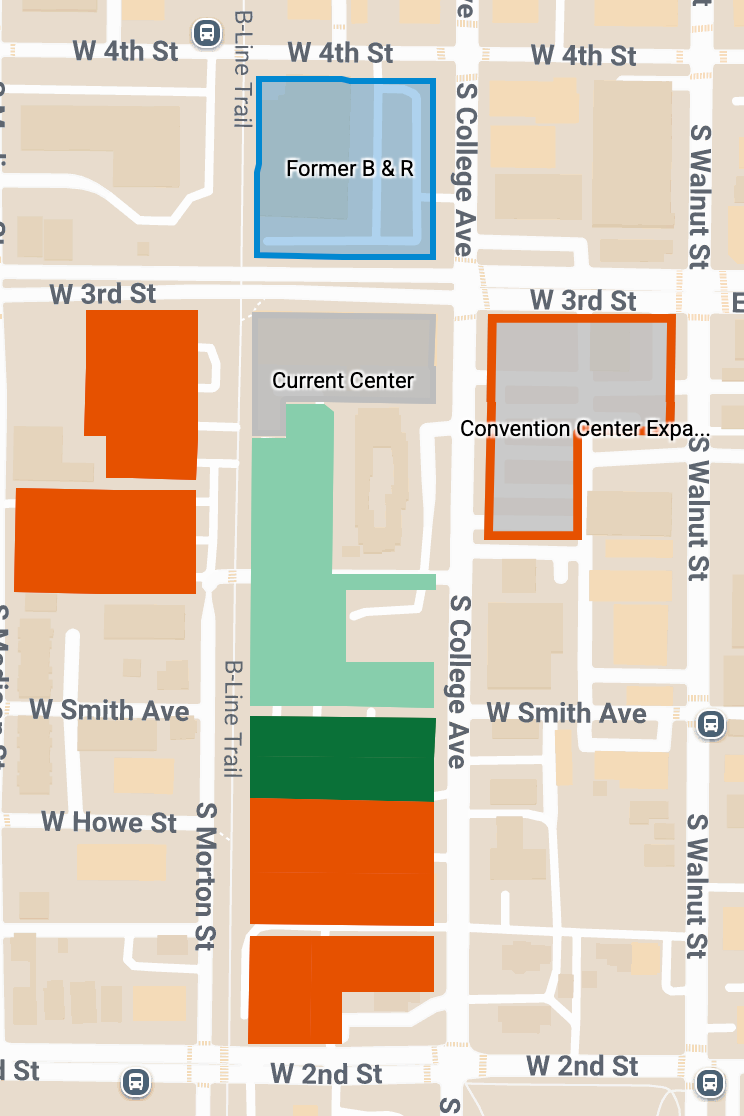
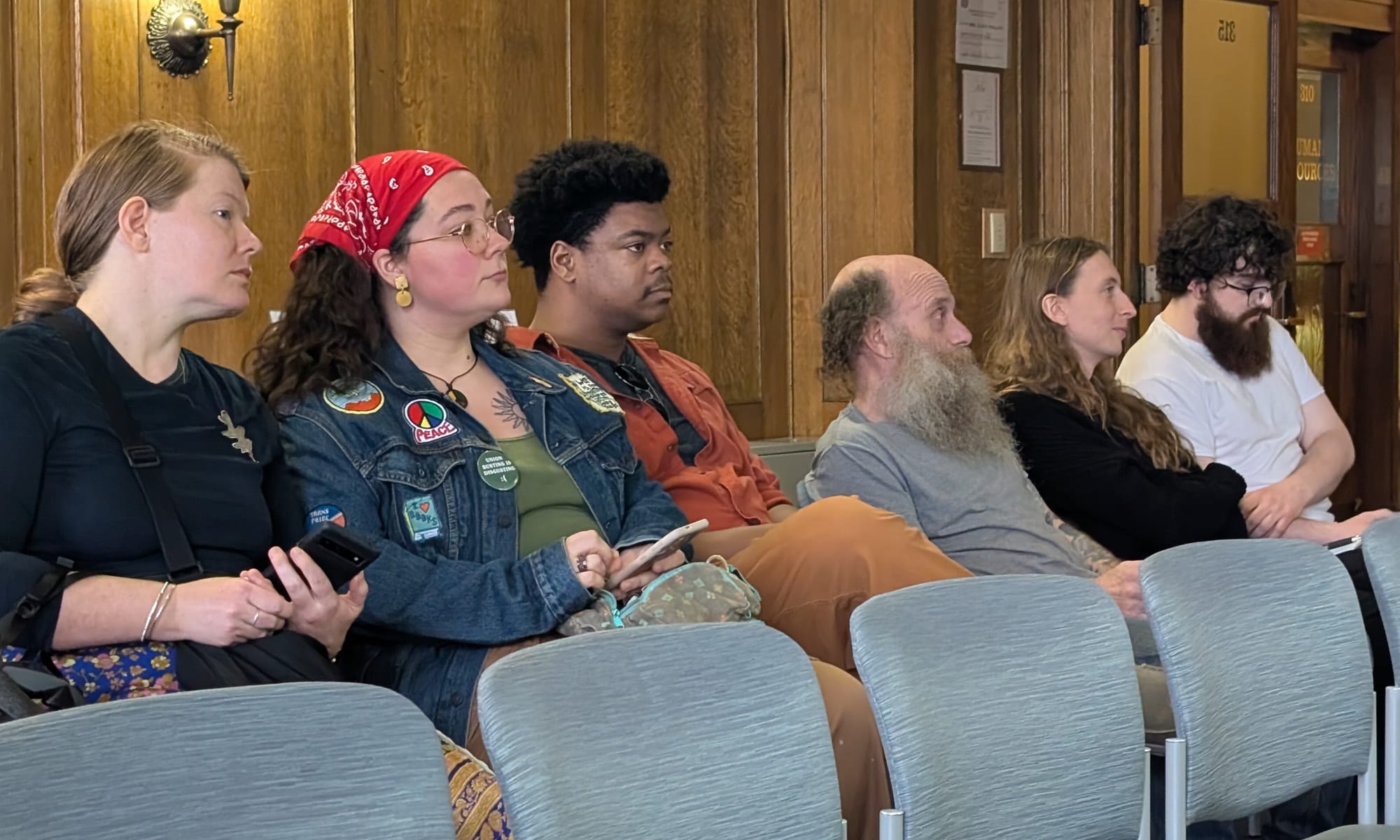
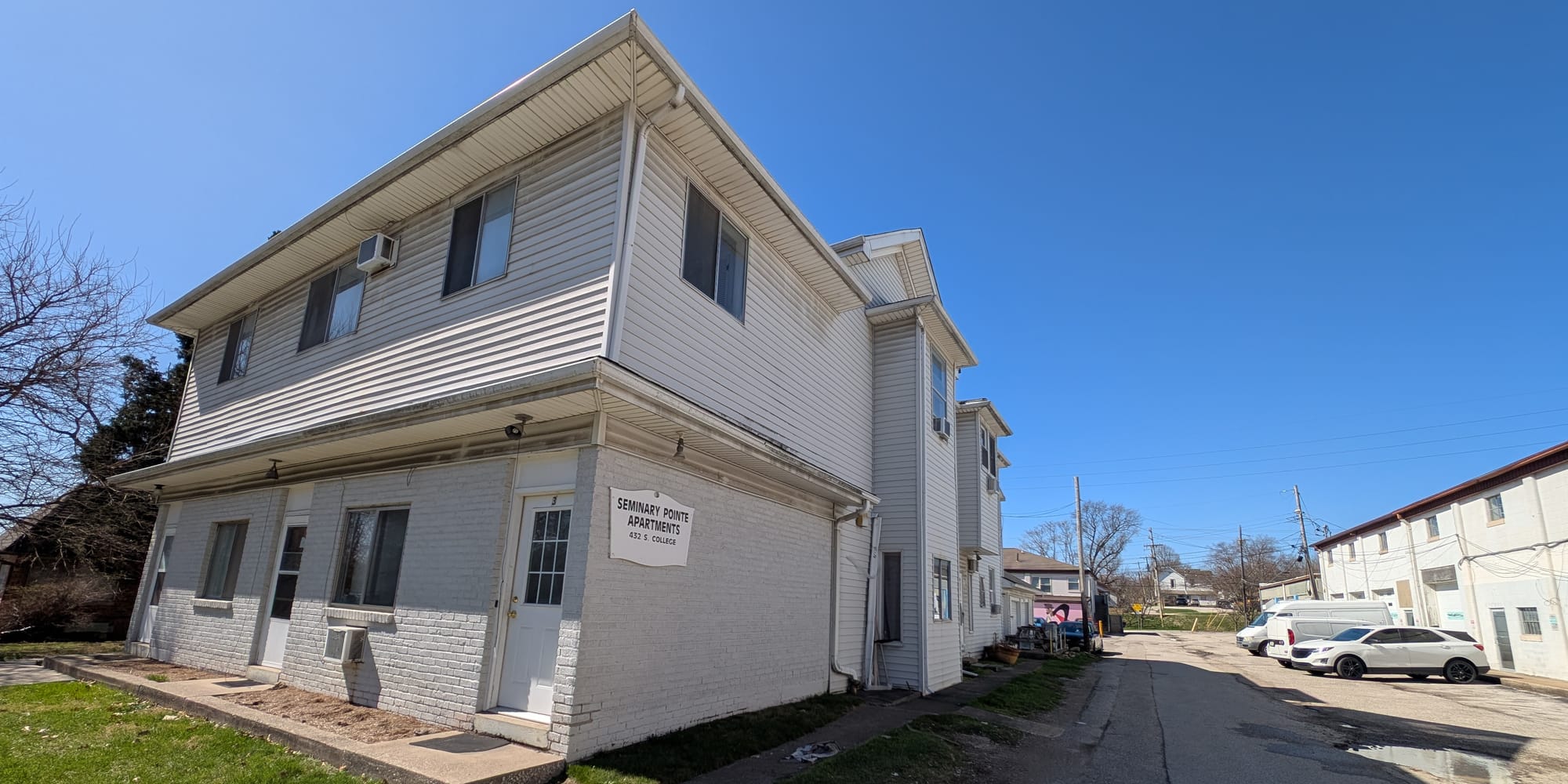
Upper Left: The area shaded blue is the former Bunger & Robertson property. The area shaded in gray with an orange border is the site of the convention center expansion—bordered orange because the Monroe County government contributed the real estate to the project. The areas shaded orange are owned by the Monroe County government. The areas shaded light or dark green are owned by the city of Bloomington. The area shaded dark green was formally accepted as a transfer from Bloomington Municipal Facilities Corporation to the Bloomington RDC at its Feb. 2, 2026 meeting. Map by the B Square. [dynamic map] Upper Right: Monroe County residents wait for their chance to address the Monroe County council from the public mic (Dave Askins, March 10, 2026) Bottom Left, Bottom Right: Apartments, commercial properties on College Avenue (Dave Askins, March 12, 2026)
Now coming into sharp relief is a clash between long-made plans for tourism development and the preservation of some rental housing that counts as the cheapest in the whole city of Bloomington.
It starts with the former Bunger & Robertson parcel, at Fourth Street and College Avenue just north of the current convention center. It’s a piece of real estate that was purchased by the city of Bloomington in two separate transactions—one in 2019 and the other in 2023.
Except for a failed year-long negotiation between the city of Bloomington and Dora Hospitality, which wrapped up in December last year, the land would have been the site of a host hotel for the new convention center expansion currently under construction.
Now, the Monroe County capital improvement board (CIB), which is overseeing the convention center expansion, is looking at alternatives for a host hotel site that could be of interest to prospective hoteliers. It’s the CIB’s job under the city-county interlocal agreement, to select a hotelier. In mid-February, the CIB asked the county and city governments to transfer real estate south and west of the current convention center for use as a host hotel site. It is land that both local governments have agreed to contribute to the project at no cost.
The idea of using the real estate to support the convention center has been long in the works. The county’s land was purchased for $2.5 million in 2010 with proceeds from the 5% innkeeper’s tax, which comes with it a requirement that the land support tourism in some way.
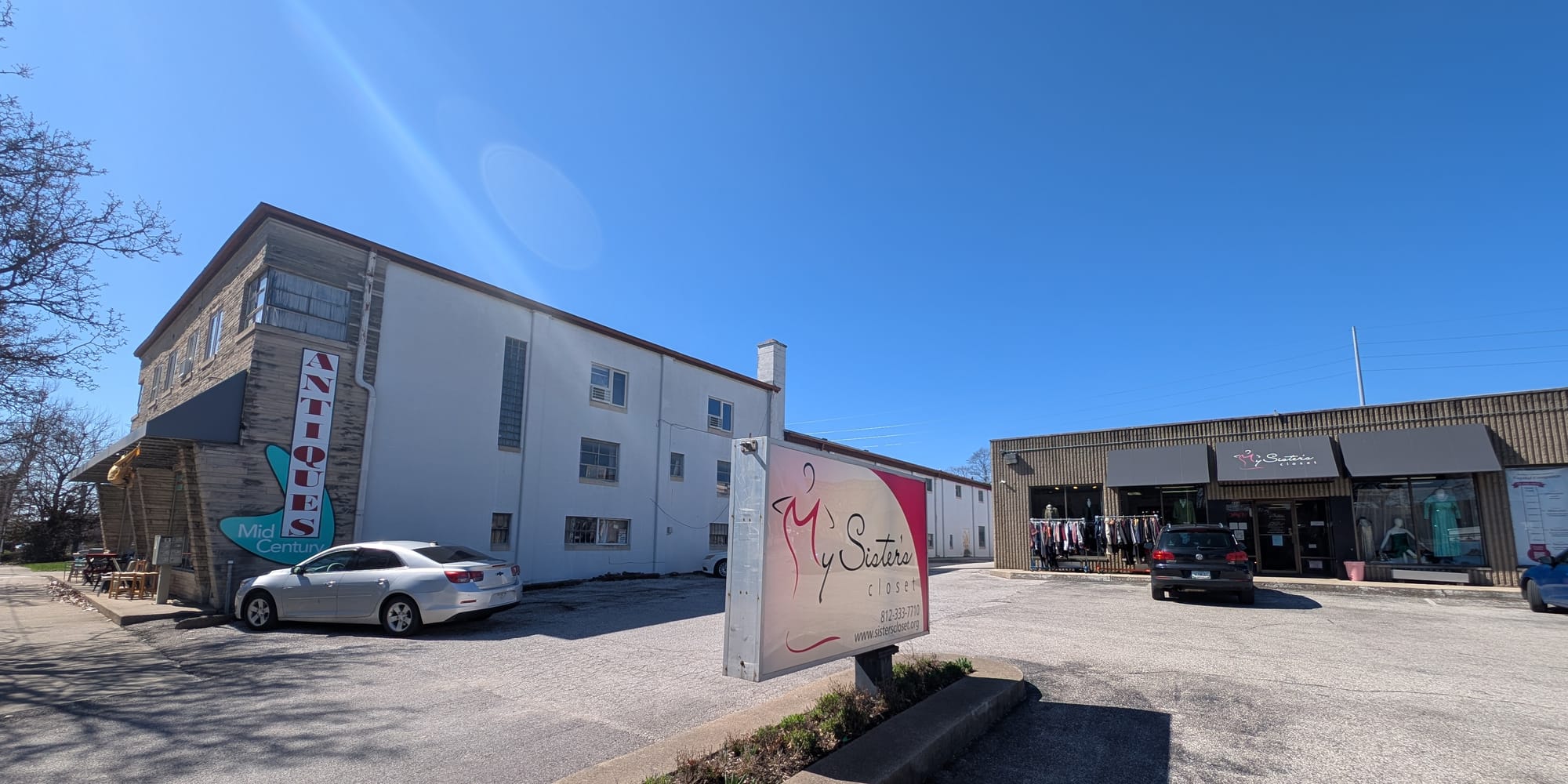
The site of the southernmost property, at 2nd Street and College Avenue, which is now owned by the county commissioners, includes buildings with 29 residential housing units, including Seminary Pointe. The rents there are reportedly in the range of $400 to $700 a month. One resident told The B Square he now pays $600 a month for his studio apartment, after previously paying $655 in another building for a two-bedroom unit.
Not long after the CIB requested transfer of the property from the county government, letters were sent to tenants, telling them that their leases, which run through July 7 this year, will not be renewed. Tenants include a mix of residents and businesses, like Jeff’s Warehouse, My Sister’s Closet, Friendly Beasts, and Bluetip Billiards.
Residents of the apartments now face the prospect of finding some other place to live, with the extra challenge of finding something at a comparable rent anywhere in the vicinity.
The property transfer will still need the approval of the county commissioners as well as the county council, which is expected to appear on a meeting agenda in the next few weeks for each of the two groups of elected officials.
At three public meetings this week, the situation has sparked vocal opposition to the pending property transfer, starting with Tuesday’s midday convention and visitors commission meeting. That was followed the same evening by comments from the public mic at the county council’s meeting.
Finally, at the regular Thursday morning meeting of the county commissioners, a couple dozen people spoke in opposition to transferring the property to the CIB. There were calls instead for the county commissioners to transfer the property to a land trust, or some other entity that would maintain the real estate as apartments with low rents.
Framing the conflict: Housing vs. economic development
After listening to the public comments at the start of Thursday’s meeting, just before adjournment, commissioner Jody Madeira summed up the conflict. On one hand, Madeira said, the county is “far, far past the point of no return on the road to the convention center expansion,” and is bound by state law governing innkeeper’s tax revenue, and by prior assurances made to the CIB, to support the convention center expansion and a host hotel.
On the other hand, Madeira said about the Seminary Pointe apartments that the CIB now wants transferred as a potential site to offer hotel developers: “We need to be honest that these apartments aren’t just parcels on a map—they’re homes.”
She continued, “We are facing real pressure in Bloomington on housing affordability, and every loss of existing residential units matters, especially when these serve as affordable housing. So whether or not we support that transfer, we can’t ignore that reality. Economic development and housing stability must be pursued together and not in opposition.”
Madeira added, “Preserving and expanding affordable housing must remain a priority for everybody. So this means recognizing the need to replace lost units, support displaced residents, and continue investing in housing units for working people and families.”
Public commentary: People impacted by decision
Several speakers described Seminary Pointe as “the most affordable housing in Bloomington’s core,” a “lifeline” for working families, and one of the few remaining places where rents fall in the $400–$700 range.
Several said that residents had been seeking lease renewals for months without being told that nonrenewal was imminent, and only received the July 7 notice recently.
One resident was described like this from the public mic: “The man I spoke to the longest is a recovering addict. He’s also a father and a husband. He and his wife have one young child and a second one on the way.” The description continued, “I asked him what his plans are when you three [county commissioners] force him out of his home. He said: I have no idea. He told me he was laid off and that he’s just trying to stay off the street.” The description wrapped up: “This apartment was a lifeline for his family, and you are cutting his lifeline, his pregnant wife’s lifeline.”
Several speakers urged the county to transfer the Seminary Pointe property to a community land trust or to the city for permanent affordable housing, if the county no longer wants to “play landlord.”
Small business owner Toby Foster, co‑owner of Friendly Beasts Cider, which operates in the Seminary Pointe block, said his business also received the notice of a July 7 end date, after months of uncertainty about renewals. His understanding was there would be some flexibility—only to be told later that the county needed to “stick to the July 7 date.”
Greater Bloomington Chamber of Commerce president Eric Spoonmore, speaking from an economic-development perspective, acknowledged the region’s “affordable housing crisis.” Still, he cautioned against the government becoming a long-term landlord.
An implicit criticism of some past zoning decisions made by commissioners Lee Jones and Julie Thomas came from Spoonmore when called for “land use policies and zoning policies that make it easier for housing developments to be constructed in Monroe County rather than rejecting them or severely restricting them.”
From the public mic on Thursday morning, the mother-daughter pair, Mary and Sarah Moser, linked the issue to family histories of housing instability: When people do find a stable place to live, they are able to make a meaningful contribution to the community. Sarah noted that when her great‑grandparents finally found an affordable place to live here after being homeless with four young daughters, it laid the foundation for a multi‑generation local business, May’s Greenhouse.
Rebecca Stoops, with the Bloomington chapter of the Democratic Socialists of America, spoke on Thursday morning, after addressing members of the convention and visitors commission at their Tuesday meeting. Stoops told county commissioners a lot has changed since the property was purchased by the county government, with its plans to support the convention center. “We are now in a housing affordability crisis,” Stoops said.
She pled with commissioners: “Please don’t displace residents.” Like other speakers she called for transferring ownership of Seminary Pointe to the city or to a community land trust.
Back to Bunger & Robertson: Land swap?
Stoops’s suggestion of a transfer of the land to the city of Bloomington would likely not be feasible—if the idea would be to transfer it directly from the county government to the Bloomington. But an indirect path could be possible.
The idea of a land swap was floated by Bloomington city councilmember Kate Rosenbarger, at a Dec. 10, 2025 joint meeting of Bloomington’s redevelopment commission (RDC) and the city council. The RDC is the entity that technically owns the Bunger & Robertson property.
The idea would be for the county government to transfer the Seminary Point block to the CIB, which would then exchange it with the city for the former Bunger & Robertson property. The requirement that innkeeper’s tax revenue support tourism would be met in the transfer to the CIB, likewise for the transfer from the CIB to the city, because it would be in exchange for a location where a host hotel could be built.
The failed year-long negotiations between Dora Hospitality and the city of Bloomington foundered over compensation for the former Bunger & Robertson property. Even if the swap fell short of the roughly $7-million purchase price, the city would still recover at least some value for the property. And the end result would place the host hotel on the parcel widely viewed as the best site for it. The city would then have control over real estate that it could use to support affordable housing.
Responding to a B Square question about the land-swap scenario, CIB president John Whikehart said: “It’s fair to say that if we get the south/south parcels, I am hopeful that a land exchange can be considered as a win-win for both sites—a hotel on [Bunger & Robertson] as best fit and potential opportunity for affordable housing on south/south with connectivity to Hopewell.”
What are tenants supposed to do?
The current tenants are getting some support in finding a new place to land from the Monroe County Apartment Association through the efforts of its executive director, Suzanne O’Connell.
O’Connell told The B Square she would be announcing the need to find new accommodations for the impacted residents at the Thursday (March 12) MCAA luncheon.
O’Connell also said she is working with a specific landlord who wants to offer tenants alternatives to standard credit checks, flexible approaches to making deposit payments, and an open house for residents to tour available apartments.
O’Connell said she is also contacting a local moving company to see if they can offer discounted moves, especially to those residents moving to the same address on the same date.
O’Connell said some of the Seminary Pointe tenants might require additional financial assistance for the security deposit on the new lease, or financial assistance for a utility deposit. So O’Connell said she has also touched base with Mary Hamric, who is strategic partnerships director with Heading Home of South Central Indiana, to see what services the nonprofit could make available for Seminary Pointe residents.
Hamric confirmed to The B Square that Heading Home has been working with O’Connell, saying O’Connell had been “taking the lead” on the issue, adding that Heading Home is “supporting in any way we can.” Hamric said she already works closely with landlords and property managers, and keeps an updated list of available units.
Residents who have not already heard from O’Connell, might find useful resources on the Heading Home website, Hamric said. The telephone number to call for rental assistance at Heading Home is: 812-955-0538.
[Note: The reporter is married to Mary Morgan, executive director of Heading Home of South Central Indiana, the nonprofit mentioned in the article.]

Comments ()