
Ridership slide fuels Bloomington Transit strategy shift: bigger buses, route rethink
Bloomington Transit is weighing service changes after a year-long ridership slide, reflected in a 16% drop in fixed-route ridership early in 2026. Plans include deploying new articulated buses on campus routes, merging Route 13 with Route 3, and expanding microtransit options.
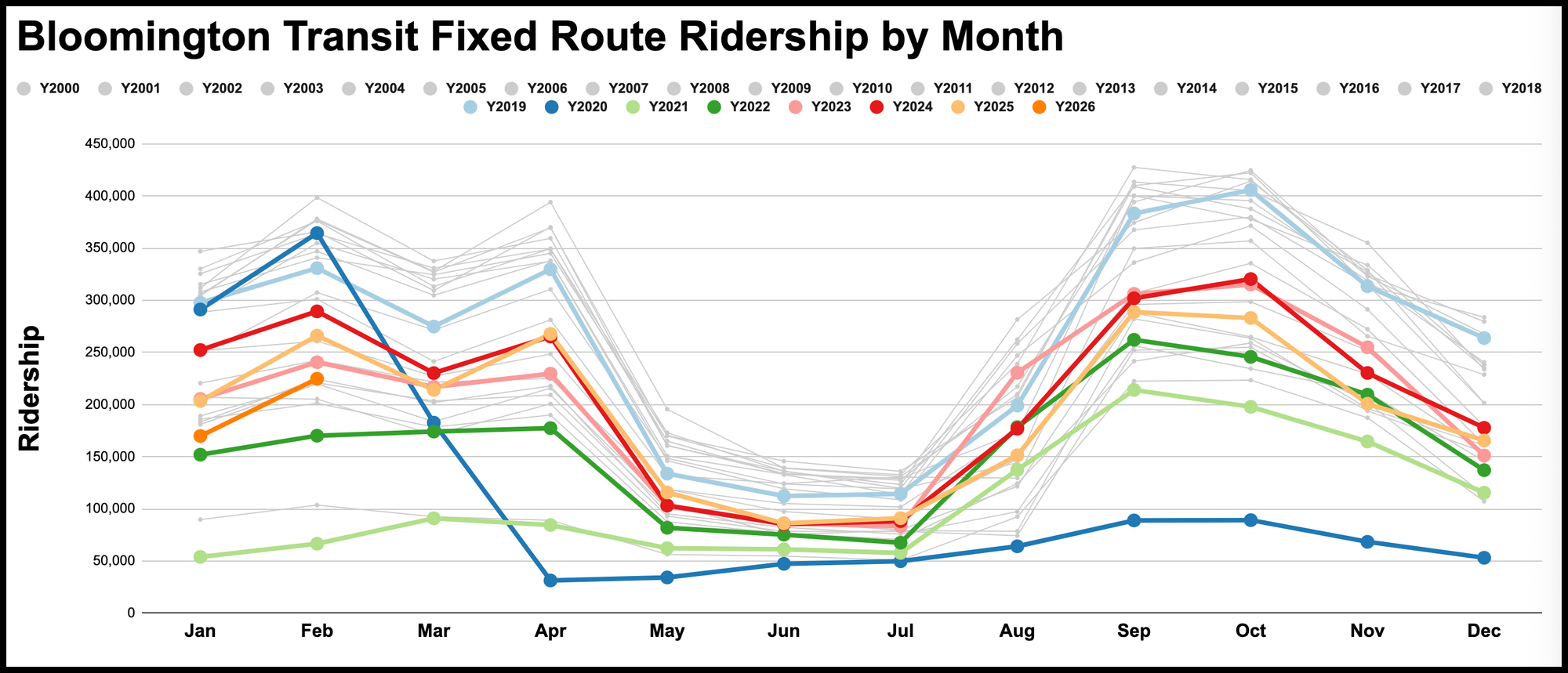
Reported at the Bloomington Transit board meeting a few weeks ago was a continued decline in ridership on BT’s fixed-route buses. There was a roughly 16% drop in February 2026 compared to February 2025, which just about matches the 16% drop measured in January.
Getting some discussion at the board’s March 24 meeting was the public transit agency’s planned response to the flagging numbers, which includes: deployment of new articulated buses on university‑oriented routes; a restructuring of Route 13, which serves employment and educational centers on the west side, outside the city limits; and revisions to the city’s microtransit (demand-response) offerings.
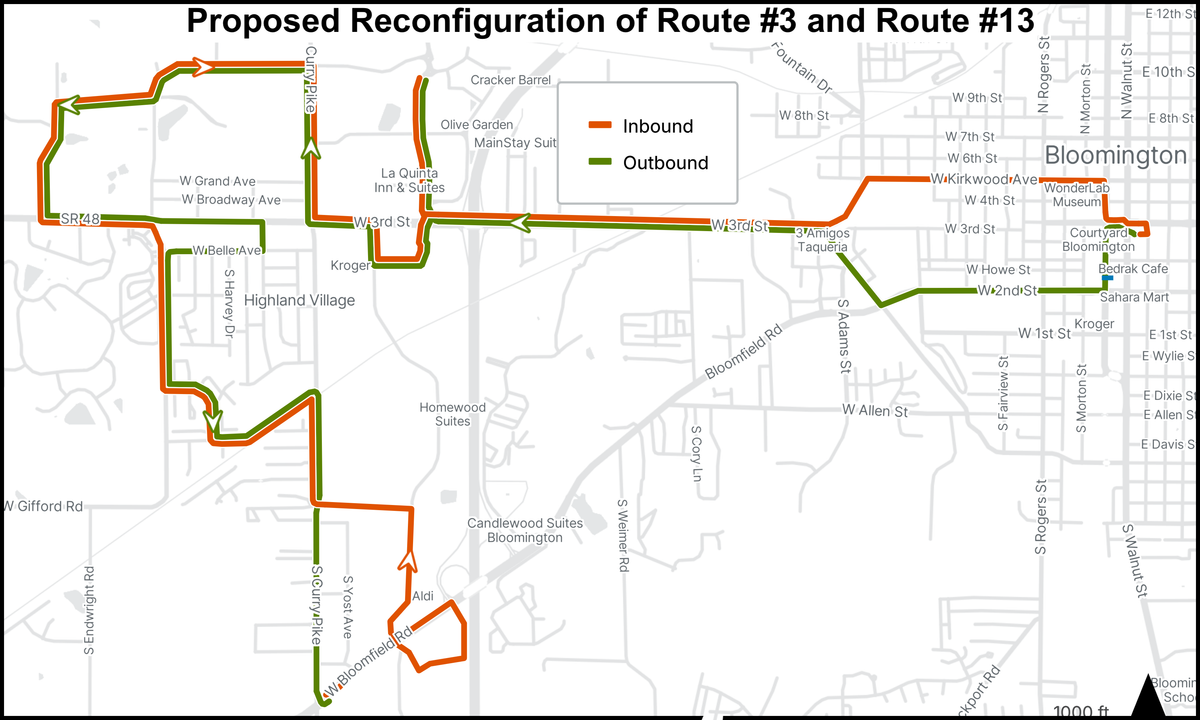
A draft plan for reconfiguring Route #13, which BT provided to The B Square, would combine it with Route #3 to make a single 90-minute loop running with three buses, making for 30-minute headways. Public meetings are planned for May 4, May 6, and May 7 to get public feedback on the proposed Route 13 changes.
Ridership decline
It was Shelley Strimaitis, BT’s planning and special projects manager, who delivered the grim news on fixed-route ridership at the board’s March 24 meeting. In January, Strimaitis said, staff partly blamed a snowstorm for some of the decline. For February, she said, there were only a couple fewer weekdays than last year, which does not come close to explaining the size of the drop.
The 16% drop so far this year, compared to 2025, continues a slide that started in 2025, when ridership was down to 2.33 million passenger trips from 2.52 million for a decline of about 7.5%.
Strimaitis said most of the raw decline is concentrated on campus routes that serve Indiana University. Apartment complexes along those lines have reported slightly lower occupancy, which appears to be a factor in decreased ridership. But the picture is complicated by a lack of capacity for service on routes that serve the university community.
General manager John Connell told the board that buses on some high‑ridership campus routes are filling to the point that operators are turning riders away at certain times of day. “Back in the good old days,” he said, BT could put extra buses out with part‑time staff.
Part of the solution: Articulated buses, microtransit
Now, the approach BT will be taking is not to add more buses, but to make the buses bigger. At the March 24 board meeting, Connell showed photos that manufacturer New Flyer had sent, of the agency’s three new 60-foot articulated buses on the assembly line, with their frames being welded together. Bloomington Transit’s regular fixed-route buses are 40 feet long. An articulated bus has an accordion-like joint in the middle to allow its extra length to bend around corners.
The buses are part of a $3.5 million contract with New Flyer. Connell told the board the vehicles are expected to be completed within six to seven weeks. They will be put into service in time for the fall 2026 semester, Connell said. Connell said for campus routes, there are times when there’s not enough space on a bus to take all the riders who are waiting at the stop.
While the articulated buses are intended to address capacity on core university routes, Bloomington Transit is also looking beyond the traditional fixed‑route network in an effort to stabilize and grow overall ridership. Connell told the board that staff have been working for several months on a comprehensive rethink of microtransit (demand-response) service, which is branded as BLink. The new approach to microtransit will be unveiled under the working banner of “Bloomington Transit for All,” Connell said.
Connell said that what is being considered for expanded micro-transit is a “walk-shed” concept for eligibility, where the microtransit service would be available for trips that have an origin or destination more than 5-minute walk from a fixed-route stop. Connell called it “all preliminary.” Connell said a detailed plan is being prepared for a board working session, along with a marketing campaign to explain the changes.
Board chair James McLary underscored his own view of where BT should be headed on the microtransit question. “I mean, there’s a reason for fixed-route, there’s a reason for articulated buses, but I think micro-transit is the future of Bloomington Transit.” BT’s recent investment in articulated buses means the agency is not looking to try to eliminate fixed-route service anytime soon.
Route 13 reconfiguration
Also getting discussion at the board’s March 24 meeting was Route 13, which runs west of the city limits and is supported by a funding agreement with Monroe County. At the March 24 meeting, board meeting gave formal approval to the county interlocal agreement, which sets a total county subsidy of $184,104. The approval of the funding on the county’s side had been delayed to the point where the BT board held a public hearing on the cancellation of the route.
Even though McLary voted for the agreement and thanked the county government for continuing to invest in BT’s first service outside the city limits, he said he is concerned that Route 13’s ridership “seems to be lacking” and that Bloomington Transit needs to do more to prove to the county that its money is well spent. The ridership figures for Route 13 show that it carries the fewest riders of any route in the system. Its riders per hour in February worked out to 3.44, when every other route except one showed double-digit numbers for that statistic.
Connell agreed that Route 13 is not performing as expected. He told the board that he, Strimaitis, and BT marketing manager Bryan Fyalkowski, have held several strategy sessions and twice met with drivers specifically about the route. Staff have looked at four different scenarios for changing patterns and service levels on the west side. The concept that has emerged would eliminate Route 13 as a standalone line and fold its coverage into Route 3, which already serves part of the area, Connell said.
On that draft plan, Route 3 would be re‑configured as a 90‑minute loop served by three buses, producing 30‑minute headways. The loop would be redrawn to ensure that the far west‑side destinations currently served by Route 13 remain covered, while providing more consistent frequency throughout the area that is served.
Since the board’s meeting, more details of the draft have started to take shape. Connell and Strimaitis told The B Square this week that the combined route will preserve existing service to Cook Medical, Tasus, and Ivy Tech, as well as Walmart. The new route would formalizes Sam’s Club as a regular, every‑trip stop, instead of the current per‑request arrangement.
An added benefit to the proposed reconfiguration is that the new route would inherit the Saturday and Sunday service from Route 3 as well as extended weekday hours. The final trip on Route #13 now is around 6 p.m. The proposed new route would run through 9 p.m.
Connell also described a planned new “guaranteed ride home program” aimed at third‑shift workers for major‑employers along the proposed newly configured route. Even if regular transit service could get them to work, they will be unlikely to take that service, if no regular service is available when they get off work. The idea of the “guaranteed ride home program” is to provide a backstop for potential late-shift transit riders.
Service changes are likely to get some air time at the next BT board meeting, which is set for April 21.


Comments ()