
Sewage backup in Monroe County justice center spurs scrutiny of future spending on ‘dying’ building
A bag of e-cigarettes flushed down a jail toilet sent sewage through the Monroe County justice building on Friday, disrupting court operations. At Tuesday’s meeting, councilors questioned why election offices were also closed and debated millions in spending for a facility described as “dying.”
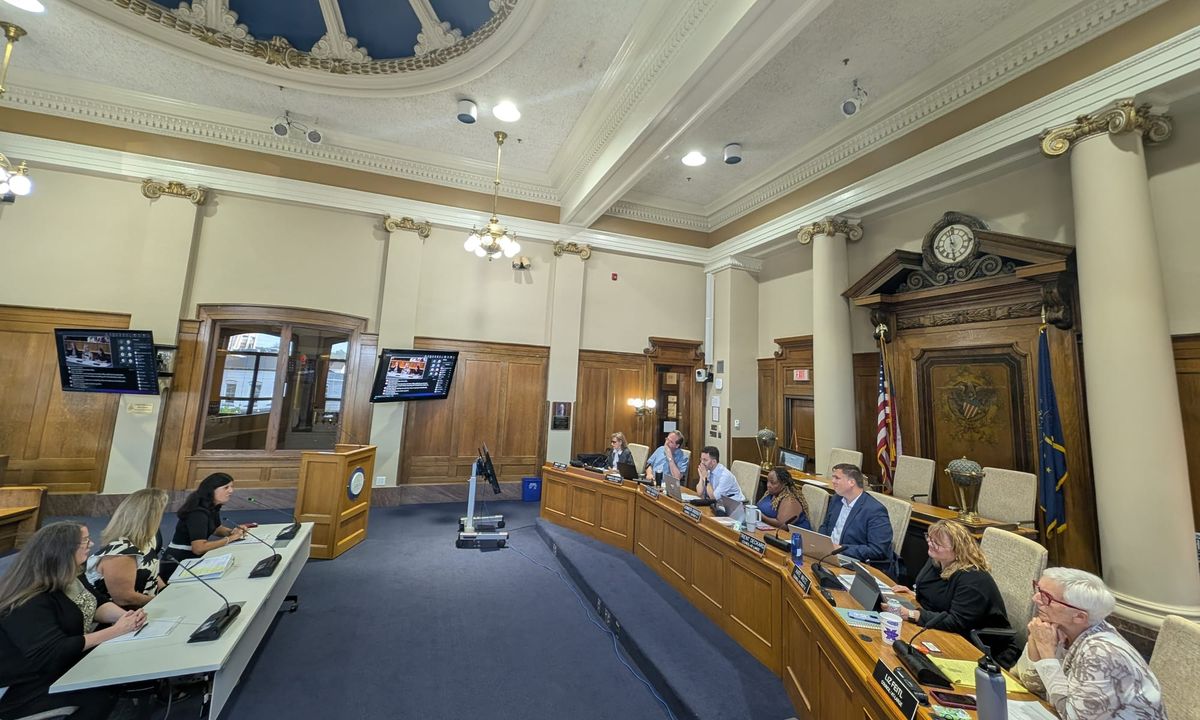
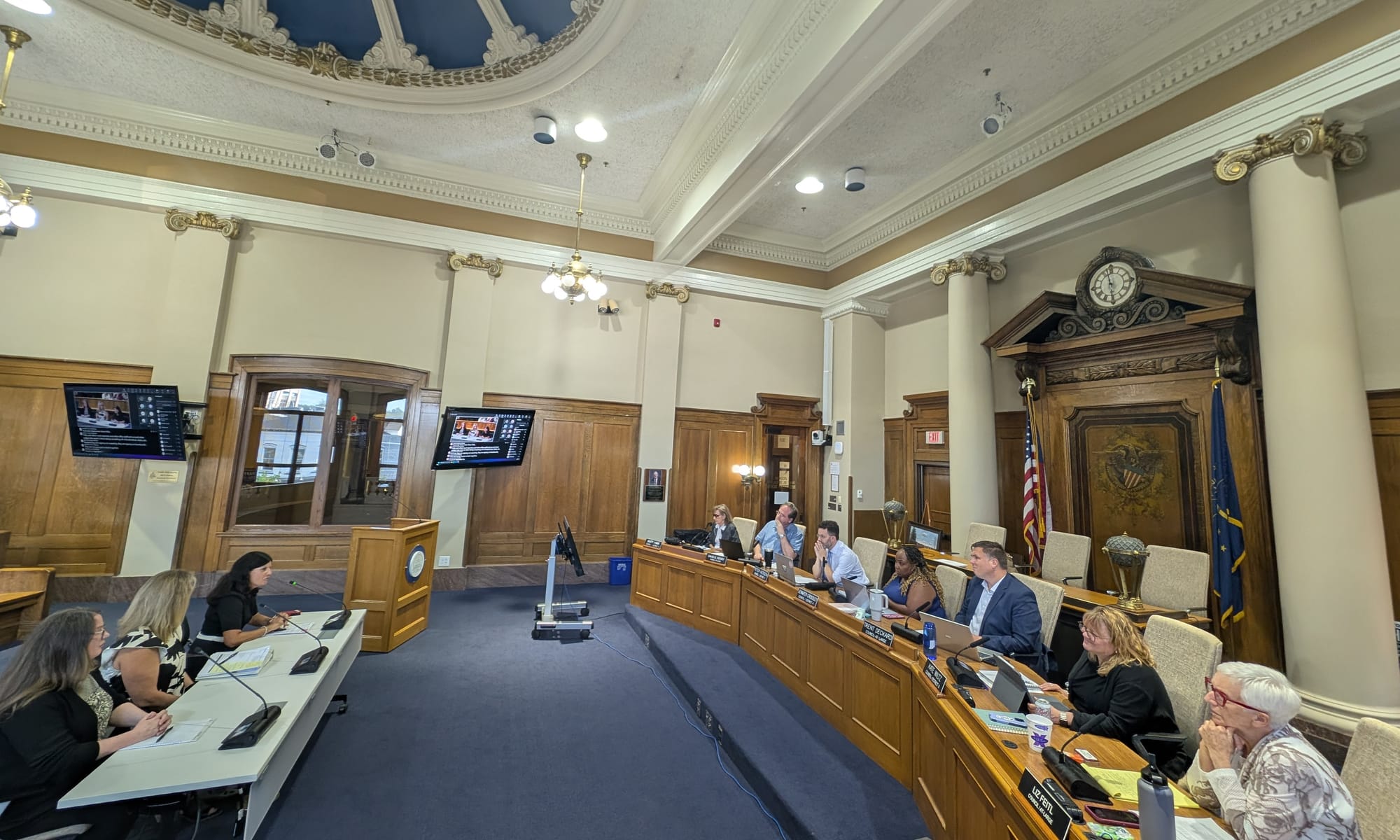
A Monroe County circuit court judge and county councilors on Tuesday (July 28) filled in graphic details about the sewage backup that forced the closure of the Charlotte Zietlow Justice Center on Friday.
The closure of the building is supposed to last at least through Wednesday.
Councilors wrestled with the idea of pouring millions more into a building that was described as “dying.”
The discussion came at Tuesday’s regular meeting of the Monroe County council, four days after a bag of e‑cigarettes flushed down a jail toilet sent wastewater cascading through ceilings and into court offices below. The jail is located on the upper two stories of the building.
Also surfacing at Tuesday’s meeting were significant concerns from councilors about a decision by the county clerk’s office to also close election division offices in the North Showers building, based on the closure of the justice building, which is a block away.
The incident has also sharpened long‑standing tension about continuing to invest in the aging justice building while planning for a new jail and possible justice complex remains incomplete. A draft list of general obligation bond projects fueled that discussion on Tuesday.
Also on Tuesday, Mary Ellen Diekhoff, who is presiding judge of Monroe County’s unified court, delivered the most vivid public account yet of the July 24 plumbing fiasco. She was in front of the council to request the filling of some vacancies during the county’s hiring freeze.
“I have been around a long time. I have seen a lot of things. This was awful,” Diekhoff told the council. “There was water just by the gallon … just spreading everywhere—and it was toilet water.” She compared the events of Friday inside the building to watching the movie “The Blob.”
Diekhoff said the flow was finally stopped only after the arrival of the county’s outside contractor for building maintenance, Dave Gardner, with ASI Facilities Services. Diekhoff said that according to Gardner, the flood would have continued if it had not been shut off.
Despite the disruption at the building, Diekhoff stressed that the courts themselves were never formally closed. That’s a step that would require a special petition to the Indiana Supreme Court.
“To close us requires the Indiana Supreme Court, but we are not fully operational because we cannot be,” Diekhoff said. “We have been on minimalistic [operations] … I was supposed to have a jury trial next week. I contacted the attorneys and told them that cannot happen because I don’t have space right now to put them.”
Probable‑cause reviews and jail releases are continuing, Diekhoff said. When the building opens back up, staff will in part work out of jury rooms and conference rooms while remediation continues.
Councilor Marty Hawk tied the failure to a basic design decision: Putting the jail above court and office space. “This is going to happen again and again as long as the jail is above the courts or the offices,” Hawk said.
Alluding to the plans for a future new jail, Hawk said, “When we get through with doing another jail, which we are going to do, do not put the courts or any offices below the jail! … Anybody who understands water goes downhill, well, you know what went with this water, and it went right down their heads, and it’s not right.”
Administrator for the county commissioners Angie Purdie told the council the immediate cause was not a random plumbing failure but an intentional act by inmates.
“The current situation was entirely intentional by inmates,” Purdie said. She described newer jail designs where staff can intercept contraband in accessible waste lines before it enters the main sewer: “The new systems have… the ability to stop items from going into the actual sewer line, and then there’s a hook that staff can use to pull out the debris, so it never becomes a problem anywhere else.”
Purdie described Friday’s clog as “like a bread sack or a commissary bag that was full of e-cigarettes.”
Why close election division offices?
Chief deputy clerk Tanner Branham appeared before the council seeking an exemption from the hiring freeze to refill a part‑time voter registration clerk position. The position had been previously approved and filled, but the new hire resigned after one day because of a family health emergency, Branham said.
Councilor Marty Hawk used the request to raise a different issue, which was the decision to close the election division and voter registration offices, in the Showers North building on Morton Street, after the justice building shutdown.
“I’m not faulting the employees because I’m sure they did what they were told, but who told them [to stay home]?” Hawk asked. She continued. “That is simply a use of county taxpayers that just went out the window, and it’s not acceptable.”
Branham told Hawk that the decision was made by the elected clerk, Nicole Browne.
About her rationale, Branham said, “We had a few voter registration people who were going to be out on vacation anyway this week.” Because the justice building was closed, there would have been no additional clerk’s staff available to help out with issues that might arise at the election division offices in North Showers, Branham said. Based on that consideration, Browne decided to go ahead and close the election division while the justice building was closed, Branham said.
Hawk rejected that reasoning. “Certainly there were folks there that could have made up whatever shortfall,” she said. “It was a very poor choice and disrespectful of the people who pay the bills around here, and that’s the people of this county.”
Councilor Liz Feitl pressed on how the time off was coded for employees and who was paid emergency time versus vacation time. County attorney Molly Turner-King clarified that employees who had already scheduled vacation would not receive emergency pay.
Hawk warned the arrangement would likely cause friction among staff: “What you’re going to find is if they get back from vacation, they took a part of their vacation day to be gone, and another person got paid emergency pay, and they didn’t have to take part of their vacation days.”
Councilors also questioned the underlying legal authority to close an office in a building that never lost its ability to function. Crossley asked Turner-King directly whether such a closure was permissible of an office in a building that was not affected by the sewage backup.
Turner King said she would need to research the question to give a more detailed answer, but said that county commissioners normally coordinate any justice building closure with the board of judges. She was not sure “how other elected officials [like the county clerk] play into that calculation.”
Councilor Trent Deckard suggested the episode exposed a broader gap in county policy on office hours and continuity of operations.
Councilor Trent Deckard urged county legal staff to look at whether commissioners could adopt an ordinance specifying minimum hours that county offices must be open to the public, so that services can continue from alternate locations when one facility is closed.
Like Deckard, councilor David Henry framed the question as one of continuity planning rather than a one‑off personnel issue. He suggested the county revisit its continuity of operations plan (COOP) to address how people in the North Showers building could have continued to work despite the closure of the justice building. Henry said it was perhaps time to “dust off some of the county’s continuity of operations plans that probably haven’t been looked at since I wrote them 20 years ago.”
General obligation bonds
The council’s more general deliberations on the justice building problems came in the context of a draft list of nearly $5.56 million in general obligation (GO) bond projects for this year, which was a discussion item on Tuesday’s agenda. The list was drafted by the county commissioners.
The finalization of the list will likely come from some back-and-forth between the council, as the county’s fiscal body, and the commissioners, as the county executive. It currently includes parks projects, emergency sirens, sheriff’s equipment, fleet vehicles and several justice-building items.
Purdie acknowledged morale among justice building employees has eroded: “They’ve lost all hope, I think … now there is just this perception of we’re stuck here, and it’s not a pleasant place.”
Purdie acknowledged the tension in asking for hundreds of thousands of dollars for jail showers, cameras and plumbing fixtures in a facility the county hopes eventually to vacate.
The discussion at Tuesday’s meeting came against the backdrop of fresh litigation, launched by the ACLU in the second week of July, over conditions at the jail.
“It is horrible to be asking … to put funds into a building that’s dying,” Purdie told the county council. But she pointed to those who still work in the building and are housed in the jail.
The $500,000 for cameras on the list are to help monitor inmates and respond appropriately, Purdie said.
Council president Jennifer Crossley pressed Purdie on the lack of a full HVAC replacement plan, calling the system “the mother of all problems.” Purdie said the administration wants outside engineers to study whether a complete replacement is feasible in a facility that is occupied 24/7.
The bond list also includes about $2 million for a new elevator at the justice building. Purdie said she understands why that request has drawn scrutiny in what she herself called a “dying” building. She noted that the elevator ranks low for commissioners on the internal priority list. [The rankings on the list are the numerals in bold, from 1 to 10, with 1 indicating the highest priority.] Crossley said she was surprised to see the elevator on the lower end of priorities ranked by the commissioners.
Councilors took no final action on the bond, agreeing instead to assign their own ranking to projects before one of their August meetings.
Henry asked his colleagues to think about the long‑term impact of fully exploiting the county’s bonding authority, which could reach around $6 million a year. “That is not a small amount of money,” he said.
Henry said he was concerned, as officials continued to discuss the building as an asset, that failing to maintain its basic structure could make it harder to sell or repurpose in the future, including rehabbing it for continued county use.
Based on the council’s discussion and remarks from county president Jennifer Crossley at Tuesday’s meeting, county councilors will assign their own rankings to items on the bond project list and send them to the council office staff. A revised list could be back for more discussion at either the Aug. 11 or Aug. 25 county council meeting.


Comments ()