
Skipped over: Bloomington city council won’t get chance to OK $500K interlocal accord on animal care, $44K deal on justice grant
Bloomington is bypassing city council review for 2 long-standing interlocal accords—on animals and JAG grants—by sending them to the state attorney general instead. The mayor’s administration says it’s easier and already OK'd. But it leaves the council without its usual public briefing on costs.
Two interlocal agreements between the city of Bloomington and Monroe County government have been familiar items on year-end Bloomington city council meeting agendas for more than a decade. But the city council won’t get a chance to review and approve them this year—because Bloomington mayor Kerry Thomson’s administration is using an option under state law to send them to the state attorney general instead.
First, there’s a long-standing agreement, renewed every year for several years, between the city of Bloomington, Monroe County government and the town of Ellettsville to provide care for animals surrendered at the city shelter. Second is another long-standing agreement, signed each year for several years, between Bloomington and Monroe County government, to share the proceeds of the Edward Byrne Memorial Justice Assistance Grant (JAG) Program.
The county government approved its side of the JAG grants in November of this year—first the county commissioners, followed by the the county council. At its Nov. 10 meeting, when the county council approved the JAG grant for a total of $44,179, county legal staff mentioned that the next step would not be the usual approval by the city council. Instead, the city administration had indicated it would be sent to the state attorney general’s office instead.
Bloomington city attorney Audrey Brittingham responded to an emailed B Square question, asking why the JAG interlocal was not being presented to the city council, by writing: “Essentially, it is administratively easier. This is particularly true at the moment—we want the JAG interlocal turned around before the end of the year, and Council has very limited availability left in 2025.”
Brittingham added: “The JAG program and the City’s participation have already been authorized through the adopted annual budget, so this is simply the administrative execution of an already approved program.”
This week, Brittingham confirmed that the same principle applies to the animal control agreement between Monroe County, the city of Bloomington and the town of Ellettsville. The animal control interlocal was approved by county commissioners on Dec. 11. Under this year’s animal control interlocal agreement, the county government will be paying the city of Bloomington around $480,000 and Ellettsville will add another roughly $37,000.
Responding to a question from the B Square, the state attorney general’s office provided a list of all the interlocal agreements that have been submitted by local jurisdictions to the AG in 2025.
Besides those submitted by Bloomington, it looks like there are just two other unique agreements—one involving the city of Elkhart, and the other involving a NEORide membership agreement. That does not answer the question: Of all the interlocal agreements that were struck in 2025, how many of them were sent to the AG’s office, instead of being handled locally? Still, it looks like the option of sending an interlocal agreement to the AG is not often used.
The impact of sending the agreements to the AG’s office instead of to the city council is that Bloomington’s fiscal body won’t get a baked-in briefing about the dollar amounts involved in the agreements this year.
For the JAG funds, the $44,179 total is split between the Monroe County government and the city of Bloomington 93% for Bloomington and 7% for Monroe County government based on the number of violent crimes in Bloomington compared to the non-Bloomington part of the county over the last three years. Monroe County will spend its $3,093 on taser cartridges. Bloomington will spend its $41,086 on portable radios.
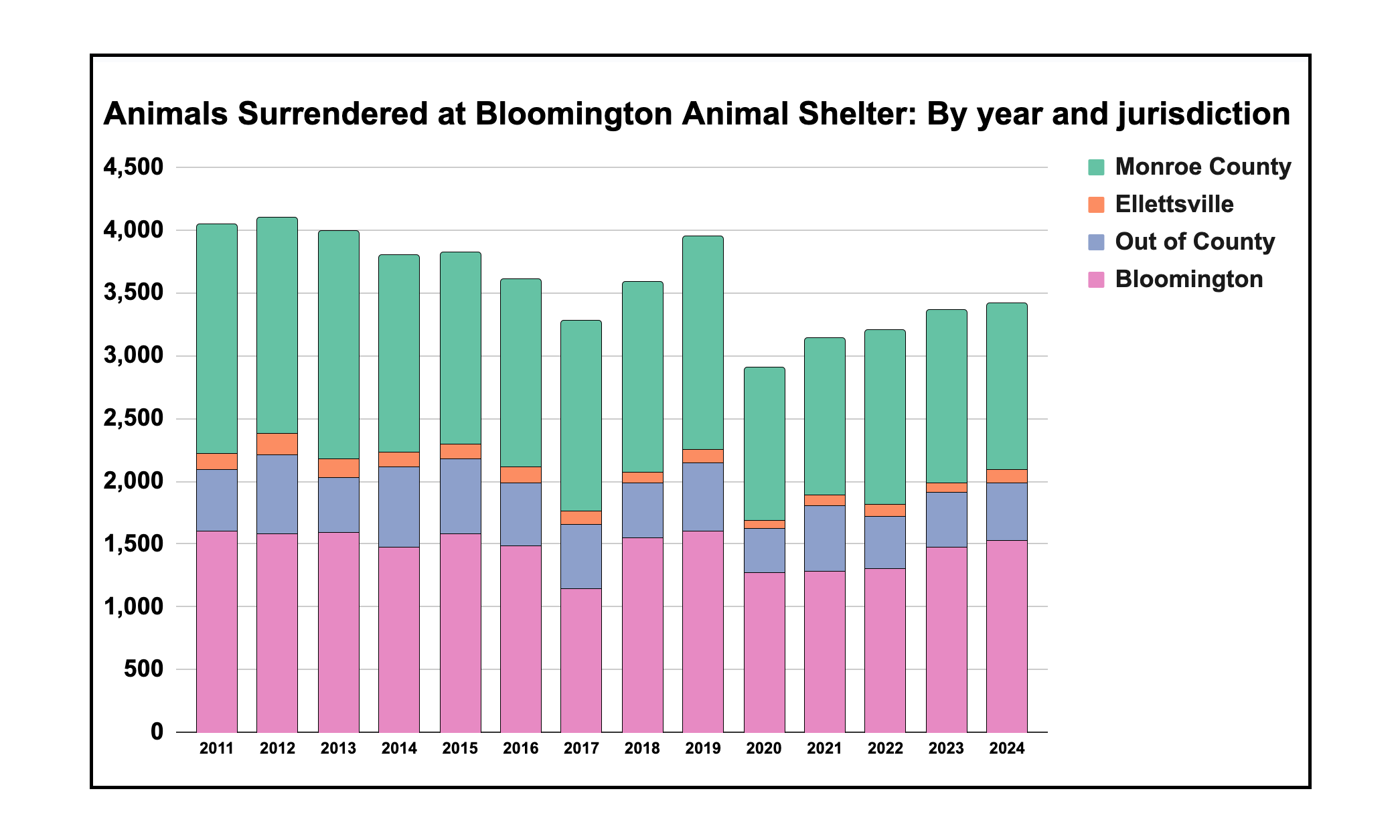
For the animal control accord, the city’s shelter calculates a cost per animal and then allocates the cost to each jurisdiction based on the number of animals from each jurisdiction. Last year, the numbers worked out like this: $433,123 from Monroe County (1,384 animals) and $23,158 from Ellettsville (74 animals). Those figures are based on a cost-per-animal of $313.
The cost-per animal in this year’s agreement has increased by 16%, to $364. That translates to $480,480 from Monroe County (1,320 animals) and $37,492 from Ellettsville (103). The trend of total animals surrendered shows a big drop in the pandemic year of 2020, with a steady incremental increase each year after that. But the numbers still have not reached pre-pandemic totals.
Comments ()