
Skybridge sculpture selected as public art for Bloomington convention center expansion
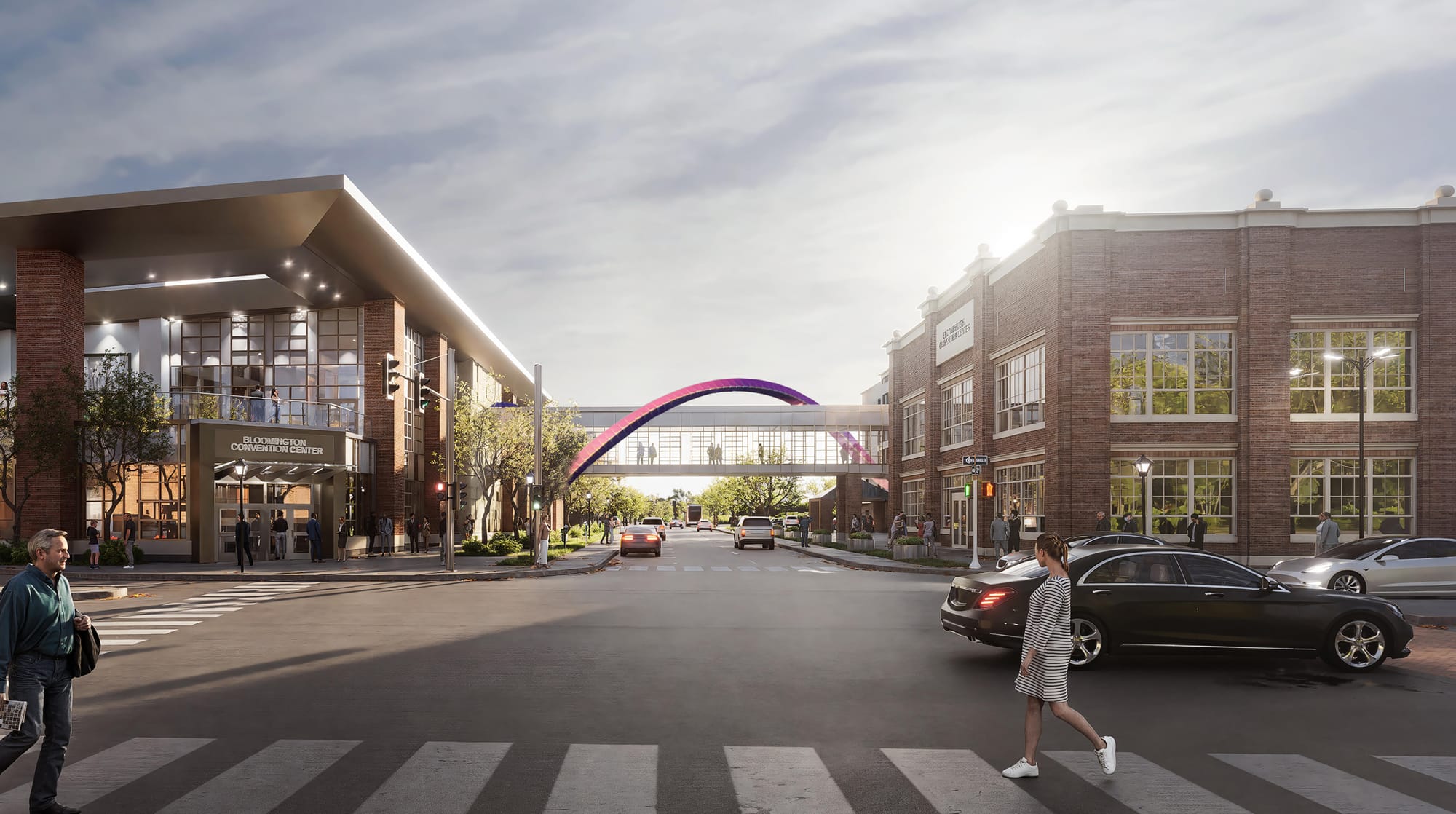
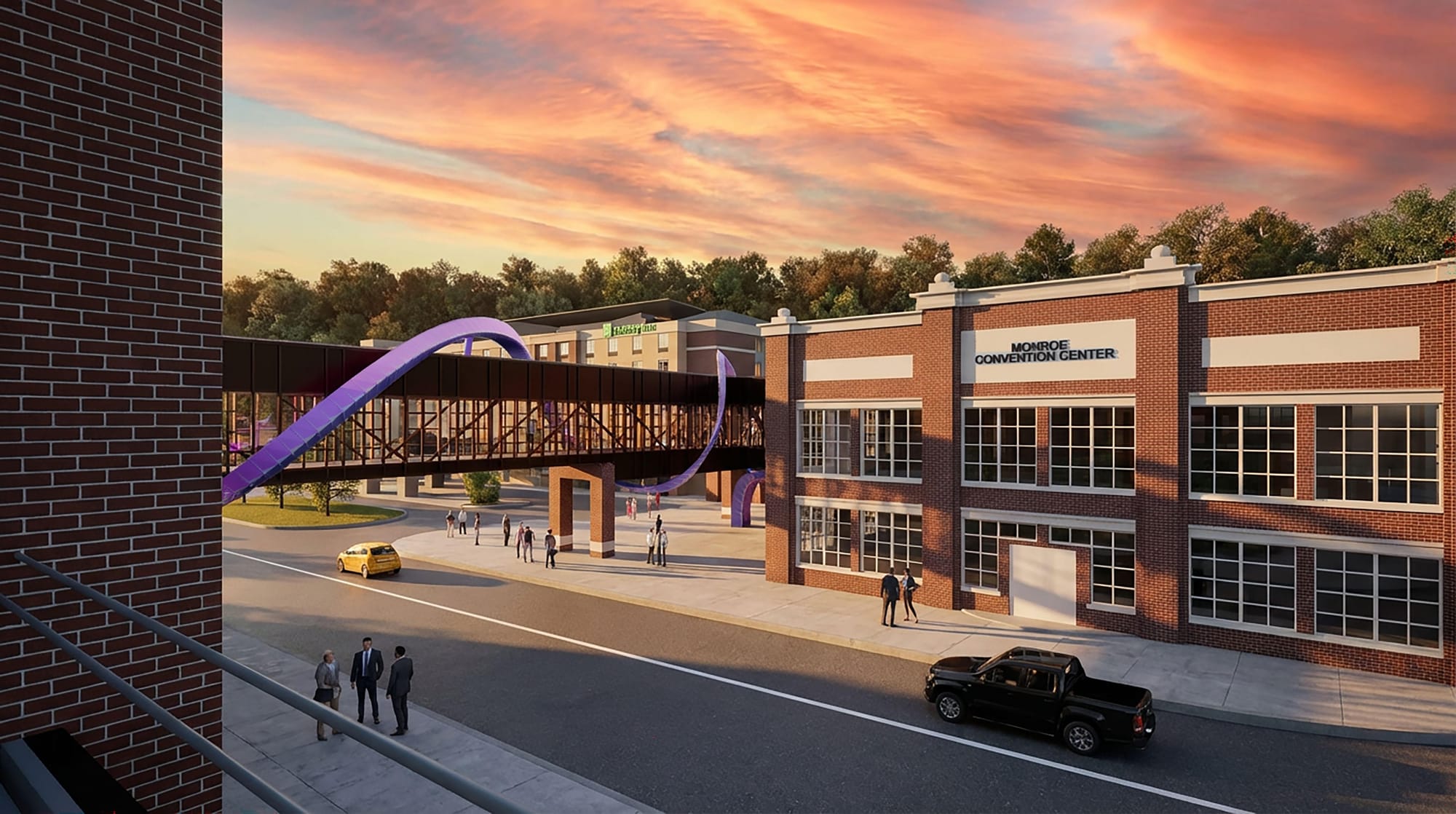
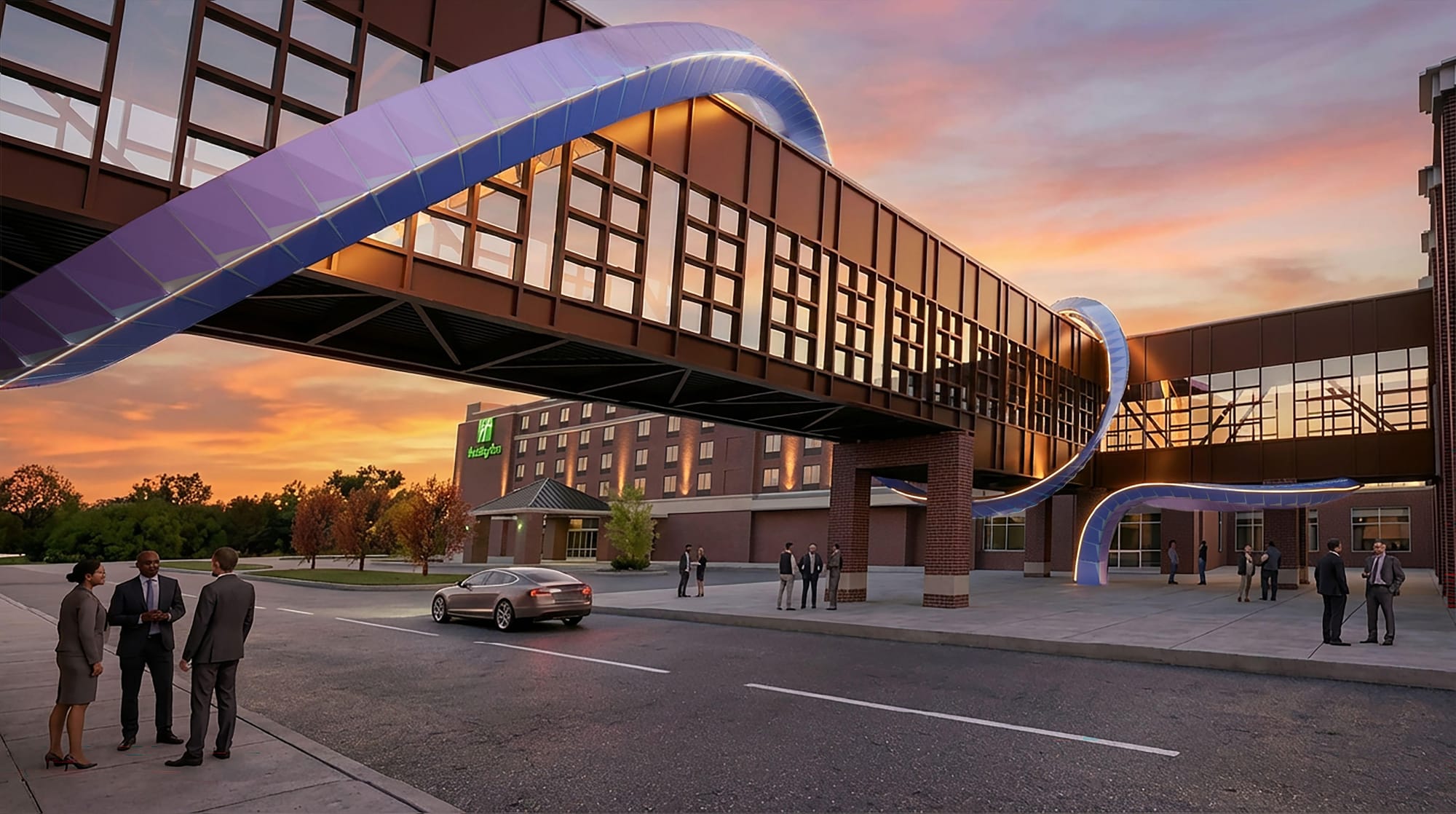
The Monroe County capital improvement board selected Los Angeles artist Benjamin Ball’s “A Form of Connection” as the signature public artwork for the Bloomington Convention Center expansion. The twisting aluminum installation will wrap around the skybridge spanning College Avenue.
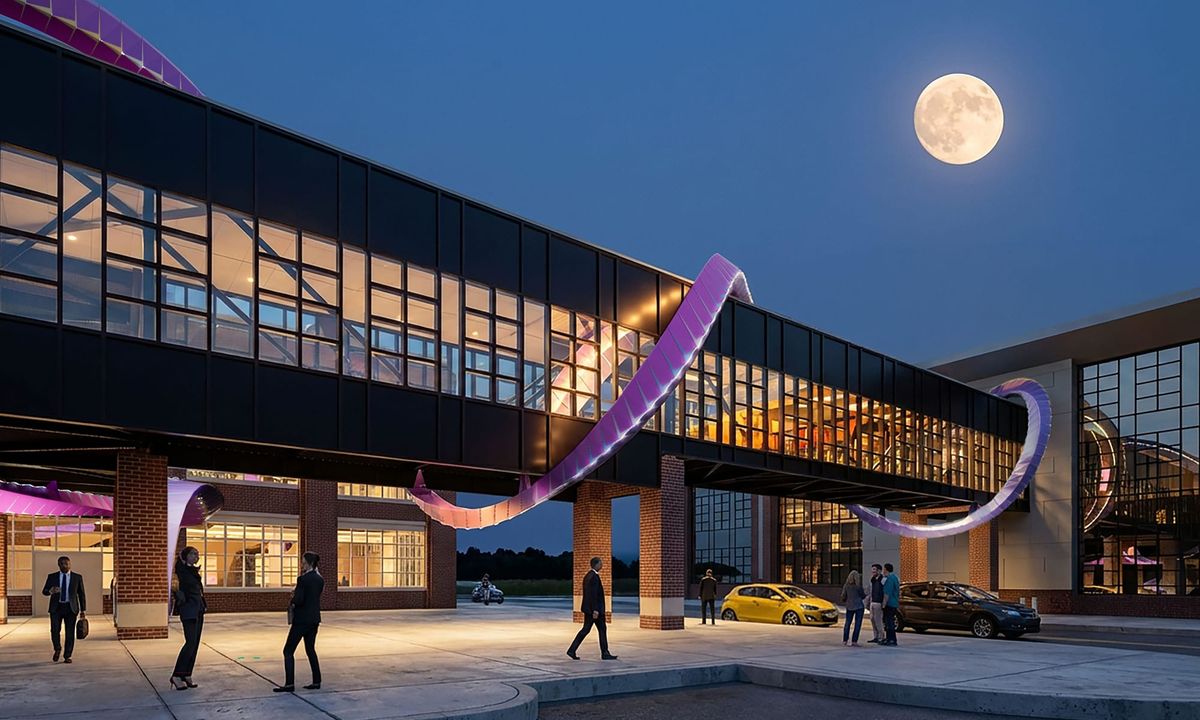
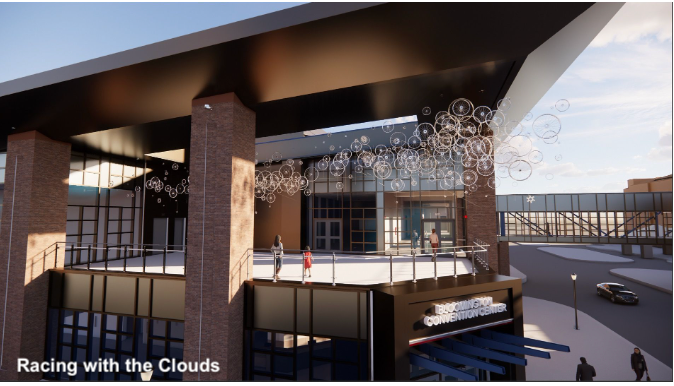
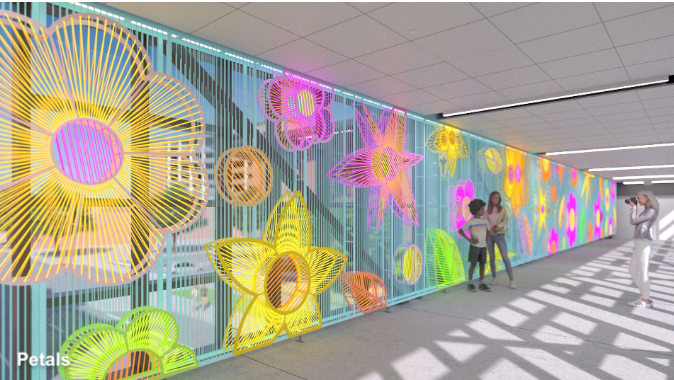
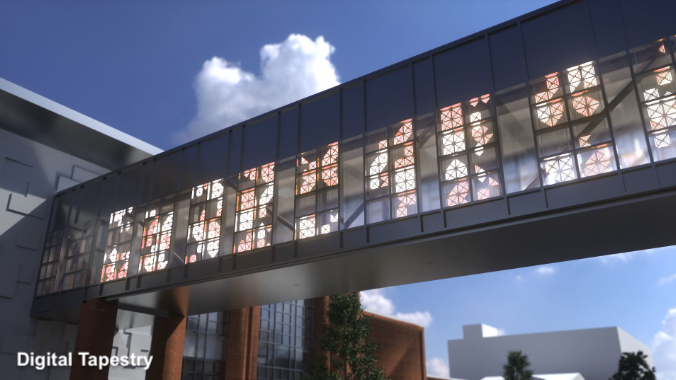
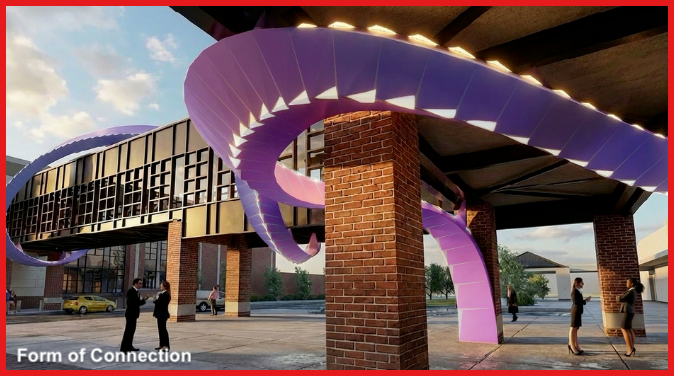
Selected on May 20, 2026 by the Monroe County CIB as the public art installation for the convention center expansion was Form of Connection by Benjamin Ball, outlined in red. Clockwise from upper left: Racing with the Clouds (Kipp Kobayashi), Petals (Hou De Sousa), Form of Connection (Benjamin Ball), and Digital Tapestry (Jason Bruges). These are the four finalist proposals for the Bloomington Convention Center expansion public art project. Images are from the online survey that the Monroe County capital improvement board is asking people to complete.
A $400,000 public art installation wrapping the new convention center skybridge in a sweeping, illuminated sculpture was approved by the Monroe County capital improvement board at its Wednesday (May 20) meeting.
The skybridge will connect the existing convention center across College Avenue to the 60,000-square-foot expansion. The construction center expansion is well underway between Walnut Street and College Avenue on the south side of 3rd Street, and is planned for completion near the start of 2027.
On a unanimous roll-call vote, the board approved “A Form of Connection” by Ball-Nogues Studio, lead by Benjamin Ball, following months of public input, community surveys, and a review by a committee and the Bloomington Arts Commission.
Presenting the public art recommendation was CIB member and BEAD (Bloomington Entertainment and Arts District) advisory group chair Galen Cassady. He opened by crediting the network of volunteers and arts leaders who helped shape the process.
Cassady gave special praise to former city assistant director for the arts, Holly Warren. Cassady told the board: “We really would not be here without the leg work that Holly put into this.” Warren, who attended the meeting, received applause from the audience. CIB president John Whikehart underscored Warren’s role when he wrapped up the agenda item, saying to her, “Holly, thank you again so much for your leadership and assistance in all of this—much appreciated.”
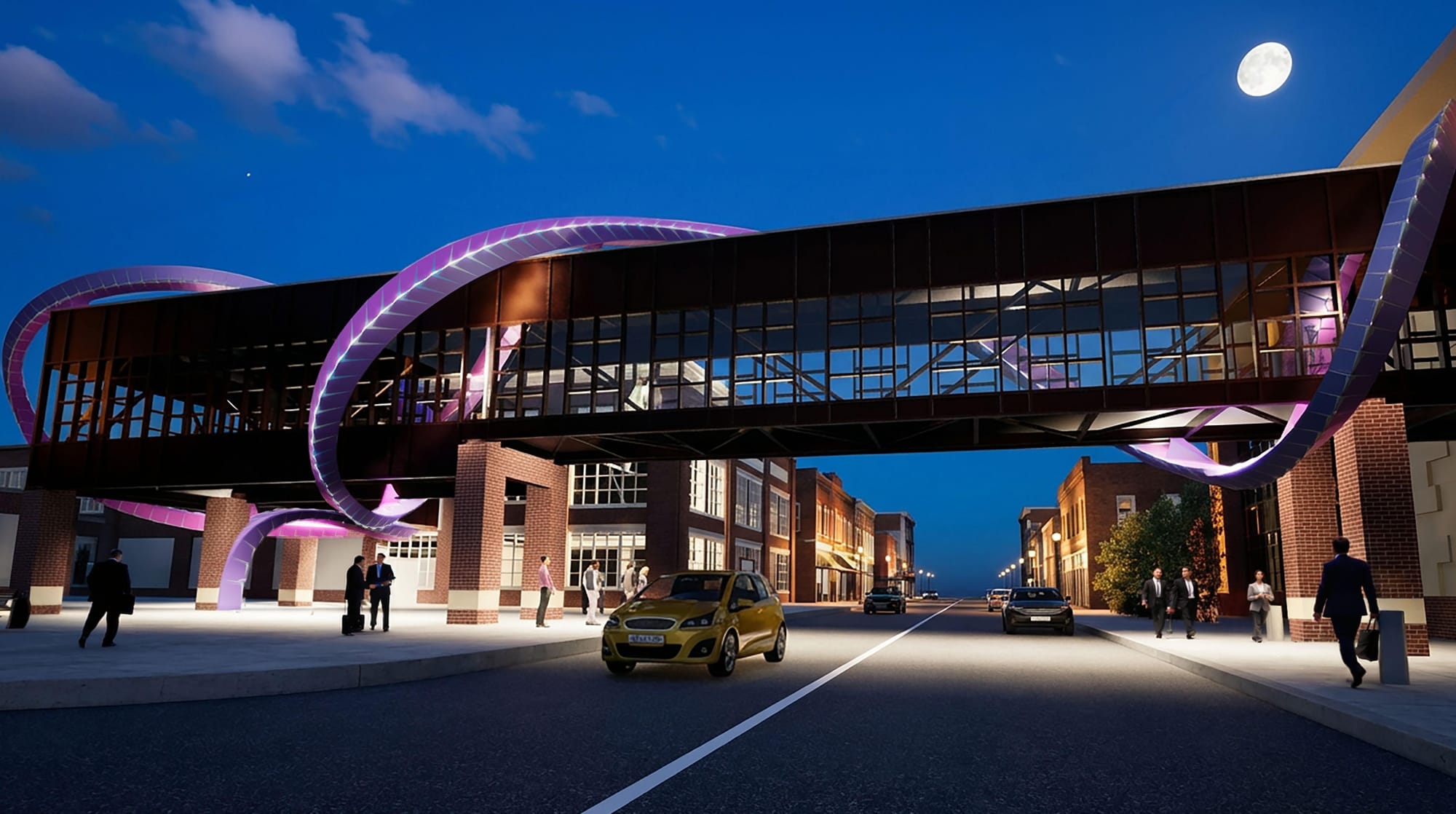
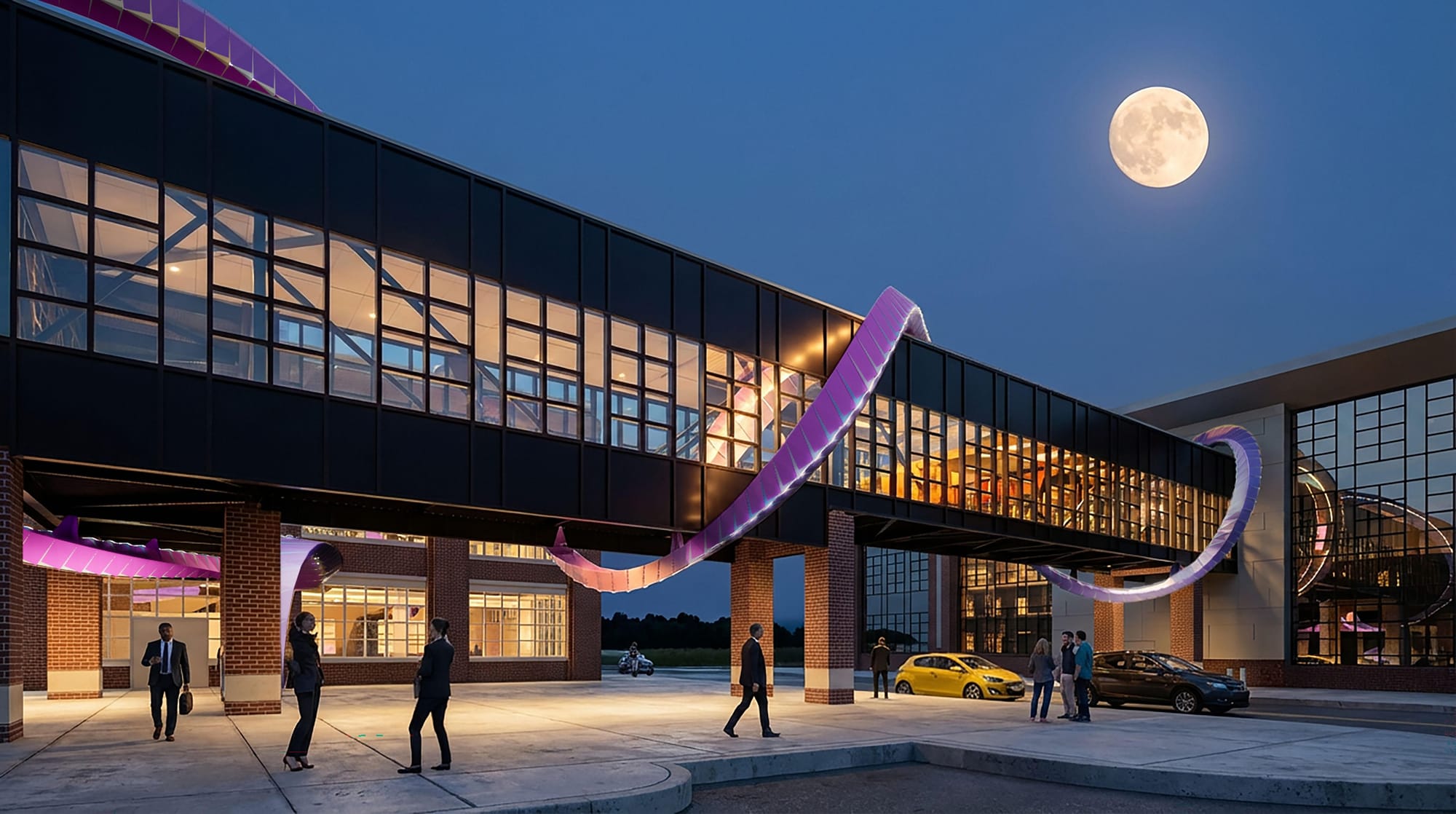
The approximately 8,000-pound installation will be fabricated from marine-grade aluminum and attached to the bridge at 14 structural connection points. Integrated lighting will illuminate the faceted surfaces at night. The proposal emphasized digital modeling, custom fabrication, and engineering precision to create what artist Benjamin Ball described as a “one-of-a-kind civic form.”
Whikehart commented on the reception of the selected design among those who reviewed the finalist proposals, indicating it was the most provocative: “If I recall correctly, this particular piece had the most public reaction. Both strongly for and strongly against, which shouldn’t be too surprising—we’re talking about art.”
The project is part of the convention center expansion’s public art component, funded through Bloomington’s “percentage for the arts” ordinance. The overall public art allocation for the expansion totals $520,000, though roughly $400,000 was designated for the signature installation itself. The rest covers artist honoraria, travel, and additional purchases of artwork by local artists.
The CIB unveiled four finalist concepts in April after narrowing an original pool of roughly 180 applicants. The finalists included proposals from Ball, Hou De Sousa, Jason Bruges Studio, and Kipp Kobayashi.
At Wednesday’s meeting, Cassady walked the board through a two-year timeline that began when the capital improvement board formed the Bloomington Entertainment and Arts District (BEAD) advisory committee in June 2024 to advise on the project’s “One percent for Art” allocation.
With Holly Warren’s help, Cassady said, the group ran its first public feedback round in September 2025 to identify themes and priorities, then issued a global call for artists the following month. More than 180 artists responded.
A recommendation committee that drew from the BEAD advisory group, the Bloomington Arts Commission, the CIB, and other community arts figures cut that pool to roughly 60, then 10, and finally five finalists by early January. Those finalists developed site-specific proposals based on the public’s feedback and, in several cases, visited Bloomington to meet with stakeholders. By April, four proposals advanced to a final round of interviews and a second public survey, which drew nearly 1,000 responses, Cassady said.
The Ball-Nogues proposal, he said, emerged with the broadest support across the groups who reviewed the finalists.
Galen read aloud from the artist’s statement by Benjamin Ball, which included:
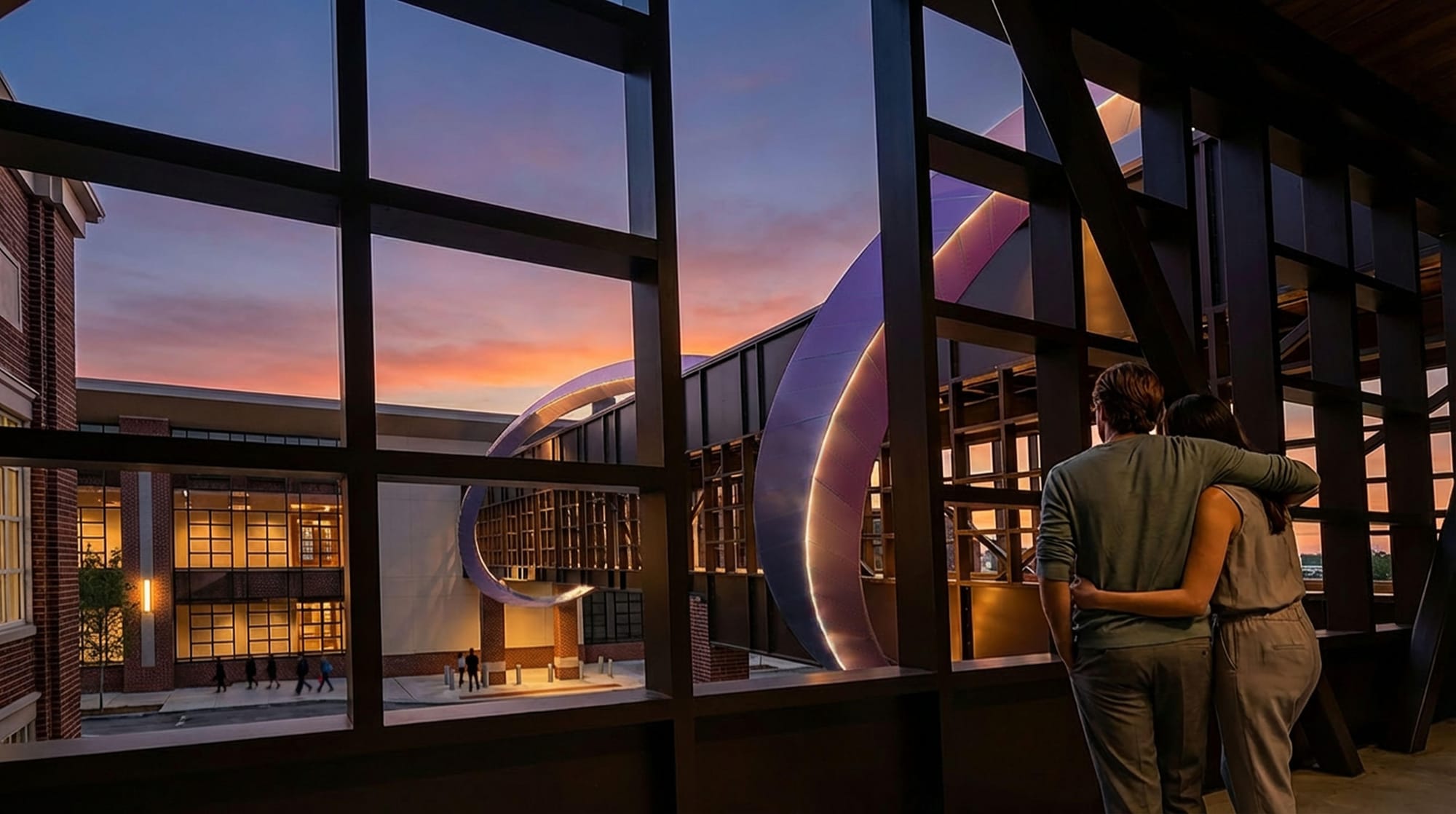
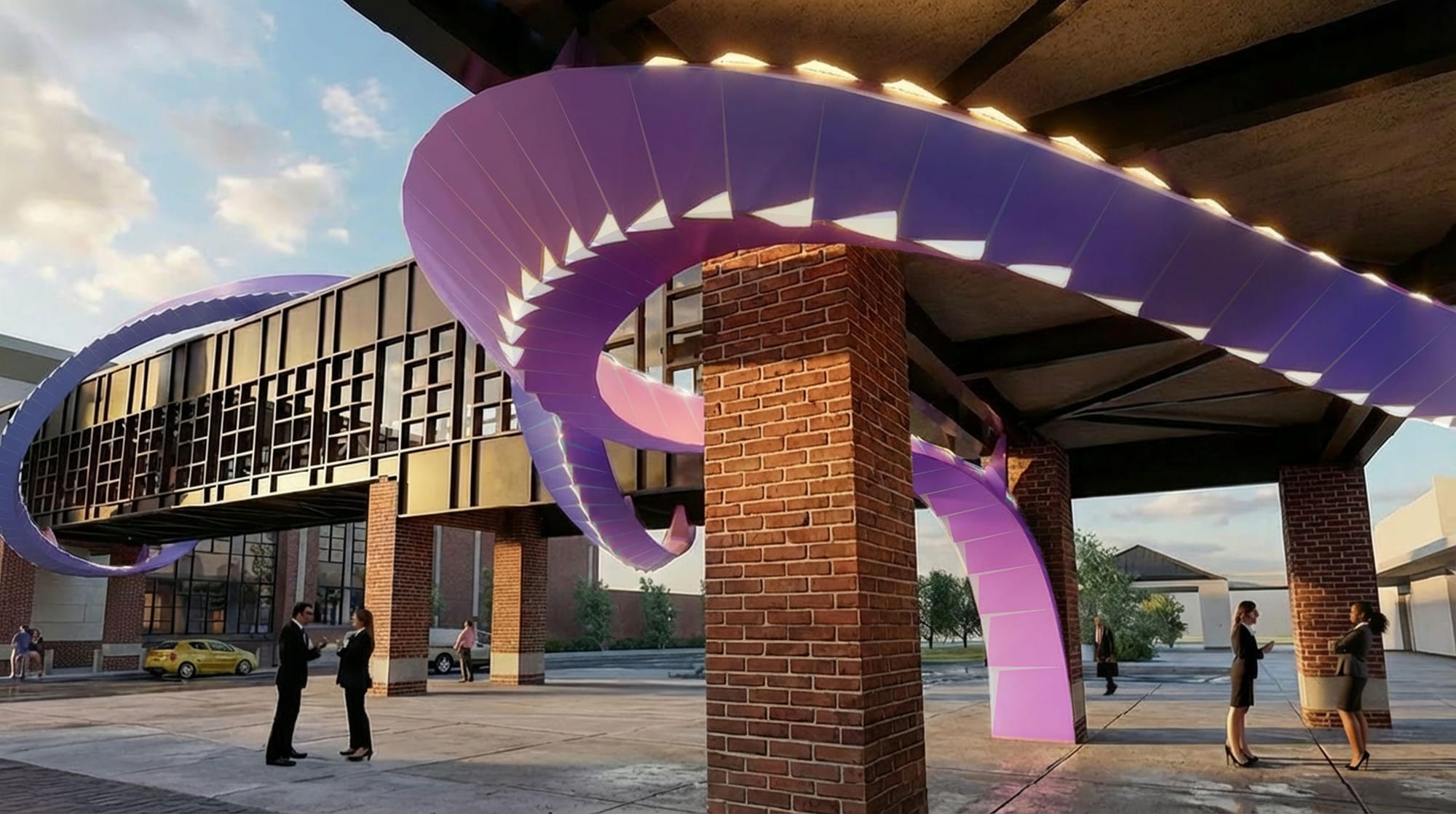
The best public art changes how people recognize and remember a place. For the Bloomington Convention Center, I envision a singular sculptural form that winds around the skybridge connecting the existing convention center to the new expansion. It then extends outward, over the courtyard, and then forms a kind of entry canopy at an entrance to the original building. In traversing along all of the walls of the bridge, the work transforms a familiar piece of connective architecture into a civic marker and gives the convention center a new image by which it can be known.
The statement goes on to describe the piece as “a lyrical line overhead, vine-like in spirit, but abstract,” that thickens and narrows as it entwines the bridge, sometimes hugging the structure and sometimes pushing out above the courtyard. The intention is that from a block or two away, people can grasp the scale of the work’s “signature urban gesture,” while up close, they can see the “pattern, precision, and intricacy of its colored panels.”
Cassady also quoted BEAD Advisory Committee member Chad Rabinowitz, who urged the city to embrace the scale and ambition of Ball’s concept. Rabinowitz described Ball’s proposal as one “that creates a sizable and memorable piece of art that also embraces the new building in its architecture.” Rabinowitz’s quote continued: “This is the postcard. This is the magazine cover. This is the image that will represent the attractiveness and uniqueness of our community to the outside world.”
Weddle Bros. construction project manager Andrew Scere said at Wednesday’s meting taht the construction firm’s coordination with the artist so far had given him confidence the art installation could be accommodated without slowing completion of the bridge. “After approval we can start working as a group with the connection points, accommodate that while we’re finishing out the connector, that way it doesn’t hold anything up.”
Ball’s background includes architecture, industrial design, and public art. Before launching his own studio, he worked for architect Frank Gehry and contributed to projects including the Walt Disney Concert Hall as well as production design work associated with The Matrix. His studio’s work has been exhibited at institutions including the Museum of Modern Art, the Solomon R. Guggenheim Museum, the Los Angeles County Museum of Art, and the Venice Biennale.
Form of Connection: Benjamin Ball
Comments ()