
Summit District residential TIF gets initial nod from Bloomington RDC, accord on road design OK’d
Bloomington’s RDC took another step to create the city’s first residential TIF for the 140-acre Summit District, including the initial Shasta Meadows allocation area. The RDC also approved a $5-million road design pact with developer Sudbury, with a final TIF vote expected in April.
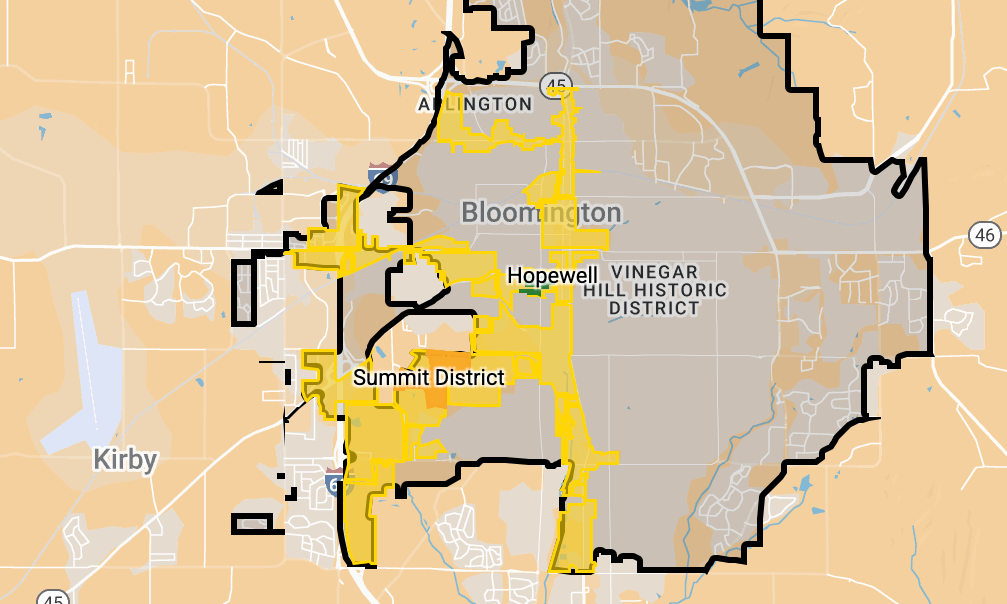
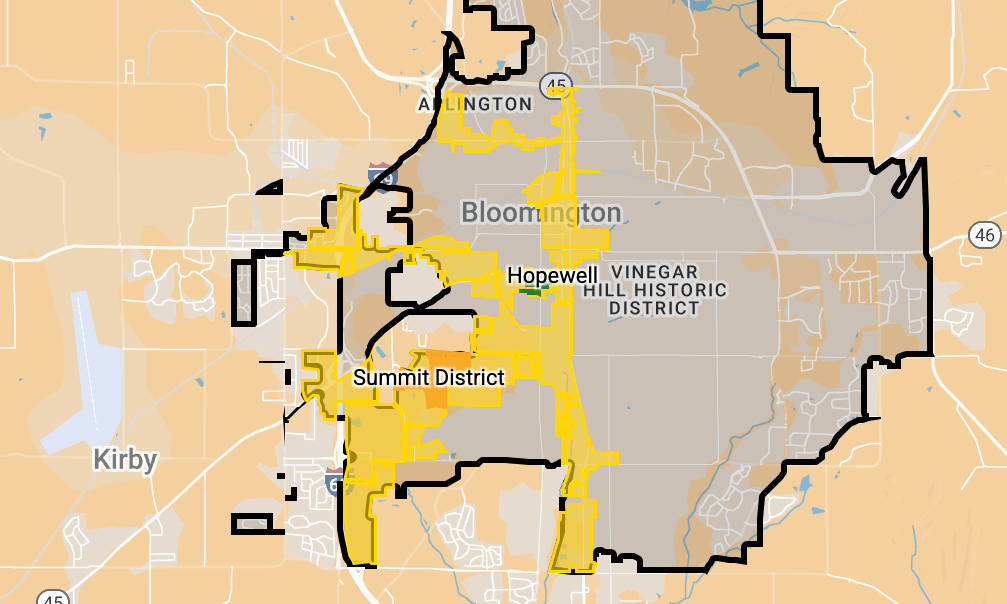
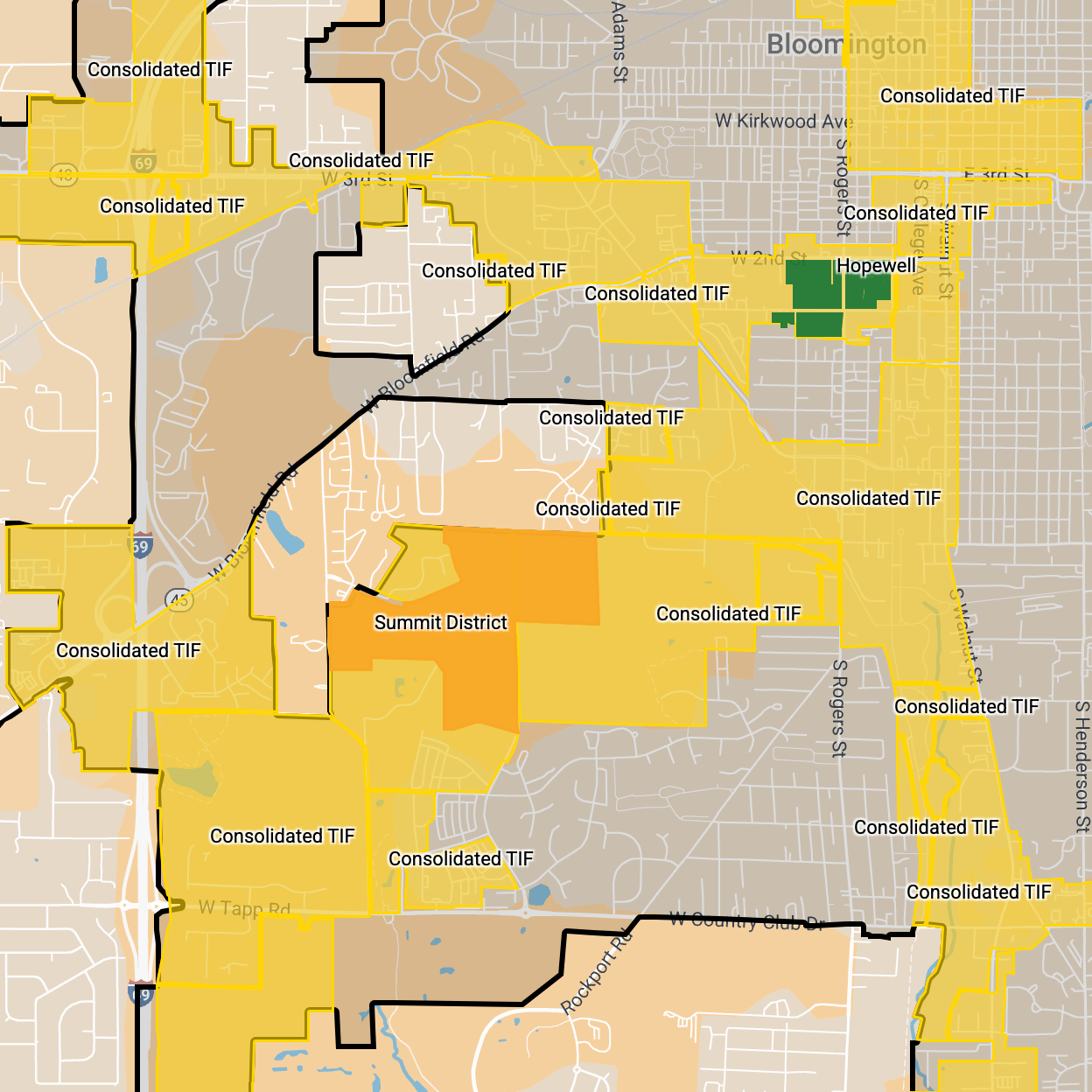
Summit District is shown in orange. Hopwell is shown in green. Bloomington’s consolidated TIF district is shown in yellow. Maps by The B Square with information from the city of Bloomington. [link to dynamic map]
Bloomington’s redevelopment commission (RDC) used its Monday (March 2) meeting to try to lay a financial groundwork for the city’s largest planned unit development (PUD), the Summit District on the southwest side.
The idea is use tax increment financing (TIF) for residential properties. While TIF districts have long been used for commercial properties in Bloomington, this would be the first time a residential TIF has been used locally. In the wording of state law, Bloomington is creating a residential housing development program (RHDP)—often called a “residential TIF.”
Summit District is one of the two geographic areas where Bloomington wants to use residential TIF districts—it’s a 140-acre area in the southwest part of the city, approved for a rezone by the city council in May 2024. The other area is the planned 24-acre Hopewell neighborhood, at and around the site of the former IU Health hospital at 2nd and Rogers Streets.
The idea had originally been to add residential TIF districts to Summit District and Hopewell South on the same timeline. But that plan hit a bump in the road when Bloomington’s city council declined to allow the introduction of the Hopewell South PUD rezone at its Feb. 18 meeting. Hopewell South is now up for consideration for the first time by the city council this Wednesday (March 4).
So Bloomington’s RDC on Monday was focused just on Summit District. Two related items appeared on the agenda. One was to approve a declaratory resolution on the establishment of the TIF area. It was not the final vote, which is expected in mid-April.
The other item was an agreement with the developer of Summit District, which is Sudbury Development Partners, on the financing of major public infrastructure projects. The agreement taps the city’s existing consolidated TIF area to pay for design of two essential road extensions—Adams Street and Sudbury Drive.
RDC member Randy Cassady supported establishment of the TIF area, but abstained on the second item, citing his ownership interest in the nearby Woolery Mill. The two items had unanimous support from the other four members of the RDC.
The RDC’s first TIF-related action established the Summit District Economic Development Area and, inside it, a first allocation area covering the initial housing phase, Shasta Meadows. Assistant city attorney Dana Kerr started off with a primer on how TIF works in Indiana. When an allocation area is created, the assessed value on that date becomes the “base.”
Property taxes on that base continue to be collected by all the underlying taxing units—schools, county, city. Any growth in assessed value above that base, generated by new development, is captured as an “increment,” which is revenue overseen by the RDC. The RDC can use the money to pay for the cost of public infrastructure needed for development.
Kerr distinguished between commercial and residential TIF districts. Under state law, a commercial TIF can run as long as twenty‑five years from the date the first debt is incurred, but it generally cannot capture increment from residential properties.
On the other hand, a residential TIF is allowed to capture both residential and commercial property increment. But for a residential TIF, the maximum life is 20 years from the first incurred debt. Because the first phase at Summit District—Shasta Meadows—is primarily residential, Kerr said it makes the most sense to start with a residential allocation area there—even though that choice caps the capture period at 20 years instead of 25.
Kerr was careful to separate the notion of the broader economic development area (EDA) from the smaller allocation areas inside it. The EDA, in this case the entire Summit Planned Unit Development, is the overall TIF footprint. Only when the RDC designates an allocation area within that footprint does it actually begin to capture the increment.
The resolution approved by the RDC on Monday declares the whole Summit PUD to be an EDA—but establishes only the Shasta Meadows sub‑area for increment capture. The rest of the land will be carved into additional allocation areas over time, as development timing and land use patterns become clearer, Kerr said.
Like Shasta Meadows, future phases of the Summit District, such as a planned Denali Woods neighborhood, will each require their own allocation areas, Kerr said. He told the RDC the next steps for the Shasta Meadows allocation area would be plan commission consideration, city council approval, and finally a confirmation vote by the RDC. Kerr is hoping for a final vote by the RDC by April 16.
The resolution adopted by the RDC also lays out how TIF proceeds are allowed to be used. Kerr emphasized that the increment generated within Summit can be spent on project costs inside the EDA, but can also be directed to improvements located outside its boundaries, so long as those improvements support development within the district. He cited as likely uses the design and construction of an extension of Adams Street (north-south) and Sudbury Drive (east-west), which will together create better connectivity for the southwest quadrant of the city.
At Monday’s meeting, Bloomington corporation counsel Margie Rice and Kerr both framed the construction of those roads as infrastructure that benefits not just Summit District but Bloomington’s broader transportation network.
The discussion at Monday’s RDC meeting also touched on housing policy. RDC president Deborah Myerson pushed for the idea that infrastructure improvements could be leveraged by the city in exchange for a commitment to housing with certain price points or housing types that the city wants to see built.
RDC executive director Anna Killion-Hanson responded by focusing on the need for more housing generally, at all price points: “We need units, and what that does to the overall market is take pressure off of existing units at similar price points. So it’s helping the housing market, not necessarily the delivery of those specific units.” Killion-Hanson added, “The goal is we need units period—we are short on units significantly in Bloomington. That is what will help drive down some of our housing affordability issues.”
Responding to Myerson, Kerr did not rule out using infrastructure negotiations later as leverage for additional housing commitments. There could be an opportunity to ask the developer for some level of affordability commitment in exchange for public support of road construction costs, he said. But Kerr stopped well short of promising that outcome.
The RDC’s second major TIF‑related action approves an agreement between the RDC and Sudbury Development Partners, LLC, the Summit developer, related to the design for extensions of Adams Street and Sudbury Drive within the Summit District boundaries.
Under an agreement, the RDC will pay up to $5 million, using revenue from Bloomington’s existing, consolidated TIF district, for professional design services for roads and related utilities tied to the Summit District PUD, including off-site infrastructure. There will be no financial contribution from developer Sudbury Development Partners for that design work. In November 2025, the RDC had already signaled its intent for that use of $5 million, with an earmark for design services work in the southwest quadrant of the city.
Also under the agreement, Sudbury will manage the design of Sudbury Drive and Adams Street within the development, subject to city engineering standards and layered invoice approvals. Sudbury also has to donate needed rights-of-way for those roads at no cost to the city.
The agreement also commits Sudbury to donate land for a future Bloomington fire station and anticipates a later, separate negotiation over how construction costs will be financed, potentially with support from the Summit District TIF and potential $4 million READi 2.0 grant.
Comments ()