
Thomson uses State of the City to push Hopewell South as Bloomington councilmembers call for revisions
Bloomington mayor Kerry Thomson used her State of the City address to urge progress on the Hopewell redevelopment as the city council prepares another vote on the Hopewell South PUD. Six councilmembers are calling for revisions, especially stronger permanent affordability requirements.
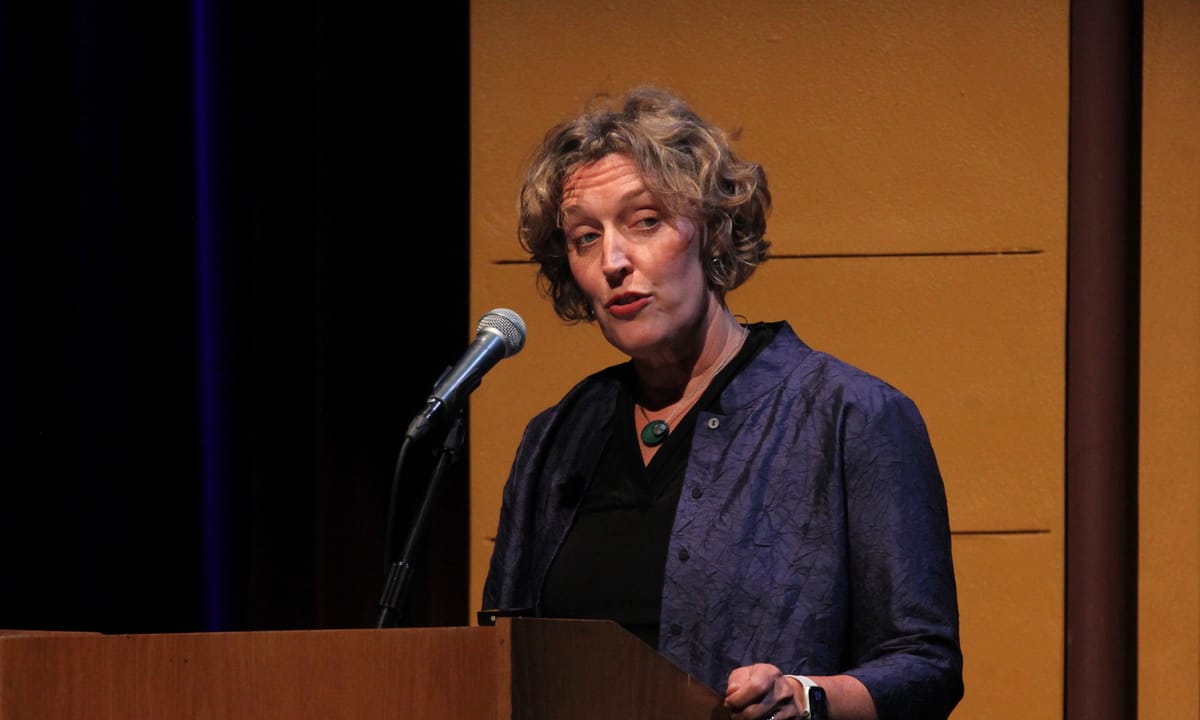
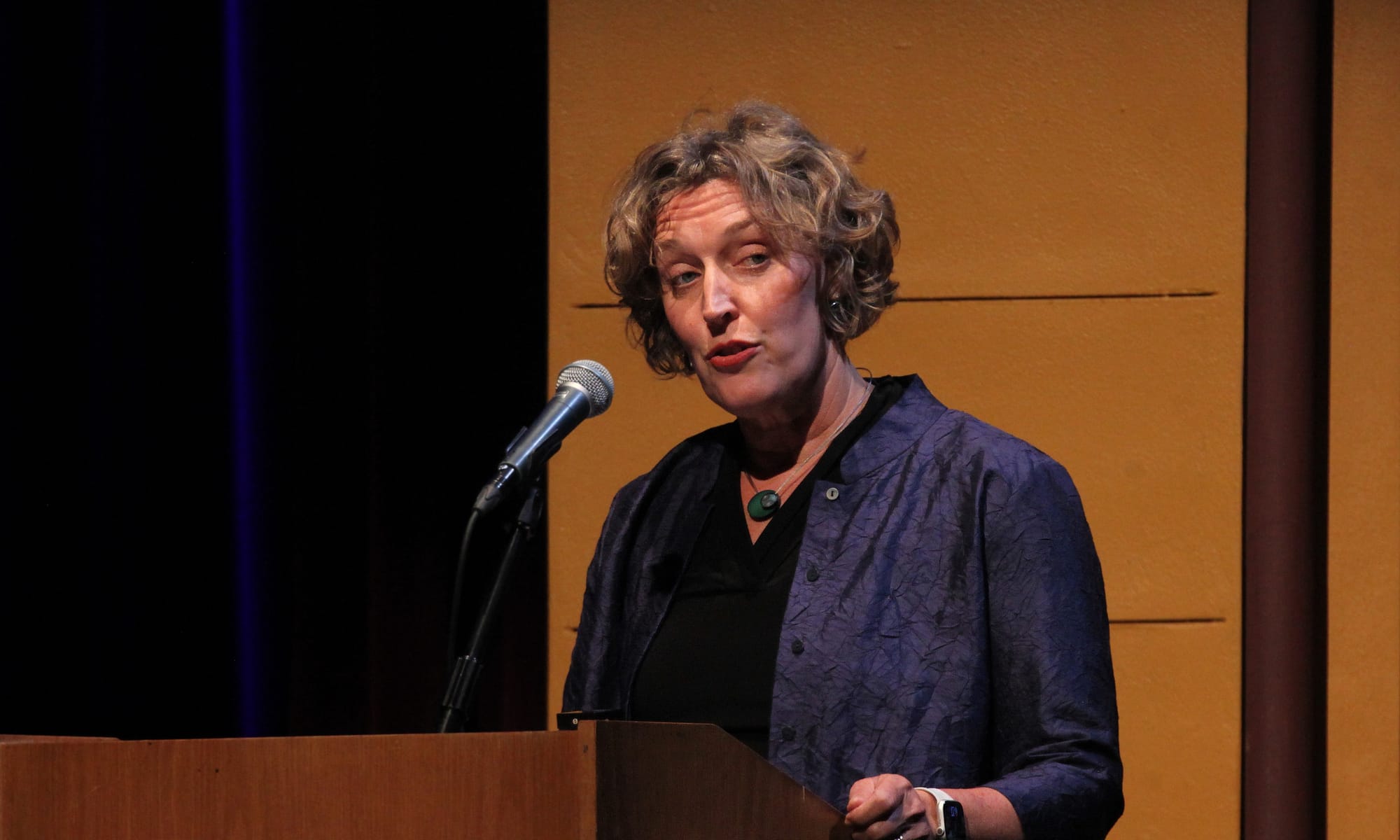
Bloomington mayor Kerry Thomson used her State of the City address Tuesday night (March 31) to make an appeal for progress on the Hopewell redevelopment.
As the city council prepares to consider the proposal for a third time on Wednesday, Thomson asked that the project be seen through a future lens of hindsight.
Speaking at the Buskirk-Chumley Theater, Thomson framed the current friction between her administration and the council over the redevelopment of the former IU Health hospital site as part of a familiar pattern in Bloomington civic life: Projects that provoke intense debate and skepticism when proposed, later become defining parts of the city that are taken for granted.
Thomson described “things happening right now that in years to come, we’ll feel [it was ] completely obvious that we did them—something we’ll wonder how we ever lived without.” Thomson said, “If there’s one thing about this community, we don’t always see the ending when we’re in the middle of it.”
Thomson cited past decisions—including preserving the historic Monroe County courthouse, building the B-Line Trail, expanding the convention center, and creating the Trades District—as examples of projects that faced controversy, but later reshaped the city. Speaking about the courthouse, she said, “In the end, it is that courthouse that Charlotte [Zietlow] saved, and now no one can remember ever wanting to demolish it.”
The implication was clear—that Thomson thinks the same hindsight might someday apply to Hopewell. “Soon we will—one way or another—have Hopewell, a once-in-a-generation neighborhood,” Thomson said. “And all of us will be proud.”
Council vote could come Wednesday
Likely pushback to Thomson’s framing from some councilmembers will be that they don’t oppose the Hopewell redevelopment itself, but are instead at odds with the mayor over the details of implementing what is seen as a once-in-a-century chance to establish permanent affordable housing in the middle of the city.
The mayor’s remarks came the day before the city council is scheduled to consider for the third time a portion of the Hopewell redevelopment—the Hopewell South planned unit development (PUD). The Hopewell South PUD is a rezone proposal that would allow the first residential phase of the city-owned redevelopment site to move forward.
The proposed PUD is supposed to include more housing than would be possible under the existing zoning. Hopewell South has a target build‑out of about 98 housing units, compared to 28 under the existing R4 zoning. Hopewell South appears on Wednesday night’s (April 1) agenda.
The council postponed a vote last week, pushing consideration to April 1, mainly amid concerns about permanent housing affordability and a legal question about whether they are allowed to amend the Hopewell PUD, which the city’s plan commission recommended for adoption on a unanimous vote.
On Monday evening, the day before Thomson’s State of the City, six councilmembers issued a joint news release calling for changes to the proposal.
The statement—signed by Isabel Piedmont-Smith, Kate Rosenbarger, Hopi Stosberg, Dave Rollo, Andy Ruff and Matt Flaherty—said the councilmembers support the promise of Hopewell but believe the current proposal should be revised.
“We are all excited about the potential embodied by the Hopewell neighborhood,” the news release says. “However, we believe the Hopewell South Planned Unit Development proposal … can and should deliver greater benefits to our community.”
The statement identifies three areas where the proposal should be strengthened: more permanently affordable housing; sidewalk and street improvements meeting city standards; and energy-efficiency requirements for new buildings.
The news release says the six councilmembers believe the proposal currently falls short in those areas, but stressed they are seeking revisions rather than rejecting the project outright.
Their suggested 50% permanently affordable housing would be an ideal outcome, but said they would accept a compromise of 25% permanently affordable units, including 15% reserved for households earning at or below 90% of area median income.
The friction on the affordability issue is about how the permanently affordable status of owner-occupied houses is to be enforced—given that simple deed restrictions make lenders reluctant to finance mortgages.
Monday night’s news release also pushed back on the mayor’s claim that the council has slowed the project, noting the proposal has been before the council less than six weeks and that state law allows 90 days for council review after a plan commission recommendation.
“We sincerely hope that going forward we will see true collaboration and a willingness to compromise … so that we can move forward together for Bloomington,” the statement says.
The Thomson administration was hoping for an approval of the Hopewell South PUD in the first week of March, with the idea that it would allow for construction on new houses to start before the end of the year. That goal appears to have slipped.
Tuesday’s speech was technically a special meeting of the city council, and the rollcall at the start revealed that three of the six councilmembers who signed on to the statement released the night before were absent: Flaherty, Rosenbarger, and Stosberg. The three who did not sign on to the statement are: Isak Asare, Sydney Zulich, and Courtney Daily.
For her part, in Tuesday’s speech, Thomson seemed to steer clear of intentional provocation of the council. She appeared to acknowledge that the council’s reluctance to move quickly on the Hopewell South PUD just reflects Bloomington’s civic culture. “We have a community that cares deeply about getting it right,” she said.
“And in Bloomington, even when we agree on the goal and what needs to be done, it can still take a very long time to move forward. Government and politics in our community tend to take the scenic route, and the trip never gets boring,” she said.
Housing goals
During Tuesday’s speech, Thomson stressed the urgency of building housing in Bloomington generally. “We need more houses, of more sizes, for more people,” she said.
She described Hopewell as the city’s largest opportunity to add housing in the coming years. “The largest opportunity to do that is Hopewell,” Thomson said.
Thomson also repeated a point she made when she addressed the council during the March 25 meeting, saying the Hopewell South PUD supports two big goals especially well: creating attainable homeownership opportunities; and connecting residents to jobs, services, and amenities in a walkable neighborhood.
“On those two goals, this plan delivers,” Thomson said Tuesday night.
At the same time, she acknowledged the project does not resolve every issue surrounding housing affordability or neighborhood development. “It doesn’t resolve every challenge. No single project does,” Thomson said. “But it moves us forward,” she added, concluding, “in a housing crisis, that matters more than perfection.”
The Wednesday meeting of Bloomington's city council meeting starts at 6:30 p.m.
Comments ()