
Two-way College–Walnut proposal in front of Bloomington commission Monday
Bloomington’s transportation commission will consider Monday (Nov. 16) whether to endorse converting College and Walnut to two-way traffic in the city’s long-range plan. The two-way part of the proposed $109.4 million redesign faces opposition from Bloomington mayor Kerry Thomson.
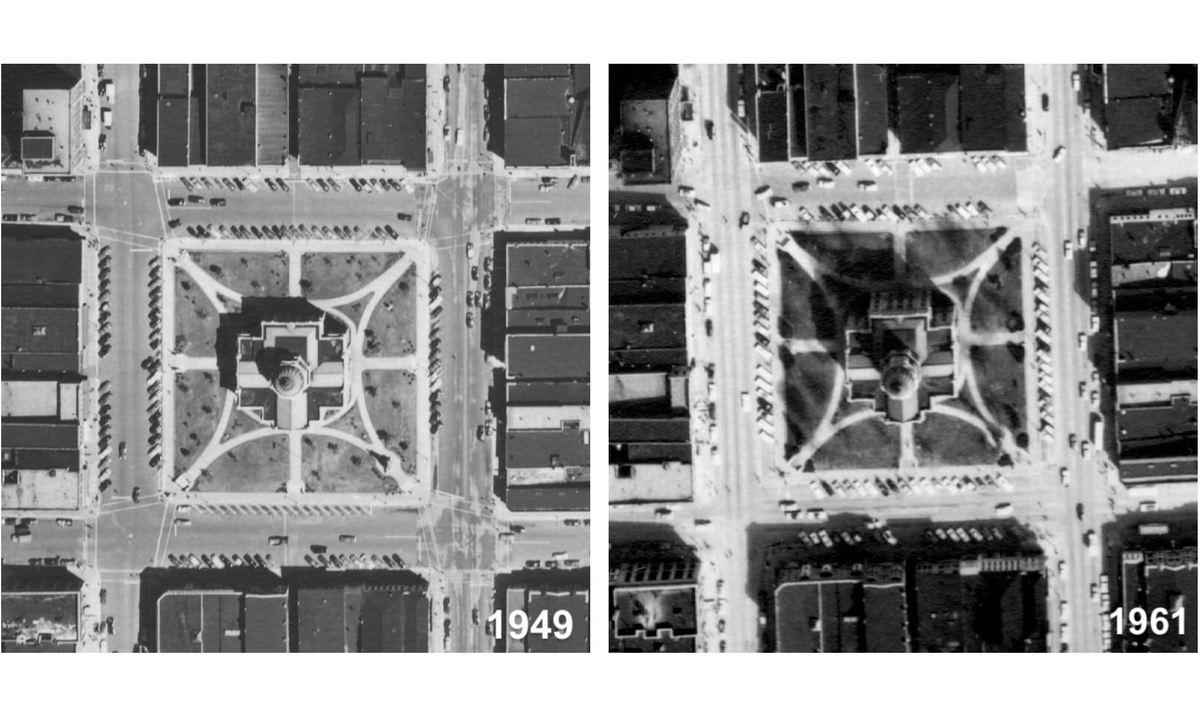
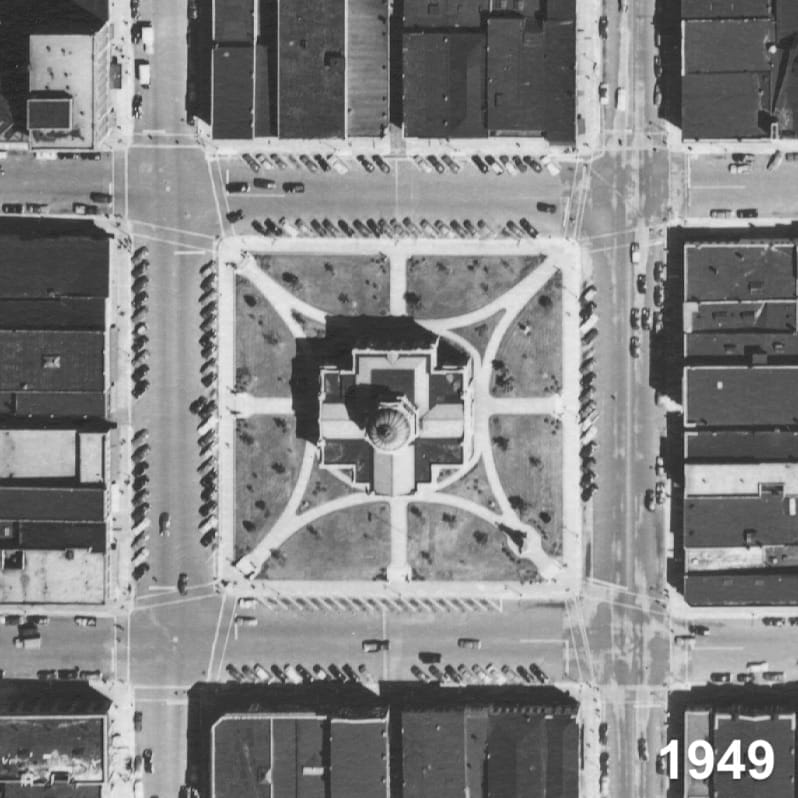
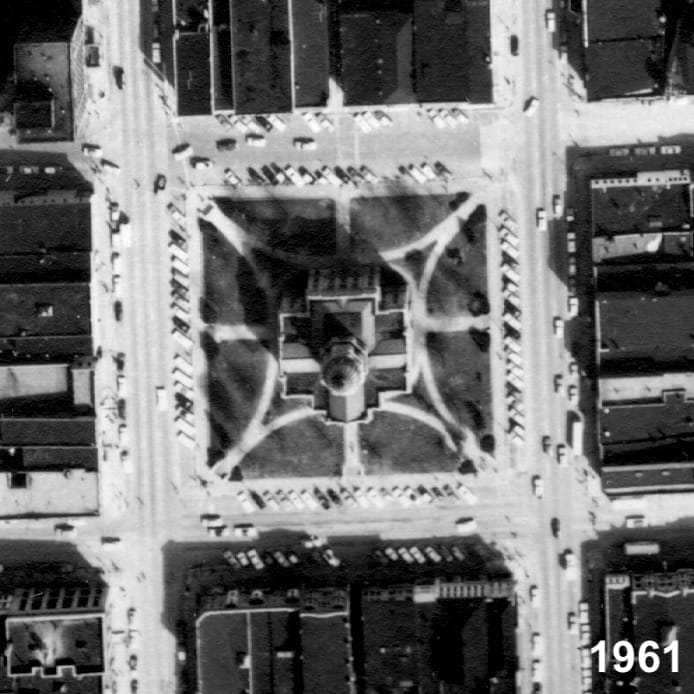
Left: Historical aerial image from 1949 of the Monroe County courthouse square. Right: Historical aerial image from 1961 of the Monroe County courthouse square. Based on the orientation of angled parking, it’s possible to deduce the switch between a two-way and one-way configuration. The switch happened in 1956.
Bloomington’s transportation commission will consider a proposal Monday (Nov. 16) to make the eventual conversion of College Avenue and Walnut Street to two-way traffic part of the city’s official long-range transportation policy.
The proposed change comes despite a public declaration by Bloomington mayor Kerry Thomson that the conversion will not happen during her administration.
The commission’s special hearing starts at 5:30 p.m. in city council chambers at city hall. The agenda includes a staff presentation, public comment and a possible vote on a resolution recommending adoption of the College and Walnut Corridor Study and corresponding amendments to the city’s 2019 transportation plan.
The city has created a webpage dedicated to the topic of the College–Walnut corridor. The backdrop to the hearing is a report from consultant Toole Design, which recommends a conversion to two-way traffic.
A recommendation from the transportation commission on Monday, or later if the commission puts off a vote, would not authorize construction or commit money to the project. The project has an estimated cost of $109.4 million for a complete two-way redesign. But even the recommended safety improvements that would preserve the one-way traffic pattern have an estimated price tag of $103.1 million, according to a city news release.
Even a positive recommendation from the transportation commission would not make the one-way option a part of the city’s official long-term plans. The transportation plan is part of Bloomington’s comprehensive plan, which is supposed to guide the city’s long-term land use and infrastructure decisions. Amending it ultimately requires approval by the city council, after review by the plan commission.
That means the two-way proposal could become an issue in Bloomington’s 2027 municipal elections, when voters will choose a mayor and all nine city council seats, as well as a city clerk. The start of 2028 could see a complete turnover in all 11 city elected positions, although that is not a likely outcome.
What would change in the plan?
The proposal involves the approximately 2.2-mile north-south corridor between the State Road 45/46 Bypass and Allen Street. College currently carries traffic southbound, while Walnut carries traffic northbound.
Bloomington’s 2019 transportation plan already calls for a comprehensive study of the corridor, including consideration of restoring two-way traffic. But the plan does not currently endorse two-way conversion as the preferred configuration.
The proposed amendments would change that in two places.
First, the plan’s description of the “Main Street” street classification would be revised to specify that future designs for College and Walnut should be based on two-way traffic. The new wording calls for one vehicle travel lane in each direction, with center turn lanes where appropriate.
It also calls for reallocating street space to accommodate protected urban trails, wider sidewalks, shorter pedestrian crossings, on-street parking and dedicated commercial loading zones.
Second, a new section titled “College and Walnut Corridor Study” would be added to the plan’s chapter on next steps for key recommendations.
That section would formally incorporate the study’s recommendations, including two-way traffic restoration, improved pedestrian facilities, an urban trail, transit-supportive improvements and redesigned intersections.
The new section also acknowledges that full implementation would require substantial outside funding. It calls for incremental investments through capital improvement programs, redevelopment and routine infrastructure work, while preserving the possibility of eventually carrying out the larger transformation.
Mayor says conversion won’t happen during her administration
In an Oct. 21 interview with Indiana Public Media, Thomson was asked about the possibility of converting College and Walnut to two-way traffic. “It’s not happening during my administration,” she responded.
Thomson pointed to the project’s cost and said a conversion would require a coordinated undertaking rather than proceeding one block at a time. She characterized the study principally as a means of qualifying for federal funding to improve intersection safety.
The mayor’s comments leave an important question for Monday’s hearing: Why should the city’s long-range plan be amended to endorse a configuration that the current administration says it does not intend to implement?
Planning services manager Ryan Robling has drawn a distinction between the envisioned long-term transformation and smaller safety projects that can proceed independently.
In an Oct. 22 email responding to questions from The B Square, Robling said the city had not calculated the cost of a bare-bones conversion to two-way traffic. He said simply converting the streets in phased sections would be technically possible, but could introduce driver confusion at the points where traffic patterns changed. Building temporary transition infrastructure could also waste money that would eventually be needed for full conversion, he wrote.
Meanwhile, the city’s adopted 2026–2030 Transportation Improvement Program (TIP), which is administered through the Bloomington-Monroe County Metropolitan Planning Organization (MPO), includes two phases of improvements to College Avenue and Walnut Street, with a combined estimated cost of $14.4 million. The planned work includes traffic calming, sidewalks, accessible crossings, bicycle facilities and upgrades to aging infrastructure.
On Oct. 23 Bloomington planning services manager Ryan Robling sent an email to Scott Faris, president of the Monroe County plan commission and a member of the Bloomington-Monroe County Metropolitan Planning Organization’s policy committee about the TIP. Robling wrote that the city’s engineering department anticipates starting design in 2027. Robling confirmed that the TIP projects would not convert College and Walnut to two-way traffic.
What the study recommends
The study, prepared by Toole Design, compared two alternatives that would substantially reconstruct the corridor.
One would retain the current one-way arrangement while generally reducing three-lane sections to two vehicle travel lanes. The other would convert both streets to two-way traffic, with one through lane in each direction and turn lanes where needed.
Both alternatives include substantial improvements for pedestrians and bicyclists, including wider sidewalks, shorter crossings, safer intersections and dedicated space for bicycles and scooters.
The two-way option would add a protected urban trail along Walnut throughout the corridor and along College between the bypass and Seventh Street. The one-way option would provide an urban trail along both streets throughout the corridor.
Both concepts would reduce on-street parking. The study estimates a 25% reduction under the one-way alternative and 30% under the two-way alternative.
The study concludes that both redesigned configurations could accommodate current traffic volumes. Its traffic modeling shows acceptable overall intersection operations during the morning and afternoon peak periods, although some individual movements would experience additional delays.
The consultant favors two-way traffic principally because opposing vehicles, narrower travel space and fewer opportunities to pass slower drivers would help reduce vehicle speeds.
Speed reduction is central to the study's safety argument. According to city crash records cited in the consultant’s report, three fatal crashes and 34 serious-injury crashes occurred along the corridor from 2018 through 2022. Speed measurements collected in October 2023 showed that more than half of drivers exceeded the posted speed limit at 11 of 14 locations.
The consultant’s recommendation is not that two-way traffic would eliminate crashes. Rather, the report concludes it offers greater potential to reduce speeds and the severity of crashes than a redesigned one-way configuration.
A debate with a 70-year history
College and Walnut became one-way streets in April 1956, when both were part of State Road 37.
The change came after pressure from state highway officials interested in moving traffic more efficiently through Bloomington. Some downtown merchants initially objected, but the threat of losing on-street parking helped shift support toward the conversion.
Problems with speeding were reported almost immediately. An April 23, 1956, “Daily Herald-Telephone” article quoted Bloomington police captain Charles Fox saying that the newly configured streets encouraged drivers to go faster than necessary: “We have been get too much speeding on these two streets. People are going faster than they need to, or have reason to, because the streets look open and inviting.”
Twenty years later, the opening of the State Road 37 bypass gave motorists a route around downtown. But the basic design of College and Walnut remained mostly unchanged.
In 2018, Toole Design recommended restoring two-way traffic during development of the city’s transportation plan. But Bloomington’s Plan Commission removed that recommendation before the plan reached the city council.
That history surfaced four years later, in October 2022, when the board of public works approved a $170,000 contract with Toole to conduct the new corridor study.
The city expanded the consultant’s scope in April 2025, adding more detailed traffic analysis. During public meetings in October 2025, residents and business owners were invited to review both design alternatives and offer comments.
Cost, business concerns, next steps
The estimated cost of fully reconstructing the corridor while retaining one-way traffic is $103.1 million. The two-way alternative is estimated at $109.4 million.
Both figures are in 2026 dollars and contemplate extensive infrastructure reconstruction, rather than simply changing traffic signs and lane markings. Neither represents an approved construction budget.
The Greater Bloomington Chamber of Commerce has questioned whether two-way restoration would deliver sufficient benefits to justify the expense and disruption. In an Oct. 26 commentary, the chamber described overwhelmingly negative unsolicited feedback from businesses about potential effects on customer access, deliveries, parking and traffic flow. It called for comparing targeted safety improvements with the cost and benefits of a full reconstruction.
Monday’s transportation commission hearing is the first step in the formal process of incorporating the study into Bloomington’s transportation plan. The proposal would then go to the plan commission and finally to the city council, with additional opportunities for public comment.
For people interested in speaking Monday, the hearing will be conducted in person and virtually on Zoom.
Even if the transportation plan is amended, the question of whether, and when College and Walnut would become two-way streets would remain subject to future funding decisions.

Comments ()