
2027 budget talks for Bloomington city council turn to potential staffing cuts
Bloomington council president Isak Asare floated new personnel and organizational cuts during Wednesday’s 2027 budget work session. They including changes to the mayor’s communications operation and the economic and sustainable development department. Votes on changes are expected Oct. 7.

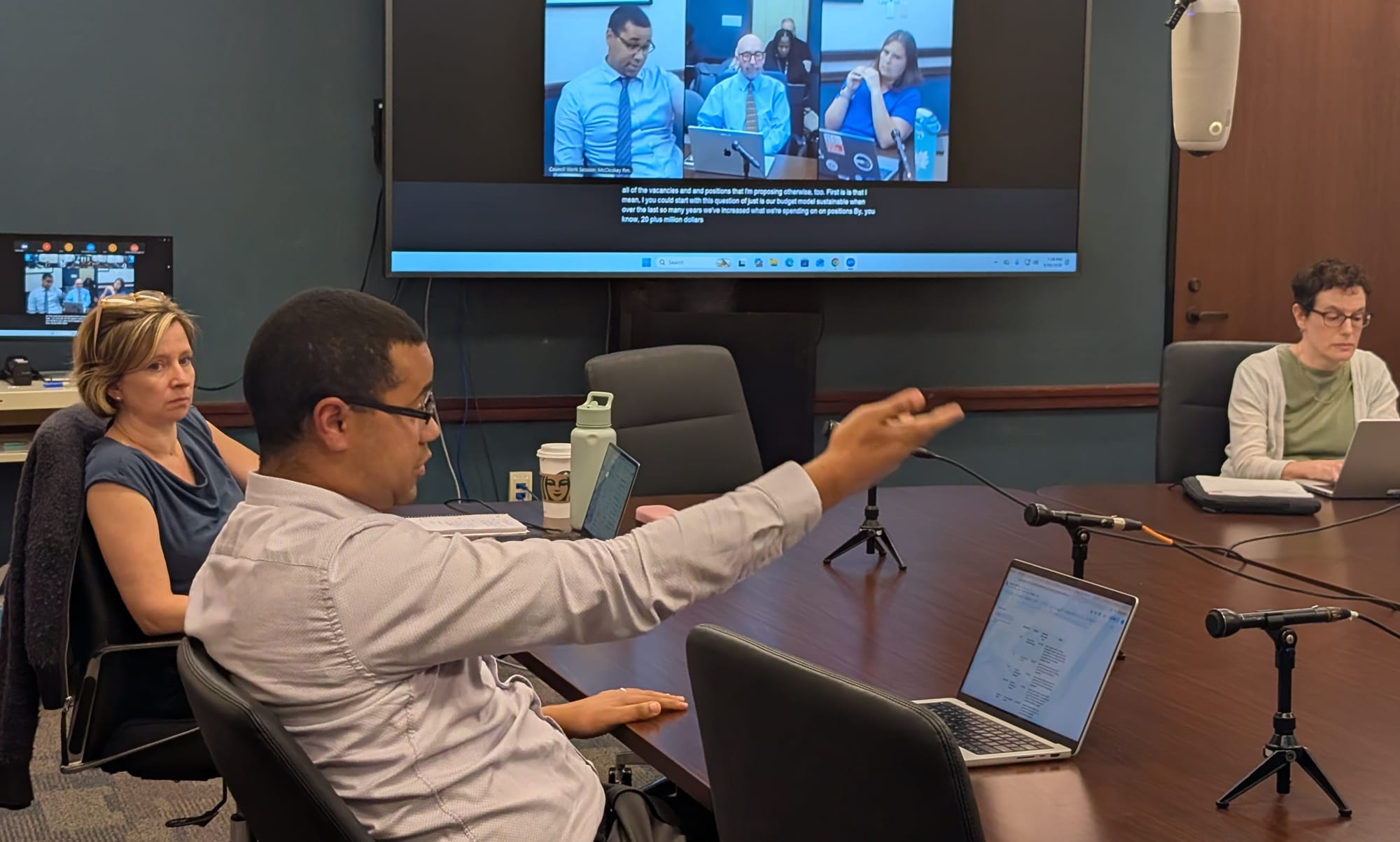
Wednesday night’s (Sept 30) Bloomington city council work session was scheduled to review proposed 2027 budget cuts that had been released just the day before. But on Wednesday, council president Isak Asare went beyond those written proposals, by putting additional personnel and organizational cuts on the table that have not yet been submitted in writing as budget amendments.
Among the possible set of cuts to the budget proposed by Bloomington mayor Kerry Thomson was a reduction of three public-facing positions in the mayor’s office, along with one that is more internally focused. Up for discussion are the vacant public engagement director position, two currently filled communications positions, as well as a legislative affairs specialist.
Having a potentially bigger impact was another idea that Asare introduced on Wednesday, which would restructure the economic and sustainable development (ESD) department, potentially funding its personnel for only part of 2027. Asare said that would force conversations about which functions should stay inside the city government and where they should be housed.
Underlying Asare’s approach, he said, is the idea that personnel costs have grown to consume a larger share of the city budget, while revenue growth is expected to slow. So he questions whether Bloomington can sustainably keep funding every existing position.
None of those ideas floated by Asare on Wednesday are close to a done deal. But councilmembers who attended the Sept. 30 work session showed some appetite for reconsidering the city’s organizational structure, even if there is also significant hesitation about using the budget to force rapid personnel changes.
Hopi Stosberg said she was “really nervous about cutting any positions.” Isabel Piedmont-Smith said she would need “a whole lot more information” before cutting anything in ESD.
At the same time, the council’s review narrowed the list of written amendments that were released on Tuesday. Asare said he would not pursue proposed cuts involving health insurance, the proposed nonunion pay increase or a 1% personnel vacancy factor. He also said his proposed reduction in fuel appropriations was unlikely to move forward.
A proposed $600,000 cut to funding for new financial software also appeared to lose momentum after city controller Geoff McKim explained that the expenditure was needed for a broader replacement of the city’s aging financial and human-resources systems.
Meanwhile, there was clearer agreement among councilmembers who were present on Wednesday about reducing the transfer into the sanitation division of public works to make up for the difference between the cost of curbside trash and recycling collection, and revenues from cart fees. The plan will be to increase carts fees to make up for the $600,000 reduction.
There was also a clear consensus among councilmembers about eliminating the vacant transportation demand manager position and removing a $2.5-million parking meter fund capital expenses placeholder until actual projects are identified.
No votes were taken Wednesday. The council is expected to deliberate and vote on amendments at its Oct. 7 meeting. If substantial changes are approved, controller Geoff McKim said staff will need a few days to recalculate the budget and prepare revised state forms. That would mean postponing final adoption, making Oct. 14 the likely date for the final budget vote.
Asare acknowledged that the personnel discussion would be uncomfortable. Speaking specifically about the mayor’s communications operation, he said: “I think that’s a hard conversation to have, but I think it’s a conversation that we have to have.”
Mayor’s communications operation
Asare’s proposal about mayor’s office staff involves at least three positions.
The public engagement director is currently vacant. The administration provided written responses to council questions submitted about the 2027 budget in a Q&A document, which included some about the public engagement director position. That document indicates the position has been open since September 2025 but that recruitment is active.
Filling the position took until April 2025, which was more than a year into Thomson’s term. The newly hired director’s departure in September that year made for just a five-month tenure.
The Q&A document says the mayor’s office has been collaborating to cover some of the work during the vacancy, but lacks a dedicated employee to provide citywide engagement expertise and track engagement across departments. Asare said Wednesday that the public engagement director position could be eliminated.
On Sept. 23, when the budget was formally introduced, the question of the public engagement director came up. On that occasion, Thomson stepped to the mic to make it clear she was opposed to cutting the position: “This position was originally created to fill a need, really, to engage especially marginalized voices and people who don’t usually either feel welcomed or get to engage, and find some equality in city life.”
Asare also named the mayor’s second communications position, identified in the city’s organizational material as the communications coordinator, as a position that could be eliminated. That position is currently filled. The position handles much of the day-to-day work of social media, photography, website content updates, and media support.
In the Q&A document, the administration responded to the question about what would happen if the position were eliminated: “If the Coordinator position were eliminated, the volume of daily tasks would require the Communications Director to simply drop most of that work, thus reducing the flow of daily and weekly communications from the City to constituents.”
Asare’s view on Wednesday was essentially that the city already has communications capacity distributed across its departments and should ask whether all of the centralized structure in the mayor’s necessary.
Asare pointed to the city’s recent branding analysis done by an outside consultant, which included the statement: “There is tons of helpful content on social, but it can feel a bit mayor-specific.” The analysis continues, “It’s good to humanize government social media and capitalize on this administration’s momentum, but we will need to be careful that the rollout of the brand does not get too wrapped up with one mayor/office.”
The administration’s written budget responses describe the communications director as responsible for overall city communications strategy, crisis communications, media relations, guidance to departmental public-information contacts, recurring publications and major projects such as the city website.
Asare also questioned whether centralized communications in the mayor’s had produced the claimed benefit of good crisis communications that the administration has used to justify it. As an example, he cited the recent countywide boil-water advisory, pointing out that the public notification came at midnight, after the problem was identified at 5 p.m.
Asare did not propose simply eliminating the communications director position outright. Instead, he suggested funding it for only about half of 2027. His purpose, he said, would be to force a decision during the year about whether the centralized structure is justified and, if so, where the function belongs.
He described the partial-year funding as leverage to require the conversation and to “prove … that outcomes are justified by what we're spending on it.”
Sydney Zulich expressed sympathy with Asare’s concern, saying that putting communications in the mayor’s office can turn information into a political or public-relations issue, when the focus should be on how government works. Piedmont-Smith added that communication between the administration and council also needs improvement.
Responding to Piedmont-Smith’s concern about improved communication between the administration and the council, Asare also said the mayor’s legislative affairs specialist should be reviewed for possible elimination.
ESD: Big restructuring?
Asare’s most far-reaching idea concerned the economic and sustainable development (ESD) department. ESD includes staff roles for sustainability and the arts as well as economic development.
Asare said ESD has grown into a structure he does not think is optimal. In his view, some functions could be shifted to other city departments or outside municipal government altogether. He suggested economic development could be led by an empowered point person in the mayor’s office. Roles that are intended to support sustainability might fit in parks and recreation or planning and transportation, Asare said.
Asare also singled out the city’s efforts in the area of public art as an example of what he considers growing administrative overhead. His concern, he said, was not that the city should spend less supporting the arts, but that too much of the funding can wind up supporting a governmental system for administering those programs rather than flowing into the community.
Asare suggested funding ESD personnel for only part of 2027 as a way to force a restructuring conversation.
When Piedmont-Smith asked what exactly he meant to fund for only half a year, Asare answered: “All of the ESD positions.”
Stosberg questioned whether six months was workable. Half-year funding would expire around the time the council itself has typically decided to take a summer recess, Stosberg said. That also falls around the time when preparation of the next budget is underway. Stosberg suggested that nine months worth of funding might make more sense, if councilmembers wanted to force a restructuring discussion.
Stosberg’s broader concern was personnel stability. She said talking about cuts before they are financially necessary could cause employees to leave before the city wants them to.
Piedmont-Smith agreed that ESD’s current “cobbled together” functions of economic development, sustainability and other functions deserves another look. But she said she wanted substantially more information before voting to cut positions.
Kate Rosenbarger likewise showed interest in redistributing some functions, but questioned using the threat of ending funding after six or nine months as the mechanism for forcing that restructuring.
Shrinking list of amendments
While Asare expanded the personnel discussion, several amendments that he had already put in writing headed in the opposite direction.
The most notable was his proposal to cut $600,000 from money intended for new city financial software. Asare had focused on the budget’s references to outcomes-based budgeting. Because the administration had not presented what he considered even a minimum implementation plan for outcomes-based budgeting, he questioned why the council should appropriate the money.
Stosberg opposed the reduction, saying the current New World system is old enough that city staff sometimes have to assemble financial reports manually in spreadsheets.
City controller Geoff McKim said the planned expenditure was really about replacing the city’s underlying enterprise system. The city needs to modernize its core financial software before layering on a new human-resources information system, he said.
“Makes sense,” Asare responded.
The discussion moved on with little indication that he intended to continue pressing the $600,000 cut.
The status of other amendments that Asare put forward was even clearer.
Asare said he would not introduce the $288,078 insurance reduction after learning that the larger appropriation was intentional, rather than the result of a mistaken or carried-over estimate. He said the $533,463 fuel reduction was unlikely to be introduced because fuel costs are too uncertain.
He also dropped the proposed $280,000 reduction in nonunion COLA increases, saying it did not move the budget enough to justify it. “Why make people make people sad for no reason?” he asked. Asare also abandoned the $405,599 vacancy-factor amendment, agreeing that reducing payroll appropriations merely because some positions are expected to be vacant was not particularly useful.
Clearer consensus on some cuts
The councilmembers who spoke showed much stronger agreement on the $600,000 reduction in the ED-LIT subsidy to sanitation. Stosberg said the sanitation division’s planned rate increases assume the subsidy will decline from $1.6 million to $1 million. Piedmont-Smith had made essentially the same proposal as Stosberg. They will be merged.
There was also substantial support for eliminating the vacant transportation demand manager position. Piedmont-Smith said the city could not show that the position had achieved its original purpose of changing how people travel. Asare supported eliminating it, and Stosberg said it had never quite performed the role originally envisioned.
A $2.5-million parking meter fund placeholder also remains a target. Councilmembers seem inclined to cut the appropriation in the 2027 budget and have the public works department ask for it when specific projects are ready.
Other proposals seem less unsettled, including cuts to planning studies and special legal services, as well as a group of reductions based on historical underspending. Several councilmembers said they want to see the administration’s written response before deciding how to vote on the historical underspending. That’s Asare’s Amendment 07.
Oct. 7 for amendments, a week later for adoption
The council is expected to formally consider the amendments Wednesday, Oct. 7.
City controller Geoff McKim warned on Wednesday that if councilmembers approve more than a handful of changes, city staff will need time afterward to put the revisions into the financial system, update the submission to the state and generate a revised Form 4 for adoption.
That makes Oct. 14 the likely final adoption date, if councilmembers approve substantial amendments on Oct. 7.
Summary table of proposed amendments
Status update: The shading reflects discussion at the Sept. 30 council work session. No votes were taken, and proposals can still be revised before formal consideration.
Savings? “Yes” indicates a substantive reduction in proposed spending; “No” indicates primarily budget right-sizing, a funding-source change or recognition of expected underspending; “Conditional” indicates spending authority removed now that could be requested again later; “Mixed” indicates an amendment containing more than one of those types of reductions.


Comments ()