
Council’s proposed Bloomington budget cuts add to millions, but savings are much smaller
Bloomington councilmembers will review millions of dollars in proposed 2027 budget cuts Wednesday, but many would trim placeholders or align appropriations with expected spending rather than produce new savings. Policy-driven proposed reductions total about $452,000.

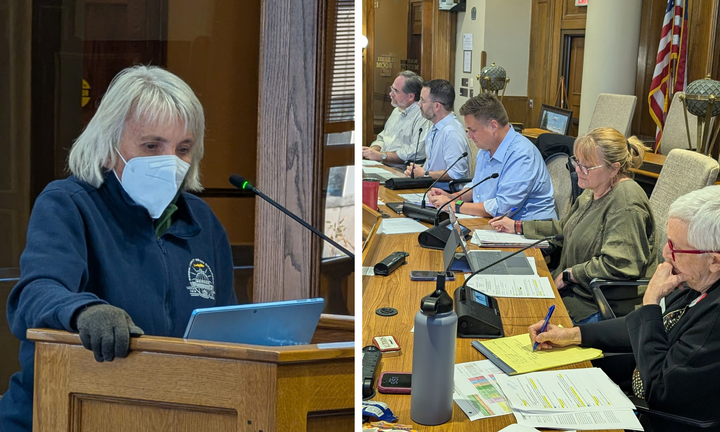
Bloomington city councilmembers will spend Wednesday evening (Sept. 30) sorting through a batch of proposed amendments to mayor Kerry Thomson’s 2027 budget. The changes range from reductions in travel and consulting accounts to the elimination of one vacant city position.
The amendments were released shortly after 5 p.m. Tuesday (Sept. 29) as part of the information packet for a council work session set for 6:30 p.m. Wednesday. The work session agenda is devoted to possible changes to the city’s 2027 basic budget and salary ordinances.
The amendments would reduce appropriations by millions of dollars. There are no proposed amendments that add spending, because Indiana state law doesn’t allow a city council to make changes that add spending.
But the total amount cut from the budget in the council’s proposed amendments is not the same as the city would actually save. Some amendments represent policy choices to spend less. Others simply bring budgeted amounts closer to what the city is already expected to spend, or remove placeholder appropriations that could be restored later.
That distinction could become a central part of Wednesday’s discussion.
The proposed 2027 budget authorizes about $165.7 million in spending across the city’s tax-supported and special-purpose funds, not counting utilities or general-obligation debt-service funds. Estimated 2027 revenue for those funds totals about $137.7 million. The city’s general fund, which is the city’s main operating fund, calls for $63.7 million in spending, compared to $58.3 million in expected revenue. That means a projected $5.47-million reduction in general fund reserves.
The distinction between an appropriation and actual spending was underscored at the council’s formal budget hearing last Wednesday (Sept. 23). City controller Geoff McKim told councilmembers that the state budget forms assume every authorized dollar will be spent. In practice, he said, that rarely happens because of vacant positions, unspent capital money and similar factors.
As an example, one of council president Isak Asare’s proposed amendments would reduce personnel appropriations by $405,599 by applying a 1% vacancy factor to the civilian payroll. That does not mean the amendment would reduce personnel spending by $405,599. It just reflects the fact that some positions are expected to sit vacant for portions of the year anyway.
Another amendment proposed by Asare would reduce health and life insurance appropriations by $288,078, reflecting a renewal increase of 5.8% instead of the 9% planning assumption that was used when the budget was assembled. The appropriation would go down if the amendment is adopted, but the amendment does not itself make insurance cheaper.
By contrast, other amendments would make an explicit choice not to spend money that the administration has proposed.
Proposed amendments that mean savings
Isabel Piedmont-Smith has proposed eliminating the vacant transportation demand manager position in the economic and sustainable development department. The corresponding budget amendment cuts $104,683 in salary funding, plus associated benefits. That would translate into actual savings, because the position would not be filled for any part of the year.
Asare proposes reducing the administration’s planned increase for nonunion employee pay from 2.7% to 2%, for an estimated $280,000 reduction including related payroll costs.
Another Asare amendment cuts non-police and non-fire travel by 25%, reducing appropriations by about $41,925. And an amendment targeting spending in the mayor’s office would eliminate $25,750 for branding, cabinet staff development, events and related materials.
After accounting for overlap between different amendments, those clearly policy-driven spending reductions total at least about $452,000.
That figure is substantially smaller than the millions of dollars in total reductions that are included in the work session information packet.
Big reductions could come back later
Several of the largest amendments would remove money from the 2027 budget without necessarily foreclosing the spending.
One example is a $2.5-million parking meter fund appropriation, which is described by the administration as placeholder money for implementation of recommendations from the city’s recent parking study.
Piedmont-Smith has proposed taking the full $2.5 million out and requiring the administration to return later with an additional appropriation after specific investments and costs have been identified.
Asare and Hopi Stosberg have proposed a separate amendment that does essentially the same thing to the same $2.5-million appropriation. Their version says a future proposal should identify the project scope, cost, implementation schedule and expected results.
Piedmont-Smith also proposes reducing housing development fund appropriations by $2 million. Her amendment would leave $1 million appropriated and allow the Housing and Neighborhood Development (HAND) department to return with additional appropriation requests as specific programs are identified.
Asare proposes cutting $600,000 from an ITS equipment account associated with implementation of outcomes-based budgeting, saying the administration has not presented a sufficiently clear implementation plan.
Another Asare amendment would remove $490,000 from planning and transportation department studies, including $265,000 for a corridor and subarea study and $225,000 for additional studies and projects, until specific scopes and deliverables are presented.
Councilmember Sydney Zulich has proposed reducing a Public Works appropriation by $418,020, from about $1.22 million to $800,000. The proposed 2027 city budget included $650,000 for Bloomington’s share of conducting the municipal elections in 2027. Zulich’s proposed reduction of $418,020 would leave the allocated amount to cover municipal elections at around $231,000. In 2023, the last Bloomington municipal election year, Monroe County billed the city 471,804 for election costs. That was the total from $198,127 for the primary and $273,676 for the general election.
Additional cuts?
The proposed amendments released Tuesday night do not include some of the more sweeping personnel reductions that Asare has circulated to at least some of his council colleagues.
At the council’s Sept. 23 budget hearing last week, Asare seemed to preview a broader set of reductions than the amendments that eventually appeared in Tuesday’s packet. Last week he said he had “a bunch of amendments that are related to reduction in positions,” including vacant positions, along with another amendment dealing with “general reorganizations of staffing and positions.”
Asare summed up the package this way: “So in total, all of the things that I'm going to be suggesting is about $7 million in cuts across the budget.” At the end of his remarks, Asare said the proposals would be circulated after the meeting: “We'll send them around in writing after this meeting …”
One set of draft amendments that Asare circulated to at least some council colleagues goes substantially beyond the personnel amendments included in Tuesday’s official work session packet. Among the possibilities in the draft set are cutting the public engagement director in the mayor’s office and the grant compliance manager in HAND (Housing and neighborhood Development), which are both currently vacant positions. The draft would also eliminate two other mayor’s office positions: the legislative affairs specialist; and the homelessness response coordinator.
More sweeping proposals from Asare would have eliminate all economic and sustainable development (ESD) department personnel, except its director and all community and family resources department (CFRD) personnel, except its director.
The council is currently scheduled to take its final budget votes at a special meeting on Wednesday, Oct. 7 at 6:30 p.m. Indiana’s Department of Local Government Finance (DLGF) lists Bloomington’s Sept. 23 public hearing and Oct. 7 adoption meeting in the state budget-notice system.
The Oct. 7 date is not the council’s last legal opportunity to act. The state’s 2026 budget calendar sets Nov. 2 as the last possible date for local governments to adopt 2027 budgets. That means Bloomington’s city council could continue consideration through the end of October if councilmembers do not finish on Oct. 7.
Wednesday’s (Sept. 30) work session starts at 6:30 p.m., which is the usual time for the council to meet. But the location will not be the customary one. Wednesday, the council will hold its work session in the McCloskey Room, which is down the hall from the council chambers.
Summary table of proposed amendments
This table of the amendments in the work session meeting information packet was assembled by The B Square with annotations added in places.
Savings? “Yes” indicates a substantive reduction in proposed spending; “No” indicates primarily budget right-sizing, a funding-source change or recognition of expected underspending; “Conditional” indicates spending authority removed now that could be requested again later; “Mixed” indicates an amendment containing more than one of those types of reductions.


Comments ()