
A time capsule in steel words: The story of (C)olumn
Installed in 2015 at 2nd and Walnut streets, Bloomington’s (C)olumn sculpture turns nearly 300 community-supplied words into a steel civic time capsule. Co-designer Jon Racek says it captures the city’s joys, frustrations and identity around 2014.
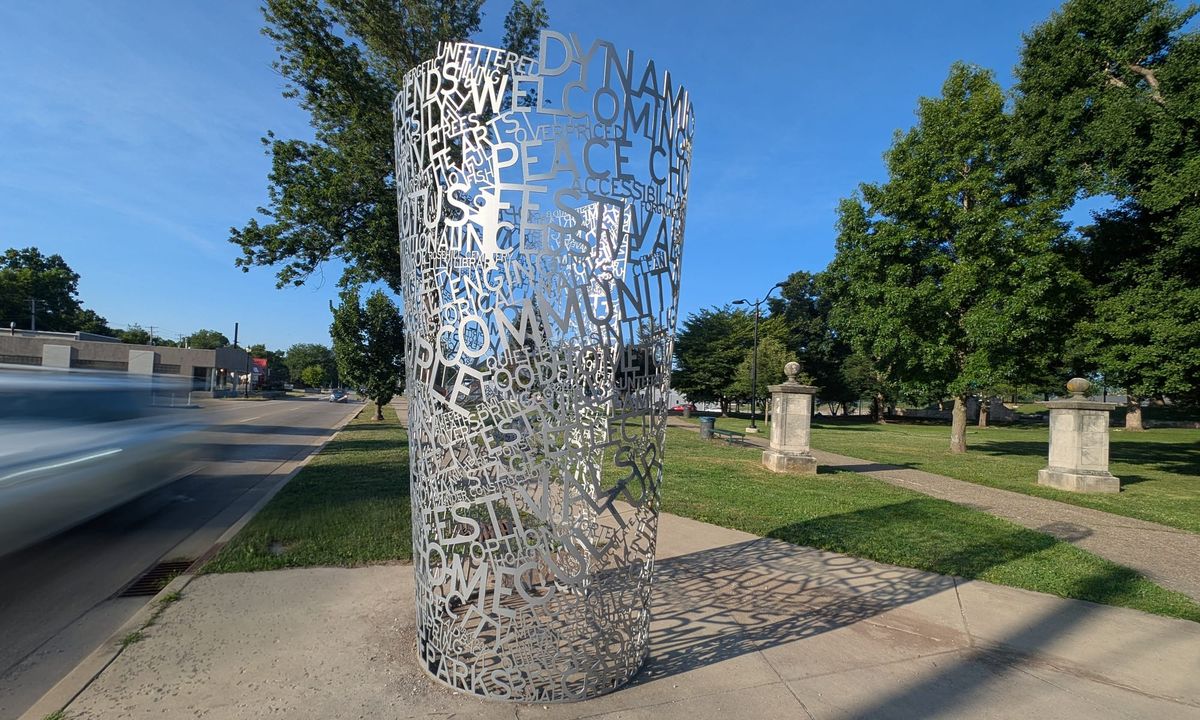
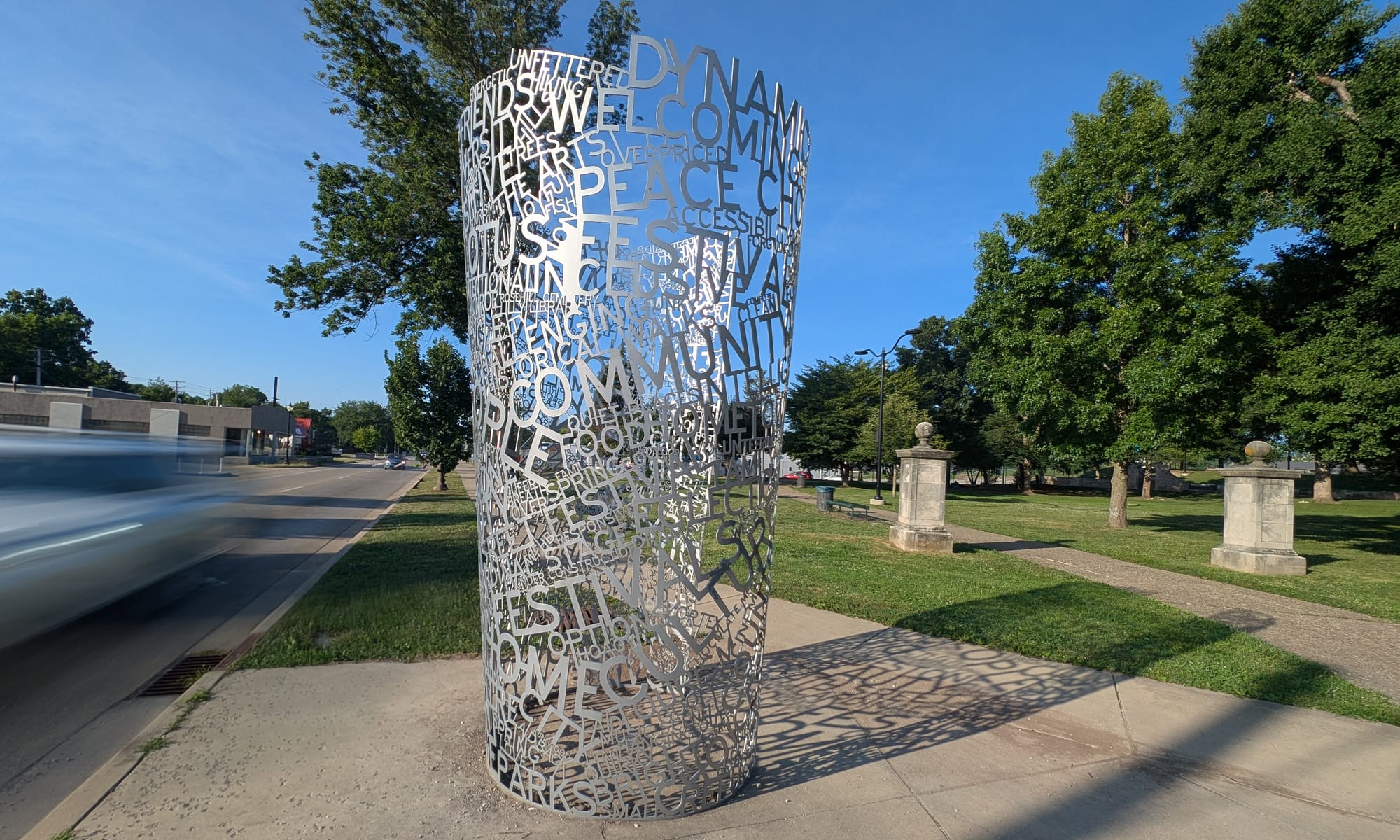
(C)olumn sculpture by Jiangmei Wu and Jon Racek at 2nd and Walnut streets in Bloomington. Left: (Photo / Joe Myers) Right: (Dave Askins, July 16, 2026)
The sculpture next to Seminary Park on the corner of 2nd and Walnut streets is hard to ignore. Whether you’re driving or walking by, or waiting for the public bus across the road in front of World Foods Market, you will spot the steel structure that could be mistaken for an enormous wire basket.
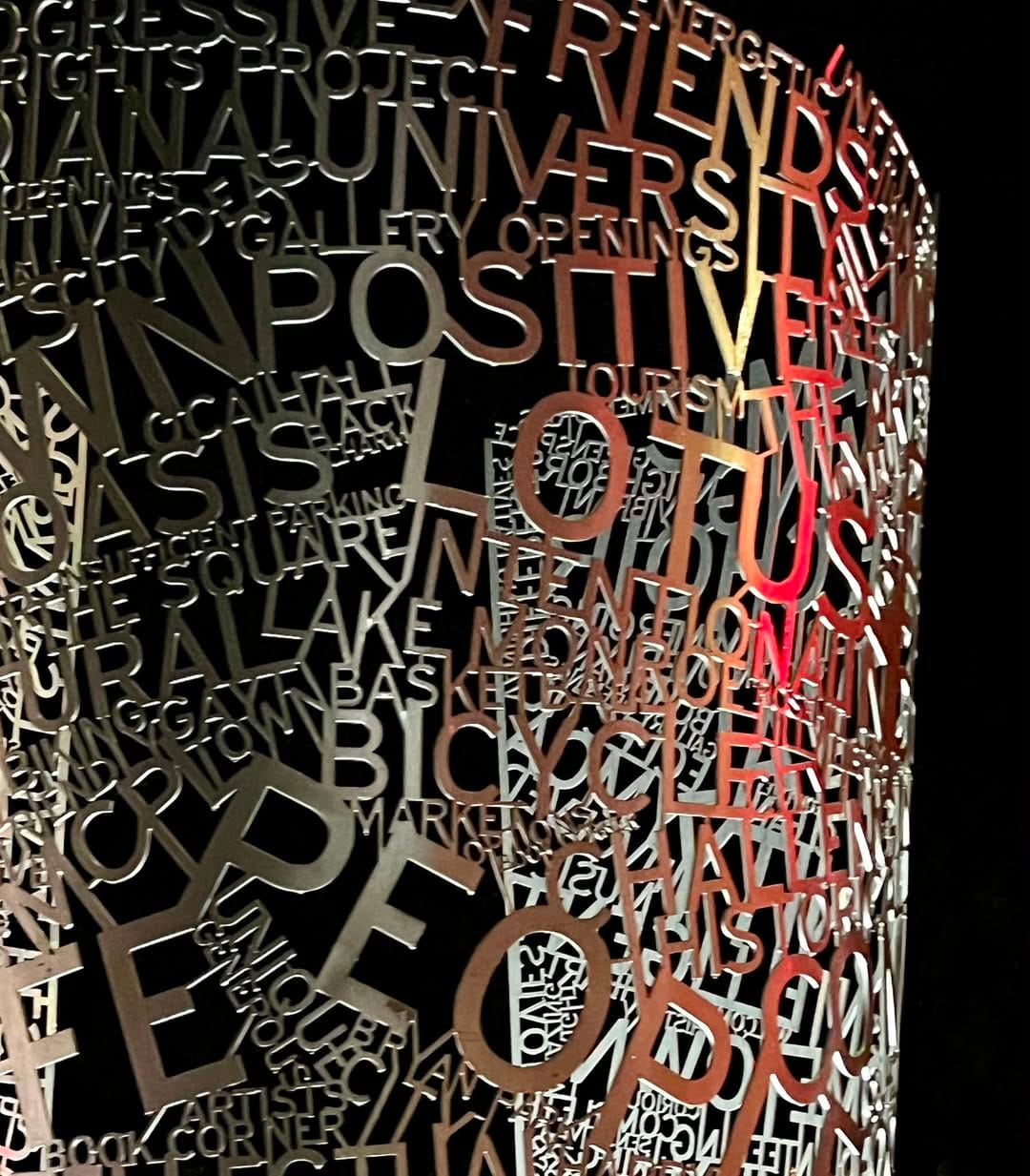
Look closer, and the steel mesh is a collection of words that may appear random at first, but is actually attempting to “capture a moment in time” in Bloomington history.
Those were the words of Jon Racek, an Indiana University professor who co-designed the sculpture, named (C)olumn, in collaboration with Jiangmei Wu, who is a colleague at the Eskenazi School of Art, Architecture + Design.
The B Square Bulletin caught up with Racek to find out more about how (C)olumn came to be, and now that it’s been around for over a decade, how it has fit into Bloomington’s aesthetic.
“If you know what a word cloud is, that was sort of a concept behind it,” Racek recalled. The artists put up a poll online, and asked people to contribute words that described what Bloomington meant to them. They then compiled them to make the design. Like a word cloud, they sized the words based on how frequently they showed up in the online polls.
“We used almost all the words. I think we did edit a little bit for things … We didn’t want to leave out words that were negative,” Racek said. “We did want to leave out words that were obscene,” he added.
Racek and Wu’s list of words and phrases includes almost 300 entries—from obvious local favorites like “B Line,” “Bryan Park,” “MCPL,” and “Buskirk-Chumley”, to some that are descriptive, like “soon over-developed”, “queerdos,” “goofy,” and “non-judgemental.” There are a fair number of IU locations and some local businesses on the list as well, and some words that try to capture the spirit of the town: “generous,” “youthful,” “emerging,” and “different”.
And what do these words reveal? Racek thinks they say more about the town’s feelings about itself around 2014, when the piece was designed, than anything else.
“I think for the most part, it wasn’t an unremarkable time in Bloomington history, but it wasn’t necessarily a remarkable time in Bloomington history. I think it captures maybe more of the long arc of how people feel about Bloomington, both good and bad,” he said.
“I think, though, that a lot of the words have remained relevant. I think if you were to do it now, we would have “Mendoza” probably showing up in the words. Or “champions,” or something like that.”
The sculpture went up in 2015. According to the city of Bloomington’s website, the C in (C)olumn stands for “community, culture, and the actual shape of the artwork when viewed from above”.
Public art tends to develop a life of its own that separate from how it’s intended. Watching people who interact with it daily find different ways to fit the sculpture into their lives, Racek has noticed a few funny things over time.
“There was one day I drove by and someone had stuck about 20 different mittens into the piece. I’ve driven by and someone has stuck loose underwear into the piece,” he said.
Over a decade of wear has given (C)olumn a weathered look now, with the finish on parts of the word cloud falling away to reveal some rust.
“The rust would come based on people, you know, scratching it, trying to pull off the finish. If the finish is undisturbed, then it shouldn’t rust,” Racek said.
According to Racek, the fact that (C)olumn is located at Seminary Park means more people get to interact with it in different ways. “The population that’s living in Seminary Park, they’re probably experiencing it in a much more personal way. … They’re probably touching it,” he said. “I think most people who are not typically in that space are driving past it.”
Racek said, “I’m glad that they chose that location. The homeless population deserves public art just like anyone else.”
Racek thinks Bloomington is a town that’s intentional about its public art, as opposed to other places across Indiana and the rest of the country.
“[Bloomington] tries to be very inclusive with who’s doing the public art. And I think it really does contribute to the life of the city. I think it contributes to sort of the aesthetic of the city and it reflects the character of the people who live here,” he said.
“I think maybe that’s something that this piece has done is that it’s verbalizing how people feel about the city, both good and bad, in a way that people might not see otherwise. So it’s sort of this physical representation of the joys and the pains of living here.”
Racek’s public art footprint in Bloomington is about to grow. In 2024, the city selected “Undulate” as the public art installation for Hopewell Commons. Initially slated for installation in summer 2025, site preparation delays have now pushed it back to the end of September this year.
As for (C)olumn, Racek has a suggestion: “I would love to see a plaque that sort of establishes the date so that people understand that this is how people were feeling at that time about their city. Because I think that would add to some of the context of it.” He wrapped up: “It’s sort of like a time capsule in a way.”
Comments ()